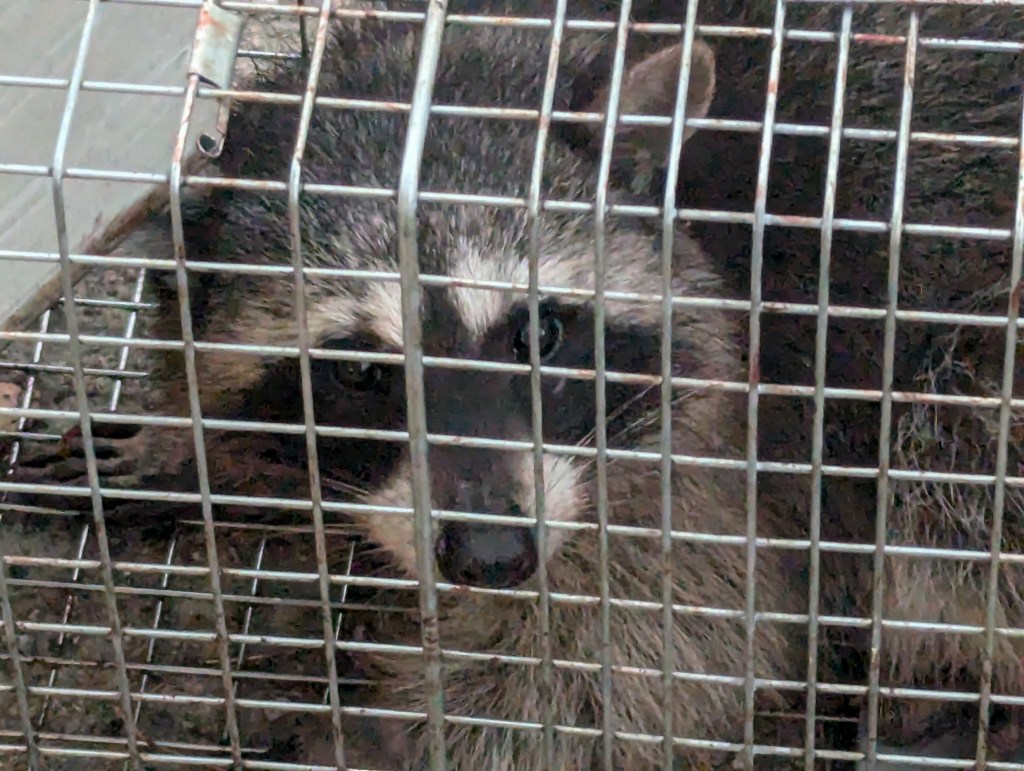
Winters are not very cold here. Otherwise, I might have assembled a fur coat. Instead, relocation of furs has been more practical than utilization. Besides, without exception, all were already in use when I encountered them. Actually, they were not relocated merely because I had no practical use for them, but, more importantly, because relocation was significantly less inconvenient to those who were wearing them at the time. Of course, it was not totally convenient either. That was sort of the objective. The inconvenience of relocation is a deterrent to those who wear the furs, who identify as racoons. They are unwelcome here. I realize that they eat mollusks and rodents; but neither mollusks nor rodents are problems here. I do not grow much vegetation that mollusks find to be appealing. Heather the kitty who identifies as a feline person is too proficient at deterrence of rodents to have use for any assistance. Actually, Heather is one of the two primary reasons that it is necessary to relocate raccoons. Rhody is the other. Unfortunately, raccoons have potential to become impolite or even dangerously hostile with my canine and feline housemates. Relocation does not permanently eliminate them, but it annoys them enough that, by the time they return, they are much more careful about avoiding us and our space. Also, their impressionable associates seem to learn from their examples. Because they can not be relocated off of the property, they go less than a mile away. So far, that seems to be sufficient. I do not know how long it takes for them to return, but I suspect that it takes quite a while. After this most recent relocation, I do not expect another relocation to become necessary until members of the most recent generation mature enough to become a problem.
The Santa Clara Valley really is, as it was formerly known, the Valley of Heart’s Delight. A long time ago, it was famous for vast orchards that thrived in its exemplary climate and soil. The climate is still here, but so are nearly two million people who now live where orchards formerly were. Not so much of the formerly productive soil remains exposed, and almost none is appreciated for its potential. Urban development continues to expand to occupy more of it. At a strip mall in the Berryessa District of San Jose, I noticed what appeared to be gravesites of small patches of once exposed soil that died slow deaths after all other soil around them was developed. The concrete pavement outside of and below the yellow curbs was likely the original parking area, walkway and paved patio, which were separated from each other by what was likely small landscaped patches of exposed soil within and at the same level as the yellow curbs. Sometime after the area outside of the curbs were paved, most of what was likely exposed soil within was also paved with exposed aggregate concrete, leaving only what was likely three smaller square patches of exposed soil, perhaps for trees to survive in. Eventually, even these three smaller square patches of exposed soil were also paved with simpler concrete. It is impossible to say why all this concrete pavement was necessary, or why exposed soil was so objectionable. Perhaps the dirt was dirty. Perhaps it was infested with weeds. Perhaps all this concrete is some sort of Brutalistic art. Regardless, the good soil below is now useless. The patio now lacks shade from trees. A little bit more of the Santa Clara Valley can not sustain any vegetation. A little bit more of Paradise is paved.
Cuttings could have been taken more neatly than this.
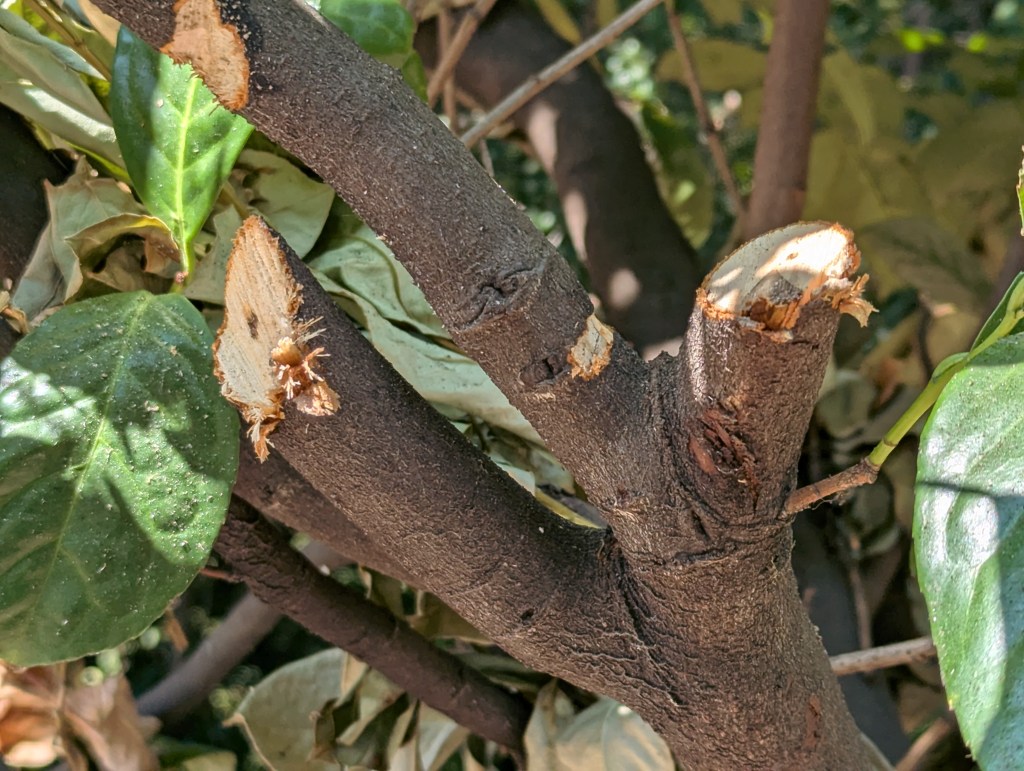
Aeonium arboreum, tree houseleek and a few other succulents within my tiny downtown garden are very important to me. They are from the former garden of a friend who passed away years ago. They have performed very well for this particular application since their arrival. They are resilient and undemanding, and provide delightful foliar color and form. The darkest bronze cultivar of tree houseleek that I ever grew arrived with them, but over a few months, was stolen until none of it remained. As the first few cuttings grew enough to become prominent, they were either taken completely, or deprived of their upper foliar rosettes. Any remaining rooted but bare stems eventually succumbed as any subsequent foliar rosettes that they generated were also taken. The surviving succulents remain only because they are both less popular, and too numerous for complete depletion. Actually, I would not mind if those who find these succulents to be appealing sometimes take a few pieces. I merely find their lack of tact to be annoying. I expect them to know better than to take the last of something. Also, I expect that they should have enough sense to take bits from where they would not be missed, and to do so neatly, without leaving broken stubs. Quite a few stems are sometimes overgrown or extending awkwardly outside the planter box, so should be removed anyway. Many stems that are overwhelmed by upper growth could be removed without compromising collective visual appeal. That might actually be a common occurrence that I am not aware of because it is done properly. Stems of these succulents can be easily broken neatly at their unions, without leaving stubs, so pruning shears are not even necessary. Fortunately, these damaged tree houseleeks will recover like they and other succulents always do.
Gilroy City Council does not endorse this landscape.
Corner lots can be challenging. Even if paths do not get worn diagonally through front lawns, vegetation between curbs and sidewalks is likely to get trampled. The pavement in the foreground of this picture connects the sidewalk to crosswalks for the two associated streets. (I realize that this is not a very good picture, and the blotched out poster for a candidate for Gilroy City Council could not be erased completely, but I took it from a car while stopped at a stop sign.) Vegetation for this particular application must be durable, and perhaps deterrent to trampling. This particular vegetation certainly conforms in that regard. However, there is no polite way of saying how extremely dysfunctional this landscape is. Firstly, from the get go, it is very dangerous to anyone who might simply trip and fall as people sometimes do. Secondly, this landscape will become more dangerous as it matures. Although most of the already crowded agaves seem to be a somewhat compact cultivar that should not reach very far over the sidewalk, the specimen at the center of the bottom of the picture seems to be a variegated common century plant, which has potential to reach halfway across the sidewalk. Thirdly, the entire hot mess will be hideous as it soon needs to be pruned for clearance. The sago palm will soon reach the sidewalk like the common century plant. Pruning will destroy their foliar form. The Mexican fan palm should eventually grow upward and out of the way, but will eventually prevent the streetlamp from illuminating a portion of the sidewalk close to the corner, where illumination is relatively important. Fourthly, this collective herd of wickedly hateful vegetation will soon be too congested to remove litter or weeds from; and curbside landscapes such as this innately collect litter.
There is nothing wrong with this picture yet. It simply shows African daisy as it begins to encroach into a row of lily of the Nile. Because it is already September, we will delay the pruning of the African daisy to maintain clearance from the lily of the Nile. Then, we can process the pruning debris into cuttings that we can plug into areas where we want more African daisy. These cuttings can grow slowly and disperse their roots through cool and rainy autumn and winter weather to be ready for next spring and summer. It is how a bit of something that is undesirable here can be desirable somewhere else. That is how the lily of the Nile arrived here. It needed to be removed from where it had migrated beyond its preferable confinement, so was relocated to become an asset to another landscape.
So called ‘gardeners’ would do this very differently; partly because, within their stringent schedules, they have no time to process cuttings or divide perennials, but partly because it is less profitable. They would be more likely to shear a neat edge for the African daisy whenever it happens to be convenient for them, and then efficiently dispose of all of the debris. If more African daisy is necessary elsewhere, they would purchase and install it, and charge their client accordingly. The lily of the Nile would probably not be here, since they would have likely disposed of it immediately after digging it from where it needed to be removed from. If any were desirable here, they would purchase it from a nursery and install it, and, of course, charge their client accordingly. Ultimately, their technique might not be much more expensive, but it is nonetheless wasteful, and frustrating to those who are aware of it.
Is it really too much work to not leave such stubs while destroying a hedge?!
It has been quite a while since I posted anything that qualifies for the theme of ‘Horridculture’. Such topics are not only unpleasant, but have become redundant and passe. They are annoyingly frequent reminders of how several of the horticultural industries attract too many of those who either lack practical experience or simply do not care about their work. I can not even remember how many times I wrote about hackers, which is why I did not assign a number to this title. I can see that I addressed this issue as recently as February. Nonetheless, because this particular incident involves a Prunus laurocerasus, cherry laurel hedge that we have been renovating for a few years, it is difficult to ignore. The formerly severely overgrown hedge had been responding somewhat slowly but otherwise adequately to its renovation, all behind a reasonably presentable facade. Actually, until recently, the facade had become tidier and denser than it had ever been before. Then, a tree service was hired to clear some adjacent unmanaged vegetation. The objective was to remove vegetation from an area that is to be paved for dumpsters. There was no concern for the quality of the work, since remnants of such vegetation can be managed or removed later. The problem is that those who performed the task also removed a significant portion of the facade of the hedge beyond the area from which unmanaged vegetation needed to be removed. What is worse is that it was done so horridly. I do not remember seeing any proper cuts. All involved stems were stubbed and gashed. I can only guess that whoever did this expected the hedge to be removed later. I can not be certain of that, since complete removal within one process would have been less work than such thorough disfigurement. I mean that someone put a great deal of effort into disfiguring the hedge this severely. Fortunately, the hedge will eventually recover. I removed the stubs and neatened what remains, and will try not to look at it for the next several months. The tree service that did this actually removes unwanted trees for us efficiently and safely. Their arborists are quite experienced and qualified for what they do. I just do not want them to do anything else.
Someone put a great deal of effort into this degree of damage.
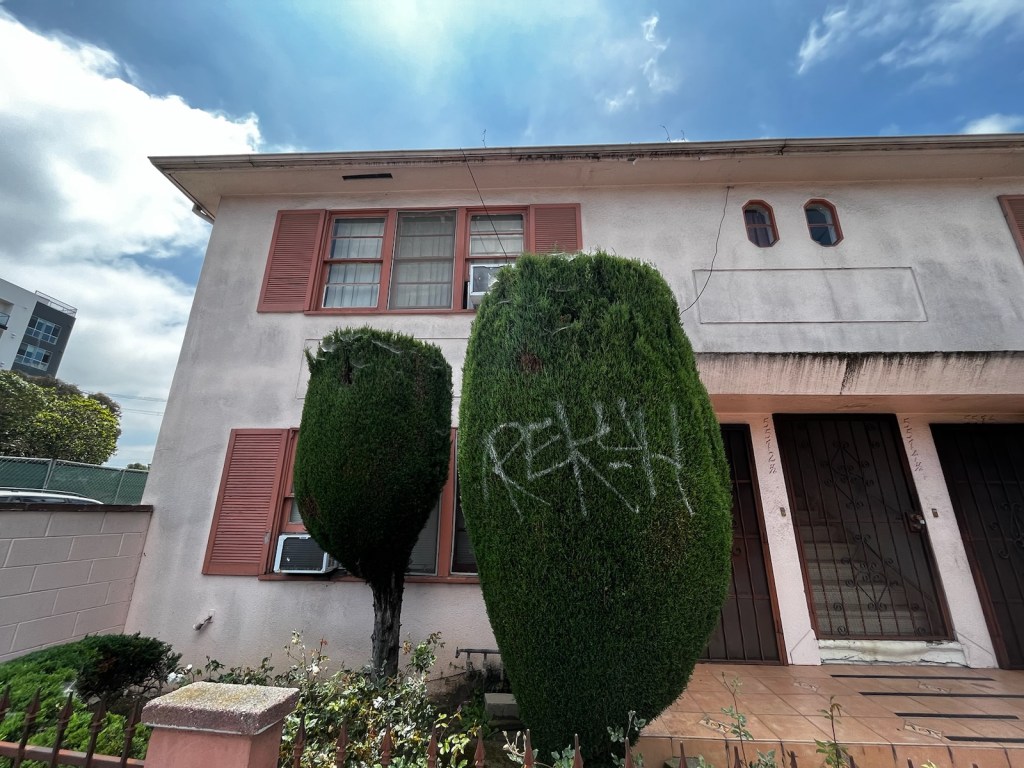
This picture is all sorts of wrong! Brent sent it to me from Los Angeles. He has a habit of sending obnoxious pictures such as this.
Firstly, why would anyone install Italian cypress in such pointless situations?! The specimen to the left is centered on a prominent window. It is an unsightly obstruction to the window, and would be just as unsightly and obstructive to the window above if only it had not been so severely disfigured. Although the larger specimen is a bit farther from the window, it is just as unsightly, obstructive and pointless.
Secondly, why would anyone disfigure Italian cypress by topping them like this?! It would be more practical to remove them if their naturally upright form is undesirable for this particular situation. Then, some other preferable vegetation could be installed instead, or perhaps nothing at all.
Thirdly, why would anyone maintain these already disfigured Italian cypress like this?! Just remove them already! They are unsightly! Seriously, someone obviously puts quite a bit of effort into shearing them so systematically. Are they that important?! Does someone actually like these pathetic trees in this pathetic condition?! Am I missing something here?!
Finally, or fourthly, how could someone make this situation any worse by defacing the larger of these two Italian cypress with graffiti?! Seriously, that takes a bit of effort also. Cut the trees down already! Why do these trees not simply die of embarrassment?! Is this supposed to be some sort of conceptual or abstract art?! Is this here merely to see what sorts of reactions it gets?! Can anyone even read what that graffiti says?! Perhaps it translates to “PLEASE CUT THESE TREES DOWN!” This picture leaves me with way too many unanswered questions. Well, if nothing else, these sad Italian cypress were strangely entertaining.
These coastal redwoods are very distinct from giant redwoods.
“Hidden giants: how the UK’s 500,000 redwoods put California in the shade” was published in the Guardian more than a month ago. It was amended to specify that it is about giant redwoods rather than all redwoods, as if that is a distinction that is easily omitted. Incidentally, it later mentions that, “For millions of years, the world’s tallest trees have graced California peaks and coastlines,” which is a reference to coastal redwoods, which are a different genus from giant redwoods.
What is worse is the claim that, “Researchers found that the Victorians brought so many seeds and saplings to Britain that experts say the giant redwoods now outnumber those in their US homeland.” More specifically, it continues to explain that, “The Victorians were so impressed that they brought seeds and seedlings from the US in such large numbers that there are now approximately 500,000 in Britain, according to a Forestry Commission estimate that includes coastal redwoods and dawn redwoods (a separate Chinese species) as well as the giant redwoods. Experts at Kew think most of the UK trees are giant sequoias, the official name for giant redwoods. California has about 80,000 giant redwoods, as well as also having coastal redwoods and a few ornamental dawn redwoods imported from China.”
Essentially, the article claims that this data demonstrates that there are more redwoods in the United Kingdom than there are here. Apparently, approximately half a million redwoods live there, and “experts” “think” that most are giant redwoods. Also apparently, only about eighty thousand giant redwoods live here.
Response to this is no easy task. It is a comparison of all redwoods in the United Kingdom to a very slim minority of redwoods here. About eighty thousand mature specimens of giant redwood live in the wild alone. Countless more immature specimens, including abundant seedlings that are only a few years old, live with them. Countless more giant redwoods have been installed into landscapes throughout areas of California that are collectively almost as large as all of Britain. Such trees have been getting planted here at least as long as they have been getting planted there. It is impossible to estimate how many giant redwoods are here, but there are many more than merely half a million. Furthermore, regardless of how the article was revised, the half a million redwoods of the United Kingdom includes coastal redwoods and dawn redwoods. There may be as many dawn redwoods here as there are there. More importantly, there are more than two million acres of wild coastal redwood forest here. In other words, for every redwood of any species there, there are at least four acres of wild coastal redwoods here. Many redwoods inhabit each acre of redwood forest. Also, many millions of coastal redwoods are planted into landscapes here.
Incidentally, the three species of redwood are actually three distinct genera, and the official name of giant redwood really is giant redwood. It is Sequoidendron, not Sequoia.
The article continues to say with complicated grammar, “Spurred by the climate crisis, devastating droughts and scorching temperatures have added new stressors for the redwood, particularly the famous giant sequoias, which now struggle to bounce back after big wildfires.” However, there is no climate crisis with devastating droughts or scorching temperatures here. Summers here are naturally dry and warm. That is simply how the climate here is. Most forests here burn at least every century or so. Therefore, redwoods that are thousands of years old have survived many fires. Now that some forests are allowed to burn as they naturally should, fires will not likely be so unusually lethal to younger redwoods in the future. Another claim that, “Vulnerable trees are also increasingly under attack from native bark beetles, insects that feed on their spongy red trunks until they topple.” is likewise inaccurate. Bark beetles rarely damage redwoods, and are no more likely to damage them now that they ever had been.
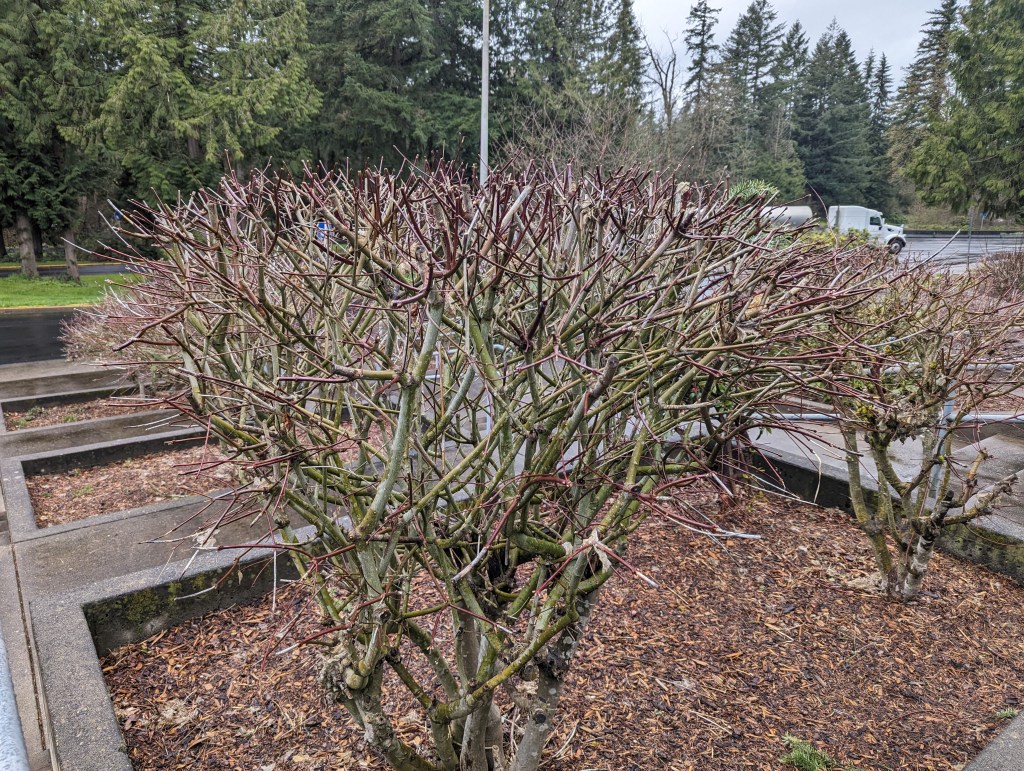
This is no simple hack job. Someone or a few someones put a great deal of effort into this very thorough hack job. This took significantly more effort than would have been needed to do it properly. Seriously, proper pruning would have been much easier, and much healthier to this victimized vegetation. In the future, this vegetation would have needed much less maintenance. Furthermore, this is more than visually unappealing. It is downright unsightly. Removal of such disfigured shrubbery would be an improvement, even without replacement. As the illustration below demonstrates, this is not merely a single specimen. It is an entire herd of brutally disfigured shrubs. How did someone determine that this was the right thing to do?!
This mangled shrubbery is vine maple, Acer circinatum, which is native to the Pacific Northwest where I got these pictures. I actually like this particular species because it can perform similarly to Japanese maple, but is not Japanese maple, which I am not at all keen on. Part of my dislike of Japanese maple is the result of working with so many that were ruined like these vine maples were. Vine maple is more tolerable to me because it is too rare here at home for me to encounter any that are ruined like these. This is a first for me. Perhaps that is why it was more difficult to ignore than the countless similarly ruined Japanese maples that I do not need to work with, but see around town.
I can not help but wonder what these vine maples would look like if they had developed somewhat natural form with only significant pruning for clearance above the adjacent pavement, perhaps with minor pruning to limit congestion within their canopies.. Would they resemble mature Japanese maples with extra trunks by now?
Rhody and his Roady, . . . still waiting to leave.
This article is scheduled to post at midnight between March 19 and March 20, which is precisely when we were scheduled to leave for the Pacific Northwest. We were supposed to arrive on the Kitsap Peninsula late in the afternoon, and likely continue to the coast the following morning. Now, we will not leave until midnight between Sunday, March 24 and Monday, March 25. I know that it is only five days later, but it changes the entire schedule. I should still be there in time to prune the apple trees prior to bloom. I do not know when we will return now, but it will likely be about Thursday, April 4.
Then, two and a half weeks later, we leave again for eleven days in Beverly Hills in Los Angeles County, and Buckeye near Phoenix in Arizona. That would involve leaving Wednesday, April 24, and returning on Saturday, May 4. That should be before the weather gets too warm in Arizona to prune the mesquite trees there comfortably. I suppose that the second trip does not necessarily need to be delayed just because the first trip was. We could still leave on Wednesday, April 17 and return on Saturday, April 27 as originally planned, even if that leaves less time between the two trips. Perhaps I should not worry about this until we return from the first trip!
This seems to happen annually. Regardless of how intent I am on leaving on time, we encounter a delay of some sort of another. Ultimately, we leave at about the same time annually, but only after planning to leave about a week earlier, just as we planned for the previous few years. I can not complain, of course, since the delay is justified, but that is another topic for another post.






 Tony Tomeo