Horridculture – Inexhaustible Resources

Wild cucumber is not a particularly substantial vine. Except for its tubers, it is quite delicate.

Wild cucumber, Marah fabacea, is also known as manroot because it develops massive tubers that can weigh as much as a man. Such tubers can supposedly weigh more than two hundred pounds, and some sources claim that they can weigh twice as much. That is a lot of storage.

Their thin leaves, slender vines, tiny flowers and fleshy fruit are not very substantial, and can not be very consumptive. They are quite watery, and leave minimal debris when cut and dried, or when they die back after frost.

So, why does wild cucumber store so much resources within their massive tubers? I have no idea. I realize that it is a survival technique, but this is major overkill. No winter is long enough to justify such extreme storage. No summer is dry enough. No wildlife is voracious enough. No forest fire burns the same place more than once in a season. Furthermore, no gardener is diligent enough.

Seriously, these things are impossible to kill. The vines pull up quite easily, with no resistance. The tuber simply makes more. Secondary vines pull up as easily as the first. The tuber simply makes more. No matter how many times the vines get pulled up, the tuber simply makes more. It never exhausts its resources. Removal of the vines deprives it of its ability to accumulate more resources, or replenish what is used to generate the vines, but it has enough to generate vines for many years.

The only way to eliminate these weeds is to dig up their massive tubers, which are fortunately not very deep underground. Even then, the tubers do not die. This one sat around through last summer, and is still viable. I suppose that we should dispose of it with the trash, since we can not compost it.

This wild cucumber tuber is bigger and much heavier than Rhody, but is smaller than average.

Horridculture – White

White bloom brightens a shady landscape.

White is my favorite color. Do not argue with me about it. I do not need to hear that it is not truly a color or that it is the absence of color. Technically, it is either or both the complete absence of color or the complete saturation of all color. In that regard, it has either or both the same or opposite definition as black.

A prism demonstrates the colorfulness of white light by separating it into all other colors that it contains. Nothing is lacking.

Other colors can be mixed with a bit of white to become a tint, but retain their identity. They can be mixed with a bit of black to become a shade, but retain their identity. They can be mixed with other colors for various hues. Only white and black lose their identities with the addition of another color. No matter how pale, white becomes a tint of the additional color. No matter how dark, black becomes a shade of the additional color.

Pink is not really a color, but it is somehow more acceptable as such than white is. It is merely a tint of red. In other words, it is red with white.

Furthermore, brown is not really a color, but is somehow more acceptable as such than white is. It is merely a shade of orange. In other words, it is orange with black.

Gray is either or both a tint of black or a shade of white, but only if either or both black or white is considered to be the color that it is. Goodness, this is getting complicated.

Ultimately, such analysis is irrelevant to my predilection for white. Brent says that I am a white supremacist. That is rude. I just know that my favorite color is white.

Horridculture (deferred from Wednesday) – Bad Garden Tour

The Jungalow, as I wrote six years ago, is Brent’s home and associated gardens. It is an overgrown mess of lush foliage. I perceive it to be a frivolous waste of very limited space. Everyone else perceives it to be a phenomenally luxuriant urban oasis.

The house next door is more my style. It is a compact and simple home with simple bisymmetric architecture and an even simpler landscape. If Brent had not installed a symmetrical pair of tipu trees at the curb, a symmetrical pair of Tolleson’s weeping junipers flanking the porch and a foundation planting of star jasmine, it would have no landscape at all. It might be my favorite house in the neighborhood. Brent hates it.

More specifically, he hates that it is right next door. He would prefer it to be a bit farther away, so that a home with a landscape that is more compatible with his could be next door instead.

Anyway, sadly, a back bedroom of the house next door that I am so fond of burned a few days ago. Fortunately, Brent was in his office behind his home when it happened. He noticed a red glow and heard a window break. When he investigated, he could see the fire and smoke through the hedge between the backyards, so called 911. A fire crew arrived within only a few minutes to extinguish the fire before it ruined more of the home.

Brent sent this brief and blurry video of the situation shortly after the fire was extinguished. It resembles a hasty video garden tour, but speeds past some of the more interesting features of the garden, including my homeless camp, before turning back to show smoke rising from the house next door. It is a saddening situation for the next door neighbor.

Horridculture – Hackers

How could anyone believe that this was appropriate?!

Of the many different types of horticultural professionals, the two most professional and educated are nurserymen and arborists. The two least professional and downright idiotic are maintenance gardeners and arborists. That means that some of the most professional and some of the least professional of horticultural professionals are arborists.

I have been very fortunate to have worded for some of the most professional, most educated and best arborists. However, much of my work as a consulting horticulturist and arborists involved damage that was caused by some of the least professional, least educated and worst of so-called arborists. They ruin the trees that their clients pay them to maintain or repair. It is infuriating.

Someone put a great deal of effort into destroying this formerly healthy tree.

This tree was formerly a nearly exemplary specimen of big cone pine, Pinus coulteri. It was impressively healthy and exhibited no indication of instability. Its only obvious problem was that it developed so many trunks that it would eventually develop structural deficiency. That will not likely be a problem now, since it will not likely survive long enough for such deficiency to develop. Even if it remains healthy enough to grow significantly, it will become too structurally deficient as a result of this recent damage to survive for long.

I can not imagine how anyone, arborist or not, could believe that this was a proper pruning technique. Nor can I imagine how anyone could have put so much effort into so blatantly destroying this formerly healthy tree. Seriously, this involved a lot of work! Every trunk, every major limb, and many minor limbs were cut. Some cuts were made at lateral branches, but many were not. It is not possible for the tree to compartmentalize all of the resulting pruning wounds, which will remain exposed to the weather until the tree succumbs to the resulting decay.

Recovery from such severe damage is impossible.

Horridculture – Salvage

A hedge of a dozen like this came from one branched stump.

This is an old and redundant topic. I should know better. Some vegetation is not worthy of salvage. Even that which is worthy can become excessive if too much is salvaged. The problem is that I find it very difficult to discard vegetation that I can relocate to another landscape, or grow in the recovery nursery whether or not we have use for it.

A few stumps of shrubbery needed to be removed from a small landscape of one of the buildings at work. With one exception, the shrubbery was common Photinia X fraseri, which had been cut down some time ago, and had not grown back much. The one exception was a common Escallonia rubra, which had been cut down even earlier, so had grown back about five feet tall, with a few distinct trunks.

I had no problem discarding the Photinia X fraseri. The stumps came up with mostly severed large roots, and very minimal fibrous roots that they needed to survive. If I really want to grow more, it would be more practical to grow it from cuttings. I am none too keen on the species anyway.

The Escallonia rubra was not so simple. Although I was determined to discard it all, and I am no more fond of the species than I am of Photinia X fraseri, it came out with more than enough fibrous roots to survive relocation. What is worse is that the several trunks were easily divided into several individual well rooted specimens, with several more layered stems attached to them. I assembled an even dozen well rooted specimens as a hedge outside a fence of our maintenance shops, and nine smaller rooted cutting to alternate between cypress trees outside another similar fence. Although pleased with the results, I should have discarded them.

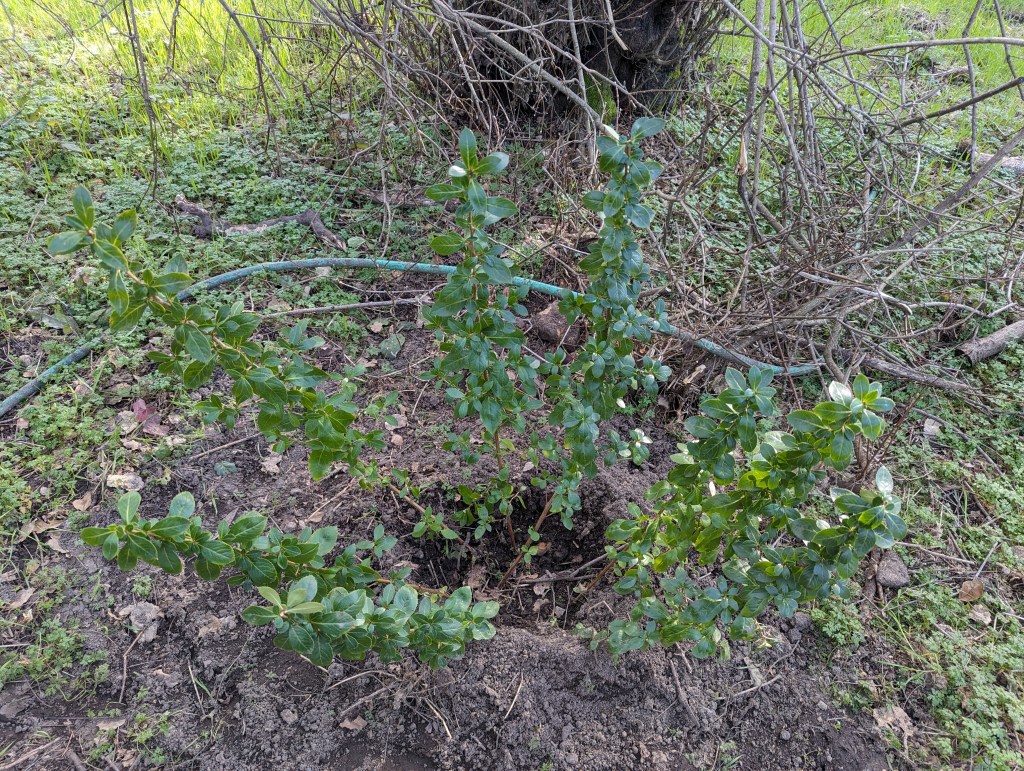
This is one of the smaller well rooted specimens, although the layered stems are smaller.

Horridculture – Weather

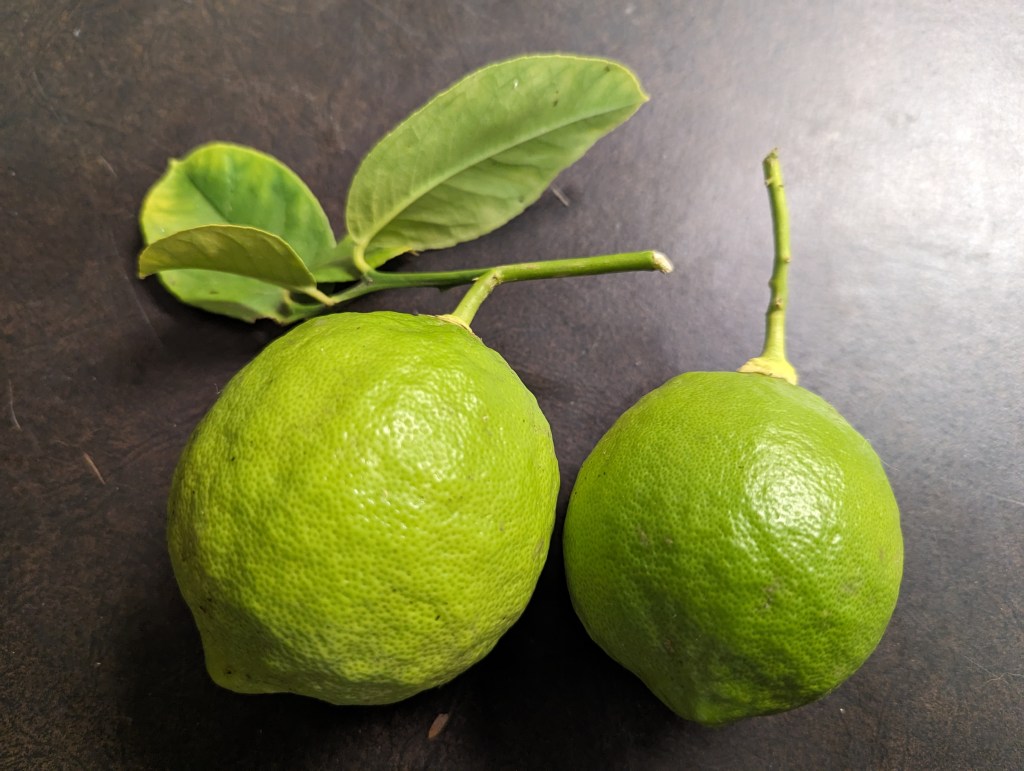
So close to ripening!

The weather here made national news on Sunday night. It was apparently quite a storm, with unusually windy wind. A few trees fell in the neighborhood. The roads were messy with debris. The electricity at home was disrupted. Otherwise, to me, it did not seem like a particularly bad storm. After all, this is winter.

HOWEVER, on Saturday, even before the worst of the weather on Sunday, the wind knocked over my small ‘Ponderosa’ lemon, only a few hours after I posted a picture of one of its two developing fruit. It is a dinky tree in a #1 can, but its lemons are disproportionately large. As I mentioned on Saturday, I should have removed the lemons to divert resources to vegetative growth, but wanted to see if they would develop and ripen. The weather did it for me.

Now I am annoyed. I do not like to be one who complains about the weather. There is not much to complain about in that regard here. This is a pleasantly mild climate that lacks the sort of severe weather that other climates must contend with. The gust that blew over the small lemon tree was not nearly as strong as those that blew over trees within the surrounding forests and neighborhoods. I am just annoyed that after letting the lemons grow as much as they did, their effort will now be wasted.

The two lemons did not develop as they should have, but are still bigger than average ‘Eureka’ or ‘Lisbon’ lemons. I put them aside to ripen if they can. I doubt that they will. I can prune the small tree to remove the stems that had previously supported the two lemons, and make cuttings of them, to grow more small trees. Actually, I should have done this anyway.

Horridculture – WWW

Online, bay laurel often passes for culinary bay.

Anyone can say anything online. There is no shortage of inaccurate information. Much of it is stupidly inaccurate. Much of this stupidly inaccurate information is more popular and more efficiently dispersed than conflictingly accurate information. To make matters worse, some accurate information that seems like it should be readily available is notably lacking. For example, I can not determine if the native blue elderberry requires a pollinator for fruit production. It is a simple question that seemingly lacks an answer.

Facebook shared a link to an article about the twenty worst trees to select for home gardens. The article does not say where this information is relevant. Nor does it bother to mention that trees perform differently within different climates. It is presented as universally accurate information.

Chinese flame tree is first on the list. What is a Chinese flame tree? The article does not provide that information. This is what botanical taxonomy was invented for.

Eucalyptus is next on the list. What species of Eucalyptus? The article does not say. Nor does it mention any of the many species of Eucalyptus that are quite practical small trees. That is like saying that France, Spain, Italy, Greece and Portugal are all countries of Europe, but Africa is just Africa. (That happens also within other contexts.)

Tulip poplar is apparently dangerous because it drops branches. That sounds reasonable. However, coast live oak, blue gum eucalyptus, California sycamore and red willow are much more likely to do so here.

Black walnut is toxic. Although true, and some naturalized black walnuts remain from understock of the now extinct English walnut orchards, black walnuts are not commonly planted, and are not even available from nurseries.

Mulberry is messy. However, the only mulberry that is commonly planted is the fruitless mulberry. Fruiting cultivars are very rare, and mostly planted by those who actually want the fruit, and maintain them so that they do not get too big and messy.

Eastern cottonwood drops limbs. However, as the name suggests, it is Eastern, so is nowhere near here. Western cottonwood is a variety of the same species, and behaves similarly, but like black walnut, is neither planted intentionally nor is commonly available from nurseries.

The list goes on to include many trees that are not available here or that are simply not problematic. After describing all of the diverse species of Eucalyptus as one, it mentions a few species of similar cottonwoods as if they are more distinct from each other than they actually are. It shows a picture of common Mediterranean olive for Russian olive, which is not even remotely related. It says nothing about palms, which are good trees within appropriate situations, but require expensive maintenance by arborists who can climb them.

The internet is a useful tool, but is not perfect.

Resolution

I got so much more than blogging going on.

I am not one to make resolutions for a New Year. Such resolutions can be made at any time. Most should probably be made as they become necessary.

I will say though, that in the future, I should post less frequently to this blog than I have been. I mentioned this a few times since I began posting here a few years ago, but never followed through with doing so.

My weekly gardening column posts in two parts, typically for Mondays and Tuesdays. That is really all that is necessary. Old columns also post in two parts, typically on Thursdays and Fridays. I could continue to recycle them, although, because topics are seasonal, the old articles are often redundant to the new articles that post at about the same time.

All other articles that post on other days are quite unnecessary. Horridculture articles that post on Wednesdays involve too much sniveling. Six on Saturday articles that post on Saturdays are fun for me, but lack substance for readers. Random articles that post on Saturdays at noon and Sundays have become somewhat too random and mundane.

Unfortunately, I can not write well with so much else happening. It is a long story, but what it comes down to is that I really should write less than I have been.

Therefore, for the future, I should commit only to posting my weekly gardening articles, from the gardening column, on Mondays and Tuesdays. I will likely continue to post recycled gardening articles for Thursdays and Fridays, even if redundant, only because they are already written. Although I may continue to post articles for Wednesdays and weekends, I may not. If not, this blog will become merely a compilation of the gardening column articles rather than a real blog. Perhaps less will be better.

Horridculture – Rainy Days and Mondays (deferred from Wednesday)

Deferred maintenance has consequences.

Karen Carpenter famously said, “Rainy days and Mondays always get me down.”

Several old and deteriorating box elders on the roadside outside the gate at work have survived many rainy days and many Mondays during the past many years that they have grown there. Earlier this week though, a rainy Monday brought one down.

It was no surprise. All of the several box elders there are in very bad condition. Most are completely dead and collapsing. However, I can do nothing about them because they extend over the roadway. They must be removed by a County Crew who can remove them safely. Unfortunately, they are unable to do so in a timely manner while so much similar work is needed throughout the County.

The problem with the demise of this particular tree is that it fell onto the hood of a Ford F150 that was travelling toward town. The Ford swerved and collided with a Subaru station wagon of some sort that swerved off the other side of the road, where it seemed to stop just inches from a utility pole. The tree or portion of the tree that fell was not very big, but indirectly caused extensive damage to both vehicles, and necessitated lane closures while the vehicles were removed.

In the picture, which was taken as I opened the gate for the crew, the Subaru is still visible on the opposite side of the road, at the center of the picture. The Ford has already been removed to the side of another road that extends to the right in the distance, beyond the bridge, where the traffic signals are. The taillights belong to one of the responding Sheriff’s cars. Most of the debris from the fallen box elder has already been pushed into the ditch to the right.

Horridculture – Sniveling

My colleagues are as totally excellent as my career is!

Horridculture is a collection of rants about horrid horticulture. Almost all of such rants are from my own experience and observation within the various horticultural industries. There are more than I can write about. I have been involved with so much more than just production of horticultural commodities on the farm. Horridculture is a bunch of sniveling about the worst of it.

Perhaps I should occasionally say a bit more about the best of it. If I thought it would be more interesting, I could write much more about the best than the worst. Except for the few experiences that I so frequently snivel about, my career has been awesomely RAD!

Therefore, for this week, I will briefly deviate from the typical Horridculture theme.

While we were in school, the professor who taught ‘Orientation to Horticulture’ told us, “If you want to make a lot of money in your career, change your major NOW!”. Of course, we did not. Brent and I both were naturally horticulturists, even if we were not good students. We studied exactly what we wanted to study. We made our careers of what we do naturally. Brent became one of the most renowned landscape designers of the Los Angeles region. I became a nurseryman.

Not only did I work for two legendary nurserymen within my primary career, but I also worked for at least four legendary arborists. I worked with the production of both citrus and rhododendrons with their companion crops. My gardening column was not planned, but has continued for a quarter of a century. Although not as well distributed locally as it had been, it is presently shared with a few publications between San Francisco and Beverly Hills in the Los Angeles region. These few publications sometimes share it with a few others elsewhere.

So, besides all the sniveling, I have been very pleased with my career. The worst of it may not have been as difficult as retirement might be. Fortunately, I do not necessarily need to retire completely, although I should quit sniveling.