Horridculture – Cyclamen (deferred from Wednesday)

Cyclamen are too expensive to be as disposable as they are.

Cyclamen persicum is a popular cool season annual. It is known simply as cyclamen here because it is the only common cyclamen that is available. It might be known as florists’ cyclamen where other species are available. Red and white are the most popular colors because cyclamen are associated with Christmas. Cyclamen can alternatively bloom with various tints and shades of pink, salmon pink and purplish pink. Some bloom with two-toned color or picotee margins. Cyclamen really is a delightful perennial.

Yes, perennial. Like many garden annuals, cyclamen is actually a perennial. It can survive in the garden for many years. It merely goes dormant through warm summer weather, and then resumes growth as weather cools during autumn.

Not only is it a perennial, but it is an expensive perennial. It is too expensive to be so disposable. So-called ‘landscapers’ do not mind. Disposable annuals are lucrative for them. Besides, even where cyclamen can perform as a perennial, it is not colorful throughout the year, and even in season, it is not as colorful as it is for its first season away from the nursery that it originally grew in.

Other species of Cyclamen that are available within other regions are becoming available here as well. Their bloom is sparser, with only light pink or blushed white flowers. They are grown as perennial wildflowers that bloom for autumn or winter, when not much else blooms. Although not as garish as common florists’ cyclamen, they are appreciated for their perennial performance.

The few florists’ cyclamen that we install at work bloom somewhat reliably only until spring. Because they were grown within ideal greenhouse conditions, they do not adapt immediately to landscape conditions. By spring, many are already beginning to rot. Those that survive their summer dormancy may become perennial.

Horridculture – Too Many Trees (deferred from Wednesday)

Excess is expensive . . . or profitable.

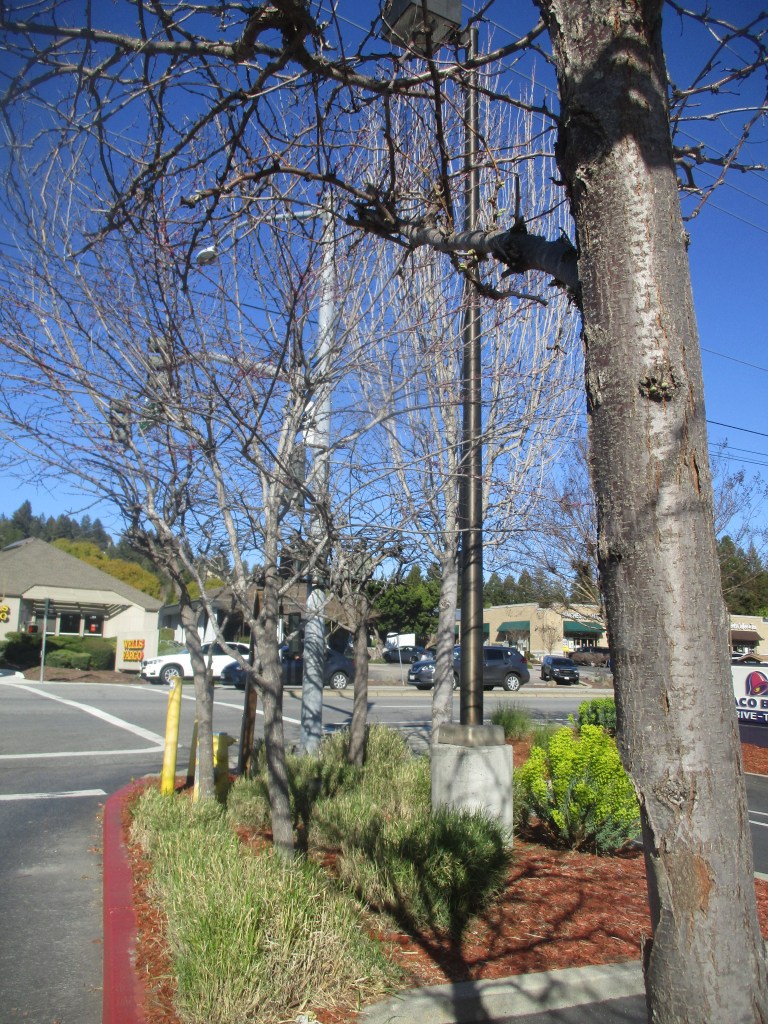
One can not see the forest for the trees here. Actually though, there is no forest, but only too many trees, surrounded by vast pavement. A wide roadway is beyond these trees. A driveway is to the left. A parking lot is to the right. Not much space remains in between for so many trees.

A honeylocust is in the foreground to the right. It mostly obscures a crape myrtle in the background. To their left, and slightly to the right of the center of the picture, there is a red maple. To the left of the center of the picture, there are three Eastern redbuds. That is six trees confined to an area that is about as spacious as three parking spaces. The picture is not of good quality, and because it is a few years old, I can not remember many more details about it.

The honeylocust and the crape myrtle are components of the original landscape of the shopping center that this landscape is associated with. Alone, they are both quite practical for this particular landscape, and would not be too crowded. The red maple and three Eastern redbuds were added for the ‘upgraded’ landscape of the adjacent business establishment. Not only are they much too crowded to grow and develop healthy form, but they also encroach into adjacent traffic signals, and obstruct illumination of their corner of the adjacent parking lot.

Furthermore, they contribute little more than problems to the landscape. Red maple provides nice foliar color for autumn, but is obscured by the other trees. Eastern redbud could bloom nicely for spring, but is too brutally pruned for clearance to do so.

Unfortunately, these crowded trees were more profitable than smaller plant material would have been for the so-called ‘landscape company’ that installed them.

Horridculture – Diet

Dinnerplate dahlias should be about ten inches wide.

Mail order scams are a topic that I have been avoiding. I do not want to consider that some of a few items that I purchase by mail order may not be what they were sold as; and, if so, I will not know until they grow, bloom or produce fruit. Furthermore, I want to believe that if such items are not what they were sold as, that the situation is merely accidental.

This was no accident.

It began with the purchase of thirty rhizomes of ‘Red King Humbert’ canna last year. They were the cheap sort that become available after their primary season. I did not expect them to be of exemplary quality. Nor did I expect them to bloom. I only wanted them to grow a bit during the remainder of their season so that their rhizomes could survive winter dormancy to grow and bloom for the following season, which would have been last spring.

They grew as expected, but seemed to be virused. I tried to believe that the supplier would not send me virused stock, and that the striations of their foliage were normal. However, as growth resumed last spring, the foliage was very obviously virused.

Also, as they grew, they were very obviously not ‘Red King Humbert’. They grew only about two feet tall, and bloomed with scrawny orange flowers. ‘Red King Humbert’ gets about six feet tall, with big and billowy orangish red bloom.

The supplier gave me a credit for the expenditure, to spend on more of their products, I should have requested a simple refund. Instead, with the credit and a slight bit more for the difference in price, I purchased two dozen rhizomes of assorted dinnerplate dahlias.

As with the canna, I did not expect exemplary performance from these dahlias so late in the season. I only wanted them to survive and grow enough to store enough resources to survive their winter dormancy, to grow and bloom for the next season.

Most were completely necrotic and mummified upon arrival. Because this was after my experience with the canna, the supplier agreed to refund what I spent, but then only refunded a random amount of a dollar and a few cents. When I asked about the refund, I was informed that it was comparable to the cost of the one rhizome that I sent a picture of, as if I was expected to send a picture of every rhizome that I wanted a refund for. I explained that almost all of the rhizomes were comparable the the one that I sent a picture of, but received no more response.

I still have heard nothing about it. I decided to be satisfied with the few rhizomes that survived, and just accept the loss. The time that I had already wasted on pursuing a refund was worth more than any refund that I would have gotten.

So, . . . a few of the dinnerplate dahlia rhizomes survived and generated a bit of growth to partially recharge their resources prior to their next dormancy. Two actually bloomed. Apparently, these are very special dinnerplate dahlias. Instead of producing blooms that are about ten inches wide, the largest bloom is less than three inches wide. I have never seen such a dinky dinnerplate.

Horridculture – White California Poppy

White California poppies are naturally very rare.

California poppy is the official State Flower of California. Most Californians are familiar with it. We certainly know what color it should be. With few exceptions, it is bright and clear orange. Some, particularly within desert climates, are golden or more yellowish. White and pastel purple California poppies are rare aberrations. When I was a kid, finding one or the other was comparable to finding a four leaf clover for kids in Ireland. They were even a bit better though, since plants that bloomed with variant color bloomed with more than a single flower.

When I was about a freshman in high school, I found both a white and a purple California poppy just a few feet apart from each other. They happened to be at the Portola Monument in Montara, near where the Portola Expedition discovered San Francisco Bay. It was too early for seed, and I did not return for seed later. Besides, most of such seed produces plants that bloom with typical orange floral color. Nonetheless, at the time, I was very pleased to have found two very rare aberrations.

In more recent years, varieties of California poppy were developed. Some bloom with white or purple bloom. Others bloom with pink, red or yellow flowers. Some have double flowers. They are readily available from mail order catalogues and nurseries, as well as online. White or pastel purple California poppies are no longer rare or special. This sort of takes the fun out of finding one.

I suspect that the white California poppy in this less than exemplary picture is natural. Poppy seed was not likely sown here intentionally. Nonetheless, I do not know. Now that it is no longer special, its source is not so important. Realistically, their typical bright orange floral color is the best anyway.

Horridculture – Long Stem Rose

I grew a nearly exemplary long stem rose!

Well, I did not exactly do it myself. One of three specimens of ‘Proud Land’ hybrid tea rose that I installed into the rose garden in about 1984 did all the work. I was quite pompous when I found it though. After all, I maintain this particular specimen in a can here until it relocates into another rose garden.

I certainly did not expect such a bloom only a week before November. Although roses can bloom until winter dormancy, the latest are generally on short stems. Increasingly cool weather decelerates formerly vigorous growth.

This particular rose bloomed on a stem that was more than three feet long! It would have been ideal for Miss Piggy of the Muppet Show! Goodness, it could have been too good for Miss Piggy!

‘Proud Land’ hybrid tea rose

The flower might have lacked perfect form, and the foliage might have been slightly blemished, but with such an awesome stem, they were inconsequential. Perhaps I should have stripped the foliage and cut the flower off, in order to most effectively display the near perfection of this most astounding stem!

After cutting it, I removed the thorns and lower foliage, and put it in water outside the lounge at work. According to tradition, unless someone else is presently experiencing marital tension of some sort, the first of the gentlemen with whom I work to find roses there takes them to his wife. This was only a single rose, but was very special. It was gratifying to know that someone with whom I work was about to experience a very special evening, although I gave it no more thought than that.

Then, the gentleman who claimed it mentioned that it was too long, and before I could protest, he cut the stem in half.

the discarded half

Horridculture – Gophers!(?)

Who took the Louisiana iris?!

This is more infuriating than the rat or rats who ate the tops off of my rare young banana trees. I do not actually know who the culprit is, but can only guess that it is a gopher or a few gophers. Initially, I thought that it was someone who intended to pull weeds, but instead pulled the beloved Louisiana iris. All I know is that the iris were growing well, and are now completely gone!

These Louisiana iris were a gift from Tangly Cottage Gardening in Ilwaco, so were extremely important to me. After bringing them here at the end of last winter, I split and groomed them, and plugged them into a single row that was about thirty feet long. This row was on the edge of a pond, where I hoped they would form a network of rhizomes to help contain the shifting mud. It was an ideal situation. I watched them grow through the year, and expected them to bloom next season. They were totally awesome!

There is no indication that they were pulled or dug. Nor is there any indication that they were pulled downward from below. Although I found a few gopher tunnels, such tunnels were not sufficiently extensive to reach all of the rhizomes of the Louisiana iris.

Only four very small plugs remained. I dug and canned them to protect them from whomever or whatever took the rest of them. Although they can grow and multiply very efficiently, they will not replace the thirty foot long row for several years. Besides, even when they do proliferate, I do not know if I can safely install them back onto the edge of the pond. Without knowing what happened to the last colony, I can not protect a subsequent colony from the same fate.

Horridculture – Rats!

Darla would not have allowed this!

Darla would be very disappointed. Rodents were not a problem while she was here. Since her retirement, they have proliferated. I do not mind if they get into the compost or even the trash. The problem is that they now inhabit portions of the shop buildings and the nursery where we grow a few items for the landscapes.

They are rudely bold about their infestation too. They know that I can not catch them like Darla would, so they are in no hurry to evade me if I encounter them while working late. They ruined a bag of seed for erosion control vegetation. Although the top of the bag was wide open, they chewed through the bag so that the contents spilled out onto the floor.

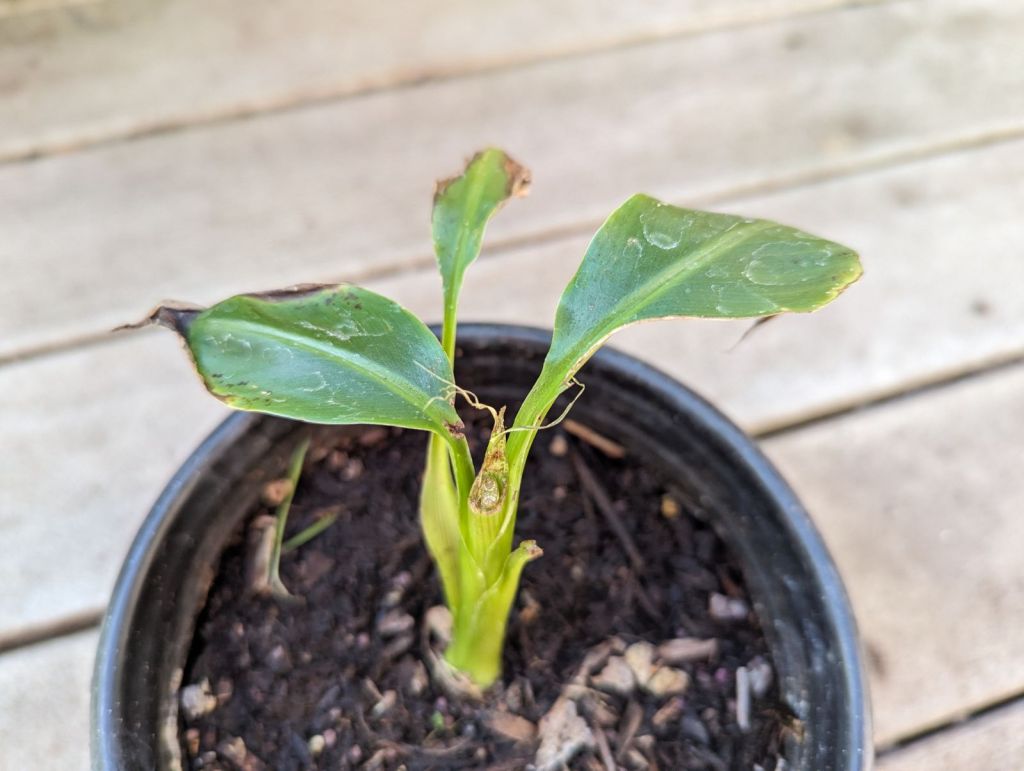
Worst of all, they chewed the tops of a few of the more unusual items within the nursery. They ruined a few of the Heliconia that I brought from Brent’s garden, and then chewed the tops off of two young banana trees. All affected specimens should recover, but I am very annoyed by the damage nonetheless. I do not put so much effort into growing such vegetation just to feed rude rodents! Besides, the banana trees are of an uncommon cultivar. I am concerned about others that are quite rare.

Rats would not be such a problem if only they were not so rude. There is plenty of vegetation, including blackberries, for them to eat within surrounding forested areas. They insist on coming inside to damage important vegetation instead. That is why I do not feel at all guilty about putting traps out.

Ultimately, I should be more diligent about hiring a feral kitty to dissuade rodent infestation. I have not yet heard back from the agency that procures employment for such feral kitties.

Horridculture – Inappropriateness

Vines and annuals are not shrubbery and ground cover.

Vegetation within a planned landscape should serve a purpose. The form of such vegetation should be appropriate to such purpose. Trees provide shade. Shrubbery defines space and obscures undesirable scenery. Vines climb fences and other infrastructure. Annual bedding plants provide more seasonal color than most other vegetation. Turf grows into useful lawns. It is helpful to plan accordingly for a landscape.

Turf can not do much more than become useful lawn. It can not provide shade, obscure undesirable scenery, climb fences or provide more seasonal color than green. Nor can trees, shrubbery or vines become useful lawn. Again, each form of vegetation should be appropriate to its particular application.

Trellised rocktrumpet is not shrubbery. Rose periwinkle is not permanent ground cover.

There is so much other vegetation that would have been appropriate to this particular situation. Star jasmine, trailing lantana, trailing rosemary or even the dreaded English ivy would have been better and more permanent ground cover. Dwarf oleander, barberry, arborvitae or even dwarf New Zealand tea tree would have been better shrubbery.

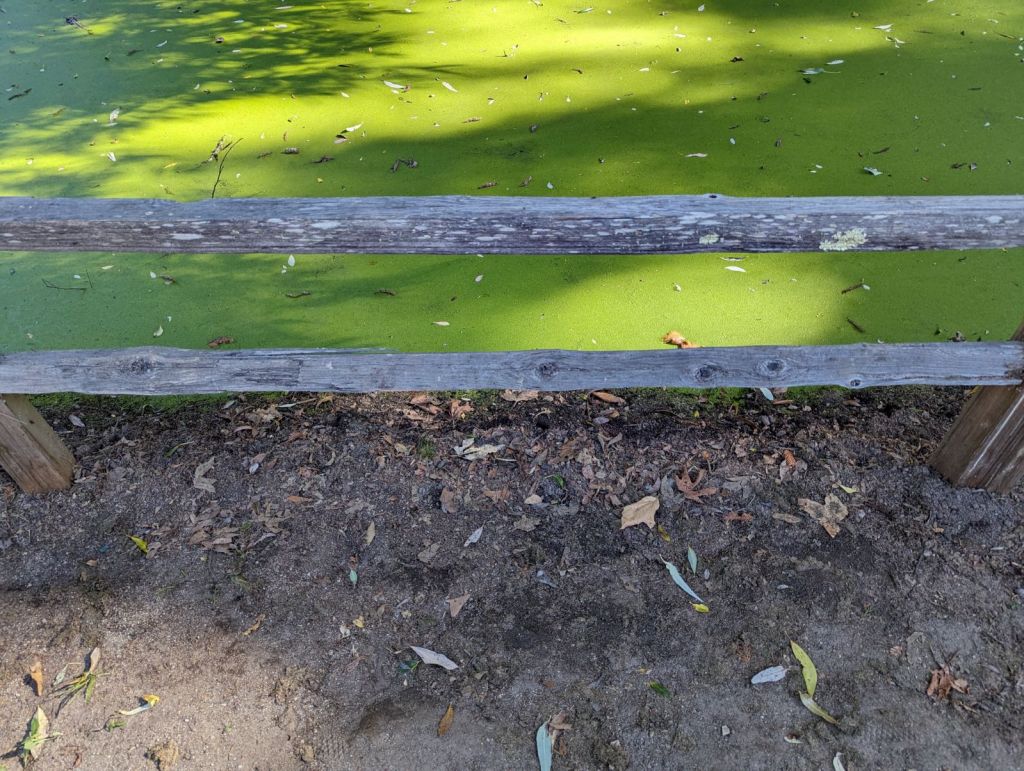
Rose periwinkle is an annual bedding plant. Although it is somewhat pretty now, it will not likely survive through winter. Even if it does, it will not migrate far enough to reliably function as a ground cover.

Trellised rocktrumpet is a small but vigorous vine that will always be reliant on trellises for support. As its cheap trellises decay and deteriorate, it will eventually develop into shabby mounds of tangled vine stems, but will never be able to support itself as high as the new trellises are now. It can reach out to cover some of the ground that will be vacated by the rose periwinkle, but can not reliably function as a ground cover for this much area. It will bloom less if shorn for neatness.

Horridculture – Green Walls

It would have been easier to paint the wall green.

Foundation plantings were quite functional while eavestroughs and downspouts were prohibitively expensive prior to about the Victorian Period. They dispersed rain water as it fell from eaves above, in order to limit surface erosion and muddy splatter onto foundations, basement windows, and lower portions of walls.

Most foundation plantings were tough perennials, such as lily of the Nile, or low and densely evergreen shrubbery, such as English boxwood or Indian hawthorne. Some did not stay so low though. Long after eavestroughs and downspouts became common, some foundation plantings grew into obtrusive hedges in front of exterior walls. Some even obscured windows. Instead of dispersing moisture, they retain moisture and damp detritus that promotes rot of associated walls and infrastructure. Furthermore, they require maintenance, such as shearing. It would be more practical to paint a wall green than to leave overgrown foundation planting pressed up against it.

Vines are no better. They can be practical on reinforced concrete and cinder block, but not much more. Not only do they promote rot, but some destroy paint, siding and stucco. Vermin can get anywhere that vines provide access to.

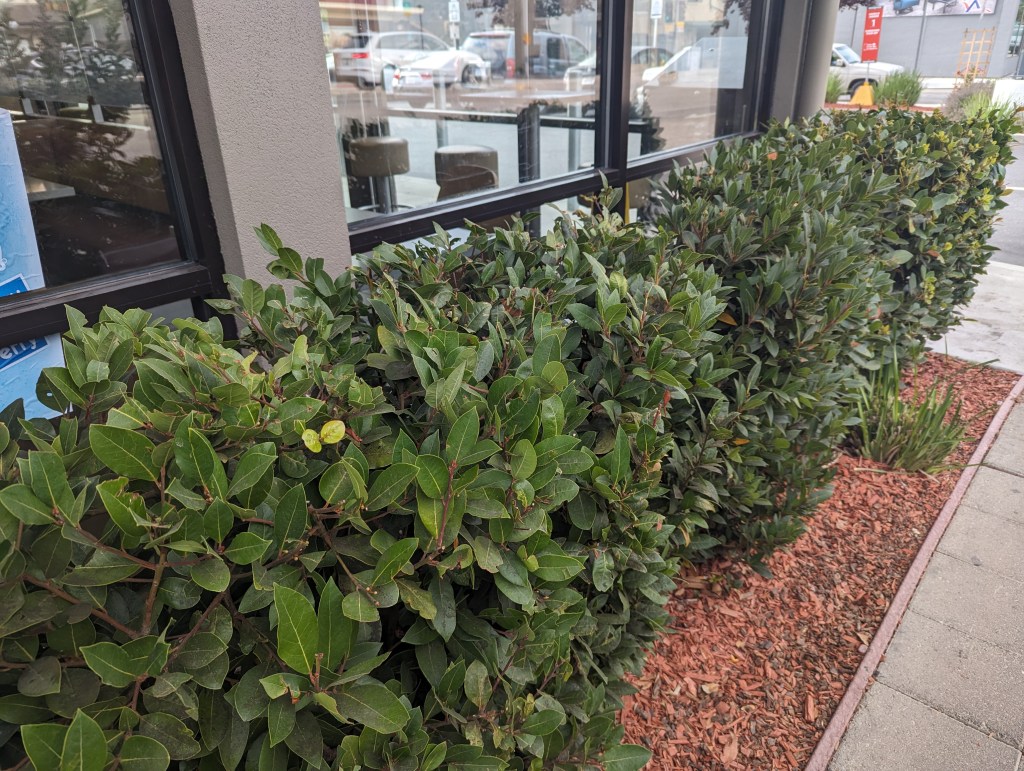
This is neither about vines nor foundation planting though. It is about this hedge in front of this glass facade. It got my attention because it did not grow slowly into this form from overgrown foundation planting, but was intentionally installed and shorn as such. Then, I realized that it is actually practical. It did not require modification of the wall. It is shorn to maintain a slight bit of clearance from the glass facade, to facilitate cleaning of the glass, and inhibit accumulation of detritus against the glass. Therefore, it does not look so bad from within. Perhaps it is comparable to painting the glass wall green, but is actually more visually appropriate.

Horridculture – Nature

Nature is dysfunctional.

Horticulture is unnatural. It involves unnatural manipulation of exotic species that were unnaturally imported from all over the World. It provides unnatural irrigation and unnatural chemical fertilizers and amendments. It involves unnatural containment of many plants within unnatural synthetic media within unnatural plastic cans or other containers. It strives to eliminate much of what is natural, such as pathogens and competition. It is ironic that so many believe that a simple but totally unnatural houseplant brings a bit of nature into their particular environment.

Nature, although quite natural, is dysfunctional. It is messy. It is dirty. It is tragic. It is potentially dangerous. It is overrated. Realistically, it is a hot mess of problems. Somehow though, it seems to be appealing.

That is why so many of us strive to incorporate more nature into our respective lifestyles by very unnatural means. We crave a sort of idealized version of what we believe nature should be. It would likely be easier and more efficient to accept such attempts as unnatural, and exclude what nature might try to contribute.

Some are quite happy to live and work in high rise homes and offices with minimal natural influence. They still breathe natural air, and appreciate natural sunlight and the stabilizing effects of natural gravity, but shelter themselves from what is most bothersome about nature outside, such as weather, wildlife and most insects.

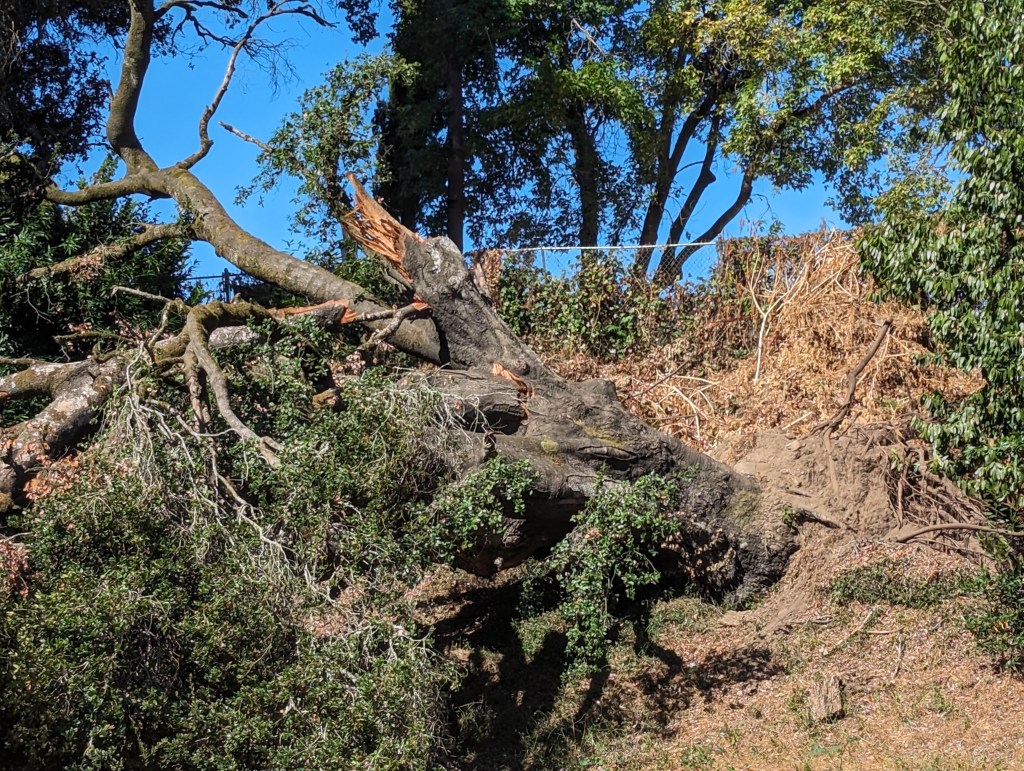
This unfortunate old coast live oak is an exemplary victim of nature. It grew here naturally for two centuries or so. It obtained all that it needed from the natural soil, air and weather. It survived natural insect infestations, and long ago, may have survived natural forest fires. Ultimately though, perhaps in conjunction with a bit of natural wind and natural fungal organisms associated with decay, it succumbed to natural gravity.

This old oak finally succumbed to the same nature that it exploited for centuries.