Tree of Hippocrates

Platanus, or sycamore, supposedly derives its botanical name from the Greek word “platys”, which means “broad”, and describes its wide leaves. However, some believe that its name was derived from “Plato”, who lectured about philosophy within the shade of a sycamore grove, rather than an olive orchard, outside of Athens. The Tree of Hippocrates, is an individual Platanus orientalis that was planted centuries ago, supposedly where Hippocrates lectured about medicine under a much older tree of the same species. Trees grown from cuttings and seed from the Tree of Hippocrates have been shared with medical institutions, schools and libraries all over the World. One seedling was planted at Dominican Hospital in Santa Cruz in 1968. Until only the last few years, it had been pollarded in an exemplary manner, which left no twigs for me to get cuttings from during winter. Only last summer, a gardener left me a few twigs, which I plugged as early cuttings. Of course, most succumbed to summer warmth. Some of the survivors did not root through winter. Now, though, there are four surviving rooted cuttings! So, we have four copies of a seedling of the second Tree of Hippocrates! Does that count for anything?

Horridculture – High End

Gladiolus papilio from Skooter’s Garden makes my garden more special than any ‘high end’ garden.

What exactly does that mean?! Why should I care? My lack of concern seems to be directly proportionate to the intensity with which someone tries to impress upon me that I should be so concerned. A colleague from high school tried to tell me about a new television show about a so-called ‘landscaper’ in Michigan who is so extremely ‘successful’ that he also lives in a home in Florida for the winter. I suspect that both of his homes combined are worth about as much as a single home here, but I will just continue with this premise that he is successful. He does exclusively ‘high end’ work, which regularly involves moving huge boulders with old fashioned technology because that is what his ‘high end’ clients want. I needed to interrupt. The ‘high end’ nonsense annoyed me too much. So, they have huge boulders in their landscapes. Perhaps their landscapes were very expensive to install. Splendid! ‘High end’ spending is healthy for the economy. Why is this any of my business? I do not know. I am a horticulturist, not an economist. My garden contains rhubarb from the garden of my paternal paternal great grandfather, and Dalmatian iris from the garden of my maternal maternal great grandmother. That is horticulturally significant. ‘High end’ gardens seem to be more concerned with expenditure than with horticulture, as if spending more will somehow make it better. Do those who purchase ‘high end’ gardens actually work in them? Do they grow anything from the gardens of their ancestors? I know that some do, but I suspect that some do not. The primary purpose of their ‘high end’ landscapes is lavishness. I can not doubt that such landscapes serve such purposes more than adequately, but am nonetheless unimpressed by their typical lack of horticultural relevance.

PruneYard

No more prunes.

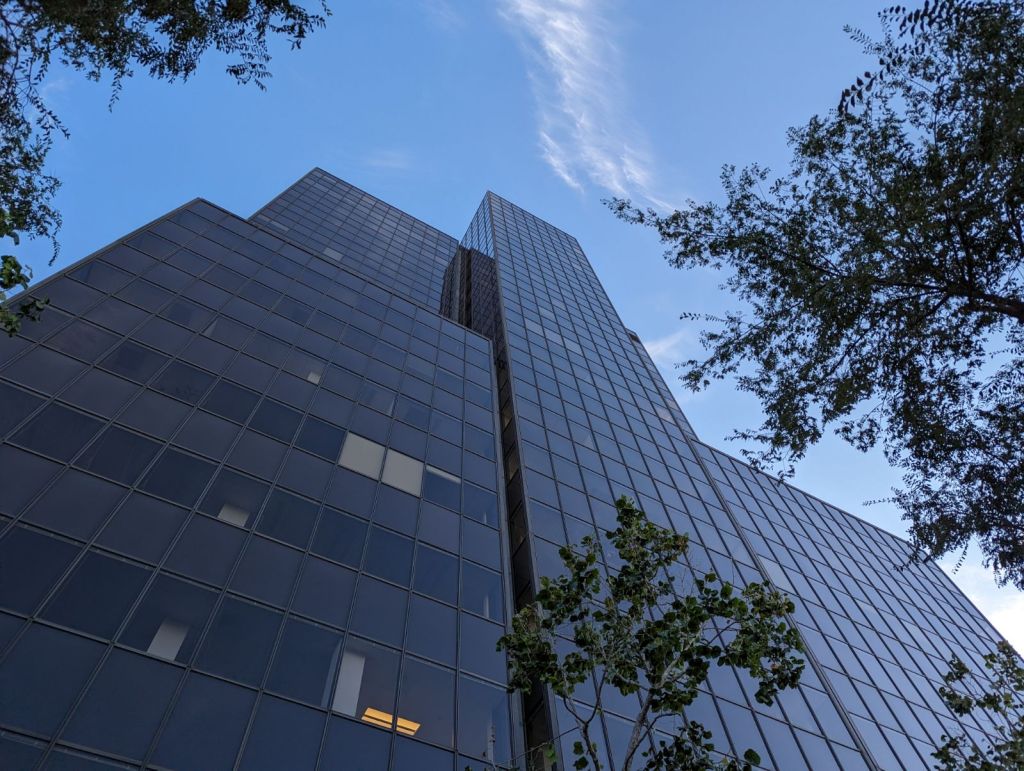
Ulmus parvifolia, Chinese elm extends most prominently into the picture from the right, with another bit from the left of the upper margin. Platanus X acerifolia, London plane extends into the picture from the right of the lower margin, with another minimal bit from the upper left. Otherwise, no other vegetation is visible. This is not exactly a horticultural topic.

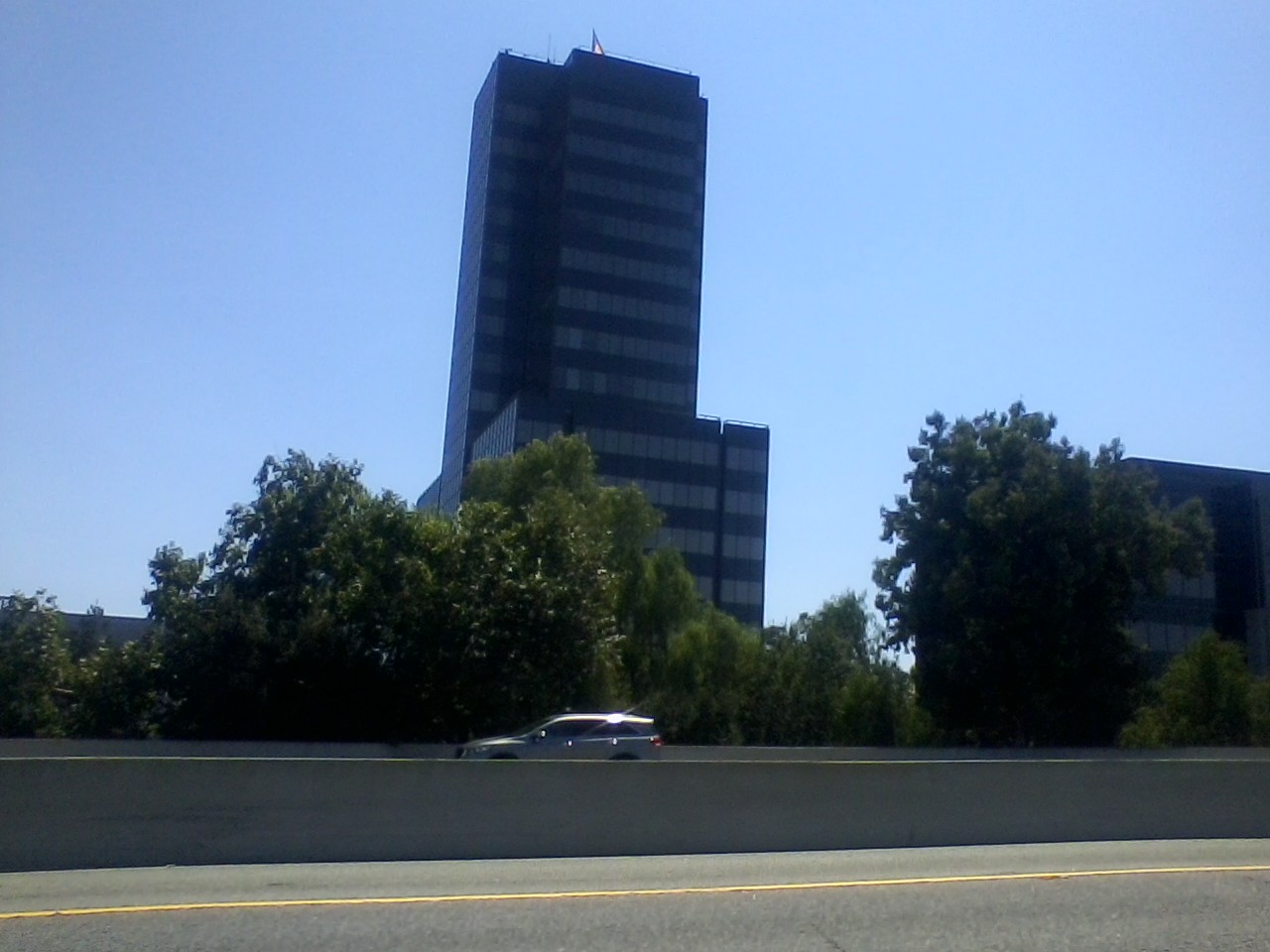
The PruneYard Tower 1 is the big and dark skyscraper above the elms and planes. For a few years, it was the tallest skyscraper between San Francisco and Los Angeles. Like many major urban developments, it and its associated complex of buildings is named for what it displaced.

The PruneYard really was what its name describes, a large yard for drying prunes, as well as apricots, from the formerly vast orchards that surrounded it. Because the primary PruneYard complex of buildings is almost as old as I am, I can not remember it not being there. However, I can remember the ruins of some of the associated facilities nearby, as well as abandoned remnants of orchards. The stouter PruneYard Tower II was added in about 1976. The PruneYard Place was added in the early 1990s.

Nowadays, the name of the PruneYard must seem silly to those who are unaware of its history. Few are aware of the difference between prune and plum. Even those of us who can remember the last scraps of orchards find it difficult to believe that, not only were orchards here, but that they were formerly much more vast, and occupied most of the Santa Clara Valley. Just as tourists go to see the fall color of New England, tourists formerly came here to see the spring bloom. It is no wonder that the Santa Clara Valley was also known as the Valley of Heart’s Delight.

Souvenir

P80609KNurseries are full of plants for sale. That is their business. They sell plants, and whatever plants need. With a bit of money, it is easy to purchase plants to compose an exquisite landscape. That is important to landscape professionals who make a business of composing landscapes to beautify the environments in which they work.

Those of us who enjoy home gardening might also purchase plants that we want for our garden. Yet, our home gardens are more than mere landscapes that are designed to simply beautify. The might also produce flowers for cutting, fruits and vegetables. Some might produce firewood. Gardens are usable spaces for active lifestyles. They are spaces for us to grow whatever we want to grow.

I buy almost nothing for my garden. The last item I purchased was a ‘John F. Kennedy’ rose, and I only did so because it was easier than growing one from scratch, and it is my favorite hybrid tea rose. Almost everything else was grown from seed, cutting, division or even as entire plants taken from somewhere else. They all have stories. My figs and quince are from trees that have been producing fruit in the Santa Clara Valley for generations. My great grandfather gave me my first rhubarb before I was in kindergarten. I found one of my pelargoniums in a neighbor’s trash heap when I was in junior high school. I found another in a creek where I grew citrus in Gilroy in the early 1990s.

My iris are from all over. My favorite are still those from the garden of my great grandmother https://tonytomeo.wordpress.com/2017/09/10/roots/. Two others came from and ‘incident’ back in college https://tonytomeo.wordpress.com/2017/09/12/the-colors-of-karma/ . I may grow as many a four white iris, not only because they are my favorite color, but because they came from important origins. The short white iris that I do not like much must stay because it came from my grandmother’s garden in Saint Helens. There is another tall iris that is not a pure white, but seems to be somewhat grayish, but it must stay too because it is the only iris I got from the historic home of a friend’s mother in Monterey. One of my favorite whites was supposed to be red, but must stay because it came from a friend’s home in Lompico . . . and because it is one of the prettiest. I have a purplish burgundy iris that I only recently learned was brought from the garden of a colleague’s grandmother in Placentia, a town in Orange County that really should change it’s name. It proliferated and was shared with the Felton Presbyterian Church, where it proliferated again, which is how I found some on a trash heap. They are a keeper now.

When they were all together in the same garden, I grew as many as fourteen bearded iris, with a few other types. Some of the redundant white bearded iris have been relocated to the garden parcel in Brookdale, just to keep the separate from similar cultivars. Not many have been added, although there does happen to be a group of mixed iris from the garden of a former client in Ben Lomond. I think I will keep them mixed because they are easier to keep track of as a single mixed group rahter than as several separate cultivars.

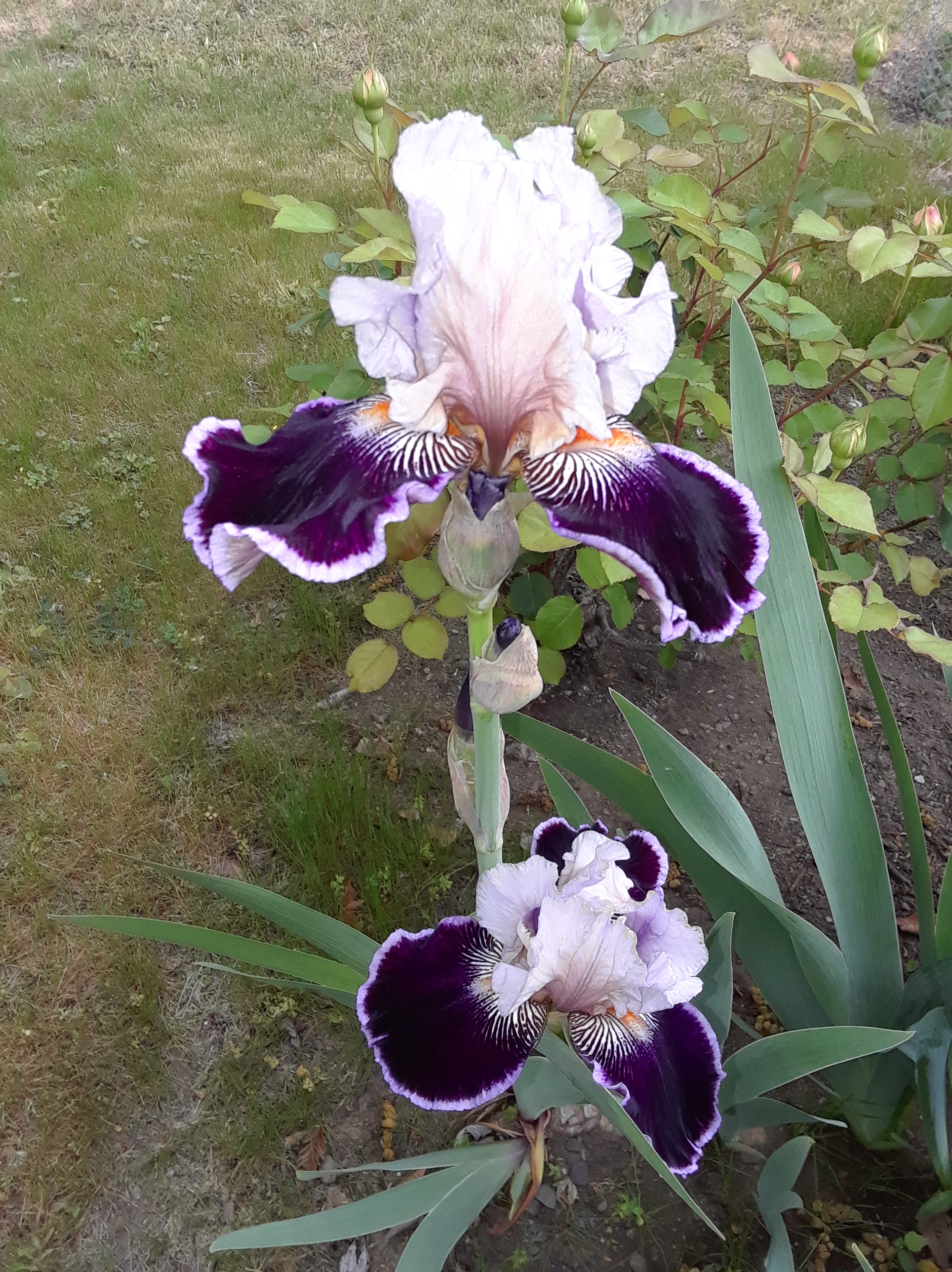
These pictures are a few weeks old, from when the iris were still blooming. The iris in the picture above came from the garden of a friend in the East Hills above San Jose. The flowers are the biggest of all the iris I grow. You can see how distinctive they are. The iris in the picture below, which is not a good picture, is ‘Blueberry Ice’. It was a gift from the Clara B. Rees Iris Society. It has stout stems to support the very wide flowers that are mostly white with a variable blue edge.P80609K+

Kitty City

P80124Los Gatos is named after bobcats. More specifically, it is named after an interchange that was named after bobcats; La Rinconada De Los Gatos. There are a few theories about how and why it was named after bobcats. The most popularly accepted theory involved the remarkably violent demise of everyone involved, leaving no one to document it as accurately is it has been repeated for generations. Don’t question it if you ever hear it. It is quite entertaining. I prefer to think that we do not need an elaborate excuse for naming our town after native wildlife. The bobcats were here. People noticed them. BINGO – La Rinconada De Los Gatos.

Regardless and contrary to what my colleague Brent would tell you, ‘Los Gatos’ does not mean ‘The Ghettos’ in Spanish.

Other towns in California have horticultural names. Some are named for horticultural commodities that were grown there. Others are named for native flora. Some are named after native flora that was harvested as a horticultural commodity!

Apple Valley, Citrus Heights, Greenfield, Lemon Grove, Orange, Orange Cove, Prunedale, Rosemead, Roseville and Wheatland might have been named after what was grown there commercially, although Orange was probably a recycled name from somewhere else. Calabasas is a Spanish name for pumpkins that were grown there. Hesperia is derived from citrus.

Del Rey Oaks, Live Oak, Oakdale, Oakland, Oakley and Thousand Oaks were probably named for the native oaks that grew there naturally. Paso Robles was named El Paso De Los Robles, and Roble is the Spanish name for the valley oak. Encino is the Spanish name for coast live oak, and a few small ones are Encinitas.

La Palma, Palm Desert, Palm Springs, Palmdale and Twenty Nine Palms are obviously named for palms, both the native desert palm and exotic palms. Yucca Valley is of course named for the native specie of yucca. Cypress, Hawthorne, Palos Verdes Estates, Rancho Palos Verdes, Walnut, Walnut Creek, Willow Glen and Willows should be easy to figure out, although some are not as obvious as they would seem to be.

Redwood City was probably named for the mills that processed redwood lumber there, rather than the trees.; just like Mill Valley. Madera translates into wood; and Corte Madera is a place to cut wood. Palo Alto translates to something like ‘high stick’, but was really derived from a tired old redwood tree with a dead top. Fresno translates into ash tree.

Bell Gardens, Bellflowers, Cloverdale, Elk Grove, Ferndale, Garden Grove, Gardena, Grass Valley, Hawaiian Gardens, Laguna Woods, Lake Forest, Larkspur, Lawndale, Pacific Grove, Tulelake, Woodland, Woodlake and Woodside are open to interpretation. Then there is Weed. After all, this is California.

What’s In A Name? Sometimes, Not Much.

P71209Newer developments are often named after what was destroyed to procure space for them. Writers and historians have been making that observation for decades.

There are obviously no remnants of a ranch in the McCarthy Ranch Marketplace in Milpitas. Heck, there are no little cornfields left in Milpitas, which is what ‘Milpitas’ means. Cherry Orchard Shopping Center in Sunnyvale? Give me a break! The Pruneyard Shopping Center in Campbell is no better.

I just happen to find the Pruneyard to be less objectionable than the others because it was built about the time I was born. It has been there as long as I can remember. My parents can remember when it was a drying yard for the prunes harvested in the surrounding orchards. I remember the last remnants of prune orchards, but by my time, there were not enough of them to justify the less lucrative use of real estate for drying, which could be done elsewhere.

The Pruneyard Towers are an office complex just to the west of the shopping center. The original Pruneyard Tower might still be the tallest building between San Francisco and Los Angeles. I know it was only a few decades ago. (Downtown San Jose has a ceiling on the heights of their skyscrapers because of the flightpath of the Mineta San Jose Airport.) I can remember as a kid, seeing the big black tower standing proudly off in the distance, beyond the blooming apricot orchards. When our parents were shopping there, and we got close to the Pruneyard Tower, we felt a bit more cosmopolitan, as if we lived in a big world class city. Back then, we had no idea that nearby San Jose was well on the way to becoming exactly that!

The shorter tower was added about 1976. The third and lowest of the three bigger towers was added in the 1990s. The late 1960s architecture of the shopping center is still prominent, but several original buildings have been rebuilt with modern architecture, and a few new buildings were added.

As much as I miss the orchards and the horticultural past of the Santa Clara Valley, I can not totally dislike the Pruneyard Shopping Center and the associated big towers. To my generation, they are also part of our history. They have been here as long as we have.

The one thing that I dislike about the Pruneyard Shopping Center is the name. It is a constant reminder that something that was such an important part of our local culture and history was destroyed so that it could be built. Nothing about the site is associated with the orchards, or drying yards or prunes, or anything of the sort.