Norfolk Island Pine

Norfolk Island pine seems to have been built rather than grown.

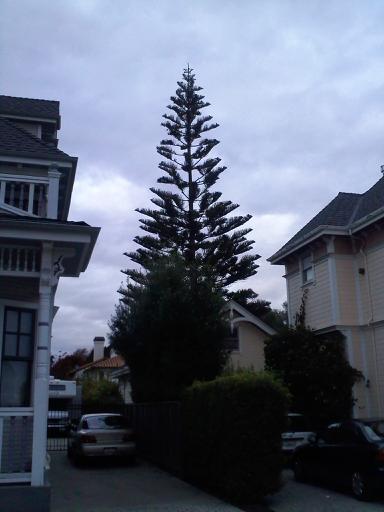
            In coastal areas of Southern California, the Norfolk Island pines, Araucaria heterophylla, are among the most distinctive large trees. Perhaps they are better described as ‘unusual’ . . . , or even ‘strange’. They are so symmetrical that they seem to have been assembled from prefabricated kits than to have grown as natural trees. Their strictly organized conical branch structures and remarkably straight central trunks are always visible through their uniformly open canopies. In such mild climates, they can get nearly a hundred feet tall and half as wide, so are not easy to hide. In Hawaii, their symmetry has actually made them popular as Christmas trees. Their finely textured juvenile foliage is comprised of narrow, half inch long pine-needle like leaves, which are wider among adult growth.

            Locally though, Norfolk Island pines are primarily enjoyed as houseplants, particularly since they can grow slowly and live in pots for many years. The climate is just a bit too cool in winter for them to be very happy in the garden. However, as they eventually get too large for their homes, many end up in the garden anyway. They stay much smaller and are not nearly as symmetrical as they are in milder climates, and may be damaged by the more severe frosts every few years, but they have a certain appeal and distinction regardless. Those that get planted in the garden while young seem to be more symmetrical than those that get disfigured by living as houseplants longer. For some reason, trees that develop weak or curved trunks as houseplants tend to continue to grow with interestingly irregular trunks and branch structure.

Which Houseplant?

Peperomia obtusifolia?

Peperomia obtusifolia, baby rubber plant is what I suspect this to be. I can not be certain. I do not work with houseplants. I can barely remember that we studied only a few cultivars of Peperomia that happened to be popular back when we were in school during the late 1980s’. The modern cultivars that are popular now were not even developed back then. I do not remember ever getting acquainted with the simple species, which this seems to be. That makes it even more perplexing. Where did someone get this copy of the simple species that has become so rare relative to popular modern cultivars as well as formerly popular cultivars? The rarest of modern cultivars is not as rare as this original. It is an exemplary specimen, too. It is at least two feet wide and stands more than a foot tall in its wide but shallow pot. Someone has maintained it meticulously for several years. Perhaps it grew as a cutting from an even older specimen that was grown before it became so rare so long ago. Perhaps someone appreciated this original simple species as it was losing popularity to more colorful modern cultivars back then. Realistically, without any of the fancy variegation of modern cultivars, the simple green original is undoubtedly more vigorous, and perhaps significantly so. It is therefore more sustainable than cultivars, and more likely to survive and perpetuate itself by cutting for many years. Alternatively, it could have originated as a reversion from a modern cultivar. Someone may have been impressed enough by its relatively vigorous simple green foliage to grow a copy from a cutting. Perhaps relatively vigorous simple green growth merely overwhelmed and replaced original but less vigorous variegated growth. These are merely guesses about its identity, which remains a mystery.

Horridculture – Pseudo-Sustainability

This would not survive for long in the wild.

Sustainability is a good idea gone bad. Theoretically, it is commendable. Horticulturally, it involves growing species and cultivars that require minimal intervention or resources that they can not obtain naturally from their environment. In more extreme application, it can involve growing only native species, but not their cultivars that would not be naturally occurring, in order to limit interference with natural and endemic ecosystems.

Capitalism is a good idea too. Unfortunately though, it too often compromises other good ideas. It is how sustainability became a cheap fad, which now involves all sorts of artificial but marketable products and interventions that are contrary to its original intention. Regardless of their sources, water, fertilizers and amendments that are not provided by nature are unnatural. Container gardening infrastructure, irrigation systems, artificial illumination and really anything that is made of unnatural material are violations of sustainability that should be more obvious than they are.

‘Sustainability’ has become a buzzword for marketing.

There is certainly nothing wrong with appealing exotic vegetation with the garden or home. Almost all of the best and most popular vegetation is not native, and most of it relies on unnatural intervention and resources to perform as desired. However, it should be recognized for what it is, and not marketed as ‘sustainable’ if it is not.

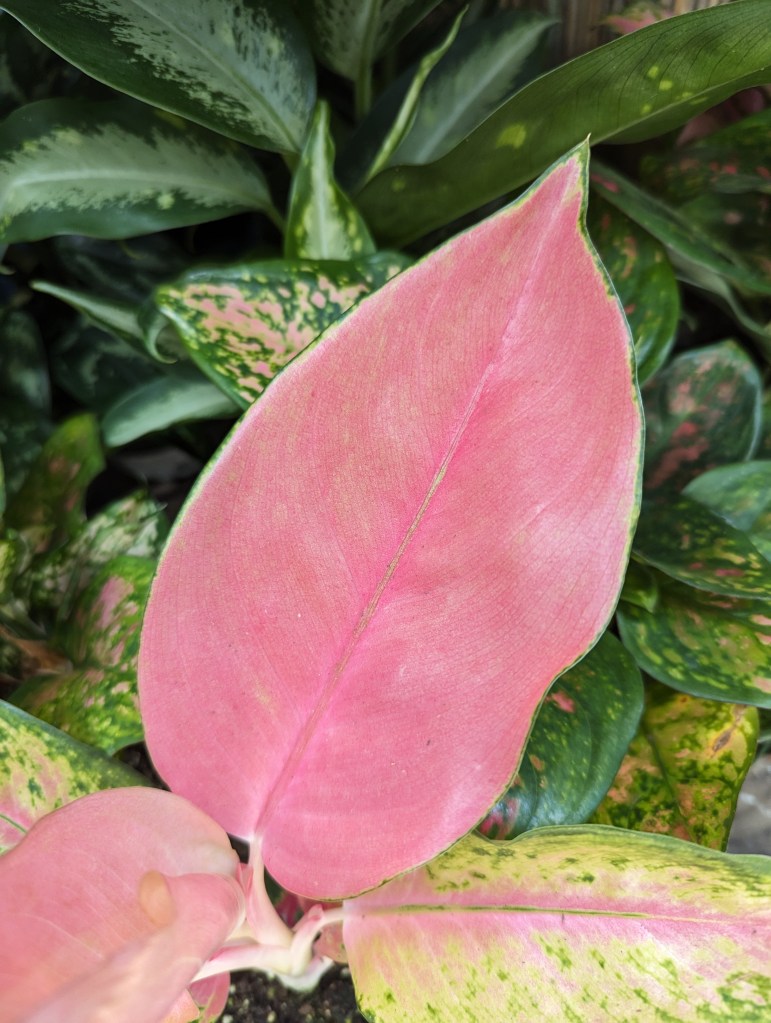
This unusual cultivar of Aglaonema was unnaturally selected or developed from species that are native to tropical or subtropical climates of southeastern Asia. it grows primarily as a houseplant here because it is vulnerable to even very mild frost. It grew in artificial potting medium, within a plastic pot. It will always be reliant on artificial irrigation, and will perform better with unnatural application of fertilizer. It will always be less vigorous than greener cultivars because it lacks chlorophyll. Yet, it is marketed as ‘sustainable’.

Coffee

It looks more like a houseplant than the source of coffee.

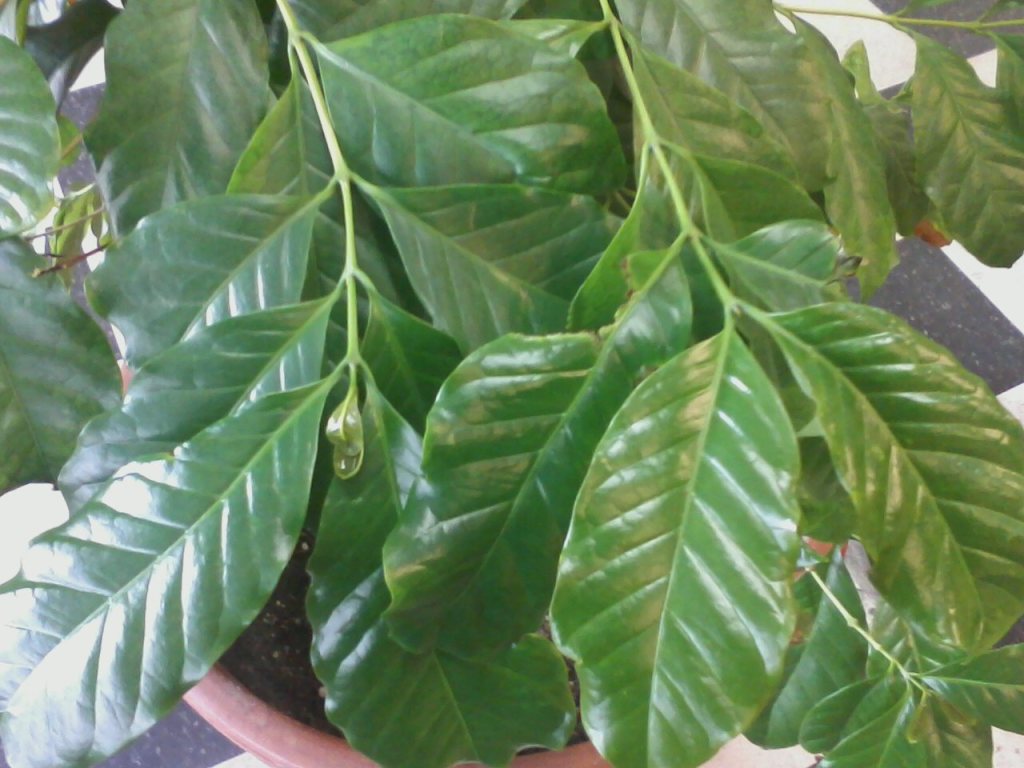
The White Raven Coffee Shop, the best little pourhouse in Felton, has an interesting but old fashioned houseplant on the counter. This group of four small but rapidly growing coffee trees, Coffea arabica, was a gift from a loyal customer.

Mature plants can get to thirty feet tall in the wild. Fortunately, coffee trees are easy to prune to fit interior spaces. Pruning for confinement is actually better than relocating big plants outside, since they do not like cold weather and are sensitive to frost.

Like various species of Ficus, coffee is appreciated more for lush foliage that happens to grow on a tree that can be trained by pruning to stay out of the way, overhead or in other unused spaces or corners. The simple remarkably glossy leaves are about two and half inches long or a bit longer. The very fragrant small white flowers are almost never seen among well groomed houseplants, and only rarely and sporadically bloom among less frequently pruned larger trees in greenhouses and conservatories.

The half inch wide coffee fruit, which is known as a ‘cherry’, is even more rare than flowers among houseplants because of the scarcity of both pollinators and pollen (from so few flowers). Those fortunate enough to get flowers sometimes pollinate them with tiny paintbrushes or clean make-up brushes to compensate for a lack of insects about the house. The resulting bright red or somewhat purplish cherries barely taste like cherries and only make two coffee ‘beans’ each; not enough to bother roasting and grinding for coffee, but great for bragging rights.

Variegated Boston Fern

Tiger fern is prettier up close.

Boston fern is merely one of several cultivars of Nephrolepis exaltata. Its cultivar name is ‘Bostoniensis’. Variegated Boston fern, or tiger fern, is reputedly a cultivar of this cultivar. Its cultivar name is either ‘Variegata’ or ‘Tiger’. From a distance, it seems to be a yellower version of the original. Prettily intricate stripes become apparent with closer observation.

Variegated Boston fern is a bit smaller and a bit less vigorous than common Boston fern. Like all variegated cultivars, it works with a bit less chlorophyll. Mature potted specimens might get no wider or higher than three feet. Unvariegated Boston fern can be more than four feet from top to bottom. Both could be larger if their long fronds were less pendulous.

In home gardens, variegated Boston fern can get rather tattered through winter. It is likely to defoliate if exposed to even minor frost. This is why it is more popular as houseplants, usually in hanging pots. Such potted specimens rely on consistent watering. Diffused but bright sunlight is best. Occasional application of fertilizer enhances foliar color and vigor.

Fiddle Leaf Fig

Fiddle leaf fig starts out as a clinging epiphytic vine.

What a weird tree! Fiddle leaf fig, Ficus lyrata, is an uncommon but familiar large scale houseplant that we might not welcome into our homes if we knew how it behaves where it grows wild in the lower rainforests of Western Africa. Although it can grow upward from the ground like almost all other trees do, it often germinates and begins to grow as an epiphyte, within organic debris that accumulates in the branch unions of other trees. While suspended, it extends roots downward. Once these roots reach the forest floor, they develop into multiple trunks that overwhelm and crush the host tree as they grow.

The bold foliage is typically dark drab green, like the shades of green that were so popular for Buicks in 1970, with prominent pale green veins. Individual leaves are about a foot long and potentially nearly as broad at the distal (outward) ends, often with randomly wavy margins. Like fiddles, they are narrower in the middles, or actually more often narrower at the proximal (inward) ends. When pruning becomes necessary, the caustic sap should be soaked from fresh cuts with paper towels so that it does not drip and stain.

China Doll

Most big China doll trees were formerly docile houseplants.

It is hard to believe that the original variety of the familiar China doll, Radermachera sinica, that grows so slowly to reach an eight foot high ceiling as a houseplant, can actually grow into a substantial fifty foot tall tree with a three foot wide trunk, where protected from frost. Modern varieties with more billowy foliage take even longer to reach the ceiling, and do not go much higher. The finely textured and very glossy foliage is bipinnately compound, which means that each of the half to two foot long leaves are divided into smaller leaflets, which are also divided into even smaller leaflets that are about an inch or so long. Trusses of tubular white flowers that resemble big catalpa flowers are almost never seen among houseplants or modern varieties, but are quite showy on big old trees.

Jade Plant

Jade plant is vulnerable to frost.

Wandering Jew, spider plant, various philodendron and jade plant were among the most popular houseplants of the 1970s. They are as easy to propagate as they are to grow, so were popular gifts for friends and neighbors. Jade plant, Crassula ovata, commonly grew too big to stay inside without pruning. It fortunately grows better than the others outdoors.

Jade plant does not grow fast, but can eventually get more than six feet tall, with densely rounded form. The succulent stems of such large specimens get quite plump, but remain rather fragile. The paired evergreen leaves are thickly succulent, and mostly a bit longer than two inches. Clusters of tiny pale pink or white flowers are not especially impressive.

At least one cultivar is variegated with irregular white stripes. Another is somewhat ruddy with relatively compact growth. Others exhibit tubular or curly leaves. Foliage can fade or develop narrow red edges in response to harsh exposure or heat. It is also susceptible to frost damage. Jade plant is mildly toxic, but also potentially appealing to dogs who chew.

Houseplants Naturally Live Outside Somewhere.

Kalanchoe is a popular houseplant here, but grows wild in Madagascar.

The plants grown as houseplants may have serious disadvantages that prevent them from being happy in the garden, but have other advantages that help them survive indoors. They tolerate the lack of direct sunlight, the lack of humidity, the minimal fluctuations of temperature and the confinement to pots that they must endure for a domestic lifestyle. Their main difficulty in the garden is most are from tropical climates, so can not tolerate cold winter weather.

However, even happy houseplants like to get out once in a while. Even though most can not survive the coldest winter weather, the mildest winter weather is actually the best for them to get supervised outings. During clear and warm summer weather, sunlight can easily roast foliage.

Houseplants with glossy tropical foliage occasionally like to be rinsed of dust and whatever residue that they accumulate in the home. (African violets and plants with fuzzy leaves do not want water of their foliage!) Foliage can be rinsed in a shower or with a hose, but are more gently rinsed by very light drizzly rain.

Timing is important. Unusually cold or heavy rain should be avoided. Plants should be brought in before the sun comes out. It is probably best to not leave plants out overnight when it gets colder and they are not likely to be monitored. While the plants are outside, mineral deposits can be scrubbed from the bases of the pots.

The rain needs to fall this time of year anyway, so it may as well go to good use in as many practical ways as possible. It may be a while before it flows into the aquifer and gets pumped out to come back later for use around the home and garden.

So much of the water that gets used around the home has the potential to be used again. With modifications to plumbing and the sorts of soaps and detergents used around the home, used water, politely known as ‘greywater’, can be redirected, collected and distributed to the garden. Water may not be so important in the garden this time of year, but a Greywater Workshop happens to be coming up next week; and advance registration is required.

The Guadalupe River Park Conservancy’s Adult Greywater Workshop (for ages eighteen and up), ‘Greywater Basics: Reusing Household Water in your Landscape’, will be from 9:00 a.m. to noon on February 18th. The Workshop will be at the Guadalupe River Park and Gardens Visitor and Education Center at 438 Coleman Avenue in San Jose. Admission is $15, or $10 for members. More information is available, and reservations can be made, at www.grpg.org  or by telephoning 298 7657.

Kalanchoe

Kalanchoes bloom with tropical fruity color.

Even if never as overly indulgent in bloom as when new, Kalanchoe blossfeldiana is one of the more sustainable of popular blooming florist plants. Forced bloom remains colorful for quite a while. By the time it deteriorates enough to necessitate grooming, new foliage may already be developing. Sporadic subsequent bloom is more natural in appearance.

Ultimately, Kalanchoe blossfeldiana becomes more of a succulent foliar houseplant that occasionally blooms, rather than a spectacular floral plant. Individual plants may survive for only a few years, but are likely to generate basal pups that grow as new plants during that time. Also, they are very easy to propagate by succulent stem and even leaf cuttings.

Mature Kalanchoe blossfeldiana do not get much more than a foot high and wide. Some may stay half as tall. Their lower leaves can get three inches long, with crenate margins. Minute yellow, orange, red, pink or creamy white flowers bloom for late autumn or winter. Garden plants require shelter from chill through winter and hot sunlight through summer. Most are houseplants that appreciate copious sunlight.