A pollinator is a vector of pollen, besides wind. Most are insects. Some are animals. Their only qualification is that they collect and deliver pollen between flowers. Almost all are unaware that they do it as they visit flowers for nectar, which the flowers produce to attract pollinators. Bees, which are probably the most common pollinators, visit flowers to collect pollen with which to make their honey, and pollinate in the process.
So, what about the flowers that provide pollen for pollination, particularly for dioecious species such as hollies, date palms and kiwi vines? (Dioecious plants are either male or female.) ‘Bing’ cherry is not dioecious, but is not self pollinating either, so needs another cultivar of sweet cherry for cross pollination. Such a cultivar is known as a pollinator.
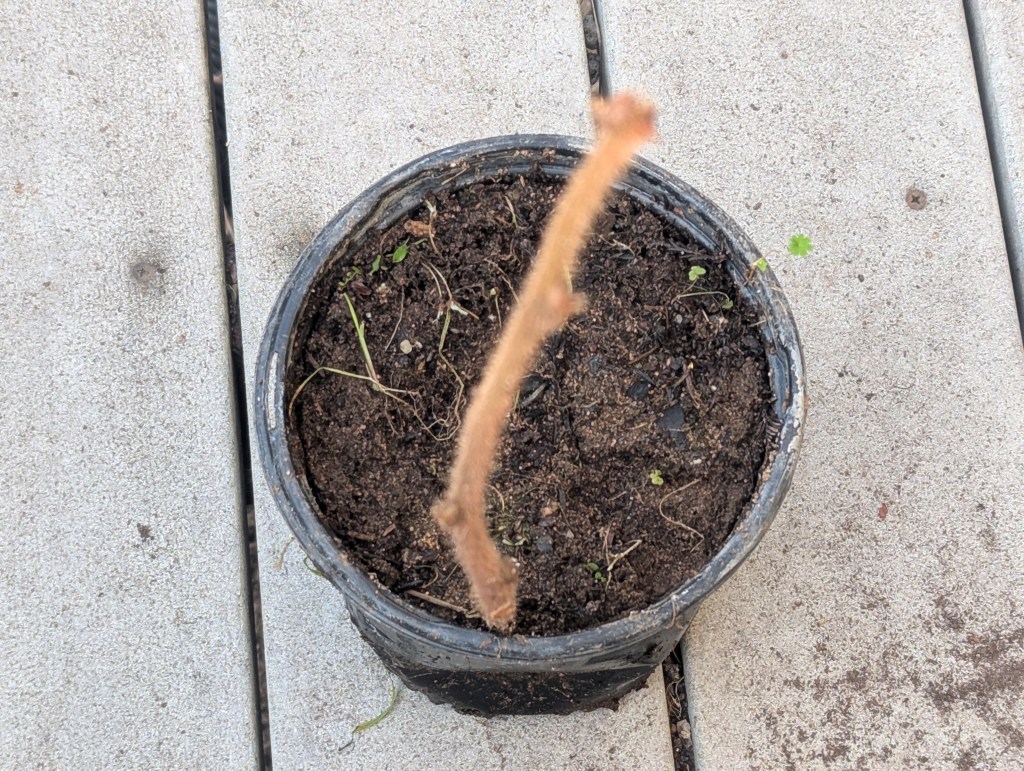
My female kiwi vine just recently acquired a male pollinator. It does not look like much yet, but will grow up to bloom with male flowers to provide pollen for the female flowers of the vemale vine. Because kiwi vines are dioecious, the female vine would be fruitless without pollination from the male vine. Perhaps the male pollinator will need a pollinator to deliver its pollen to the female vine.
Since the seeds arrived in the mail from Renee’s Garden, I have been waiting for the pale yellowish white ‘Buttercream’ nasturtiums to bloom. The appearance of their first few leaves was quite an event. They then started to grow a bit faster like annuals do this time of year. Then, suddenly and without warning, they where overtaken by a herd of hungry aphids!
These small but prolific insects congregate at the tips of new foliage and flower buds. They pierce fresh tissue and suck out the juices within. They are more often yellowish green, but can be grayish black, pale white or sickly pink. Although minute, the fattest aphids can be as plump as caviar.
Fortunately, aphid are typically not problematic for very long, and are easier to control than other insect pests. Even without insecticides, their festivities will be brief before their natural predators move in and break up the party. Pesticides can actually be detrimental by also killing some of the natural predators, and delaying their conquest of the aphids.
Right now though, I do not care! The aphids are hurting the nasturtiums. They must die!
On tougher plants like roses, aphids can be blasted off with water from a hose. Because roses can get mildew if their foliage stays wet too long, they should get blasted early in the day, so that they can dry in the sun. This procedure does not kill all the aphids, and may not even dislodge all of them, but it slows their proliferation so that the natural predators have the advantage.
Nasturtiums and other annuals that are too soft to get blasted with water can instead be sprayed gently with very slightly soapy water, which efficiently kills aphids. Water with a bit of vinegar, or a ‘tea’ made from cigarette butts, also work. Foliage is less likely to be damaged if rinsed afterward. This likewise does not kill all aphids, but controls them long enough for the predators to take over.
Parasitic wasps, syrphid flies, lacewings, lady beetles and predatory midges all eat aphids. They only need some time to do so because they rely on the primary proliferation of aphids to feed their own proliferation. In other words, there must be enough aphids to feed the predators before there can be enough predators to feed on the aphids.
However, aphids have an ally. Ants dutifully protect aphids from their predators, and actually cultivate aphids on choice plants because they like to eat the ‘honeydew’ excreted by the aphids. (ICK!) That is why lemon trees that are infested with aphids also have an abundance of busy ants commuting up and down the trunks.
Trimming an aphid infested lemon tree so that it does not touch anything else, and circling the base of the trunk with axle grease, will keep the ants out without preventing predatory wasps from flying in. Just like with roses, blasting with water dislodges many of the aphids and stranded ants; but the wasps simply get out of the way and return when it is safe. It may all seem unfair to the aphids and the ants, but is gratifying for the predatory wasps, the lemon tree and whoever cares for the lemon tree.
This is the mess that remains after acorns get raked or blown off pavement.
Masting is a technique that oaks and many other genera use to both outsmart and exploit squirrels and other wildlife that both consumes and disperses their seed. For several years, oaks here produce enough acorns to sustain a population of squirrels that is limited by their production of acorns. It may not seem to be very effective, since the squirrels consume almost all of the acorns, leaving very few or none to grow into new trees. Then, every several years, the same oaks collectively produce a ‘mast’, which is a crop of acorns that is too excessive for the limited population of squirrels to consume as thoroughly as they typically do. Squirrels instinctually bury many of the surplus acorns anyway. Because they do not return to dig and eat all of their buried acorns, some acorns grow as new trees. This is how the oaks sustain those who disperse their seed, but also get them to disperse their seed without eating all of it. Mast crops of acorns supposedly typically precede exceptionally rainy winters. So far, the mast this year is only coinciding with a messy situation with drippy nut disease. It is caused by bacterial infection of wounds that are caused by filbert weevils, filbert worms or other insects that damage developing acorns. Consequently, squirrels are ignoring many of the unusually abundant but damaged acorns, leaving icky messes of infected acorns and the goo that they exude. When it eventually arrives, the first rain will make this mess even messier. Later rain should rinse some of it away. It is impossible to know how successful this mast will be, since it is impossible to know how many viable acorns will actually contribute to the abundance and grow later, and how many will merely contribute to this unusually messy mast.
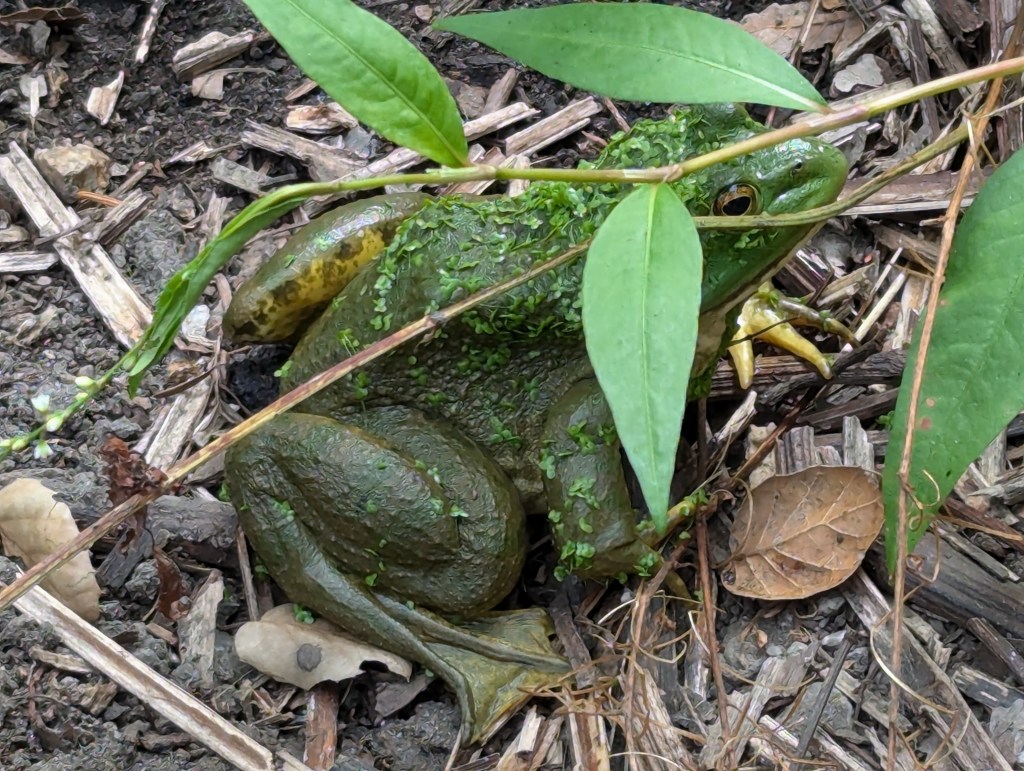
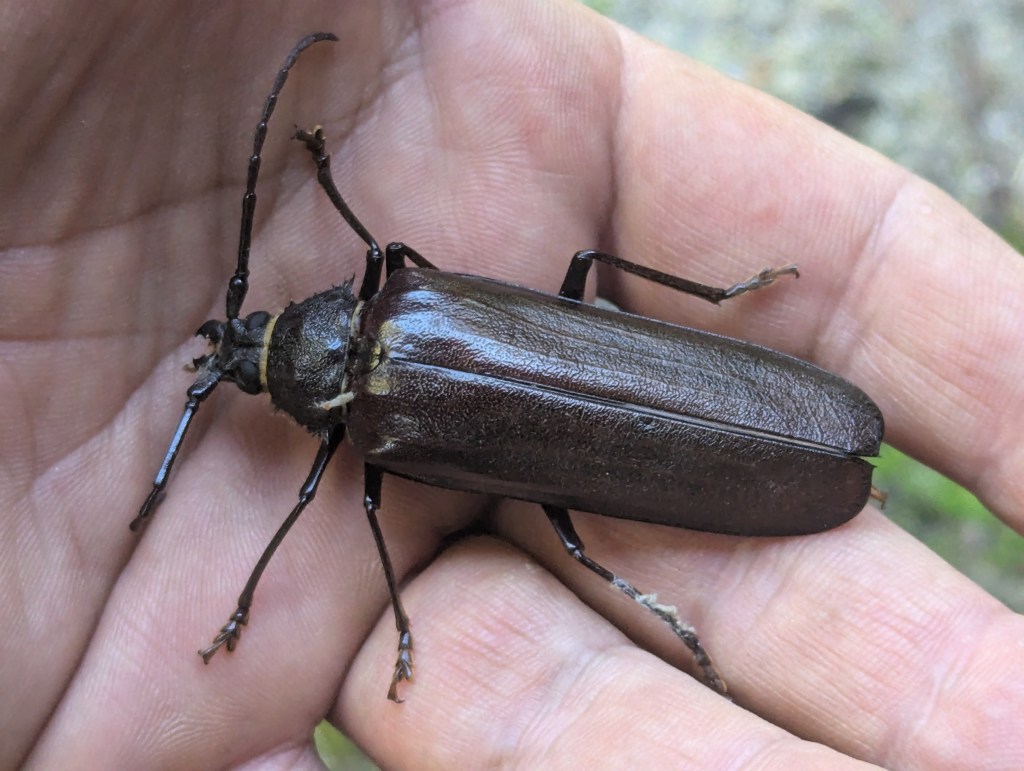
The World Wrestling Federation is now known as World Wrestling Entertainment because the World Wildlife Fund was already known as the WWF. The dude in the picture above could go either way. Apparently, he, or she, is some sort of aggressively invasive exotic bullfrog. Nonetheless, he or she still qualifies as wildlife, and now inhabits the drainage pond that is within a cultivated landscape that is adjacent to natural forest ecosystems. I mentioned his or her presence to a biologist who then informed me of how much damage this particular species can do to any natural ecosystem that it infests. I then realized that the tree frogs that had been so loud through spring had been silent all summer. Although they naturally get quiet by summer, they are not normally so completely silent. I am now concerned that the bullfrog might eat small fish who might inhabit the pond. Duckweed obscures activity below most of the surface of the pond. I would not mind if the bullfrog ate the duckweed. He or she probably does, but there is just too much of it. This species of bullfrog is omnivorous, so will eat anything that it can get its big mouth around, including mollusks and insects. That could be beneficial, but might also include beneficial insects. Actually though, I am more concerned about any baby fish than insects. Besides, when I met the insect in the picture below, I was actually somewhat concerned about the unwelcome bullfrog. I do not want his or her demise to be as violent as the appearance of this insect suggests it could be. I have no idea what this insect is, but it looks like it should have a Volkswagen hood ornament. Getting it together with the bullfrog could be an event for the WWF!
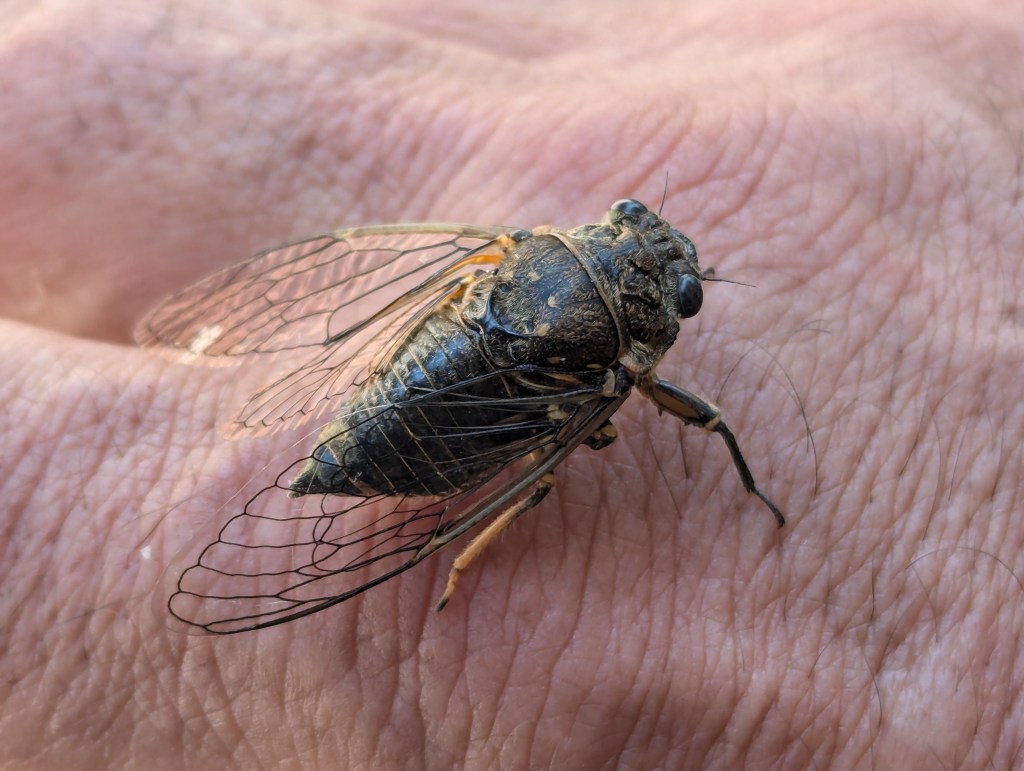
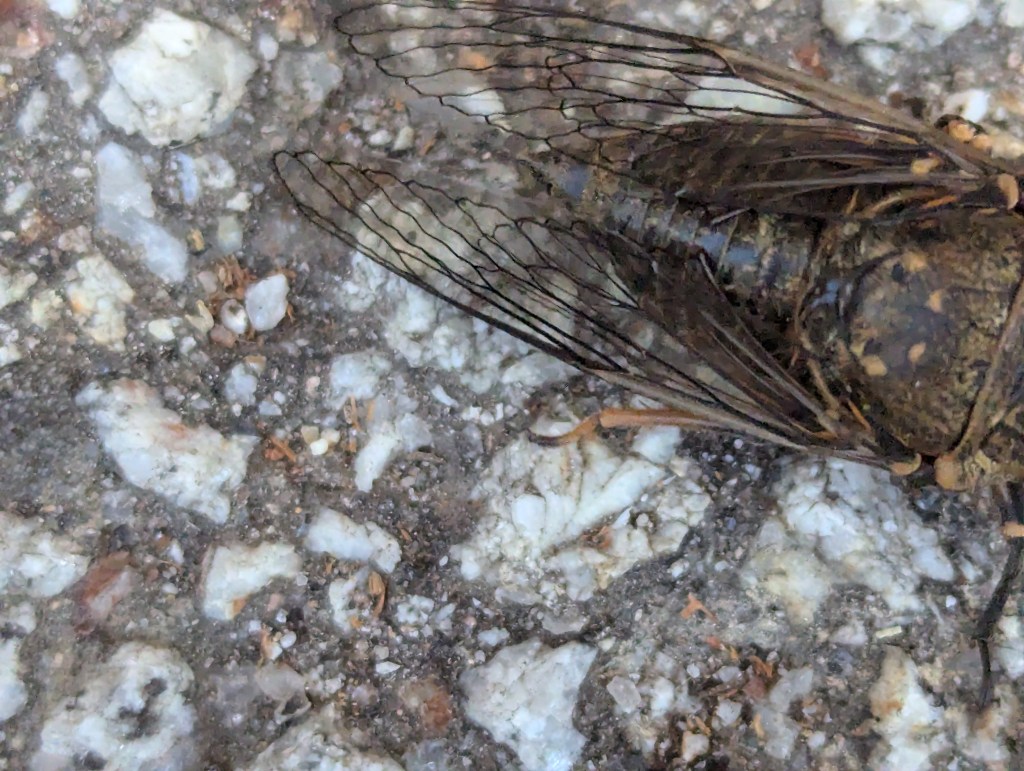
Contrary to common belief, cicadas are native to California. There are actually more native species here than in any other state. Of course, that is partly because California is so big, with so many distinctly diverse ecoregions. Cicadas are merely less prominent here because they are less numerous than they are within dense hardwood forests farther east. Within most regions here, they are somewhat rare. Even where they are most numerous, they do not congregate to form obnoxiously loud populations as they do elsewhere. Some native species are content to share their relatively mixed western forests with relatively few individuals of their own kind, and perhaps a few individuals of other cicada species. They are loud enough to find each other over significant distances. This cicada found its way to where I was enjoying the garden last Thursday. It was quite intimidating when it arrived with loud buzzing of its wings. It flew awkwardly before bashing into a steel building with a loud ‘PING’ that sounded more like a fat acorn falling onto the roof. I should have fled. It circled on the ground briefly before getting airborne again, and coming after me! It landed on my collar. I managed to maintain my composure as I removed it. I could see that one of its wings was impaired, as is evident in the picture above. That did not stop it from trying to fly again. It did not get far before landing on the asphalt driveway. It did not cooperate for the second picture below, which, although not of good quality, demonstrates that the impaired wing is not so impaired. It was likely merely out of whack from crashing into the wall. Before we could get acquainted, this no longer so intimidating cicada flew away as awkwardly as it arrived.
Both wings seem to be fine now. (This cicada did not want its picture taken.)
Well, not exactly locusts; although, until they were reclassified within the Order Mantodea, they were of the same Order Orthoptera as locusts. Nor are they affiliated with either honey locust, Gleditsia triacanthos that I wrote about for last Tuesday, or carob, Ceratonia siliqua that I wrote about for the previous Tuesday, and which is the sort of locust that sustained John the Baptist in the desert. These abundant critters are young mantises, which likely hatched shortly before posing for this picture that my niece took on her front porch. My niece had seen a slow moving adult mantis there last autumn, and guessed that it might have deposited eggs, and then later died in privacy. Fortunately, she enjoys all sorts of flora and fauna, and was not too disturbed by this scene, or by the mother last autumn, as even some who work outside might have been. In fact, to the contrary, she was pleased that their mother felt that her porch was safe enough for them to start their lives on. She knows that there are plenty of insects for them to eat within the vegetation that inhabits the landscape there, as well as in nearby landscapes. This many mantises will eventually disperse into the neighborhood to satisfy their voracious appetites as they grow. That is why mantis eggs are available for sale from some nurseries. They are beneficially predatory insects because they consume detrimental insects. Since their arrival, my niece did a bit of research on their sort, and found that some people actually raise certain rare varieties of mantises as pets. As weird as it seems, it is no weirder than pet tarantulas. Anyway, this picture was taken more than a week ago. These baby mantises are likely already growing fast and dispersing elsewhere into Los Angeles.
Wasps, hornets and yellow jackets that get established within landscapes or buildings are a serious problem. They are not so easily avoided like those out in the wild are. They are aggressive to people and pets who get too close to their nests, and attack with painful stings. Such behavior is unacceptable within the publicly accessible landscapes at work.
There are a few species of wasp, hornet or yellow jacket here. We do not get sufficiently acquainted with any of them to actually identify them. Our priority is eliminating as many of them as possible from the landscapes. Some get trapped. Others get evicted from the few nests that we locate. It is unpleasant work, but it is better than others getting stung.
Wasps, hornets, yellow jackets, or whatever they are, become more of a problem later in summer. They are just getting started for now. We were surprised to find two subterranean nests in a landscape that is in the process of being cleared for renovation. More surprisingly, they were only eight feet apart. Whomever they were, they should have been more territorial than that.
Since they are just getting started, there were not very many to get aggressive when we got too close to them. There were scarcely enough to follow as they entered and emerged from their nests. They were surprisingly easy to kill. The first nest was quite small. The second nest was a bit more concerning. We dug both out as the last few visible insects were dying.
The picture above shows a few waffle-like layers of the larger nest. Empty cells were likely left by the adult insects that were flying about and trying to defend the nest. Other cells are full of larvae that would have matured to many more of the same!
Pesticides are a topic that I do not talk much about. There really is not much to say about them. Only a few are used at the farm, and only while certain destructive insects or perhaps mites are active. Even less pesticides are used in the landscape. It is not that I have serious issue with them. They are just not as useful for controlling pests as proper horticultural techniques are.
Plants that we would expect to require pesticides simply are not welcome in our landscapes. We know that snapdragons and hollyhocks are very likely to be detrimentally infested with rust. Therefore, we grow neither.
Roses live in some of the landscapes only because we do what we must to help them avoid infestation by the various pathogens that they are susceptible to. They get pruned aggressively in winter so that their new growth grows faster than aphid and mildew that try to infest them in spring. Their fallen foliar debris that fungal pathogens overwinter in gets raked away cleanly.
On rare occasion, we find weeds that we would like to kill with herbicide; but we can’t because they are too close to riparian environments. With two creeks and two streams flowing through here, many of the landscapes are too close to water. We must instead pull the weeds that we can, and hope that more aggressive cover crops overwhelm what remains before they recover.
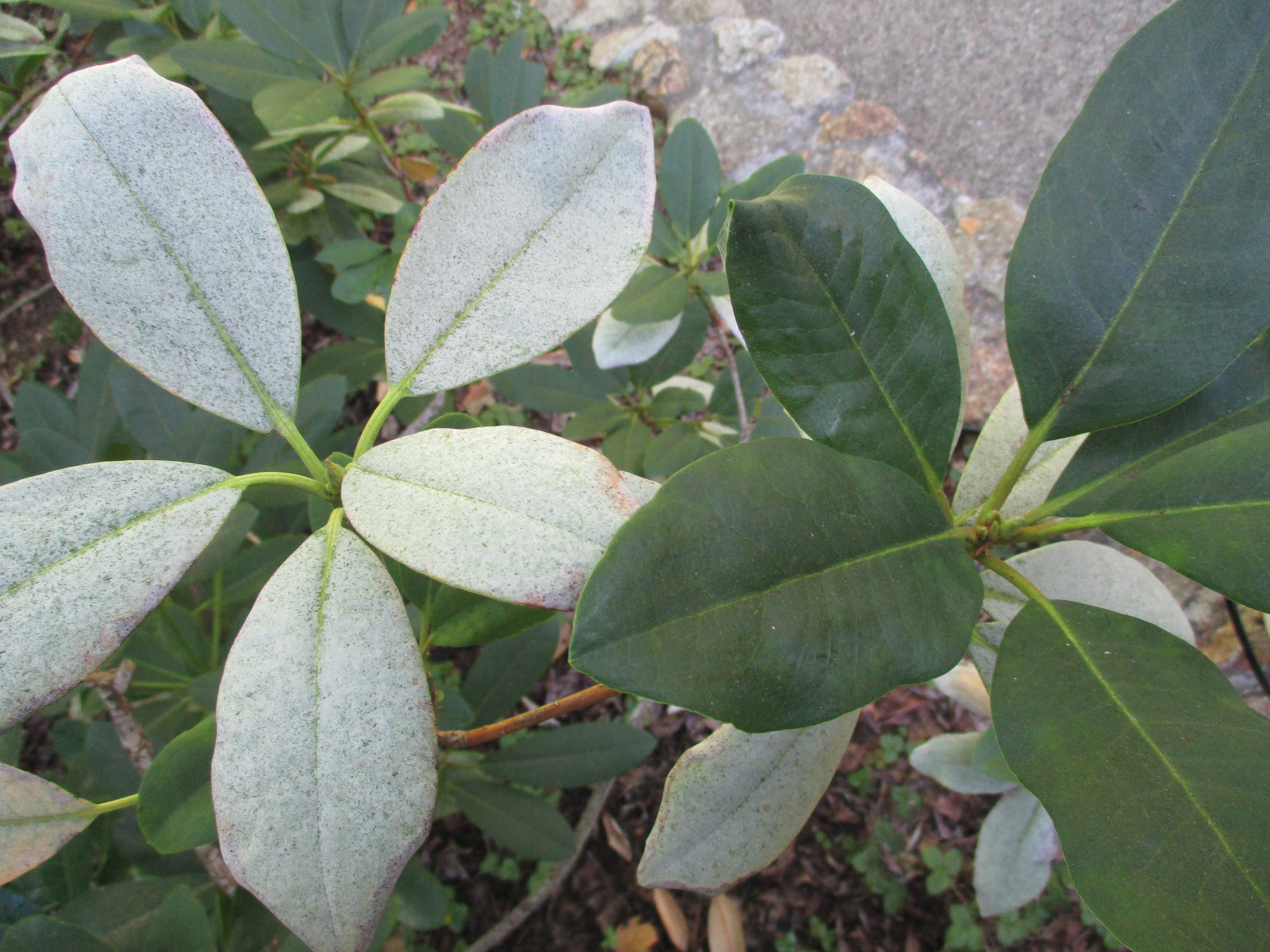
One of the few insect problems that we sometimes notice is the thrip on the rhododendrons. They are sort of always there, but had been tolerable. Aggressive pruning to stimulate vigorous new growth, and also improve air circulation, should have inhibited the thrip. Instead, the damage has been worse than it has been in a very long time. It was necessary to spray insecticide.The pictures above and below show the worst of the damage caused by thrip. The picture below compares damaged foliage on the left to undamaged foliage on the right. Thrip rasp the foliar surfaces so that they can lap up the juices within. The process causes silvery discoloration, and ruins the foliage. Young damaged foliage is likely to get crispy around the edges, or get shed.For this sort of damage, I do not mind using insecticide. However, I have doubts about this particular insecticide, or whatever it is. It is supposed to be three in one; insecticide, fungicide and miticide. How is that even possible? Insects, mites and fungi are physiologically completely different. Anything that kills all three must be very nasty stuff! Yet, it is somehow safe for bees?!
There are several active ingredients, but I do not recognize many of them. I suppose that some could be insecticidal, some could be fungicidal, and some could be miticidal. The label does not explain the functions of the various components. None are hazardous enough to warrant a use permit like we need for agricultural pesticides. This product is available at the hardware store.
I do not doubt that this nonselective ‘pesticide’ is safe for bees, even though it is supposedly formulated to kill just about anything that might bother the rhododendrons. However, since it will not kill bees, and bees are insects, I do sort of doubt that this product will kill many other insects, including thrip.
Incidentally, I am sorry for the delay of posting my weekly ‘Horridculture’ rant, which should have posted yesterday. It normally posts on Wednesdays. The article that posted yesterday really should have posted today instead.




 Pesticides are a topic that I do not talk much about. There really is not much to say about them. Only a few are used at the farm, and only while certain destructive insects or perhaps mites are active. Even less pesticides are used in the landscape. It is not that I have serious issue with them. They are just not as useful for controlling pests as proper horticultural techniques are.
 Tony Tomeo