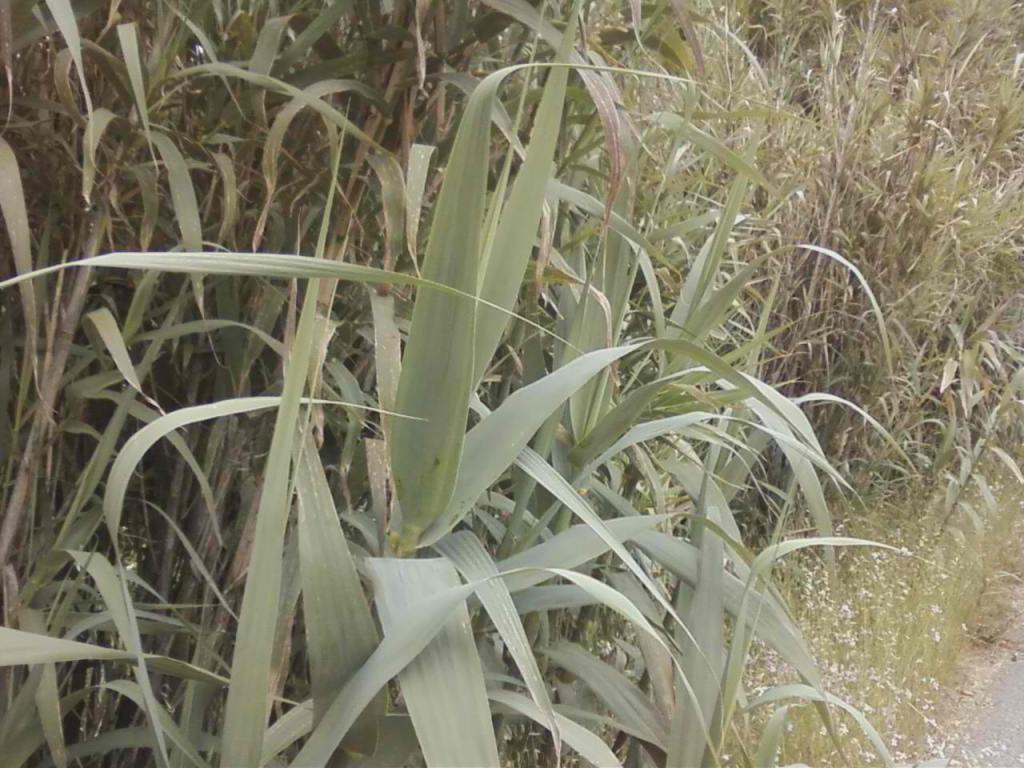
Giant reed is a horrid weed within many ecosystems.
The earliest infestations of giant reed, Arundo donax, that clogged tributaries of the San Joaquin and Sacramento Rivers supposedly grew from pieces used as packing materiel for cargo from China. It was simply dumped into the rivers as cargo was unloaded in port cities like Stockton and Sacramento. How it got to China from its native range in the Mediterranean is unclear.
Because it is so aggressive and invasive, giant reed is almost never found in nurseries. In many rural areas, particularly near waterways, it is listed on the ‘DO NOT PLANT’ list. However, giant reed can sometimes be found in old landscapes where it was planted before it became so unpopular. It can also grow from seed in unexpected places.
Once established, giant reed can be difficult to eradicate or even divide. It spreads by thick rhizomes that resemble the stolons of bamboo, but not quite as tough. It is often mistaken for bamboo. Where it gets enough water, it can get nearly thirty feet tall, with leaves about two feet long.
Where it can be contained and will not become an invasive weed by seeding into surrounding areas, giant reed can provide bold foliage that blows softly in the breeze. ‘Versicolor’ (or ‘Variegata’) has pale yellow or white variegation, and does not get much more than half as tall as the more common green (unvariegated) giant reed. Incidentally, the canes of giant reed are used to make reeds for musical instruments.
Wildflowers may not be what they seem to be. California poppy, various lupines, various sages and several others are native species. Saint John’s wort, periwinkle, mustard and several others are not native. They are exotic but naturalized, so can proliferate as if they are native. In other words, several of the most familiar of wildflowers are invasive weeds.
In fact, some of the most invasive weeds were once more popular for their pretty flowers. These includes Saint John’s wort and periwinkle. Pampas grass, various brooms, yellow flag iris and Hottentot fig are more examples. Mustard likely originated as a home garden vegetable. Many grassy weeds were livestock fodder. Not many weeds were accidental.
Nonetheless, invasive weeds are here and established within local ecosystems now. By their simplest definition, weeds are merely unwanted vegetation. Native brambles qualify as invasive weeds as they invade home gardens. Because they are native, though, they are not invasive in the wild. Most of the most aggressive weeds just happen to be exotic.
Invasive weeds become invasive because of their various unfair advantages. Many lack pathogens that limit their proliferation wherever they are native to. Many lack competition from vegetation that they shared their natural ecosystems with. A few may actually prefer local climate to their natural climates. Weeds exhibit too much variety for generalization.
Although, generally, invasive weeds are accelerating their growth with warming weather. Most are proficient at growing faster than their competition and other preferable species. Several bloom and disperse seed before some deciduous species foliate. Weeds exploit resources before desirable species can. Several rampantly overwhelm their competition.
This is therefore a convenient time for weeding, before invasive weeds grow much more. Their roots will disperse more and be more difficult to pull from drier soil later. With more time, most weeds disperse more seed for subsequent generations. Diligence now might not eliminate all weeds for very long, but it helps. Later, weeds should be less abundant.
Dodder is likely the second most common parasitic vegetation here. Only mistletoe is more common. Yet, it is very rarely encountered within home gardens. When it does appear, it seems to do so spontaneously, with its source difficult or impossible to identify. Its many species can also be difficult to identify, since most are so visually similar. This species seems to be a bit greener than most, which are typically somewhat yellowish or even orangish. Only its genus of Cuscuta is known. If its wiry twining stems resemble those of bindweed, it is because the two are related. Unlike bindweed, dodder lacks, leaves, roots and perhaps a few other otherwise important parts that it does not need because it draws resources from its hosts, which, for this example, is red yucca. Most are yellowish or orangish because they do not need chlorophyll to photosynthesise for themselves while they rely on their hosts to do so for them. Dodder looks like something from science fiction. Not only does it parasitize its hosts, and exploit them for their resources, but it is also very invasive and persistent. Like mistletoe, it is difficult to remove completely from its hosts, and any small bits that remain regenerate efficiently. Its seed remain viable for many years. Even if visible dodder growth is completely eradicated, it may have tossed seed that can grow two decades later! Because dodder is parasitic and mingles so thoroughly with its hosts, herbicides are impractical for its eradication. Sometimes, infested host vegetation is too thoroughly infested to be salvaged. Dodder has an extensive host range, so can infest other species in the landscape even after original hosts are removed. Dodder may look interesting, but should not be allowed to grow wild. When removed, it should be disposed of rather than composted.
Most vegetation within home gardens is better than it was naturally in the wild. For many, systematic selection isolated the best from average populations. Selective breeding and hybridization improved many others. Some are too genetically compromised by breeding to produce viable seed. Feral progeny of those that are not demonstrate the divergences.
Such feral progeny are generally not true to type. They are, to varying degrees, more like their ancestors than their direct parents. Some can revert directly to a natural state in the first generation. Some do so slower through a few generations. Feral progeny of hybrids are still hybrids but may be more primitive. Many hybrids produce no viable seed though.
‘Jewel Mix’ nasturtium, for example, blooms with many shades of yellow, orange and red. Several are pastels. Some are dark enough to be almost brown. A few are bicolors. Their progeny though, blooms with less light, dark and red colors. Bloom becomes exclusively bright yellow and orange as feral plants replace originals. It reverts to more natural color.
That is because nature is efficient. By human standards, innately unnatural breeding and selection improve plant life. They produce better fruits, vegetables, flowers and anything that grows on plants. However, they interfere with natural function such as reproduction. Seedless limes, which are preferable within home gardens, would go extinct in the wild.
Plants that revert to more natural feral states are merely trying to survive. Sterile pampas grass is only sterile because it is exclusively female. Naturalized Andean pampas grass can pollinate it from a distance, though. Their hybrid but nonsterile feral progeny may be as invasive as their Andean parent. They are detrimental to their ecosystem, but survive.
Not all feral flora grows from seed. Seedless and thornless honeylocust are grafted onto wild honeylocust understock. Seedy and thorny suckers can grow from such understock below its grafts. They commonly develop after removal of original grafted trees. By some standards, they become aggressively invasive. By other standards, they are sustainable.
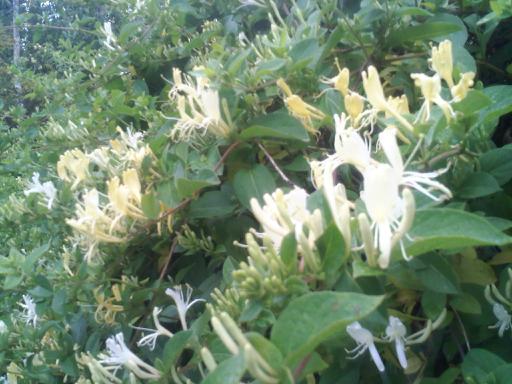
Hall’s honeysuckle climbs aggressively by twining.
The unrefined twining vines of good old fashioned Hall’s (Japanese) honeysuckle, Lonicera japonica ‘Halliana’, seem to fit in so naturally with lilacs, hydrangeas and bearded iris; the sort of plants that grow in grandma’s garden. Grandma may need help controlling it though, since it can climb more than twenty five feet, and get overgrown and invasive. It is best pruned back to main canes or to the ground annually at the end of winter. Even though it is evergreen, it drops some of its foliage and looks rather tired by the end of winter anyway.
Just as the fragrance of the earlier spring blooming flowers gets depleted, Hall’s honeysuckle begins to bloom with its own distinct sweet fragrance, attracting bees and hummingbirds. Bloom is typically most abundant in spring, and followed by sporadic bloom until autumn. Fluctuations of weather or watering can cause subsequent phases of abundant bloom during summer. The pale white tubular (and bisymmetrical) flowers fade to pale yellow that is perhaps the color of French vanilla ice cream. The simple light green leaves are about two inches long. A few leaves on the most vigorous vines may be lobed.
Squirrels are annoying. I do not care that gray squirrels are native, or that their ancestors were here before mine. They are still annoying. They ruin bulbs, seedlings, fruits, nuts and vegetables. Although I do nothing to exclude them from my garden, I do not want them there.
Some native vegetation is also annoying. It grows like weeds where I want other vegetation to grow. Like for squirrels, I do not care if it is native. It is still annoying, and I do not want it trying to infest my garden where I grow vegetation that I want to grow.
I have been told that native species can not be invasive merely because it was here before I was. That is completely false. If it aggressively invades my garden, then it is invasive. Claiming otherwise is comparable to claiming that I can move into any home here that I choose simply because I am native.
Everyone who lives here inhabits space that was formerly occupied by native flora and fauna. So does all the infrastructure. Anyone who disapproves should leave, and relocate to where they do not occupy space that was formerly occupied by native species. I do not know where that is, but perhaps they do.
Realistically, I do my part. I live very simply, in compact and minimally consumptive homes. Although I enjoy gardening, I do not use much more space than is necessary to sustain my simple lifestyle. I do not live so simply because I would feel guilty about living more lavishly. I do so because it appeals to me, and allows me to feel less sheltered from the same sort of nature that some might accuse me of being inadequately protective of. Ultimately, nature does what it wants to here, with or without my assistance.
Weeds pull up relatively easily while the soil is still damp from winter rain.
My garden may lack the sort of ‘riot of color’ that landscapers like to promote to achieve the other popular cliché of a ‘tranquil garden retreat’, but is the victim of a different kind of violence. The desirable plants and undesirable weeds are about as compatible as the terms ‘riot’ and ‘tranquil’ are. Recently, the weeds have been gaining ground in the ongoing battle between the two. In another heroic effort to help the plants that I want in my garden, I will soon venture onto the battlefield to do what I can to defeat the weeds. The native sky lupine, California poppy, California fescue and some sort of native iris would otherwise be displaced by the invading oat grass, oxalis, burclover and sowthistle.
Different weeds invade other areas. Perennial weeds like nutsedge, dandelion, Bermuda grass, bindweed and brambles (blackberry) are among the worst in most areas. Annuals like purslane and spruge can be just as troublesome though. I really dislike the various twining vetches, even though they are good for the soil. Pampas grass, giant reed, blue gum eucalyptus, black acacia and Acacia dealbata are the largest weeds and the most difficult to battle.
All of the weeds that I need to contend with pull out easily while the soil is still damp from winter rains. If I do not pull them now though, they will be difficult to pull as the soil dries. Broom, the nastiest weed in my garden, comes out relatively easily now, but is ridiculously hard to pull from dry soil. Brambles and poison oak also come out easier now like the rest of the weeds, but are of course always difficult to handle.
Sometimes, if I do not have enough time to pull all the weeds in an area, I at least like to keep them from spreading if possible. If I cut annual oat grass down with a weed whacker before it blooms and sets seed, it is unable to reproduce to replace itself before it dies at the end of its season. This also works for sowthistle. Dandelion is perennial, so does not die at the end of its season, but will not spread so aggressively without its flowers or seed.
This has not worked so well with other weeds. Spurge sets seed before I catch it. Yellow oxalis and nutsedge reproduce more profusely by offsets than by seed. Bermuda grass is a creeping perennial that does not mind if it loses its seed. Burclover and bindweed are so low to the ground that pulling them is the only option. Broom and the various weed trees may initially be deprived of their seed, but are harder to pull when they regenerate after getting cut back.
Regardless of what it takes, this is the best time of year to get weeds under control. Later in the season, they will have had time to set seed or get more established. As the soil dries and gets baked by the sun, pulling weeds, or in some cases, digging them, becomes more difficult.
Warming spring weather accelerates bloom and growth. Early spring bloom is now much more colorful than the best of winter bloom. Fresh foliage is already replacing defoliated deciduous foliage and faded evergreen foliage. Vegetation will soon be more active than they will be during any other time of year. Such vegetation unfortunately includes weeds.
Weeds are only weeds because they are unwanted. That is their only commonality. Most are exotic, or not native, but a few are native. Most are annuals, but a few are perennials, vines, shrubs or trees. Annuals grow from seed, but several of the others can perpetuate vegetatively. Some are appealing where appropriate, but migrate to where they are not.
Weeds become weeds because they are generally invasive. Many are aggressively so. They grow wherever they can, and compete with any desirable vegetation for resources. The most aggressive annual weeds begin growing before preferable species. They can overwhelm their slower victims. Several have bloomed and are already dispersing seed.
Exotic weeds are here for a variety of reasons. Some arrived inadvertently as seed in fur or digestive systems of livestock. Some were fodder for livestock. Many were originally desirable flowers for home gardens. A few were formerly useful as cover crops or erosion control. Many lack natural pathogens from their native ranges that limit their proliferation.
Regardless of their origins, weeds now necessitate weeding. They grow throughout the year, but most are most active as winter becomes spring. Obviously, they grow like their horticultural designation implies. Those that are not already dispersing seed should not get the opportunity to do so. Less weeding will be necessary later if more happens now.
Besides, weeding is easier while the soil is still evenly damp from winter rain. Roots are more pliable and less dispersed. They toughen and disperse as the season progresses. Rhizomes, stolons and other perennial weed parts are likewise easier to pull or dig now. Tilling might be more efficient for eradication of small but profuse young weed seedlings.
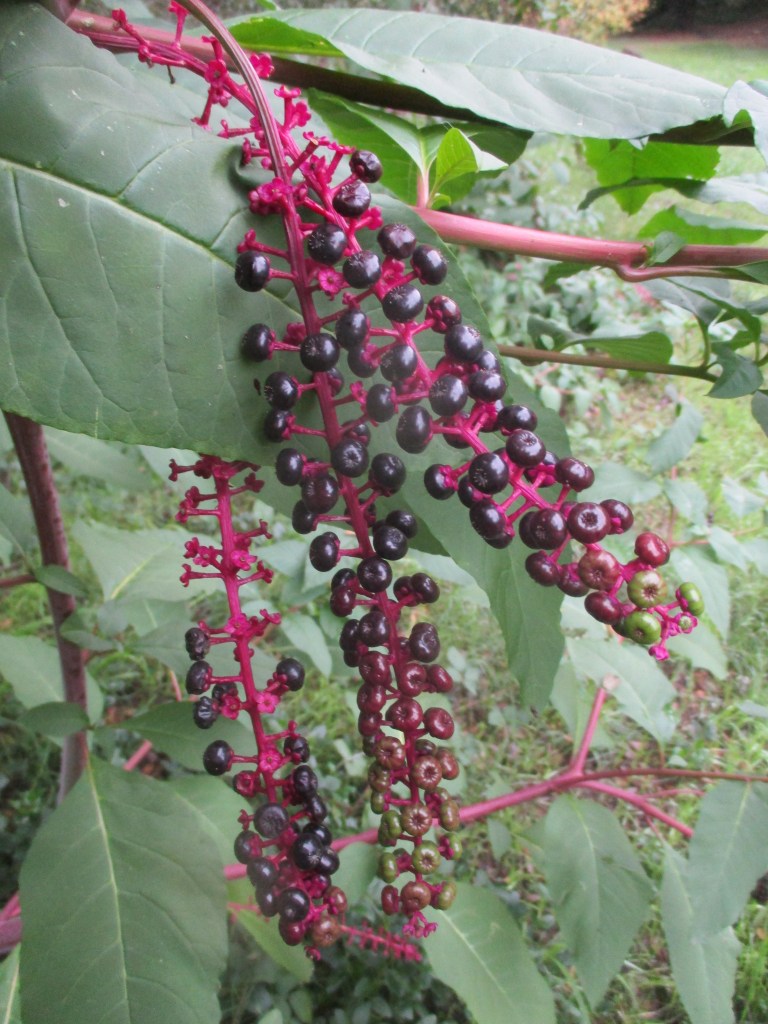
Phytolacca americana is known by several names; pokeweed, pokeberry, pokebush, pokeroot, poke sallet, and simply, poke. I have no idea what poke is, but it is obviously famously associated with this species, which I know instead as inkberry. That is a more sensible name to me, since I made ink from the famously toxic berries. However, within its native range, a species of holly is also known as inkberry.
The ink is initially an obnoxiously bright magenta, but fades to a light brown. Those who prefer the bright magenta color can preserve it somehow. I prefer the faded brown. Because the ink is caustic, it should be used only with disposable quills. Inkberry is also used for dying fabric, either magenta or brown.
Weirdly, inkberry is both extremely poisonous and also edible. Tender young vegetative shoots can be collected as they begin to emerge after winter. They can be boiled and drained a few times to eliminate toxins that might have developed within them by that time. Such growth becomes more toxic as it matures. A few shoots must be left to grow through summer and autumn to sustain tuberous roots below, so that new shoots can grow for the following season. This sustaining growth gets quite large, after providing only a minor volume of edible shoots. In other words, inkberry is a large perennial that needs plenty of space but provides only a small amount of potentially edible but possibly toxic greens. There are plenty of safer and more efficient greens and vegetables to grow in the garden.
Inkberry has become a somewhat invasive exotic species here. We prefer to remove it from public landscapes because its poisonous but pretty berries might be tempting to those who are unfamiliar with it. They certainly look like they would be tasty.
Exotic species are not native. It is that simple. There is nothing fancy about it. They came from elsewhere to live here. They are not necessarily rare, unusual or innately desirable. Most plant species within most refined landscapes and home gardens are exotic. Native species that inhabit unrefined areas, although trendy, remain unpopular for landscaping.
Not only are exotic plant species not necessary rare or desirable, many are too common or undesirable. With few exceptions, the most aggressively invasive of weeds are exotic. For a variety of reasons, they proliferate faster than native species. Some are aggressive because they are endemic to competitive ecosystems. Most lack natural pathogens here.
A weed is merely any undesirable plant. Some might be desirable in some situations but not others. English ivy, for example, which is a practical ground cover within landscapes, is also an aggressively invasive weed within coastal forests. Most weeds are annuals or biennials, but others are perennials, shrubbery, vines, aquatic plants or substantial trees.
An unfortunate reality about exotic weeds is that they are not here by mistake. Generally, their importation was justifiable at the time. Most were ornamental plants for gardens and landscapes. Some came as fruits, vegetables, herbs, cover crops or forage for livestock. Some came as timber. Species that escaped cultivation and naturalized became weeds.
Such weeds compete for the same resources that desirable plants utilize, and are mostly visually unappealing. Some enhance the combustibility of landscapes and forests. A few weeds produce seed structures that are hazardous to pets and wildlife. Even if problems are not directly obvious, weeds disperse seed to share their innate problems elsewhere.
This is typically the best time of year to pull or grub out weeds, although more weeds will grow later. Annual weeds are mature enough to get a good grip on. Soil should be damp enough from winter rain for roots to pull out relatively easily. Weeding will likely require a bit more effort this year because of the extended dry and warm weather since December.