Bear’s Breech

Bear’s breech can be a bit too sustainable, and difficult to get rid of.

Like some other Victorian perennials that are still happy after a century, bear’s breech, Acanthus mollis, can get to be too much of a good thing. It can become invasive where not contained. Once established, it is difficult to eradicate. The bold coarse foliage looks great while the weather is favorable, but then dies back after bloom when summer weather gets warm, leaving obvious voids where other plants were crowded out.

The good news is that bear’s breech does not require much attention at all. It is very easy to propagate by division or simply by digging a few thick roots while dormant or just as new foliage appears in autumn. Well watered plants can keep their foliage all year, so that they only need to be groomed of older foliage and spent flower stalks. Partial shade is not a problem; although snails can be.

Big arching leaves form bold mounds of glossy foliage about three feet wide. The distinctively lobed and toothed foliage has an appealing texture and deep green color. Elegant mostly white flower spikes stand nearly five feet tall late in spring into summer. Acanthus balcanicus (illustrated) is more compact, with more intricately textured foliage.

English Daisy

Common English daisy can infest lawns.

Like pampas grass, periwinkle and the ivies, English daisy, Bellis perennis, has a bad reputation as an aggressive weed. The primitive species with single white flowers with bright yellow centers is very difficult to eradicate once it becomes established in lawns. The first phase of bloom in early spring can be profuse enough to resemble thin patches of snow that appear as the weather gets warmer instead of colder.

Varieties that are sometimes found in nurseries are much better behaved and more colorful. Their red, pink or white flowers are typically double, and stand on stems about three inches high. Their rich green, inch and a half long leaves make six inch wide clumps that are compact enough to mix with other small perennials in borders, urns or large pots. Deadheading (removal of fading flowers) is a bit tedious for so many small flowers, but promotes continued bloom. English daisy is very easy to propagate by division.

Horridculture – Aquatic Vegetation

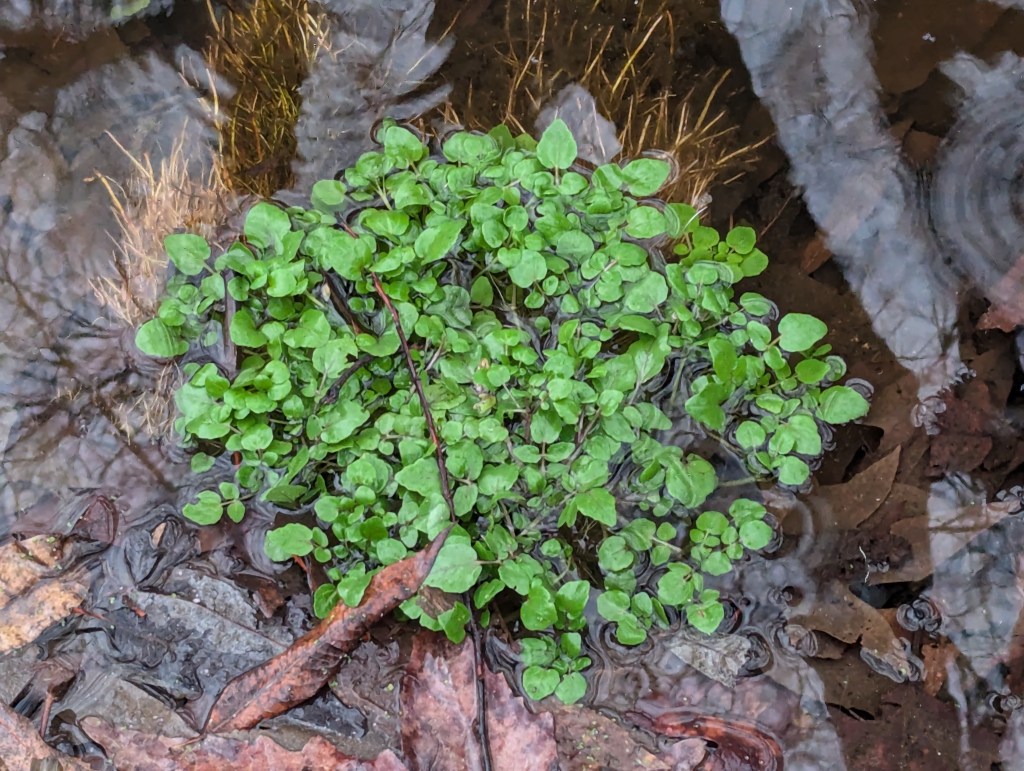
Watercress, Nasturtium officinale

Watercress, Nasturtium officinale, seems to be proliferating a bit more in the drainage pond than it did last year. It is difficult to compare, since I was not concerned about it enough to monitor it last year. I am likely noticing it more now because the duckweed, Lemna minor, deteriorated slower than it did last year, which maintained my interest in such infesting aquatic vegetation. I have been monitoring the cattail, Typha latifolia, also. Although none of these species are exotic, I do not want any of them to proliferate so much that they obscure the pond that they inhabit. That has been a problem with duckweed as long as the pond has contained water. I am aware that cattail also has potential to proliferate aggressively, although I believe that such proliferation would be easier to mitigate. I really do not know how watercress behaves, though. I can not remember ever seeing a pond anywhere completely overwhelmed by it. I doubt that, even if it does proliferate aggressively, that it would be as difficult to contend with as duckweed is. Perhaps it would compete with duckweed! Goodness; I never intended to get so involved with aquatic vegetation. It is not exactly the sort of vegetation that inhabits ‘land’scapes. Yet, the drainage pond is a feature of the landscapes here. We maintain the willows, cottonwoods, sycamores, oaks and Landon’s tree around it, so obviously, must maintain the aquatic vegetation within it as well. In that regard, I would prefer to grow a few more ornamental but less aggressive aquatic species, such as water lilies. Unfortunately, the few water lilies that we tried were tropical species that seemed to succumb to cool winter weather and overwhelming duckweed. I should try some native water lilies, but they might be a bit too prolific.

Spearmint

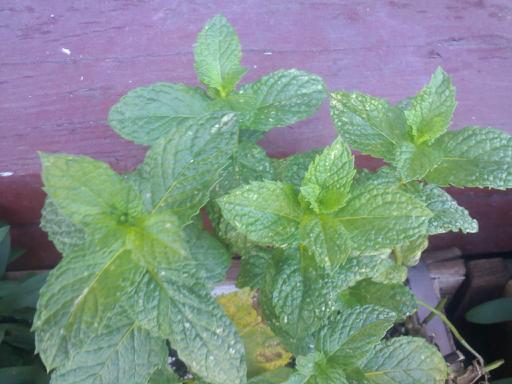
Mints have a sneaky way of migrating around a garden.

What most people who have grown the various mints remember about them is that they have a sneaky way of getting around the garden. They do not seem to be aggressive or weedy, but can be invasive with their subterranean stems nonetheless. That is why they are so commonly grown in pots, planter boxes or even pots sunken into the ground. Contained plants that get cut back at the end of winter every year look much better than unkempt plants that do what they want to anyway.

Once established, mint does not need any attention at all and only moderate watering. However, it performs much better with somewhat rich soil, regular watering and occasional grooming to remove old stems and spend flower stalks, (as well as getting cut to the ground in winter). Mints tolerate considerable shade or can be just as happy with full sun exposure.

Spearmint, Mentha spicata, is probably the most popular mint, with rich green serrate leaves that are a bit smaller than those of the second most common mint, peppermint. Minute pale blue flowers bloom in vertical trusses at high as two and a half feet. Most of the foliage stays lower, about a foot deep. The leaves can be used for flavoring fresh from the garden or dried. Like all mints, spearmint is very easy to propagate by division of rooted stems.

Horridculture – Invasive Species

It blooms splendidly, and has stayed compact for many years, but I do not trust it.

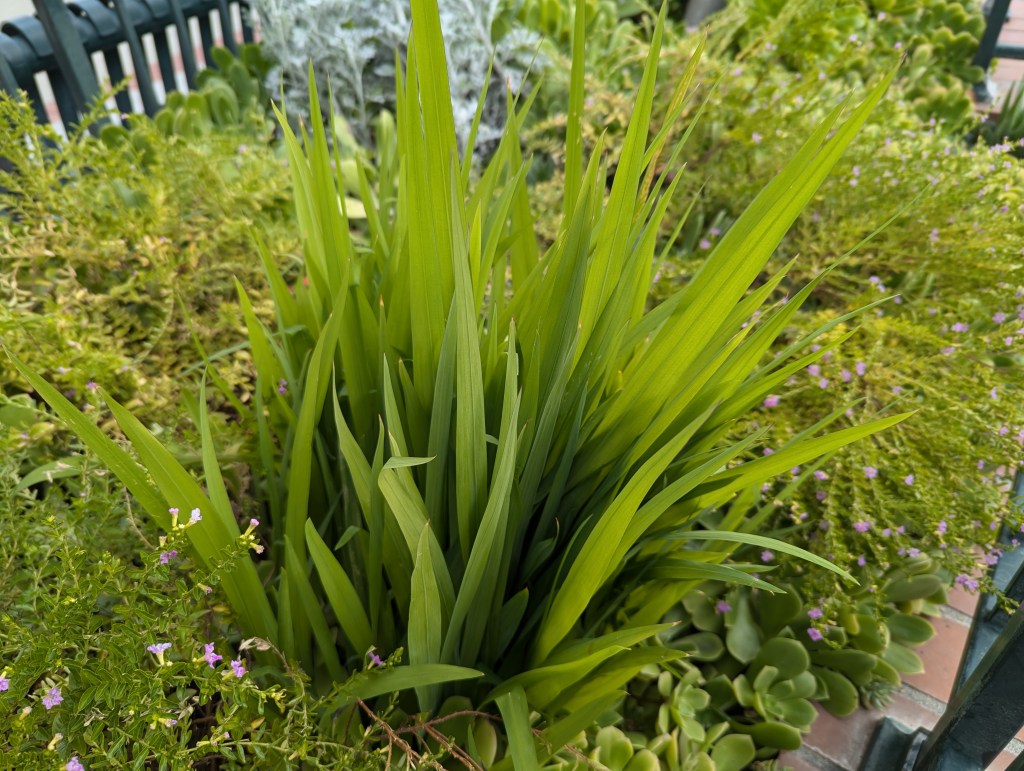
Many exotic species that became aggressively naturalized here escaped from home gardens and landscapes before anyone who enjoyed growing them was aware of how invasive they could be. Although I am aware of this, I was not particularly concerned with it while I lived within a suburban area in town through the 1990s. If I chose to grow something there that had potential to be invasive, it had no place to escape to. I mean that, from my suburban home garden, it could not migrate into a natural ecosystem to naturalize into it. Even if seed from something managed to get into the suburban drainage system, which flows into Los Gatos Creek, it would not be the first. I mean that anything that could naturalize there had likely already done so from seed from the countless other home gardens and landscapes in town. I have not lived within that suburban neighborhood for a very long time, though. I need to be more careful with what I select to inhabit my home garden. For example, the yellow flag iris and montrebetia that I enjoy growing at work can not inhabit my home garden, from which each has potential to escape and naturalize into the wild. The montbretia seems to be sterile and noninvasive, and I have been acquainted with it since childhood, but I just do not trust it. Another variety of montbretia that has inhabited my downtown planter box since before my time, and that I have been acquainted with for many years, also seems to be sterile and even less invasive than my first variety. After all this time, it was tediously slow to migrate outwardly, and provided me with only a few spare bulbs. Nonetheless, I can only enjoy it within the confinement of the downtown planter box.

Parasite

Cuscuta spp., dodder

Dodder is likely the second most common parasitic vegetation here. Only mistletoe is more common. Yet, it is very rarely encountered within home gardens. When it does appear, it seems to do so spontaneously, with its source difficult or impossible to identify. Its many species can also be difficult to identify, since most are so visually similar. This species seems to be a bit greener than most, which are typically somewhat yellowish or even orangish. Only its genus of Cuscuta is known. If its wiry twining stems resemble those of bindweed, it is because the two are related. Unlike bindweed, dodder lacks, leaves, roots and perhaps a few other otherwise important parts that it does not need because it draws resources from its hosts, which, for this example, is red yucca. Most are yellowish or orangish because they do not need chlorophyll to photosynthesise for themselves while they rely on their hosts to do so for them. Dodder looks like something from science fiction. Not only does it parasitize its hosts, and exploit them for their resources, but it is also very invasive and persistent. Like mistletoe, it is difficult to remove completely from its hosts, and any small bits that remain regenerate efficiently. Its seed remain viable for many years. Even if visible dodder growth is completely eradicated, it may have tossed seed that can grow two decades later! Because dodder is parasitic and mingles so thoroughly with its hosts, herbicides are impractical for its eradication. Sometimes, infested host vegetation is too thoroughly infested to be salvaged. Dodder has an extensive host range, so can infest other species in the landscape even after original hosts are removed. Dodder may look interesting, but should not be allowed to grow wild. When removed, it should be disposed of rather than composted.

Six on Saturday: Day Out

Rhody and I were in Capitola to attend to a few important tasks. Consequently, I did not take any pictures from home or work. My ‘Six’ for this week are therefore totally random without a theme.

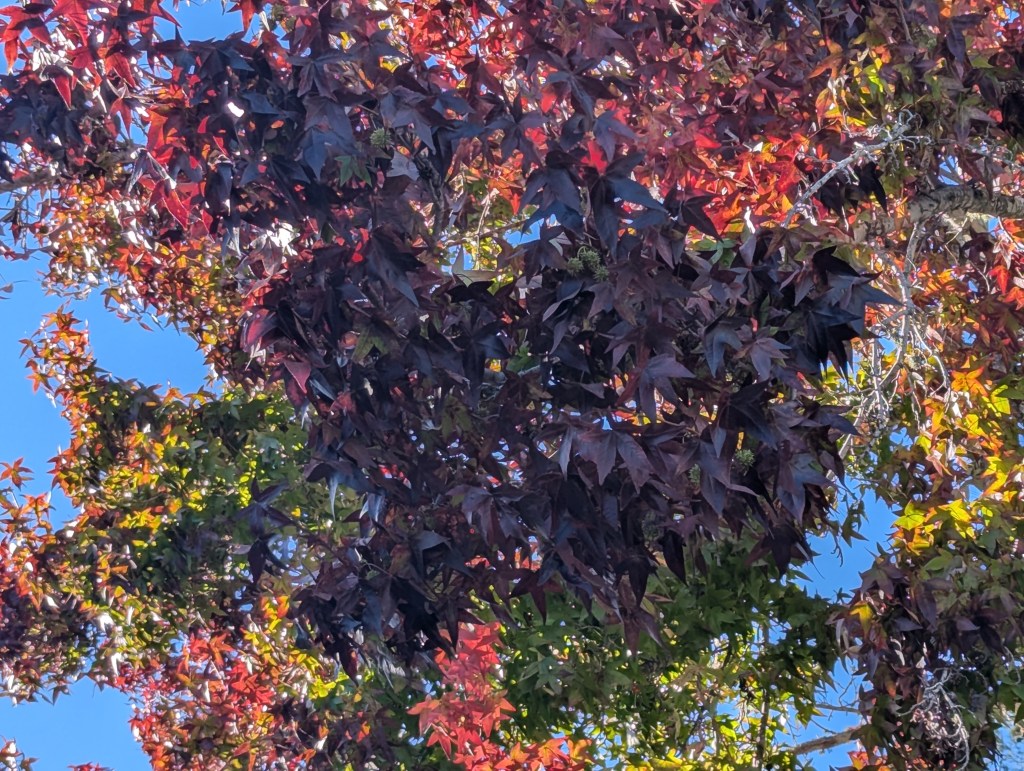
1. Liquidambar styraciflua, sweetgum does not require much chill to exhibit exemplary foliar color for autumn. This deep garnet red is almost too dark to be visually appealing. It looks like it should be in Vermont rather than here on the Central Coast of California.

2. Archontophoenix cunninghamiana, king palm is more common closer to Los Angeles than here. I know of only a few here, and almost all are somewhat shabby like these are. King palm is less tolerant of slightly excessive chill than sweetgum is of inadequate chill.

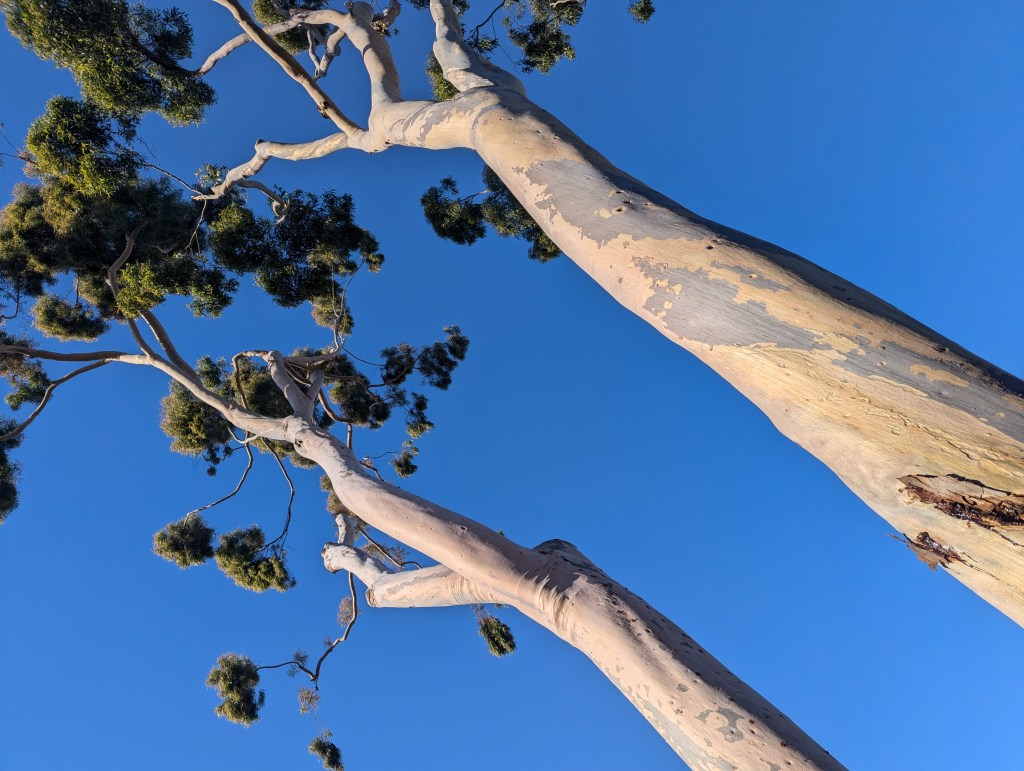
3. Eucalyptus citriodora, lemon gum is also more common in Southern California, likely because it prefers warmer winters. Although these are reasonably happy here, not many are so happy within the Santa Clara Valley on the other side of the Santa Cruz Mountain.

4. Cortaderia jubata, pampas grass is the aggressively invasive sort which is naturalized so wickedly on the West Coast of California and Oregon. This is not a good picture, since it shows only its bloom peeking above the edge of the cliff, with foliage concealed below.

5. Eucalyptus globulus, blue gum is another aggressively invasive naturalized species. It has a completely different personality, though. Where it competes with other tall trees, it grows very high, and is very combustible. This exposed tree is relatively short and stout.

6. Carpobrotus edulis, Hottentot fig, which most of us know incorrectly as ice plant, was imported from South Africa more than a century ago, and is now so abundant that some believe that it is native. Technically, it is invasive too, but it is not easy to dislike as such.

This is the link for Six on Saturday, for anyone else who would like to participate: https://thepropagatorblog.wordpress.com/2017/09/18/six-on-saturday-a-participant-guide/

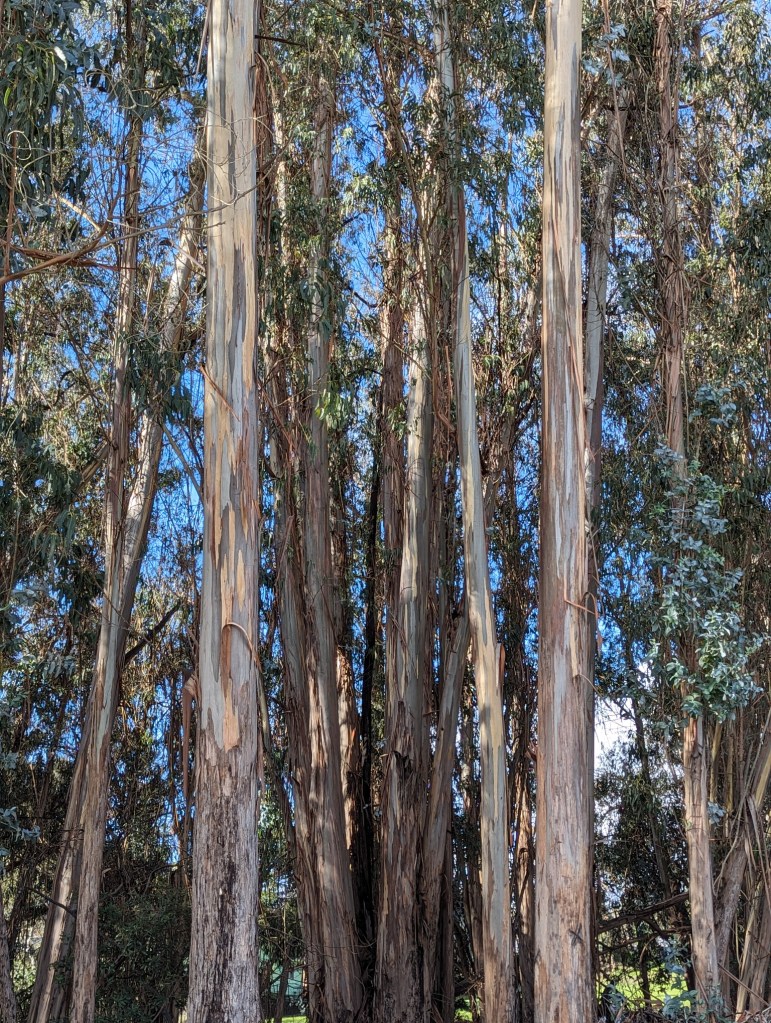
Blue Gum

Blue gum easily outgrows home gardens.

Almost no one adds blue gum, Eucalyptus globulus, to a landscape intentionally. Almost everyone who is familiar with it understands why. It is much too big and much too messy. Even where space is sufficient for it to mature, it is innately hazardous. It sheds big limbs from very high up. It often disperses its roots too shallowly to maintain adequate stability.

However, blue gum inhabits a few home gardens. Some were already there as gardens developed around them. Some grew from seed from nearby trees. Blue gum naturalizes in some regions. Mature trees are tall enough to share their shade, debris and seed with a few gardens. The copious debris inhibits weeds, but also inhibits desirable vegetation.

Blue gum in the wild is one of the tallest trees in the World. Naturalized trees commonly grow more than a hundred and fifty feet tall here. They stay shorter in windy situations. The tall and straight trunks constantly shed long strips of smooth tan bark. Fresher bark is tan, gray, greenish or even pinkish. The curved lanceolate leaves are quite aromatic. Ovoid juvenile leaves are bluish gray, and even more aromatic. Fuzzy staminate bloom is white.

Horsetail

The allure is more in the form than in the bloom.

            It is no wonder that the many specie of horsetail have been around since the Carboniferous Age. They seem to be impossible to kill! Because they can be so invasive and persistent, they should be confined to planters or areas of the garden where they can be controlled. They should probably be kept away from thickly foliated areas where they can spread and mix with other plants unnoticed.

            Even though they are among the oldest plant specie, they seem well suited to modern architecture. Besides, the narrow areas between modern residences, walkways and driveways are confining by nature. Many modern buildings are even outfitted with awkwardly narrow planter areas that could use plants that get three or four feet tall without spreading out laterally, just as Equisetum hyemale, the most common species of horsetail does. The partial shade and potentially bad drainage in these confined spaces is not a problem.

            The hollow segmented stems are rich green with black or dark brown joints. Some specie of horsetail have symmetrical whorls of wiry stems radiating from their joints. Otherwise, no other foliage is evident. Small knobs on top of the stems produce rusty brown spores. The larger types of horsetail are more likely to become invasive. Equisetum scirpoides stays about half a foot tall and is relatively complaisant. I do not know the identity of the horsetail that I got this picture of; but it has unusually large spore ‘blooms’ and a more relaxed texture.  

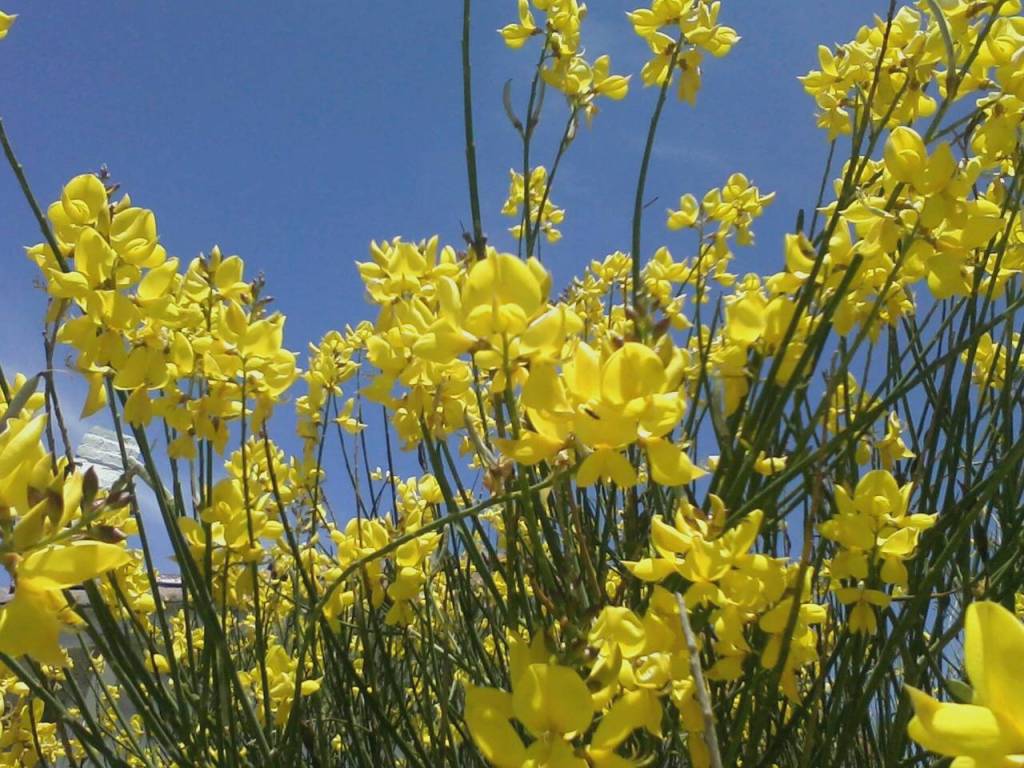
Broom

Most broom is an aggressively invasive weed.

French, Spanish, Mediterranean and common brooms are the most familiar of the brooms because they are among the most invasive and aggressive of weeds in rural areas. Many other brooms (that are primarily within the two genera of Cytisus and Genista) that are tame enough for home gardens unfortunately share the bad reputation, even though many of the modern varieties are hybrids that do not even produce viable seed. Once established in sunny, well drained sites, brooms are not at all demanding.

Broom bloom is almost always bright yellow, although a few varieties of broom have white, pink, pale orange or even purplish flowers. Most have finely textured evergreen foliage. Others are foliated only for a short time in spring before they drop their foliage in early summer to reveal distinctive bare green stems. The most popular modern varieties are fluffy, low shrubs less than four feet tall. Some of the more traditional types get taller than ten feet.