 Nature has been getting by just fine for a very long time before humans started to interfere. It has survived all sorts of catastrophes literally longer than anyone can remember. It was here when dinosaurs were exterminated by a meteorite or comet or vulcanism or whatever catastrophic yet natural event finished them off. In fact, Nature was here for all of the few mass extinction events of the very distant past, including the Permian – Triassic Extinction, which only about 4% of life on earth survived! We all know that “It’s not nice to fool with Mother Nature.”, or serve her margarine that tastes like real butter; but we should also realize that it is rather presumptuous to think that we can be more efficient with correcting all environmental damage. Very often, it is best to let nature do what nature does best.
For example, forest fires are perfectly natural. They are more frequent now because of human activity; but they are less extensive, likewise because of human activity. Humans contain fires that would naturally burn much larger areas. Preventing vegetation from burning allows it to accumulate and become more combustible. If deprived of fire long enough, vegetation within ecosystems that rely on fire as part of their natural restorative cycle eventually deteriorates, or become so combustible that when it does burn, its seed gets incinerated.
Many box elders along the San Lorenzo River have been dying for the past many years. We have not identified the pathogen associated with the necrosis, but it is probably a naturally occurring pathogen that is an intricate component to the natural ecosystem, (although after last winter, an inordinate number of box elders succumbed at the same time). Regardless, trees succumbed and fell. A significant void developed within the collective forest canopy on the Eastern Bank, near the Graham Hill Road Bridge. ‘Environmentalists’ wanted to ‘help’.
These new trees in the picture were planted within the area vacated by a few deceased box elders. The closer of the two is a coast live oak. The other is a bay laurel. There are a few more beyond those in the picture. Native vegetation that developed ‘naturally’ but happened to be in the way was removed to facilitate this project. To prevent native deer from damaging the trees as deer would do ‘naturally’ the trees were imprisoned in small cylindrical cages. Because the trees did not grow there and disperse their roots ‘naturally’, they must be irrigated until they can survive on what they get ‘naturally’ from rain.
The irony of all this is that native vegetation that was growing ‘naturally’ was removed to install ‘unnatural’ nursery grown trees intended to restore a ‘natural’ ecosystem that was already doing what it does ‘naturally’. Although native, the coast live oak ‘naturally’ prefers to avoid riparian environments such as this. It ‘naturally’ prefers a more exposed and drier situation. Bay laurel trees live there ‘naturally’, which is why a few had already started to grow from seed. These seedlings would not have needed to be caged or watered, but were removed to plant the new trees. Yes, bay laurels that would have survived on their own were replaced by bay laurels that must be watered and protected. Willows and cottonwoods that were quite prolific in the area were likewise removed, although many more remain lower on the bank of the River.
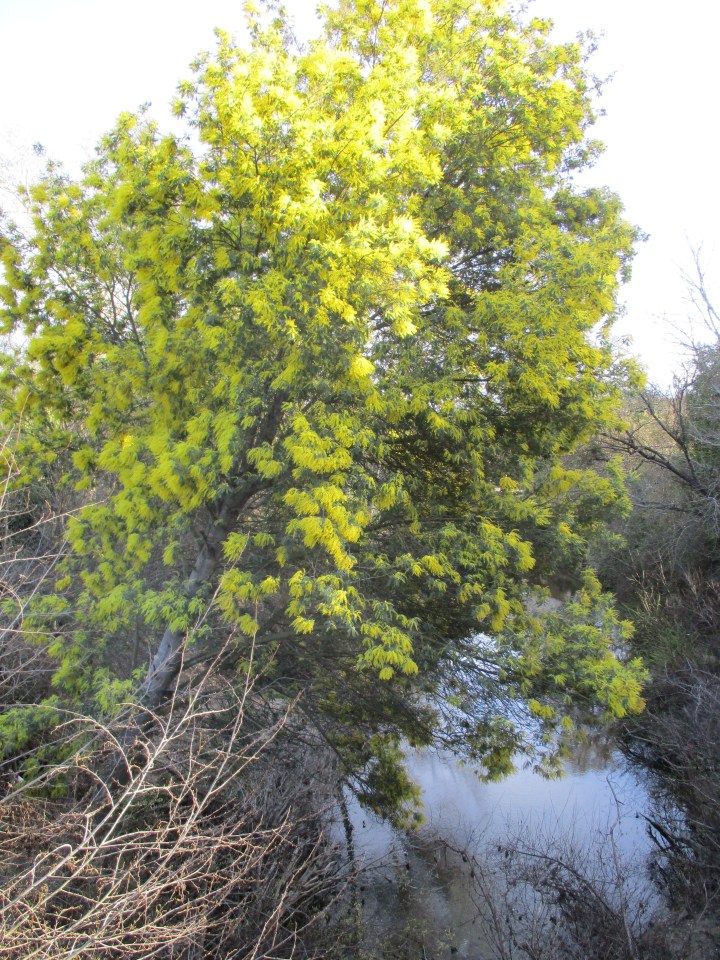
In the background, in the upper right corner of the picture, the bright yellow flowers of an Acacia dealbata can be seen. It is a seriously invasive exotic species that displaces native vegetation. Although it is impossible to exterminate the species, this individual tree that has been dispersing profuse seed into the San Lorenzo River for many years, really should be removed. Even if nothing were to be installed to replace it, the removal would benefit the ecosystem. Nature would have no problem finding native trees that would like to occupy that spot.
 Every invasive exotic (non-native) species has a story of how it got here.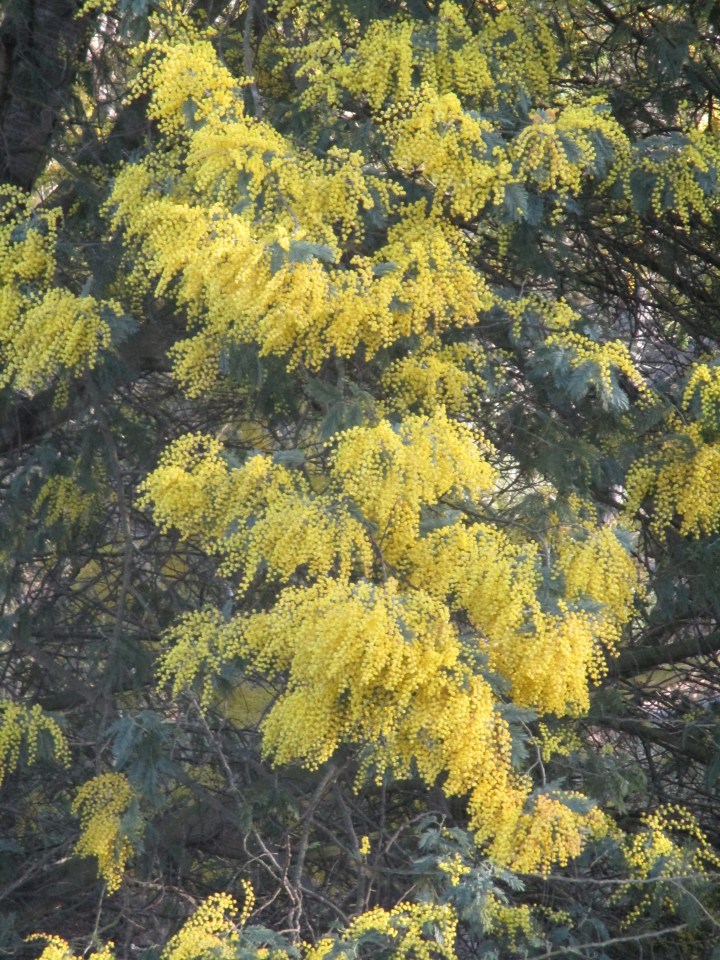
 This is no timid vine! Flame vine, Pyrostegia venusta, is related to the lavender trumpet vine and blood red trumpet vine, and is just as vigorous. Although it can not be recommended for tight spaces or small refined gardens, it excels at obscuring concrete walls. It only needs wires or stakes to be convinced to climb. If it gets too big, it can be cut back after bloom to regenerate quickly.
 Just because it ‘can’ be grown as a houseplant does not meant that it ‘should’ be. That is a lesson that Brent and I never learned in college. He and I were roommates in the dorms at Cal Poly in San Luis Obispo, which, as you can imagine, was a problem. Our room on the top floor of Fremont Hall was known as the Jungle Room. It was so stuffed full of weird houseplants, as well as a few plants that had no business inside. We had a blue gum eucalyptus bent up against the ceiling, an espaliered Southern magnolia, a Monterey cypress, and a herd of camellias that we rescued from a compost pile on campus.
 You can say what you like about nasturtiums. My landscape designer colleague, Brent Green certainly did when he named them ‘dago pansies’. They are still one of my favorite flowers, and just might be my favorite, even though none are convincingly white. They were my first. I discovered them when I was very young. They were growing near an old English walnut tree in my great grandfather’s garden. He noticed that I liked them, so found some seeds underneath to send home with me.
 Tony Tomeo