Form Follows Function For Gardening

Star jasmine either climbs or trails.

Home gardens are components of the homes that they serve. They are the exterior of the interior. They are the environments in which homes exist. Some provide vegetables and fruits. Many provide flowers. Ideally, gardens enhance domestic experiences. Therefore, their design is as relevant as architecture. Accordingly, horticultural form follows function.

Gardens can be single open spaces or, like their associated homes, a few spaces. They benefit from features that function like those that define interior spaces. Lawns are floors. Trees are ceilings. Hedges and shrubbery are walls. Patios, decks and fences are static features. Vegetation, though, requires more discriminating selection for appropriate form.

Lawns seem to be the simplest of such functional vegetation to select. Form is not overly variable. Nevertheless, turf grass must be appropriate to its particular exposure. Some is more tolerant of partial shade than others. Some requires less water than others. Ground cover vegetation is more appropriate for many situations. Artificial turf might be an option.

Trees and shrubbery are much more diverse. Although they are the largest vegetation of a garden, some are quite small. They are evergreen or deciduous, and both have distinct advantages. While palms lack branches, other trees and shrubs develop sculptural form. Consequences for inappropriate selection of such significant vegetation can be serious.

Furthermore, different varieties of the same species can behave very differently. Junipers are practical shrubbery for some situations. However, some are prostrate ground covers. A few grow as small trees. Also, while some rosemaries are shrubbery, some are trailing. Selection of an inappropriate cultivar of an appropriate species is a rather common error.

A few species change form as they mature. With confinement, the trailing juvenile form of English ivy is a practical ground cover. However, as it encounters support, it becomes its vining adult form. This clinging growth ruins paint, and overwhelms trees and shrubbery. Star jasmine evolves from ground cover to twining vines even without changing its form.
Seed Collection For Another Season

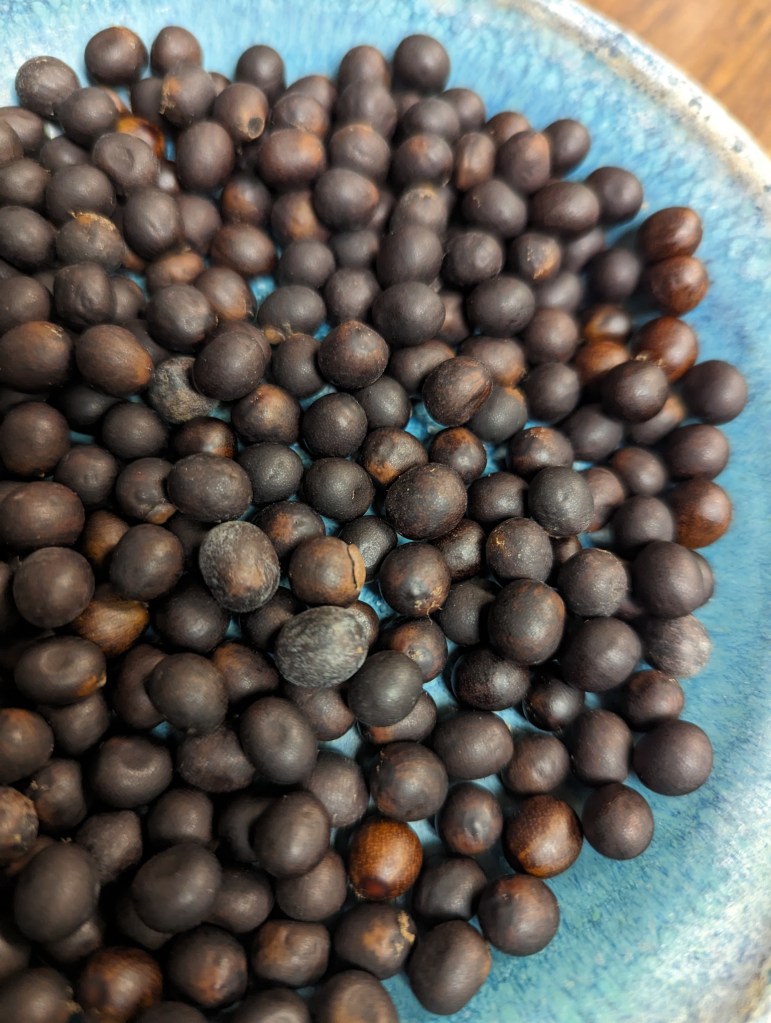
Less hybridized canna produce more seed.

Deadheading conserves resources that would otherwise sustain production of seed. For species that bloom more than once, it promotes continued bloom. For others, it promotes healthier vegetative growth. Also, it inhibits proliferation of potentially invasive seed. It is neater anyway. However, several species might forego deadheading for seed collection.

Flowers that bloom only once for a brief season generate all their seed at the same time. Flowers that bloom for an extensive season generate seed for a more extensive season. Some seed is obtainable from ripe fruit. Some is obtainable from unharvested vegetable plants that go to seed. Seed collection involves various sources during various seasons.

Regardless of its season and source, most seed is too abundant for complete collection. A single fruiting vegetable, such as a true to type chile, provides more than enough seed. A few stalks of naked lady might provide more seed than one garden can accommodate. Wildflowers are an exception. Their seed collection is rarely too excessive to broadcast.

Many species do not reliably generate viable seed though. Some require pollination by a very specific pollinator that does not live here. Yuccas that are from Central America rely on moths that live only in Central America. Some bamboos generate seed only once in a century or so. Most hybrids are too genetically dysfunctional to produce any viable seed.

Hybrids that can generate viable seed are very unlikely true to type. In other words, their progeny will be very different from them. Such progeny tend to revert to a simpler or more primitive form. The same applies to progeny of cultivars of extensive breeding within one species. Genetic aberration, such as variegation, is likewise unlikely inheritable by seed.

To complicate seed collection, some species begin life with juvenile growth. Some might take several years to mature. Avocado seedlings initially grow very fast, and tall, without blooming. By the time they mature, bloom and produce fruit, such fruit can be too high to harvest. Trees from nurseries are fruitful lower only because of grafting with adult growth.