Nothing is official yet. I am hopeful, though. I am currently in training to establish a new Garden Report on Pirate Cat Radio KPCR-LP 92.9 FM in Los Gatos, KMRT-LP 101.9 FM in Santa Cruz, KVBE-LP 91.1 in Portland, and online at KPCR.org. For me, it is daunting. However, those training me are confident of my ability. I have no problem talking about horticulture for an hour. My difficulty is operating the necessary electronics. It is not much, and actually looks quite simple. I am just not comfortable with it. I am intent on doing what I must, though. I miss my former Garden Report gardening shows on KSCO 1080 AM in Santa Cruz and KBCZ 89.3 FM in Boulder Creek. Ultimately, I would like to post recordings of the new Garden Report here on the blog, or at least post links to such recordings. I am told that is not difficult to do, if I record the shows, which is apparently standard procedure. I still need to find “intro” music for the beginning and end of each show, but I believe that I have a source for that. Goodness, although I know this should be easy, I am nervous!

Redwoods grow much too tall for this particular application.
The worst part of getting stuck in traffic on the West Valley Freeway was actually not that I was without a Buick. It was the objectionable view of ridiculously dysfunctional landscaping that flanks newer section of the freeway south of Steven’s Creek Boulevard. After more than a decade and a half, it should be performing much better than it does.
Instead, it has developed far more problems than the older section to the north. Many of the purple leaf plums have been overwhelmed by their own green suckers. Some of the flowering pears also have serious suckers, or have been damaged by the harsh exposure they get on the side of a freeway. All sorts of plants have succumbed to irrigation problems.
The overly abundant micro-trees like purple leaf plums and crape myrtles are not proportionate to a freeway landscape. London planes will eventually be more proportionate, but are almost as useless for muffling the sound of traffic while they are bare through winter. The few functional features of the landscape are can only be seen in the background.
Meanwhile on the relatively old fashioned Junipero Serra Freeway, the landscape does what it was intended to do when it was planned in the late 1960’s. Where there is enough space, mature eucalyptus trees absorb ambient noise all year. Arizona cypress trees do the same where there is less space. Western redbuds and oleanders add a bit of color whether they get watered or not.
Home gardening may not always get the sort of planning that freeway landscapes need, but deserves the same sort of common sense. Much of what goes into the garden will be around for a very long time, so should be selected accordingly in order to function as intended with as few problems as possible. Yet, it is sometimes worth taking minor risks to get trees and plants that get the job done.
For example, crape myrtles have become much too common because they do not get big enough to cause many problems. They are used as street trees because they will not damage pavement; but they do not get big enough to make much shade or to get out of the way of trucks. Honey locusts may not seem like such a good choice because they may eventually displace pavement when they get older, particularly if watered too much while young; but they are more proportionate and out of the way.
Proper selection of plants simply makes the garden work better. Trendy plants like crape myrtles, London planes, carpet roses and dwarf Heavenly bamboos (nandinas) certainly work well in the right situations, but are not necessarily the best choices for every situation. Desired function, proportion (when mature), exposure, potential problems, maintenance requirements and landscape style are just some of the variables that should be considered when selecting new plants for the garden.
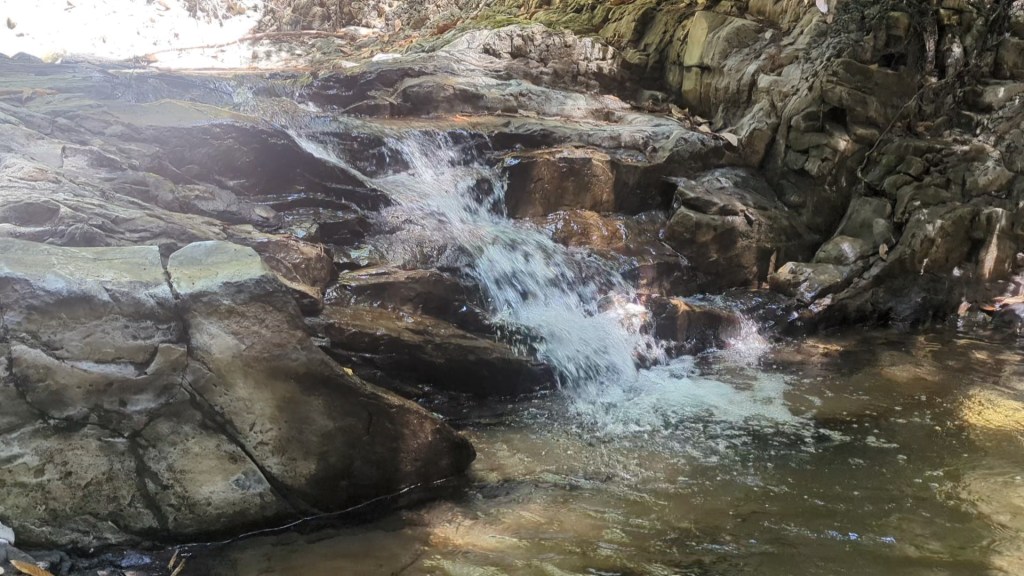
Life was very different where I lived in town in the 1990s. I miss that neighborhood and my garden there very much. However, it was an urban neighborhood, only a few blocks from the interchange of Highway 17 and Highway 85. My neighbors had me build a small solar powered fountain adjacent to a patio of our apartment building to obscure the ambient urban noise. I thought it was a silly component of the landscape, but everyone else was fond of it. Well, sadly, I left that home and garden many years ago, and relocated to a quieter neighborhood a few miles away. Except for a few lights at night on distant hillsides, I can see no other households. I do not hear much more from them than I can see. Air traffic to and from Mineta is the most traffic that I notice, if I notice. In fact, the noisiest noise in my garden is from this creek that flows through it. I flows all day at night, so does not stop when the sun goes down. I can not unplug it. It gets louder during winter. Perhaps I should build another solar powered fountain to obscure the noise.
Tangly Cottage Gardening made good use of obsolete water meter lids as stepping stones. Now that I procured quite a bunch from where I work part time, I can try something similar. Because they are rectangular and of standardized dimensions, they can alternatively function as contiguous pavers. I intend to eventually pave a small patio with them. Forty-three are identical, 20.75 inches long by 10.5 inches wide, which is approximately 1.5 square feet. One is slightly different, but of the same dimensions. Two are smaller. Because they are not exactly twice as long as wide, all must be set in the same orientation, but that will not be a problem. They can be arranged in five rows of nine, or nine rows of five, as an almost square patio of approximately 68 square feet, with approximately eight foot long sides. Only one lid will be different, and one lid, likely in a corner, will be lacking. If necessary, I can add the two smaller lids to awkwardly fill the otherwise lacking corner, or simply find another lid somewhere. More will be available later. Although it is not yet constructed, I am already pleased with this recycled cast iron patio.
Roses from a home garden are not quite the same as roses from a florist or market. They mostly bloom on stems that are relatively thinner and shorter. Floral and foliar blemishes are more likely. As they unfurl, they can get a bit wider and disperse more fragrance. One of the more obvious differences is their seasonality. They are unavailable through winter.
Florist roses are likewise different from garden roses. They are not as limited by season, so are available at any time of year. Their elegantly straighter stems are relatively longer and a bit heftier. Blemishes are rare. Buds are generally plumper and likely to last longer, but may not unfurl completely. They are typically relatively narrow and a bit less fragrant.
Environmental factors cause most of the differences. Home garden roses develop with a relatively natural exposure to weather. Florist roses develop within synthetic greenhouse environments without natural weather. However, genetics cause some of the differences. Florist roses are not the same cultivars that are available from nurseries for landscaping.
The same applies to several florist quality potted plants. They also grow within unnatural environments. They also are cultivars that perform well for their specific purpose. Some cultivars are impractical for landscapes. Some take quite a while to adapt to landscapes. Many that are seasonally popular for particular Holidays may not last for long afterward.
Most azaleas and hydrangeas are landscape cultivars. Some are florist cultivars though. Landscape cultivars that grew outside in nurseries adapt efficiently to landscapes. Florist cultivars that grew in greenhouses take more time or may not adapt. Those that do might bloom with lavishly large florist type flowers. Such bloom may not be resilient to weather.
Several cultivars of florist carnations and chrysanthemums are also landscape cultivars. Florist lilies are the same that are seasonally available as dormant bulbs from nurseries. Adaptation to a garden can be stressful, especially for those that bloomed out of season. However, once they adapt, they might perform for several years as short term perennials.
Horticultural industries are innately hazardous. Most horticultural professionals work outside in all sorts of weather, regardless of what that weather might be; stormy, cold hot and so on. Some of us who grow horticultural commodities might occasionally work with hazardous chemicals, and many of us work exhaustingly long hours, and sometimes in the dark of night. Those who work with landscapes might also work with the same chemicals, as well as potentially hazardous motorized tools. Arborists work with the most hazardous machinery, as well as dangerously heavy debris falling from great heights, and those who climb do their work dangerously high above the ground. Then there is this, which sounds much worse than its bad punctuation. “!PLEASE DO NOT! SIT (I WAS HIT BY A STRAY METEOR)” It sounds like all sorts of bad! I do not know what is worse, sitting or a stray meteor. It is not actually a horticultural concern, but the implication is that whatever happened, it happened on this now broken bench that was formerly located within one of the landscapes that we work in. I suspect that the bench merely broke because it was deteriorated by the weather, which is a concern of meteorology.
Music videos were so artistic in the 1980s. Some of them said as much as their associated music. The Talking Heads composed a music video for Road to Nowhere that, although it seems ridiculous now, was captivating at the time. It seemed to be about how life is dynamic with deviations from that which is expected. To me, it also seemed to be about enjoyment of being here now, or perhaps, there then. After all, it was filmed near Hi Vista in 1985, far away and long ago.
I did not experience Hi Vista in 1985, but did manage to get to Littlerock in about 1987, about two years later and thirty miles to the southwest. I am glad to have seen the region then. It has changed so much that I sort of hope to never see it again. Although I do not intend to avoid it if there is ever any reason for me to return, I would prefer to remember it how it was about thirty-seven years ago. There are plenty of other scenic regions of the Mojave Desert to tour.
While in the region, I noticed that a few interchanges on the highways that we drove on were more substantial than the highways were. They were proportionate to the urban development that was expected for the region. The portions of the highways between the interchanges were upgraded later, which is now a long time ago. So much of what I remember as rural is now suburban or urban.
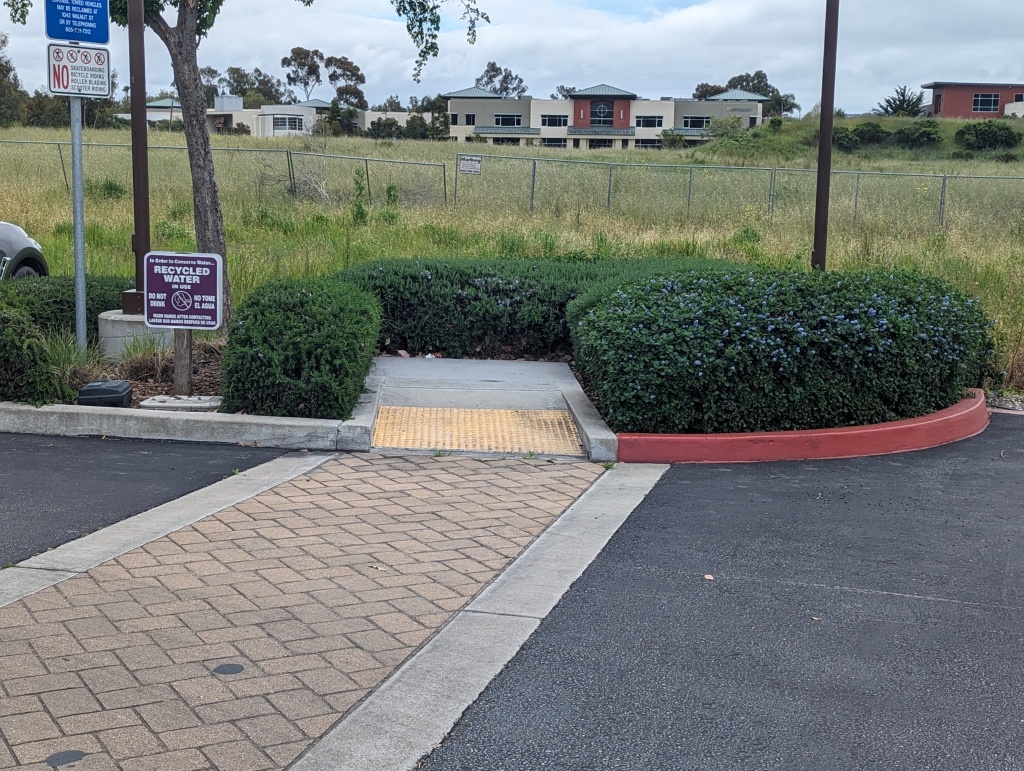
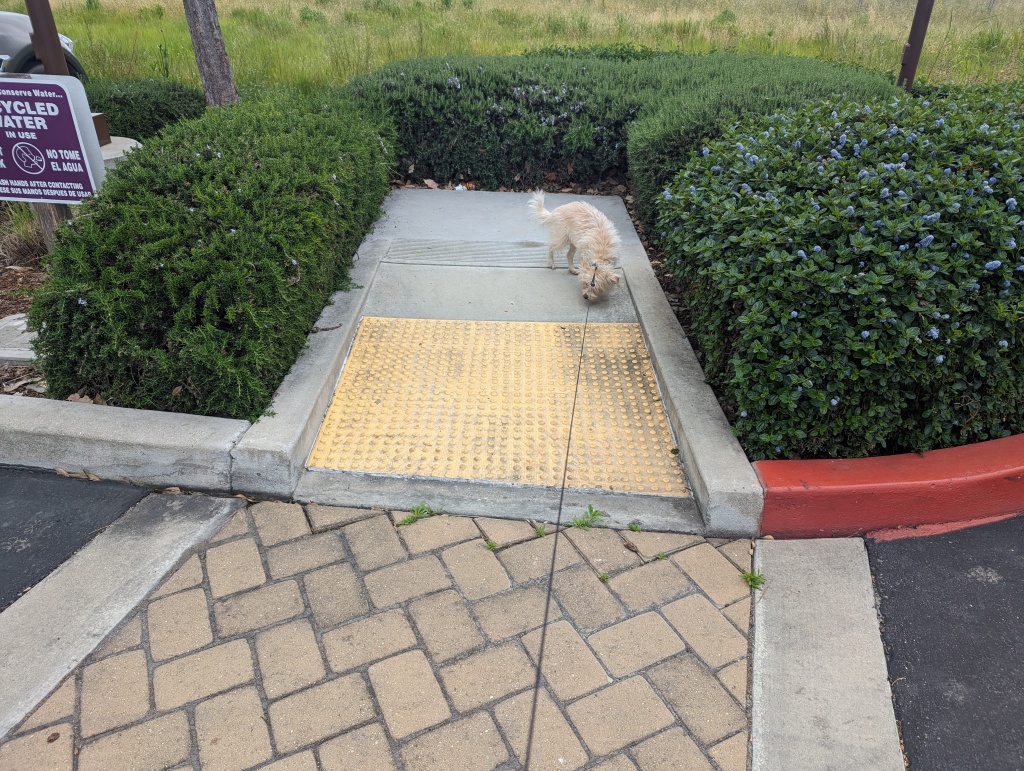
That is what this landscape reminded me of. It is near my formerly rural home south of San Luis Obispo, where I lived while in college. Although this parking lot was here before I was, it has since been renovated. The area beyond was merely pasture occupied by cattle. This long and prominent crosswalk crosses the parking lot as if going somewhere important, only to terminate at this empty landing, which is surrounded by ceanothus. It certainly looks odd. Obviously, the walkway is intended to continue in some form into development that is planned for the adjacent site. I had not been here in about thirty-four years, so should not be surprised by such changes. Perhaps I am no more surprised than I am amused by this landscape and its associated road to nowhere.
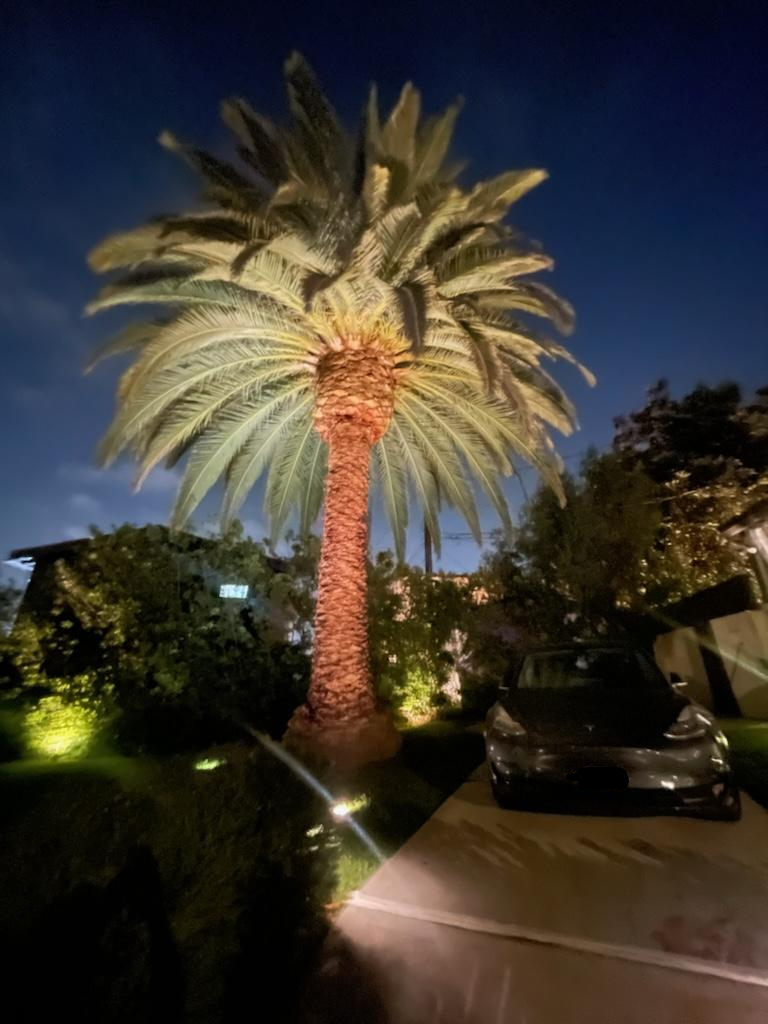
That is what this uplit Canary Island date palm seems to be responding to. It seems to be surrounded by police, with their spotlights aimed at it as they proceed with an arrest. It actually seems to be guilty, although it might merely be humiliated.
Brent is a renowned landscape designer in the Los Angeles region. I know that I should not question his work. After all, aside from all the other unusual horticultural work that I do, my primary work is supposed to be on the farm. I merely grow the material that Brent’s crews assemble into their landscapes. I know that Brent knows what he is doing, and his clients appreciate it very much. I just do not quite get it.
Although I happen to be fond of Canary Island date palms in other peoples’ landscapes, I do not think that I would want one in my own garden. I would prefer a fruiting pair of date palms. Even that is a stretch. They occupy significant space, and probably would not produce good fruit here anyway. Even if such palms inhabited my garden, I know that I would not want them uplit like this. Such trees seem to be embarrassed or annoyed about being kept up late. They really deserve to get some sleep at night like everyone else.
Uplighting became popular in the 1970s. By the time that Brent and I were in school, and he was studying landscape design, lighting of various colors had become popular. I can remember a landscape in his Parents’ neighborhood that was done up like a horror movie with red lights. Another was done up like a circus with various tacky colors. Eventually, white lights became most popular, although colorful lights are not completely unpopular.
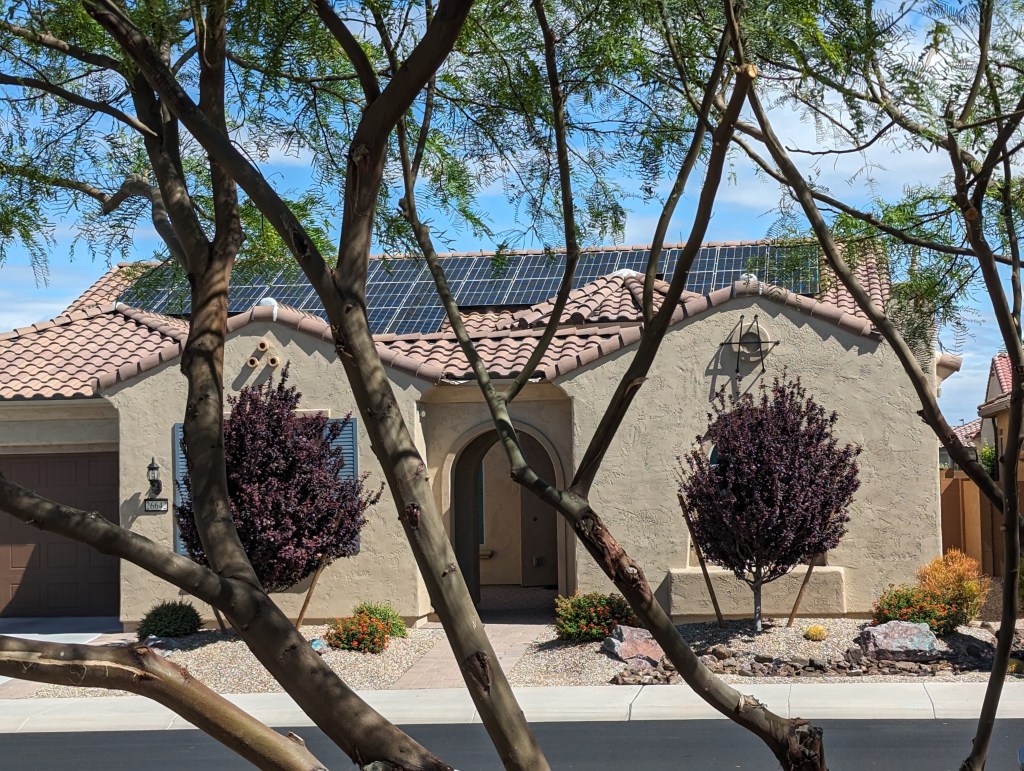
The landscape in front of the home across the road from where I am staying in Arizona is weird. Like many of the landscapes here, it is simple, with only a few small shrubs and stone surrounded by gravel, but also includes this silly pair of purple leaf plum trees. They are pruned into symmetrically round form. The pruning keeps their canopies nicely dense with strikingly bronzed foliage. What makes them so weird is their location. Within the climate here, shade is an asset. However, these trees are not allowed to make much shade. The natural form of these small trees could frame the facade of this house nicely. However, they clash with it defiantly. With their profuse spring bloom and rich foliar color, these trees might enhance the scenery from within the windows. However, they subjugate it and exclude any other scenery, and likely exclude a bit too much sunlight without providing significant cooling shade through summer. I am certainly no landscape designer, but in my opinion, this landscape looks odd. The vegetation is of good quality and quite healthy. The stone and gravel is neatly arranged. The facade of the home is quite appealing. The problem is that the assemblage of the landscape relative to the home is awkward. The tree in the foreground is one of the first three mesquite trees that I ever met when I pruned them up for clearance last year. It and the specimen next to it are also awkwardly placed in front of their home, although the third is in a better situation next to the garage. That is precisely why these three trees were pruned up for clearance, and why they will be pruned higher as they grow. They already provide a bit of shade, and will provide more as they grow.
The Jungalow, as I wrote six years ago, is Brent’s home and associated gardens. It is an overgrown mess of lush foliage. I perceive it to be a frivolous waste of very limited space. Everyone else perceives it to be a phenomenally luxuriant urban oasis.
The house next door is more my style. It is a compact and simple home with simple bisymmetric architecture and an even simpler landscape. If Brent had not installed a symmetrical pair of tipu trees at the curb, a symmetrical pair of Tolleson’s weeping junipers flanking the porch and a foundation planting of star jasmine, it would have no landscape at all. It might be my favorite house in the neighborhood. Brent hates it.
More specifically, he hates that it is right next door. He would prefer it to be a bit farther away, so that a home with a landscape that is more compatible with his could be next door instead.
Anyway, sadly, a back bedroom of the house next door that I am so fond of burned a few days ago. Fortunately, Brent was in his office behind his home when it happened. He noticed a red glow and heard a window break. When he investigated, he could see the fire and smoke through the hedge between the backyards, so called 911. A fire crew arrived within only a few minutes to extinguish the fire before it ruined more of the home.
Brent sent this brief and blurry video of the situation shortly after the fire was extinguished. It resembles a hasty video garden tour, but speeds past some of the more interesting features of the garden, including my homeless camp, before turning back to show smoke rising from the house next door. It is a saddening situation for the next door neighbor.