Proper Plant Selection

Redwoods grow much too tall for this particular application.

The worst part of getting stuck in traffic on the West Valley Freeway was actually not that I was without a Buick. It was the objectionable view of ridiculously dysfunctional landscaping that flanks newer section of the freeway south of Steven’s Creek Boulevard. After more than a decade and a half, it should be performing much better than it does.

Instead, it has developed far more problems than the older section to the north. Many of the purple leaf plums have been overwhelmed by their own green suckers. Some of the flowering pears also have serious suckers, or have been damaged by the harsh exposure they get on the side of a freeway. All sorts of plants have succumbed to irrigation problems.

The overly abundant micro-trees like purple leaf plums and crape myrtles are not proportionate to a freeway landscape. London planes will eventually be more proportionate, but are almost as useless for muffling the sound of traffic while they are bare through winter. The few functional features of the landscape are can only be seen in the background.

Meanwhile on the relatively old fashioned Junipero Serra Freeway, the landscape does what it was intended to do when it was planned in the late 1960’s. Where there is enough space, mature eucalyptus trees absorb ambient noise all year. Arizona cypress trees do the same where there is less space. Western redbuds and oleanders add a bit of color whether they get watered or not.

Home gardening may not always get the sort of planning that freeway landscapes need, but deserves the same sort of common sense. Much of what goes into the garden will be around for a very long time, so should be selected accordingly in order to function as intended with as few problems as possible. Yet, it is sometimes worth taking minor risks to get trees and plants that get the job done.

For example, crape myrtles have become much too common because they do not get big enough to cause many problems. They are used as street trees because they will not damage pavement; but they do not get big enough to make much shade or to get out of the way of trucks. Honey locusts may not seem like such a good choice because they may eventually displace pavement when they get older, particularly if watered too much while young; but they are more proportionate and out of the way.

Proper selection of plants simply makes the garden work better. Trendy plants like crape myrtles, London planes, carpet roses and dwarf Heavenly bamboos (nandinas) certainly work well in the right situations, but are not necessarily the best choices for every situation. Desired function, proportion (when mature), exposure, potential problems, maintenance requirements and landscape style are just some of the variables that should be considered when selecting new plants for the garden.

Boinkification

Dwarf Alberta spruce needs to know its place.

Many dwarf plants are very practical. The many different dwarf cultivars (cultivated varieties) of false cypress that are grown for their interesting forms, textures and foliar colors are much more proportionate to home gardens than similar specie in the wild, which are big enough to get harvested for timber. Oranges are easier to reach on dwarf trees than on standard trees, which get as big as shade trees.

However, not all plants should be bred to be dwarfs. Dwarf Southern magnolias certainly have their appeal for tight spots, but do not make as much shade as larger trees do. Compact cultivars of crape myrtles (although not actually dwarfs) take too much time to grow above truck traffic to be practical as street trees.

Many classic annuals and perennials are likewise bred to be too compact to be as practical as they were in the past. Annie of Annie’s Annuals in Richmond refers to this all too common practice as ‘boinkification’. It makes many blooming plants more marketable and resilient to shipping and installation, but deprives them of their natural form and elegance.

Short annuals and perennials certainly have their place. Lobelia, sweet alyssum, dwarf marigolds and petunias are fine along walkways and in pots with other larger plants. They also work well as bedding plants for a profusion of color. Yet, there is all too often too much of a good thing. Some flower beds are simply so big and plain, that it would be just as colorful to paint an area orange instead of planting so many marigolds.

Taller flowering annuals like nicotiana (flowering tobacco), cosmos and zinnias add depth behind lower growing annuals. Dahlias are perennials that can accomplish the same thing. Some of the older and less common varieties of familiar bedding plants that have not been so boinkified also work well. There are even petunias that can get two feet tall and wide! These taller plants also provide cut flowers; which is something that boinky plants are not so good at.

Boinkification also compromises fragrance and aroma. Bedding dianthus have almost no fragrance at all; unlike the old fashioned dianthus and carnations that had such distinctive spicy fragrance. Modern zonal geraniums are more colorful than classic varieties, but their foliage is not quite as aromatic.

Not only does increased foliar density of boinky plants promote the proliferation of many diseases and pests; but the genetic violations necessary for boinkification interfere with resistance to diseases and pests!

Horridculture – Keep Out!

Gilroy City Council does not endorse this landscape.

Corner lots can be challenging. Even if paths do not get worn diagonally through front lawns, vegetation between curbs and sidewalks is likely to get trampled. The pavement in the foreground of this picture connects the sidewalk to crosswalks for the two associated streets. (I realize that this is not a very good picture, and the blotched out poster for a candidate for Gilroy City Council could not be erased completely, but I took it from a car while stopped at a stop sign.) Vegetation for this particular application must be durable, and perhaps deterrent to trampling. This particular vegetation certainly conforms in that regard. However, there is no polite way of saying how extremely dysfunctional this landscape is. Firstly, from the get go, it is very dangerous to anyone who might simply trip and fall as people sometimes do. Secondly, this landscape will become more dangerous as it matures. Although most of the already crowded agaves seem to be a somewhat compact cultivar that should not reach very far over the sidewalk, the specimen at the center of the bottom of the picture seems to be a variegated common century plant, which has potential to reach halfway across the sidewalk. Thirdly, the entire hot mess will be hideous as it soon needs to be pruned for clearance. The sago palm will soon reach the sidewalk like the common century plant. Pruning will destroy their foliar form. The Mexican fan palm should eventually grow upward and out of the way, but will eventually prevent the streetlamp from illuminating a portion of the sidewalk close to the corner, where illumination is relatively important. Fourthly, this collective herd of wickedly hateful vegetation will soon be too congested to remove litter or weeds from; and curbside landscapes such as this innately collect litter.

Propper Gardening

Brent’s landscape style is VERY different from mine.

If you have ever seen ‘The Osbornes’ on television, you know how extravagant the work of landscape designer Brent Green of GreenArt of West Hollywood can be. He actually landscaped and has maintained the home of the Osbornes since before the Osbornes lived there, and has managed to fit a more extensive range of plants into the gardens than I have grown in my career as a horticulturist, arborist and nurseryman. His own home garden is just as bad . . . I mean ‘extravagant’, with more diversity of plants than could be found in any nursery.

Would you believe that Brent Green and I were actually college roommates in the dorms? Sometimes I do not believe it either. Nearly a quarter of a century ago, he came two hundred miles north, and I came two hundred miles south to ‘meet in the middle’ and study horticulture at Cal Poly in San Luis Obispo. He was very trendy for the time, wearing brightly colored mid ‘80’s clothes and a flat topped afro like Grace Jones. (Yes, he once had hair.) I was old fashioned for ten years earlier, just like I am now, with Levi’s, Durango’s and flannel.

As a landscape designer, Brent Green enjoys the diversity of plants, and getting them to fit into practical, functional and yet very enjoyable landscapes, gardens and outdoor rooms. Most of his favorite work is lush and tranquil, with all the fancy and artful curves, ‘meandering’ walkways, water features, extensive diversity of plants, and herds of color! Conversely, I am still a nurseryman at heart, so engage my garden as a commodity with conformity, simplicity and very basic functionality. I grow vegetables, many fruit trees, and many ‘copies’ of the same reliable plants that I propagate myself, mostly arranged in what Brent Green refers to as straight line ‘row crops’.

Yet, our gardening philosophy is the same. We both ENJOY our gardens, and agree that everyone should likewise do gardening on their own terms. Those who do not enjoy gardening should not need to. There are plenty of other things besides gardening to enjoy.

To facilitate the execution of proper horticultural techniques, we should grow only what we are able and want to take care of. What looks good in a magazine may require more attention that we can commit to or would enjoy. I still believe that the legendary horticulturist Robert Leakley was the first to say what many have copied in various forms since, “If you enjoy it, you are doing it right.”

Change of Scenery

I am certainly no landscape designer, but I think that I sort of dig this.

Window boxes annoy me. They were originally developed to contain aromatic herbs that dissuaded mosquitoes from entering small windows, likely before the invention of window screens. They remained popular while window screens were expensive, and to grow culinary herbs where garden space was limited in old European cities. None of that is useful to me. Mosquitoes are not much of a problem here, and if they were, window screens are not expensive. There is plenty of space for herbs in the garden. Furthermore, window boxes eventually rot as a result of the irrigated medium within, and share their rot with the wooden walls that support them.

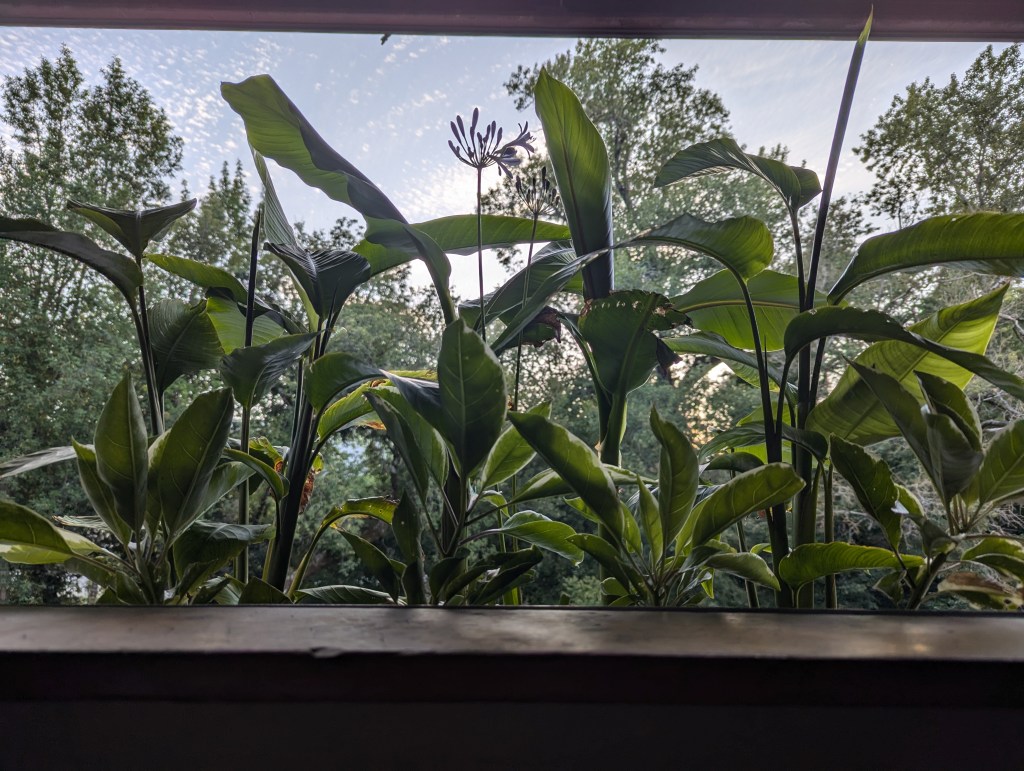
The small shelf that I suspended below this window was intended for eleven small tissue culture plugs of various cultivars of banana. I wanted to shelter them from minor frost last winter. I intended to remove the shelf after winter. Obviously, I did not.

Without a plan, I moved eleven small specimens of various species from the nursery onto the shelf just to see how their composition could develop. I typically do not like to obscure scenery or obstruct sunlight from windows, but thought I could make an exception for this window. The scenery is not particularly appealing, with a busy roadway nearby. Through summer, a bit of shade from the warm late afternoon sun might be nice.

I did not want the grassy texture or bronzed foliar color of the sugarcane right outside the window. Nor did I want the disorganized texture of any of the gingers. I am rather pleased with how these few other species work though. They are nearly half as high as the window, but as I mentioned, for this window, I do not mind. They look rather jungley.

The eleven small specimens here are in eight #1 cans and three 4″ pots. The three 4″ pots are nestled into the gaps in between two rows of four #1 cans. A pair of young plugs of Cucurma longa, turmeric, in two of the three 4″ pots are not visible to the left and right. Only two blooms of a small specimen of Agapanthus africanus ‘Peter Pan’ lily of the Nile in the middle 4″ pot are visible. Four rooted cuttings of Solandra maxima ‘Variegata’ cup of gold vine are in the closer row of #1 cans. A pair of large specimens of an unidentified cultivar of Heliconia psittacorum, parakeet flower, are to the left and right in the rear row. A pair of pups of Musa acuminata ‘Golden Rhino Horn’ banana are in the middle of the rear row. This is so very inconsistent with my style, but I am getting to like it.

Road to Nowhere

Music videos were so artistic in the 1980s. Some of them said as much as their associated music. The Talking Heads composed a music video for Road to Nowhere that, although it seems ridiculous now, was captivating at the time. It seemed to be about how life is dynamic with deviations from that which is expected. To me, it also seemed to be about enjoyment of being here now, or perhaps, there then. After all, it was filmed near Hi Vista in 1985, far away and long ago.

I did not experience Hi Vista in 1985, but did manage to get to Littlerock in about 1987, about two years later and thirty miles to the southwest. I am glad to have seen the region then. It has changed so much that I sort of hope to never see it again. Although I do not intend to avoid it if there is ever any reason for me to return, I would prefer to remember it how it was about thirty-seven years ago. There are plenty of other scenic regions of the Mojave Desert to tour.

While in the region, I noticed that a few interchanges on the highways that we drove on were more substantial than the highways were. They were proportionate to the urban development that was expected for the region. The portions of the highways between the interchanges were upgraded later, which is now a long time ago. So much of what I remember as rural is now suburban or urban.

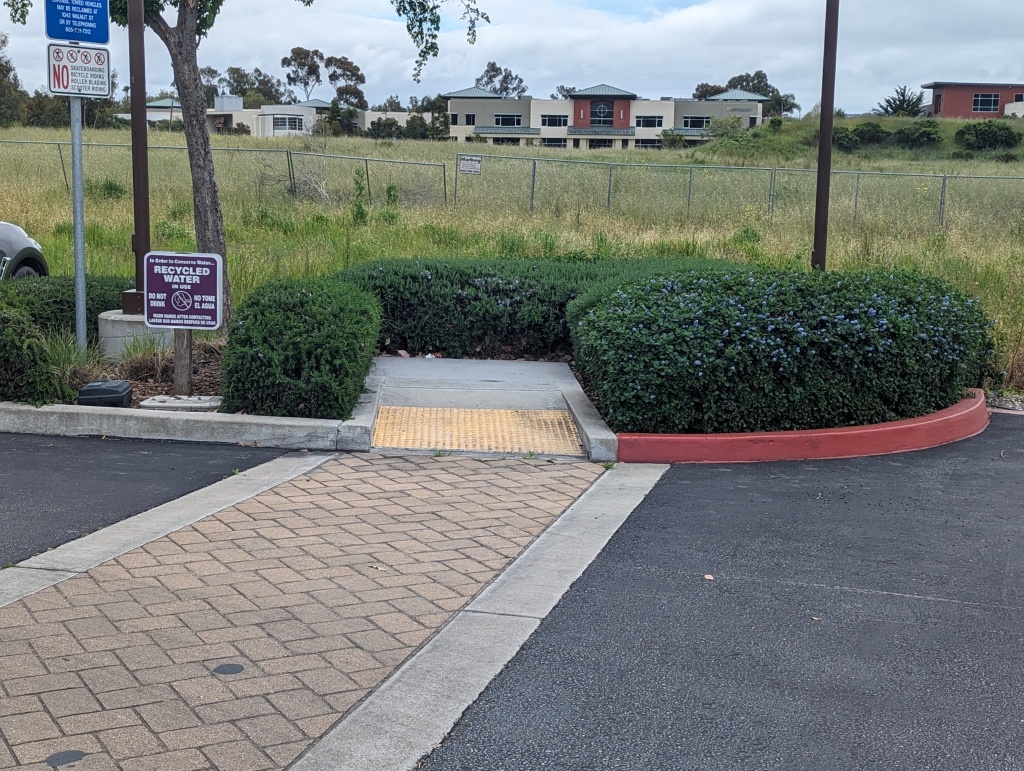
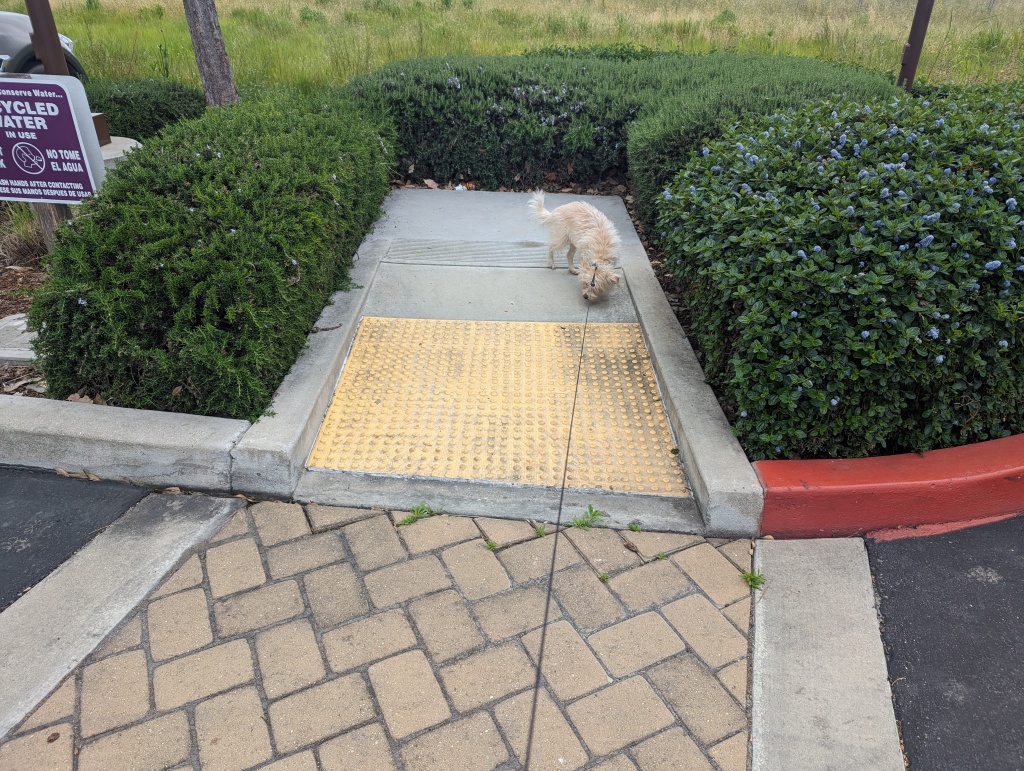
That is what this landscape reminded me of. It is near my formerly rural home south of San Luis Obispo, where I lived while in college. Although this parking lot was here before I was, it has since been renovated. The area beyond was merely pasture occupied by cattle. This long and prominent crosswalk crosses the parking lot as if going somewhere important, only to terminate at this empty landing, which is surrounded by ceanothus. It certainly looks odd. Obviously, the walkway is intended to continue in some form into development that is planned for the adjacent site. I had not been here in about thirty-four years, so should not be surprised by such changes. Perhaps I am no more surprised than I am amused by this landscape and its associated road to nowhere.

Arrest

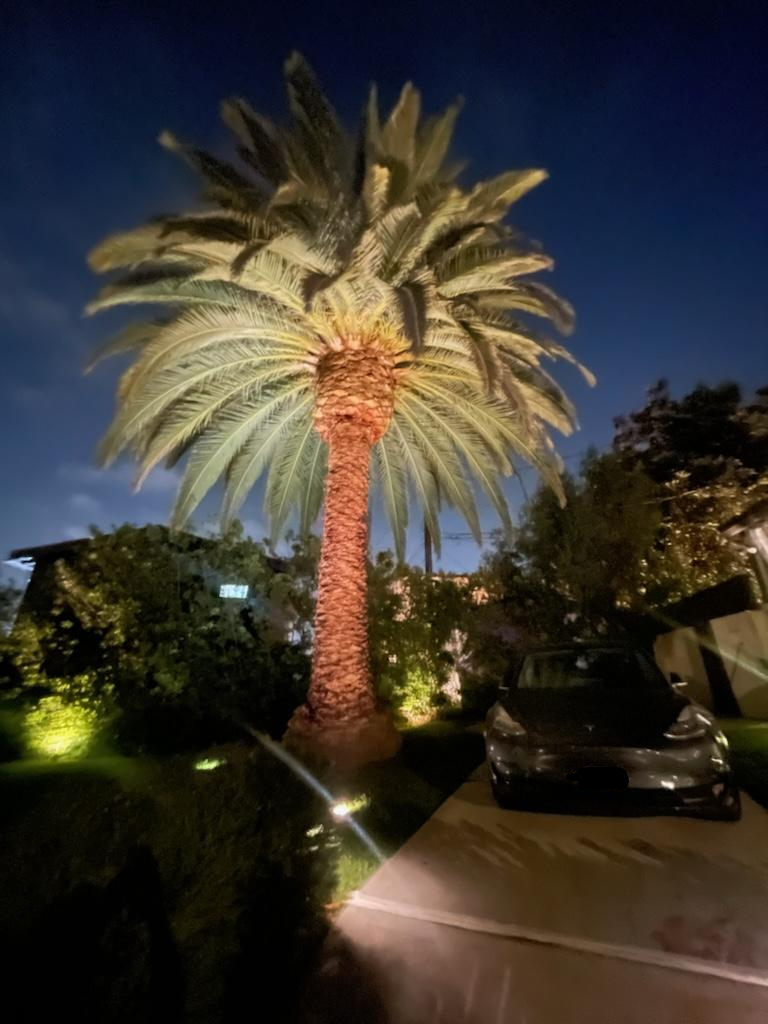
Phoenix canariensis, Canary Island date palm

“Put your hands in the air!

That is what this uplit Canary Island date palm seems to be responding to. It seems to be surrounded by police, with their spotlights aimed at it as they proceed with an arrest. It actually seems to be guilty, although it might merely be humiliated.

Brent is a renowned landscape designer in the Los Angeles region. I know that I should not question his work. After all, aside from all the other unusual horticultural work that I do, my primary work is supposed to be on the farm. I merely grow the material that Brent’s crews assemble into their landscapes. I know that Brent knows what he is doing, and his clients appreciate it very much. I just do not quite get it.

Although I happen to be fond of Canary Island date palms in other peoples’ landscapes, I do not think that I would want one in my own garden. I would prefer a fruiting pair of date palms. Even that is a stretch. They occupy significant space, and probably would not produce good fruit here anyway. Even if such palms inhabited my garden, I know that I would not want them uplit like this. Such trees seem to be embarrassed or annoyed about being kept up late. They really deserve to get some sleep at night like everyone else.

Uplighting became popular in the 1970s. By the time that Brent and I were in school, and he was studying landscape design, lighting of various colors had become popular. I can remember a landscape in his Parents’ neighborhood that was done up like a horror movie with red lights. Another was done up like a circus with various tacky colors. Eventually, white lights became most popular, although colorful lights are not completely unpopular.

More Bad Design

blindfolded house

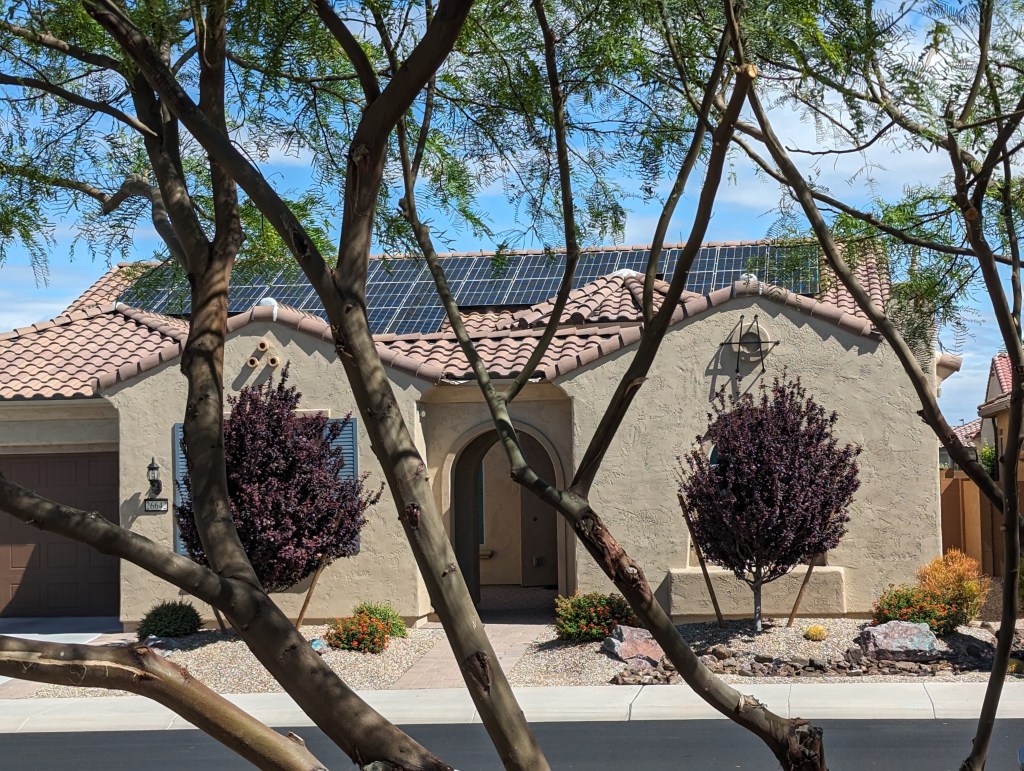
The landscape in front of the home across the road from where I am staying in Arizona is weird. Like many of the landscapes here, it is simple, with only a few small shrubs and stone surrounded by gravel, but also includes this silly pair of purple leaf plum trees. They are pruned into symmetrically round form. The pruning keeps their canopies nicely dense with strikingly bronzed foliage. What makes them so weird is their location. Within the climate here, shade is an asset. However, these trees are not allowed to make much shade. The natural form of these small trees could frame the facade of this house nicely. However, they clash with it defiantly. With their profuse spring bloom and rich foliar color, these trees might enhance the scenery from within the windows. However, they subjugate it and exclude any other scenery, and likely exclude a bit too much sunlight without providing significant cooling shade through summer. I am certainly no landscape designer, but in my opinion, this landscape looks odd. The vegetation is of good quality and quite healthy. The stone and gravel is neatly arranged. The facade of the home is quite appealing. The problem is that the assemblage of the landscape relative to the home is awkward. The tree in the foreground is one of the first three mesquite trees that I ever met when I pruned them up for clearance last year. It and the specimen next to it are also awkwardly placed in front of their home, although the third is in a better situation next to the garage. That is precisely why these three trees were pruned up for clearance, and why they will be pruned higher as they grow. They already provide a bit of shade, and will provide more as they grow.

Design and Implementation

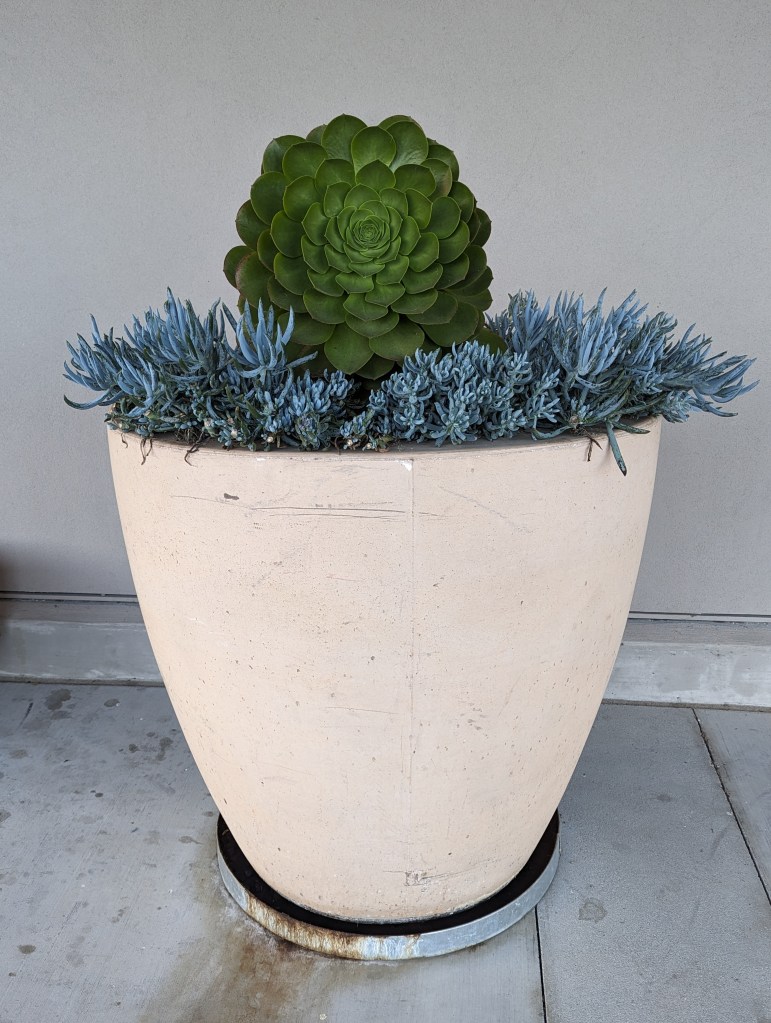
This exposed urn looks like a koala tummy.

This is so silly that I sort of like it. I mean, I found it to be sufficiently amusing to get a picture of it to send to Brent. It is a nice large urn, with an Aeonium arboreum that is a bit bolder than any of mine, and delightfully blue Senecio mandraliscae. It has nothing else going for it, but perhaps its simplicity is an asset. It might look junky if it contained any other well planned but comparably maintained material.

My only personal criticism of its design is that it is located on otherwise useful pavement, where pedestrian traffic must divert around it; but I am merely a horticulturist, not a landscape designer. For all I know, it could be there to intentionally soften the expansiveness of all that useful pavement, without occupying too much of it. I would also say that the urn should be outfitted with species that are more tolerant of the partial shade of its particular exposure, but obviously, these two simple species are reasonably happy there.

My more realistic criticism is of its implementation. Is it really too difficult for so-called maintenance ‘gardeners’ to maintain this as the landscape designer who designed it thought they should be able to? Must landscape designers design their landscapes with the expectation that their work will not be maintained as expected? Although it is delightfully silly, it might be more visually appealing if the Senecio mandraliscae cascaded a bit more over the edge. Alternatively, it could be confined to the upper surface of the urn if a third perennial were allowed to cascade somewhat over the edge; but again, I am no landscape designer. The urn is nice, but might be nicer with a bit of foliar color, form and texture over some of its exterior.

Selection of Appropriate Trees

Many trees get too big for many situations. Trees should be proportionate to their spaces.

Japanese maples are among my least favorite of trees. There; I said it! Even though I can not think of any single species of tree that has so many distinct and fascinating cultivars, I am bothered by how Japanese maples have been denigrated by their own overuse. That which is naturally an understory tree (lives in the partial shade of larger trees), which should be thoughtfully selected for its individual form, texture and color, to function as a focal point specimen tree, has become too common and misused.

Every tree should be thoughtfully selected for its particular application. The ultimate size, shape, shade, potential mess, cultural requirements, root characteristics and foliar characteristics (evergreen or deciduous) all need to be considered. Japanese maples are certainly appropriate for certain applications, but not every application. The same goes for London plane, crape myrtle, Chinese pistache and any overused tree.

Crape myrtles and Japanese maples are popular partly because they do not get too big, and are proportionate to small spaces. However, they do not get big enough for other situations. Although a silver maple will not fit into an atrium as well as a Japanese maple would, it is a much better shade tree for a big lawn. Italian cypress can actually get taller, but its very narrow shape makes a minimal shadow. Monterey cypress gets broader, but the shade is too dark for lawn.  

Unfortunately, there is no such thing as a perfect tree. Jacaranda is of moderate size, has a good shape, and makes medium shade, but is quite messy, particularly over pavement. Silk tree is both messy and has aggressive roots that can break pavement, but just like jacaranda, it looks great and is not a problem surrounded by ground cover. Both are deciduous, so allow warming sunshine through in winter. An evergreen tree that would be better to obscure an unwanted view should not get so large that it also blocks a desirable view for a neighbor.

Palm trees are very different from all other trees in that they have no branches, only leaves. As they grow out of reach, they will need to be groomed by professional arborists. Palms only grow upward, and can not be pruned around utility cables. They will need to be removed if their trunks get too close to high voltage cables.

I certainly do not intend to convince anyone to not plant any trees. I merely want people to consider the variables involved with the selection of trees that are appropriate to each particular application. Trees are long term commitments. Problems caused by improper selection can be difficult or impossible to correct later.