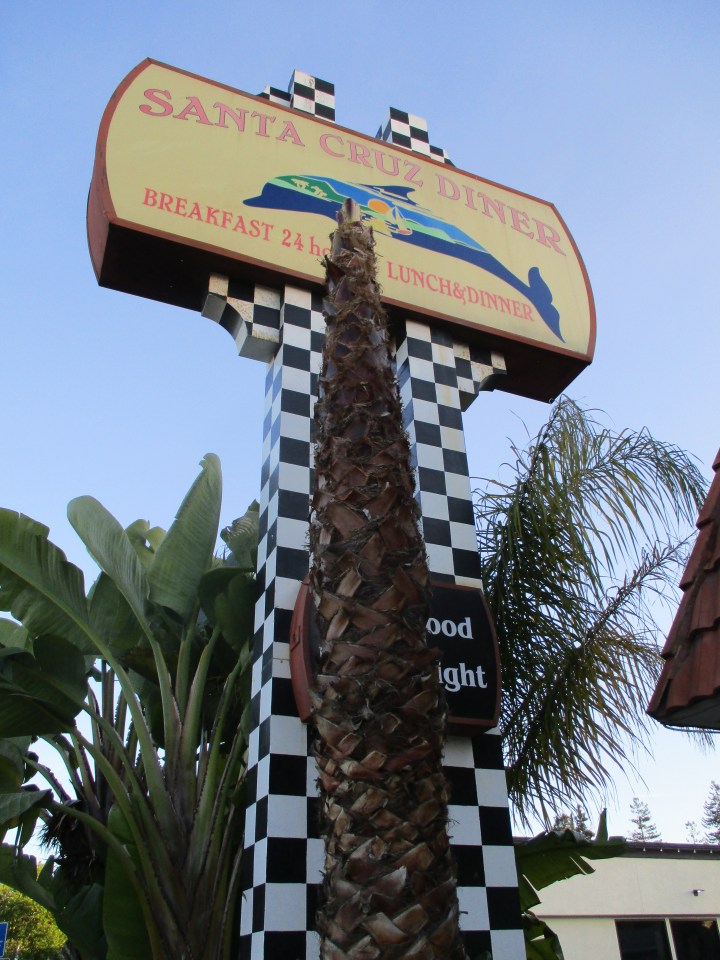
Location – Location -Location!

P80422Speaking of which, this is not the right location!

This unhappy Mexican fan palm may have grown here from seed, as they often do. They are notorious for growing under utility cables because that is where birds drop so many of their seed. Perhaps the seed for this one was dropped by a bird perched on the sign many years ago.

Ironic, isn’t it. Birds tend to perch on utility cables and signs and in trees and everywhere that palms should not be planted. How often do they drop seeds out in the open, where whey will not encroach into something as they grow up? Why can’t they drop palm seeds in places where palm trees would actually be an asset? It happens sometimes, but not as often as palms appear where they are not wanted.

The picture below shows three larger Mexican fan palms that were intentionally planted in the original landscape, with a smaller palm between two of the larger palms. The palm in the first picture is barely visible in front of the sign in the background, and is about the same size as the smaller tree that is more visible between the taller trees.

It is possible and perhaps likely that the two smaller palms were not planted intentionally. It is also possible that someone actually planted them.

It does not matter now. The palm in front of the sign needs to be removed. The removal of all the foliage will not kill it. It will generate new foliage that will again obscure the sign if the tree is not eliminated soon. There is no way to prune the palm to divert growth around the sign. It has only one terminal bud, and is unable to generate another if topped. Palms under utility cables have the same problem. Once they get too close to the cables, they must be removed.

Getting back to the first picture. The shock and awe of the defoliation of the subject Mexican fan palm was likely sufficient distraction to prevent anyone from noticing the queen palm foliage peeking around the right side of the sign. Unlike Mexican fan palms, queen palms rarely grow from seed here, especially in a spot where there are no other queen palms nearby. Yes, someone planted ‘another’ palm in the same spot!P80422+

Median Landscapes

P80311Medians are nice on the widest of boulevards. They break up the expansiveness of otherwise contiguous lanes. They make a four lane boulevard seem more like a pair of two lane roadways. Berms and other obstacles within medians limit the potential for head on collisions with traffic from opposite sides of the medians. Trees shade and cool some of the pavement when the weather gets warm. Besides all that, medians that are modestly landscaped simply look nice.

Notice that I said ‘modestly’ landscaped. There really is no need to get carried away with landscapes in medians. No one is really looking too closely at them anyway. People are driving past them, and really should be paying more attention to the road ahead rather than what is blooming to the side. Even passengers who are not driving probably are not seeing much of what goes into median landscapes. Color in such landscapes is nice; but no one cares if the color is provided by plants that are expensive and consumptive to maintain, or plants that can more or less survive on their own. It other words, resources should not be wasted on medians. Expensive and consumptive public landscapes should be installed only in parks or other places where they can be seen and appreciated.

Then there are those who must perform the maintenance. It is not safe for them. It will of course be necessary for crews to go out to maintain medians sometimes, and sometimes they might need to block a lane to do what needs to be done; but they should be out there as little possible. They should not be out there deadheading roses, pruning wisteria or planting petunias. They certainly should not be mowing lawns that no one can use! High maintenance features, like formal hedges, fountains, espaliers, trellises, arbors and beds of seasonal annuals, have no business out in medians! Such features require too much attention from those who must interact with traffic to attend to the maintenance.

Turf uses too much water anyway. It is useful in parks and athletic fields, but should be limited to situations where it can actually be useful for something. It is not useful in medians.

Trees are perhaps the best features of median landscapes, but even they are often not well thought out. They should be proportionate to the roadways that the get installed into, and get high enough for adequate clearance above truck traffic. Vertical clearance is not important if small trees can fit between the curbs of wide medians, but such wide medians should probably be outfitted with larger and taller trees. Trees in medians should exhibit complaisant roots that are less likely to damage curbs and pavement.

Landscape design takes serious work; and there is a lot to consider when designing landscapes for medians.

Tent City

P80224KIn the autumn of 1989, small and temporary tent cities appeared in parks and other public spaces around the San Francisco Bay Area and the Monterey Bay Area, where many homes had been damaged or destroyed by the Loma Prieta Earthquake. They were necessary at the time, but were not intended to be permanent features of the landscapes. For a while, they were unpleasant reminders that some people could not go home until their homes were repaired or rebuilt.

In more recent history, ridiculously expensive real estate and rents have increased homelessness in the same regions. Even gainfully employed people are homeless because they can neither purchase nor rent a home, either because of expense or because of a lack of availability. Those who live in homes complain about the unsightliness and other problems associated with the homeless living in homeless encampments and small tent cities.

We get it. Tents are bad.

So then, what is this small tent city on one of the main roadways in town?

Good planning and bad planning.

First the good. Each of the shop spaces in the contemporary retail building behind this tent city needs its own water meter and valve manifold. Each of these meters and manifolds must be easily accessible. Because they are accessible, they are also exposed, so they need to be insulated so that they do not freeze during the very rare occasion (in our mild climate) that the weather gets cold enough to do so. This explains why the water meters are next to the sidewalks, and the upright valve manifolds behind them are covered with these billowed tents.

The bad? Good landscape design should have been considered with the location of these meters and manifolds. A water main line should have been routed so that this whole complex could have been constructed within a utility closet or shed, or even a small utility yard that could have been fenced in a less prominent location. If constructed inside a utility closet or shed, the insulating tents would not be necessary. Now that it is too late for that sort of planning, there is not even enough clearance from the sidewalk for hedging or low fencing to obscure the meters and manifolds without obstructing access. It really would not have taken much of a landscape modification to obscure the view of all this infrastructure, if only more space had been made available where it is needed.

Sadly, landscape design was not a priority on this building. Although the water meters and manifolds are completely exposed, shrubbery obscures window and more appealing features of the buildings, such as ornamental stonework. The view from inside many windows is of the unsightly backsides of pointlessly shorn shrubbery. Trees were crowded and planted directly in front of signs, even though there is plenty of frontage without signs where trees could have been planted. It is amazing what some landscape designers get away with.

Dreamscape at the Jungalow

B80128The Jungalow is my colleague Brent’s bungalow home, surrounded by a jungle of a landscape, just about a block off of the Santa Monica Freeway in Mid City Los Angles.

This picture very effectively illustrates that Brent has no business taking pictures . . . and that he should have had a V-8.

The landscape really is spectacular though. You might have seen bits and pieces of it in Sunset Magazine or other horticultural magazines. Pictures of specific flowers and plants were used to illustrate the Sunset – Western Garden Book.

Brent likes his garden to be spectacular. He uses it to trial a few plants before using them at the homes of clients, and to demonstrate how effectively his home garden functions as a lush jungle oasis in the middle of the city. The dense hedging obscures views of neighboring homes, and muffles the sound of the Santa Monica Freeway and La Brea Avenue. Fountains obscure more of whatever outside noise that happens to get through. Although the situation is completely synthetic, and includes species that were imported from all over the World, to be pruned, groomed and trained to do unnatural things, Brent likes to think that it mimics nature. The straight lines, square corners and flat surface of the compact urban lot are invisible behind curvacious borders, terraces, lush foliage and sculptural trees. There is way too much material for such a compact space. It is all so completely contrary to the big city that surrounds it.

Three hundred and fifty miles to the northwest, on acreage in the forests of the Santa Cruz Mountains above Los Gatos, my garden could not have been more opposite. Despite the abundance of more space than I could possibly use, the area used for gardening was quite confined to less than an eighth of an acre. The hilly terrain was flattened as much as possible, and surrounded with straight retaining walls and walkways. Native vegetation was removed to allow more sunlight through. There was no need for hedging because there was nothing beyond the garden to obscure the view of. There was no need for fountains to obscure outside noise because the only outside noise was that of Zayante Creek at the bottom of the garden. For efficiency, plants were installed in rows and grids, and very evenly spaced. It was completely contrary to the surrounding forest.

That is why Brent is a landscape designer and I am just a horticulturist and nurseryman. Who is right? I am.