Analysis

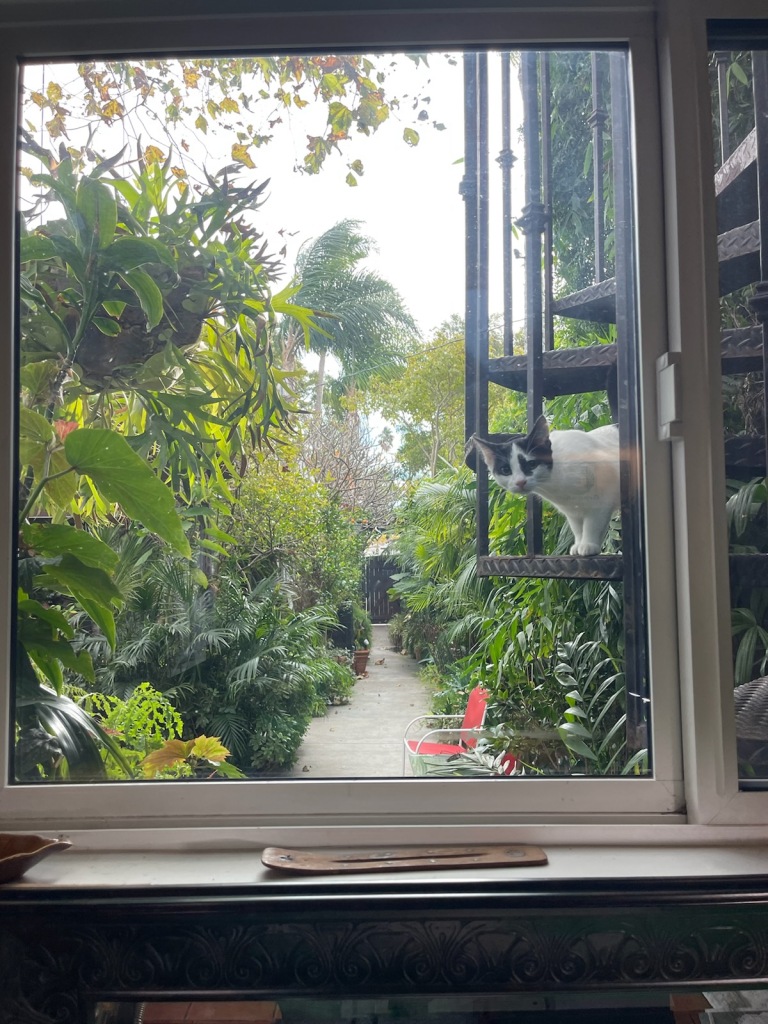
There is so much more to this picture than the kitty.

As Brent mentioned when he sent me this picture, which was included with my ‘Six on Saturday’ post earlier this morning, “There’s a lot going on in the picture.”

Slightly above the exact center of the picture, to the left of the tip of the kitty’s right ear, a Mexican fan palm peeks through a small void in the vegetation. It is at the curb of a home on the west side of the next street to the east. It is what Brent would have taken a picture of if he had zoomed in as intended. It leans to the right and south, as tall Mexican fan palms do there in response the the Santa Ana Winds.

The foliage of the queen palm above and to the left demonstrates that the Santa Ana Winds were blowing when the picture was taken.

The trunk that extends upward through another smaller void in the vegetation below the queen palm foliage is of another Mexican fan palm at the curb in front of Brent’s Jungalow. It is in alignment with the other Mexican fan palm to the east. Its canopy is obscured by that of the queen palm.

The foliage above and to the right of the primary Mexican fan palm, but below and to the right of the queen palm, is pink trumpet tree, which blooms spectacularly bright pink for spring.

The defoliated thicket of stems below and to the left of the primary Mexican fan palm is a large plumeria, which Brent, while very young, acquired from an elderly neighbor. He got it at about the same age that I was when I acquired my Dalmatian iris and rhubarb. More than a dozen other plumeria grow and bloom in a row that extends parallel to the walkway, in front of and behind the large specimen that is visible.

The somewhat yellowish foliage below and to the left of the plumeria is an impressively large Mexican lime that is somehow productive within all that shade.

The strange foliage that hangs outwardly from a dark central mass above and to the left of the Mexican lime, and left of the queen palm is a large colony of staghorn fern that is much closer to the window. Some sort of weird begonia foliage is below and to the left of it. California sycamore foliage is above it.

The top of a tall Indian laurel hedge is visible to the upper right of the picture. Some sort of odd dracaena and odd fern are visible to the lower left corner. Much but not all of the remaining vegetation is a mixture of understory palms, including various bamboo palms, Raphis palms and kentia palms. The spiral stairs lead to an upper deck, which has a splendid view of the rest of the garden that extends to the left, beyond the view of this picture. Finally, on the spiral stairs, is this kitty.

Horridculture – New Lawn for Old Trees

These mature oaks can not adapt to the irrigation that the new lawn requires.

Californian climates are impressively diverse. However, most climates here are chaparral or desert climates, or similar to such climates. That means that almost all rain occurs during the rainy winter season, and that almost no rain occurs during the dry summer season. Vegetation that is native to California is very familiar with the climates here. Therefore, it does not expect rain during summer. This should be obvious.

Some native species can adapt to irrigation during summer. Some may grow faster than they normally would without irrigation, but compromise their natural life span in the process. This is acceptable within some landscapes. Many riparian species are not bothered by irrigation.

However, some species adapt less efficiently. Some do not adapt at all. Some that can adapt while young can not do so while mature. Oaks are a common example of this.

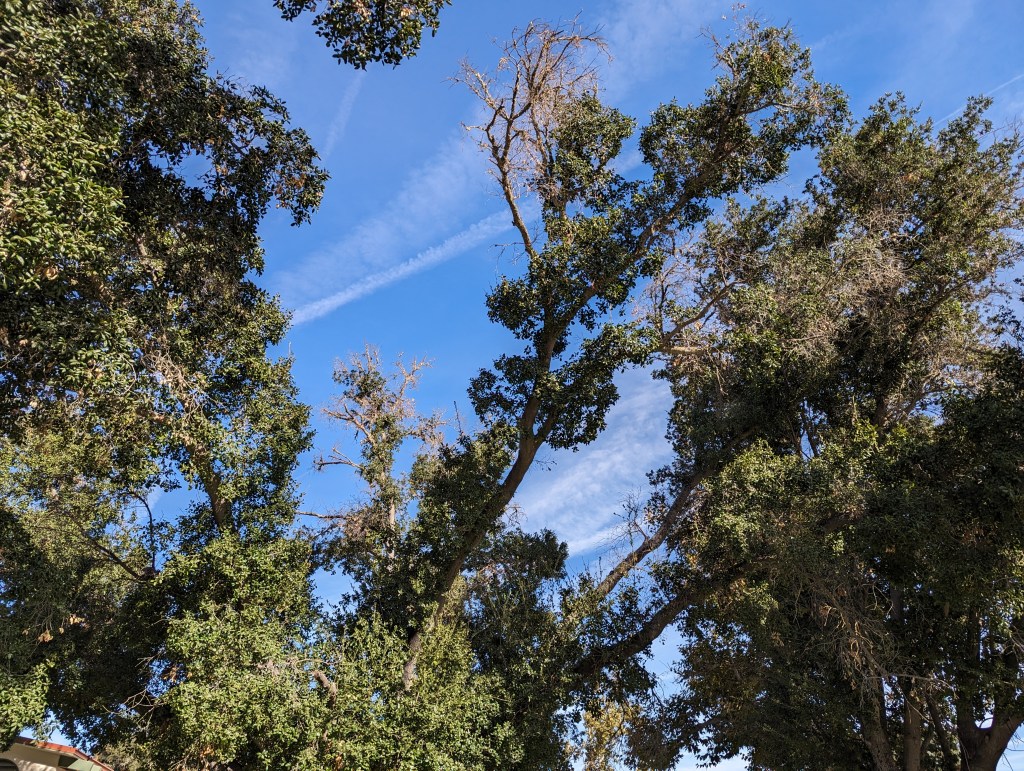
These coast live oaks with a few blue oaks were installed as shade trees within a formerly minimalistic landscape that did not include turf. They were happy with annual rainfall for half a century or so. Then, this generously irrigated lawn was installed around them. They can not adapt to the frequent irritation that the lawn requires. Their roots are succumbing to decay, so will eventually be unable to sustain their foliar canopies. As they deteriorate, decay may eventually compromise their structural integrity and stability. Dieback is already evident within their upper canopies, with lower watersprouts attempting to compensate.

I suspect that the trees will be removed before they deteriorate enough to become hazardous. I also suspect that new trees will systematically replace them prior to their systematic removal. Their eventual demise is likely an acceptable loss, and perhaps expected. Turf with adapted shade trees is likely more important within this particular situation than preservation of these middle aged oaks.

Dieback is evident within the upper canopy. Watersprouts are evident with the lower canopy.

Horridculture – Too Busy To Write

The little windmill palm is not so little anymore, and deserves a space in the garden.

It will be a while before I resume blogging as I formerly did, if I resume. I may just continue to share my gardening column here. The situation is too complicated to explain, and too irrelevant to bother with.

So, if I do resume, I hope to write more about my own home garden. I have been negligent in that regard for a few reasons. Firstly, my home garden is not very interesting. I am a nurseryman, so am in the habit of giving away anything in the garden as it becomes appealing. Secondly, my uninteresting home garden has been neglected for too long. I have been too busy with several other obligations that I still can not keep up with. Thirdly, the landscapes where I work part time are far more interesting than what I would grow in my own uninteresting and neglected home garden if it were not so uninteresting and neglected.

In the future, I hope to renovate my home garden and make it more interesting. Seriously, all those interesting species that I bring back but do not give away from Southern California, the Pacific Northwest and even the Phoenix region deserve a comfortable garden in which they can perform as they should. Seven cultivars of banana grow fast! It would be unhealthy for them to remain canned much longer.

Because I know nothing about landscape design, I do not know how to renovate my home garden, but can figure it out as I proceed, even if most of it is as simple and utilitarian as it had formerly been. Palms do not conform to a simply utilitarian garden, so do not leave me much choice about incorporating them as aesthetic elements. It should be fun. At least that is what I continually try to remind myself.

Fads Influence Contemporary Garden Design

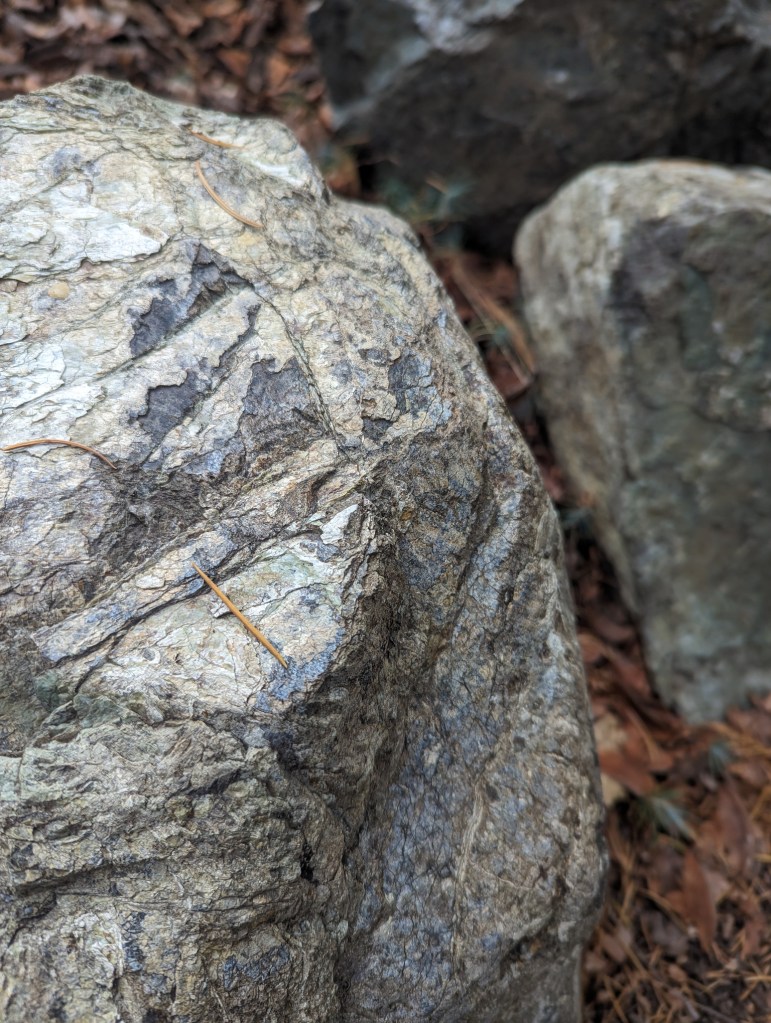
Even boulders can become a fad.

Landscape design and gardening trends change like every other sort of fashion. Several fads of the past were quite practical and justifiable. Many were not. Whether justifiable or not, many merely became old fashioned. Some evolved into a more contemporary style. Others were not so adaptable. Planning for a landscape is easier than planning for fads.

For example, plants seem to be disproportionately small within a new landscape. That is because someone planned for them to have sufficient room to grow. Shade trees should eventually mature to be proportionate to their respective spaces. In fact, all plants should mature accordingly. However, overly trendy queen palms can become passe at any time.

Many home gardens contend with fads from the past that are awkward to accommodate. Strict symmetry that was very common long ago has become more than old fashioned. It is now considered to be unappealing. Relaxed asymmetry is now common and popular. Of course, this is an advantage as aged trees of symmetrical rows begin to die randomly.

Queen palms that became popular in the 1990s are getting more expensive to maintain. Only professional arborists can groom them as they get too tall to reach from the ground. Queen palms at rear fences of backyards were a fad. Sadly, most utility cable easements are above such rear fences. Palms that encroach too closely necessitate costly removal.

Living Christmas trees was another fad that caused serious problems later. Most of such trees were either Italian stone pine or Canary Island pine. Many found permanent homes within confined home gardens after Christmas. They seemed to be so docile while small and potted. The problem was that both species grow too big for compact home gardens.

Sustainability is presently a fad that actually has potential to be beneficial in the future. It only needs proper execution. The results of fads may linger long after the fads are gone. Many trees that are fads now could survive for centuries. No fad demonstrates that more accurately than sustainability. That which is truly sustainable can evolve with future fads.

Horridculture – Bend The Truth

This bender board does nothing that the curb should not do.

The truth of this bender board is that it is not necessary. Seriously, what it is supposed to accomplish there that the curb should not already be doing? That stake wedged between the curb and the bender board to the upper left makes it seem even sillier than it already is. I realize that bender board is designed to bend, but this just draws attention to bad design. Perhaps this is one of those rare situations in which the stake should be on the inside, with the bender board screwed onto it, like might have been the intention for the unattached stake to the lower right. Heck, the curb does almost all of the work of holding the bender board in place anyway.

The dyed chipped wood to the upper right of the bender board seems to rely on the bender board for containment. That would be a realistic application for bender board in a situation that lacks a curb. For this situation, the curb should be adequate. If the soil below the chips is too high, it should have been excavated to a lower level prior to the installation of the chips. As one can see in this picture, such excavation would have been minimal.

Bender board certainly has practical application, such as separating chips like these from turf grass or ground cover. It might contain or provide a neat edge for vigorous ground cover. However, it does nothing that a curb does not already do. In some landscapes it merely adds another component to an innate tripping hazard. It gets dislodged or damaged if vehicles drive over it, or if enough people trip over it.

Unfortunately, for so-called ‘landscape professionals’ it is too easy to install; and such installation is too lucrative. Simplicity is much less lucrative.

Six on Saturday: Ghost Town

As a result of prioritizing our efforts within the landscapes at facilities that have been in use through summer, landscapes at unused facilities have been neglected. It would be embarrassing if anyone else were here to see the results. Those who maintain the other infrastructure have mentioned that these neglected areas resemble ghost towns. Flowers continue to bloom without any assistance. Also though, weeds continue to grow and toss seed for the next generation. There is so much to catch up on. What is worse is that I will not be working here much until November, and will be gone again in February.

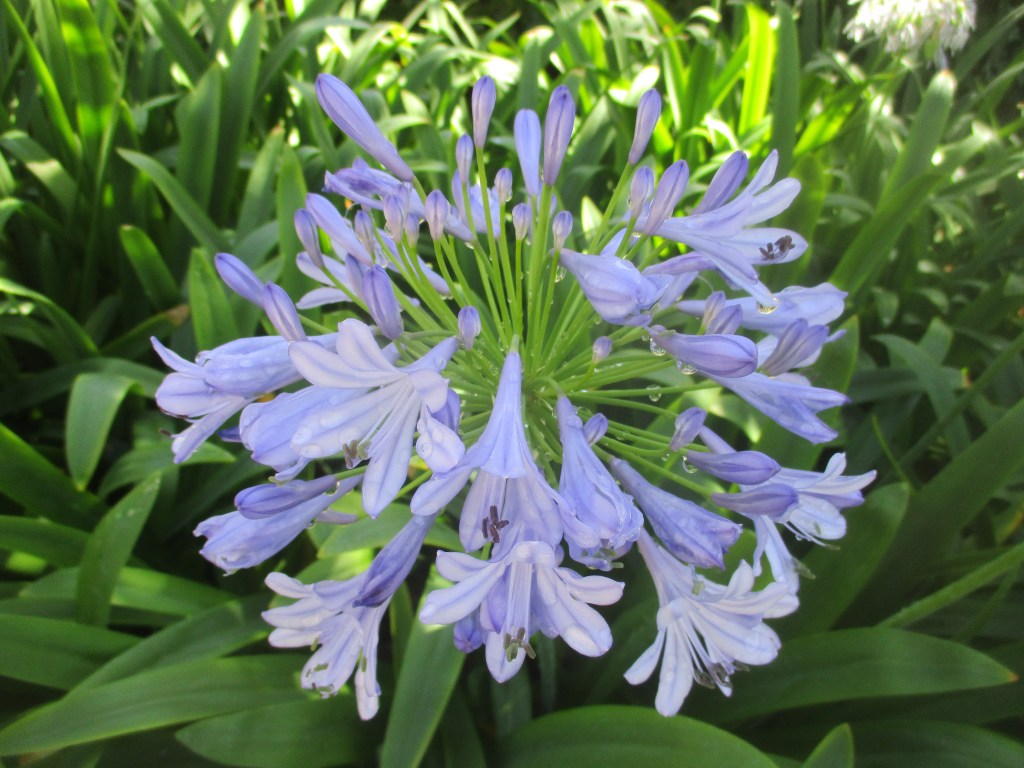
1. While no one is looking, lily of the Nile continues to bloom into the middle of September. I was not here to see it, but I suspect that this particular colony was not blooming on time for July.

2. Kahili ginger is blooming too, but right on schedule. This is obviously a substandard bloom. I am impressed nonetheless. It was not expected to bloom at all. It was just planted over winter.

3. Otherwise, most of the bloom here is that of weeds. Strangely, I do not remember anyone pulling weeds from the pavement before. Could the formerly constant traffic have inhibited them?

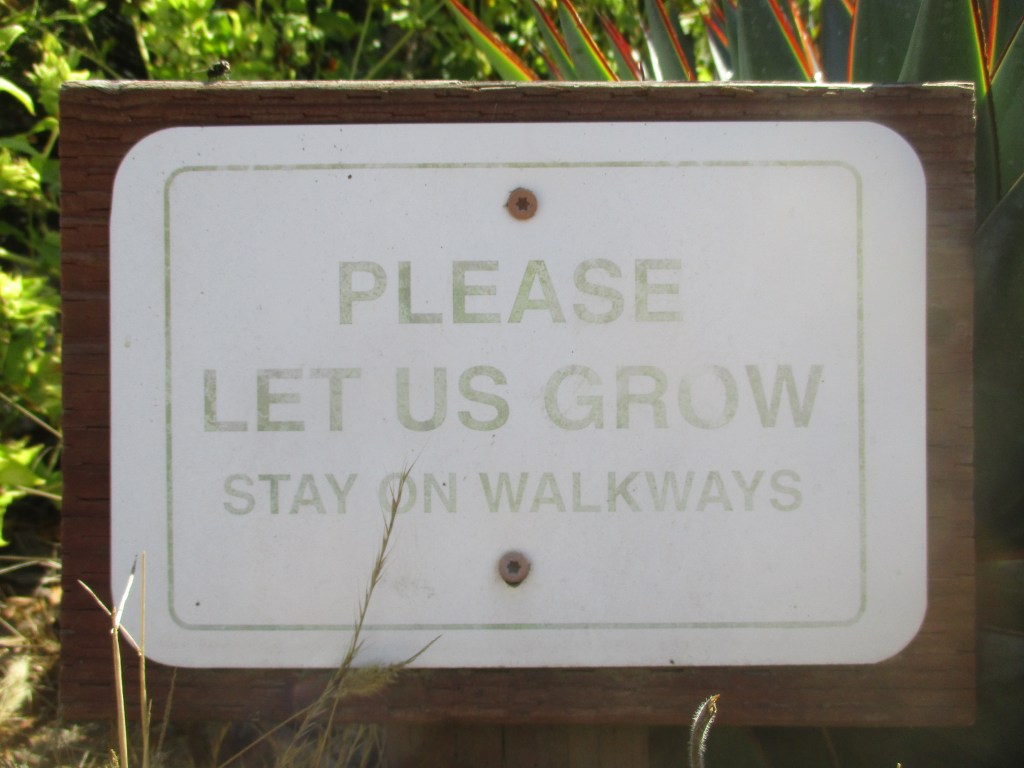
4. Should this say “PLEASE LET US GROW ON WALKWAYS” or maybe “PLEASE LET US STAY ON WALKWAYS”? Regardless, I am impressed by the ability of weeds to compose a sentence.

5. Grapes would certainly be easier to reach if they grew on neglected, hanging vines like these. Unfortunately, if left long enough to produce fruit, these vines would become a tangled thicket.

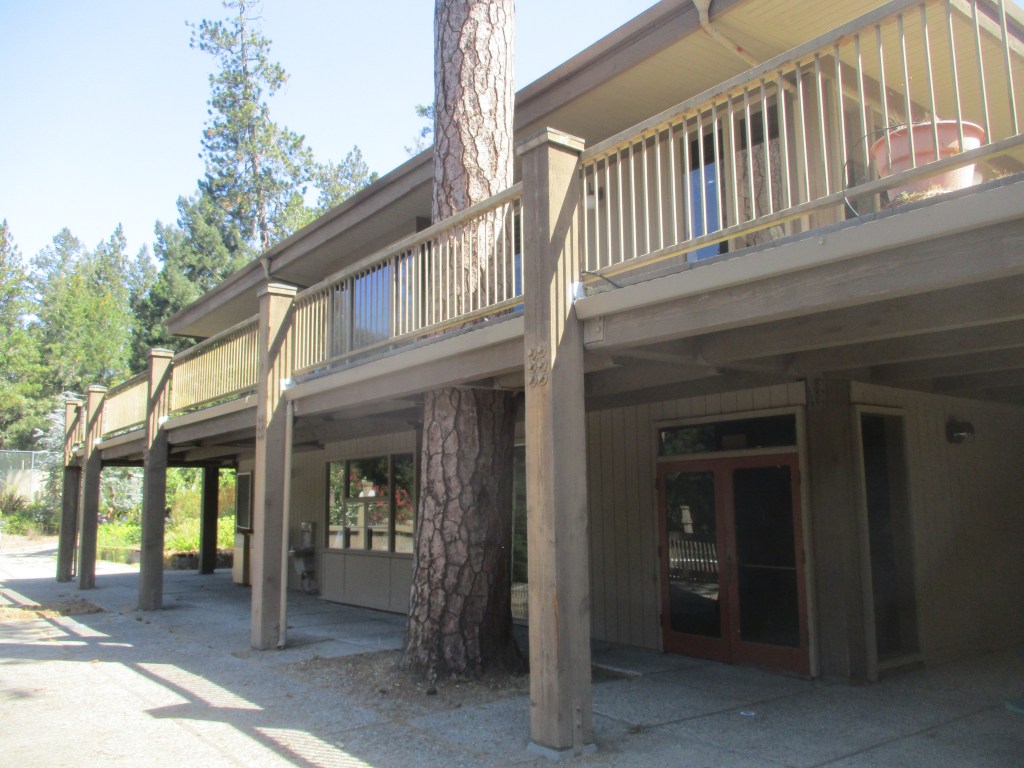
6. Goodness! This is what happens when a ponderosa pine seedling grows under a deck, and no one is here to pull it out before it grows right through! The weed problem here is now serious!!!

This is the link for Six on Saturday, for anyone else who would like to participate:

Nature Gets Too Much Credit

P00405
So much of nature is unnatural.

Vegetation make people feel closer to nature. It is, after all, what most of us expect to see out in the wild. Most vegetation that is observed in forests and undeveloped areas really is natural. Much of the associated insects and wildlife are natural as well. Such flora and fauna know how to survive within their respective ecosystems. They can not rely on any unnatural intervention from anyone.

Naturalized exotic (non-native) species proliferate only because they are adapted to similar environmental conditions. A lack of pathogens that afflicted them within their natural ranges is a major advantage for most of them. Nonetheless, they are unnatural components of what is commonly considered to be nature. Most naturalized exotic species actually interfere significantly with nature.

Vegetation and associated wildlife that inhabits synthetic landscapes is very different from that which lives out in nature. Only some of the vegetation has potential to naturalize. Even less is native. Almost all of it is reliant on artificial intervention for survival, particularly irrigation. Associated wildlife is reliant on the survival of the reliant vegetation. Landscapes accommodate. Nature does not.

With few exceptions, landscapes that emulate nature are impractical. Landscapes within forests are some of those few exceptions that might need no more than what the forests provide. Even in such situations, combustible vegetation and structurally deficient trees should be cleared away from homes. In California, nature is innately combustible. It is messy and potentially dangerous too.

Most urban landscapes of California would still be dreadfully bleak if limited to natural components. Both San Jose and Los Angeles are naturally chaparral regions. They were formerly inhabited by sparsely dispersed trees on scrubby grasslands. Now, relatively abundant vegetation in both regions is more appealing, and improves urban lifestyles, but is nothing like what nature intended.

Nature is simply inadequate for what is expected of urban landscapes of California.

Horridculture – Halloween

P91009Halloween is a topic that I could rant about for days. Seriously. I loathe it. I dislike any formerly respectable holiday that has been ruined by excessive commercialization. We all know what happened to Christmas. For me, Halloween, in some regards, is even worse. Christmas is at least pretty. Halloween is intended to be morbid and grotesque and creepy and . . . just plain bad.


This should be about gardening though. Yes, there is always that guy who gets too drunk at the Halloween party down the road, but manages to stagger just far enough to vomit on my lawn. Then, I need to figure out how to get all the toilet paper out of the redwoods. The nasturtiums that get trampled by hasty brats who are too old for trick-or-treating will eventually recover.

The worst, though, are the Halloween ‘decorations’ in the front yard! We put too much work into maintaining our gardens in good condition to make them look so bad. I do not care if it is just for one day out of the year. Seriously, it is just wrong, on so many levels. Why on Earth should I want my garden to look as cheap and trashy as young ladies dressed up as naughty nurses?!

Pumpkins and even Jack-O’-lanterns are tolerable, and even appealing in a traditional sort of way, but spiderwebs make me think that the witches could put their brooms to better use than frequent flier miles. All those angry black cats should more efficiently control all the spiders and bats. Tombstones?! – Corpses in various degrees of decay?! – There goes the neighborhood!!P91009+

What about the effigies concealed by white sheets, and the other effigies hanging from trees and porches? Whoever thought those were good ideas?! Perhaps Brent can share some insight.

P90330+++++

Boom! Zap! Wow! Bam! Zing!

P90630P90630+P90630++P90630+++P90630++++Batman and Robin were here!
. . . well, not quite. It is decoration for summer camp. We never know what we will find in the landscapes that we maintain here. Those who work at camp arrive before guests, so that they can get ready, and of course, to decorate. Guests only started to arrive two weeks ago. It makes our work more interesting, as we try to work around the traffic and events, but it is SO gratifying to see so many guests enjoy the facilities that we maintain!
Those who work at camp enjoy being here too. It is obvious in all the work they put into preparation. It gets pretty wild and colorful, as I was reminded when I found what had been done in a grove of coast live oak just outside of one of the main auditoriums. Last year, I pruned and groomed the trees to expose their naturally sculptural trunks. I thought they were rather exemplary; but apparently, there was some room for improvement.
There is more to the wardrobe of a well rounded tree than mere ‘trunks’. One might select stylish attire such as this. Really though, I am not certain if this tree is feeling ‘Absolutely Fabulous’ or totally embarrassed.P90630+++++
This one went for an old fashioned veil.P90630++++++
English ivy on the ground below the grove is wearing too much makeup.P90630+++++++
It is not really makeup of course. It is paint from this mysteriously hovering door . . . as if that somehow makes more sense. It was locked.P90630++++++++
This one is more my style, and it has a window. There is no need to open it to see what is outside . . . or inside.P90630+++++++++
If neither of those are good enough, there are plenty of others to choose from.P90630++++++++++