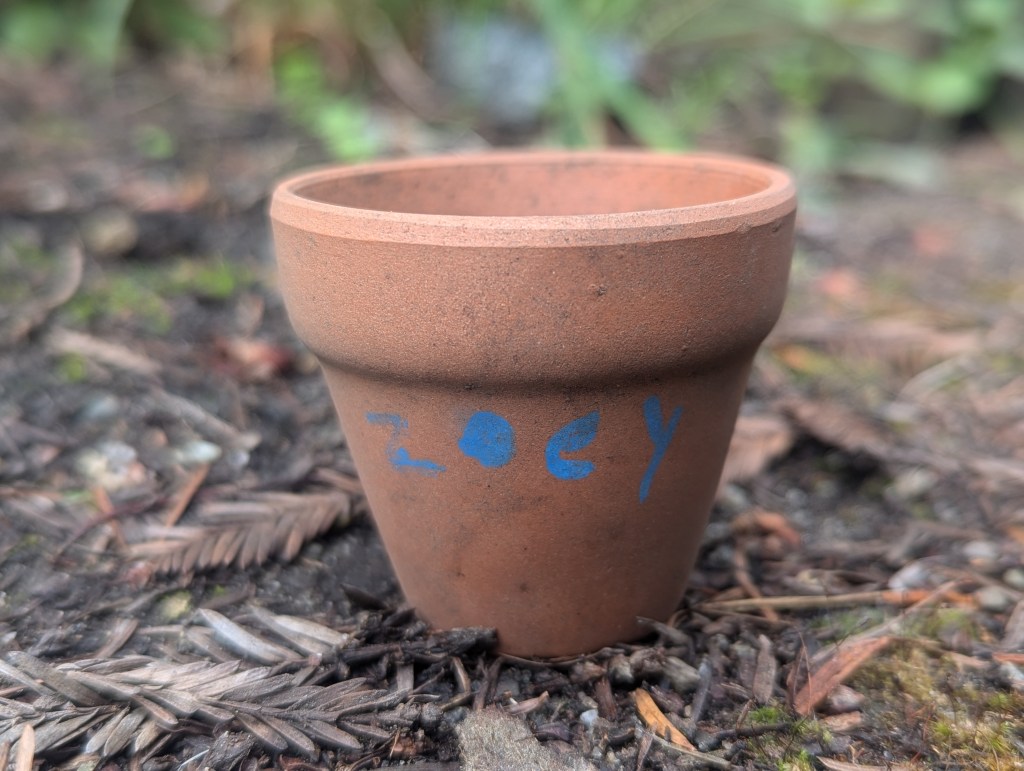
Working within landscapes is obviously very different from working on the farm. Actually, there are too many differences to mention. One difference is people. There are only a few on the farm, spread out over many acres. Conversely, the landscapes that I work in are designed for use and enjoyment by countless people who attend events there. I can rarely get away from all of them. Although it can be fun, it can also be challenging, and often interesting. On rare occasion, I find artifacts that make me wonder about whomever left them. This tiny terracotta pot with “Zoey” painted on it, for example, was found in a small landscape outside of a bookstore, quite a distance from the facility a which young children typically engage in such crafts. I hate to think that Zoey misplaced it there. I sort of hope that it was intentionally left there, perhaps containing a tiny plant that Zoey hoped a gardener would find and add to the landscapes. If so, I found it too late and empty. Zoey does not need to know that. Hopefully, if she returns, she finds something that she believes to be her plant growing happily in our landscapes.
Pavement necessitates trees with complaisant roots.
Trees of substantial size are not as popular as they had been among old home gardens. Modern landscapes of bigger homes on smaller parcels can not accommodate as many. Clearance from various infrastructure is now more of a concern than shade. Within many modern urban gardens, most available space is in front. Such is the realm of street trees.
This is not because of a lack of obstacles, such as infrastructure that requires clearance. It is more because such obstacles are closer to the ground with more open space above. Many street trees must actually be more adaptable to certain constraints than other trees. Selection of such trees, if allowable by their municipalities, necessitates diligent scrutiny.
Street trees are, most simply, trees between curbs and sidewalks. Some inhabit medians while others are adjacent to curbside sidewalks. Many municipalities prescribe particular trees for particular situations. Anyone who is uncertain of such limitations should inquire. Many municipalities permit property owners to install any trees they prefer, or none at all.
For those who can select street trees, such trees must be appropriate to their application. They must grow high enough to not obstruct sidewalks or roadways. Both sidewalks and roadways require minimal clearances. So do street signs, streetlamps and traffic signals. However, street trees should not grow too large for the confined spaces that they inhabit.
This includes their roots. Aggressive roots of willows, poplars and sweetgum are likely to displace pavement. Oaks, although too big for confined situations, are more docile. Their roots are less likely to displace adjacent infrastructures. Crape myrtle has become overly common because it is too small to cause damage. It does not make much shade, though.
Crape myrtle might also get rather messy, which is another consideration for street trees. It drops flowers during summer, and can get infested with scale, which exude honeydew. Magnolias drop flowers that can be a slipping hazard. Whether deciduous or evergreen, street trees should be reasonably tidy. Over roads, they should not need much attention.
(This is an old recycled article that includes very outdated information, some of which was omitted, but the website for the San Francisco Flower & Garden Show is the same.)
Bonsai, composting, palms, flower arranging and lawn alternatives, as well as rare, edible and drought tolerant plants; there will be seminars for almost every horticultural topic imaginable at “Life in the California Garden”, the 26th annual San Francisco Flower and Garden Show. Xeriscapes, contemporary garden design and water conservation; there will be something for anyone who enjoys any kind of gardening. A schedule of seminars and any other information can be found at www.sfgardenshow.com.
The most spectacular display will be the twenty gardens created by some of the most innovative local, and perhaps not so local, landscape designers and horticultural professionals. There will be everything from contemporary to traditional and functional to ‘artistic’ landscapes. Anyone who has been to a San Francisco Flower and Garden Show knows what ‘artistic’ can mean, but will be surprised nonetheless.
Just about anything that can be done in the garden will be done at “Life in the California Garden”. Bee keeping, practical pest control and water management will all be there. “The Modern Homestead” designed by Star Apple Edible Gardens of Oakland will be a 6,000 square foot exhibit featuring aesthetic vegetable plantings and an elegant chicken coop, as well as beer and jam making demonstrations.
The Marketplace will include more than 200 vendors with all sorts of seeds, plants, tools, gifts, patio furniture, pottery and garden sculpture. Plants will range from orchids, dahlias, epiphytes, vegetable plants, cacti and succulents, to name a few. The Farmers’ Market will have flowers and produce available. Sproutopia will feature interactive gardening experiences and demonstrations for children.
Many very impressive bonsai will be exhibited by the prestigious Bonsai Society of San Francisco. Many of the bonsai subjects that are decades old have been returning to the San Francisco Flower and Garden Show for many years. There will also be bonsai demonstrations.
Horticulturists of the Western Horticultural Society will be available to discuss rare and recently introduced plants, as well as more traditional plants that are regaining popularity. Some recent introductions are not yet available in nurseries. California Garden Clubs will have representatives from many of the various horticultural associations, with information about membership.
Gladiolus papilio from Skooter’s Garden makes my garden more special than any ‘high end’ garden.
What exactly does that mean?! Why should I care? My lack of concern seems to be directly proportionate to the intensity with which someone tries to impress upon me that I should be so concerned. A colleague from high school tried to tell me about a new television show about a so-called ‘landscaper’ in Michigan who is so extremely ‘successful’ that he also lives in a home in Florida for the winter. I suspect that both of his homes combined are worth about as much as a single home here, but I will just continue with this premise that he is successful. He does exclusively ‘high end’ work, which regularly involves moving huge boulders with old fashioned technology because that is what his ‘high end’ clients want. I needed to interrupt. The ‘high end’ nonsense annoyed me too much. So, they have huge boulders in their landscapes. Perhaps their landscapes were very expensive to install. Splendid! ‘High end’ spending is healthy for the economy. Why is this any of my business? I do not know. I am a horticulturist, not an economist. My garden contains rhubarb from the garden of my paternal paternal great grandfather, and Dalmatian iris from the garden of my maternal maternal great grandmother. That is horticulturally significant. ‘High end’ gardens seem to be more concerned with expenditure than with horticulture, as if spending more will somehow make it better. Do those who purchase ‘high end’ gardens actually work in them? Do they grow anything from the gardens of their ancestors? I know that some do, but I suspect that some do not. The primary purpose of their ‘high end’ landscapes is lavishness. I can not doubt that such landscapes serve such purposes more than adequately, but am nonetheless unimpressed by their typical lack of horticultural relevance.
Brent’s landscape style is VERY different from mine.
If you have ever seen ‘The Osbornes’ on television, you know how extravagant the work of landscape designer Brent Green of GreenArt of West Hollywood can be. He actually landscaped and has maintained the home of the Osbornes since before the Osbornes lived there, and has managed to fit a more extensive range of plants into the gardens than I have grown in my career as a horticulturist, arborist and nurseryman. His own home garden is just as bad . . . I mean ‘extravagant’, with more diversity of plants than could be found in any nursery.
Would you believe that Brent Green and I were actually college roommates in the dorms? Sometimes I do not believe it either. Nearly a quarter of a century ago, he came two hundred miles north, and I came two hundred miles south to ‘meet in the middle’ and study horticulture at Cal Poly in San Luis Obispo. He was very trendy for the time, wearing brightly colored mid ‘80’s clothes and a flat topped afro like Grace Jones. (Yes, he once had hair.) I was old fashioned for ten years earlier, just like I am now, with Levi’s, Durango’s and flannel.
As a landscape designer, Brent Green enjoys the diversity of plants, and getting them to fit into practical, functional and yet very enjoyable landscapes, gardens and outdoor rooms. Most of his favorite work is lush and tranquil, with all the fancy and artful curves, ‘meandering’ walkways, water features, extensive diversity of plants, and herds of color! Conversely, I am still a nurseryman at heart, so engage my garden as a commodity with conformity, simplicity and very basic functionality. I grow vegetables, many fruit trees, and many ‘copies’ of the same reliable plants that I propagate myself, mostly arranged in what Brent Green refers to as straight line ‘row crops’.
Yet, our gardening philosophy is the same. We both ENJOY our gardens, and agree that everyone should likewise do gardening on their own terms. Those who do not enjoy gardening should not need to. There are plenty of other things besides gardening to enjoy.
To facilitate the execution of proper horticultural techniques, we should grow only what we are able and want to take care of. What looks good in a magazine may require more attention that we can commit to or would enjoy. I still believe that the legendary horticulturist Robert Leakley was the first to say what many have copied in various forms since, “If you enjoy it, you are doing it right.”
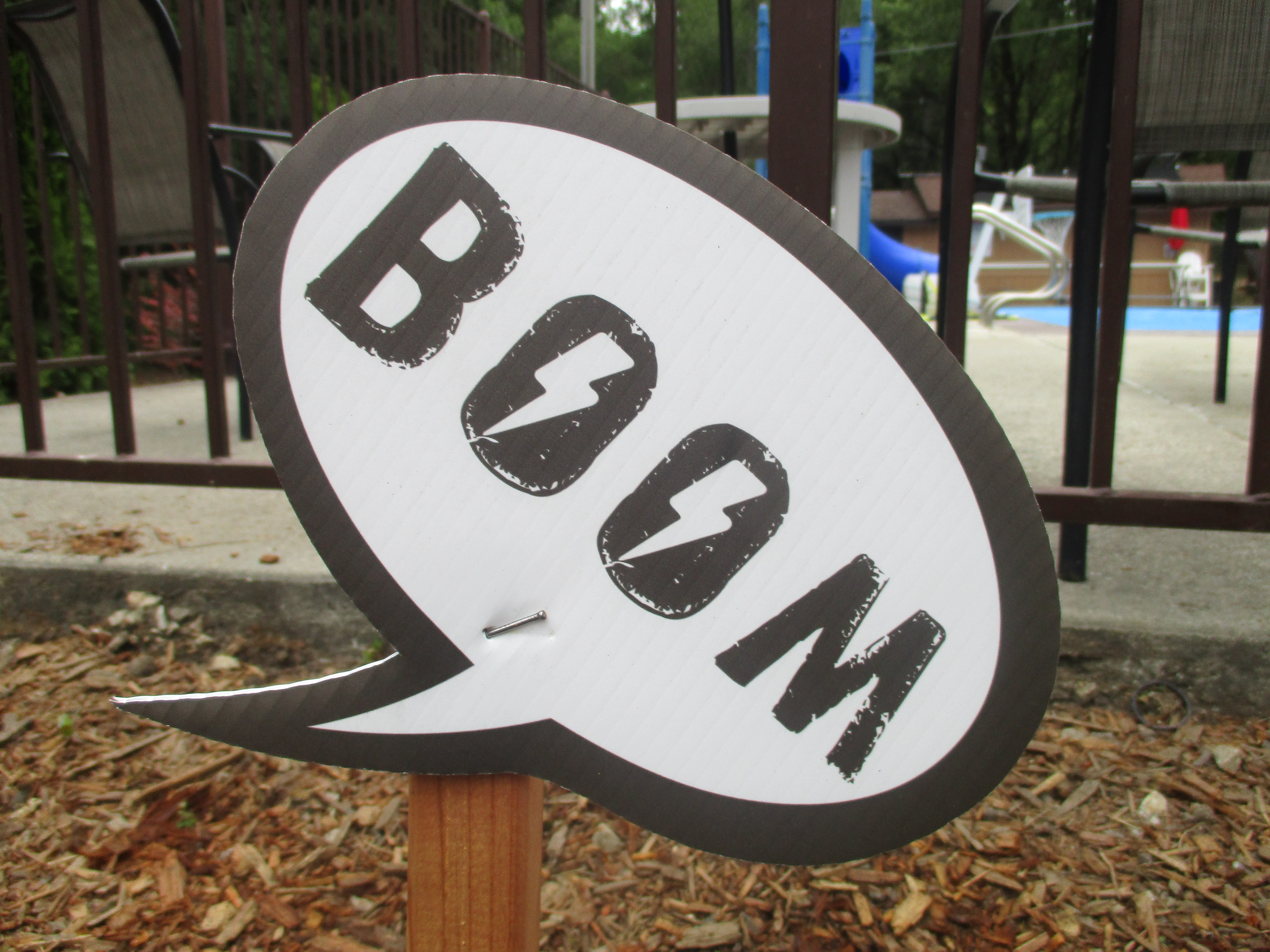
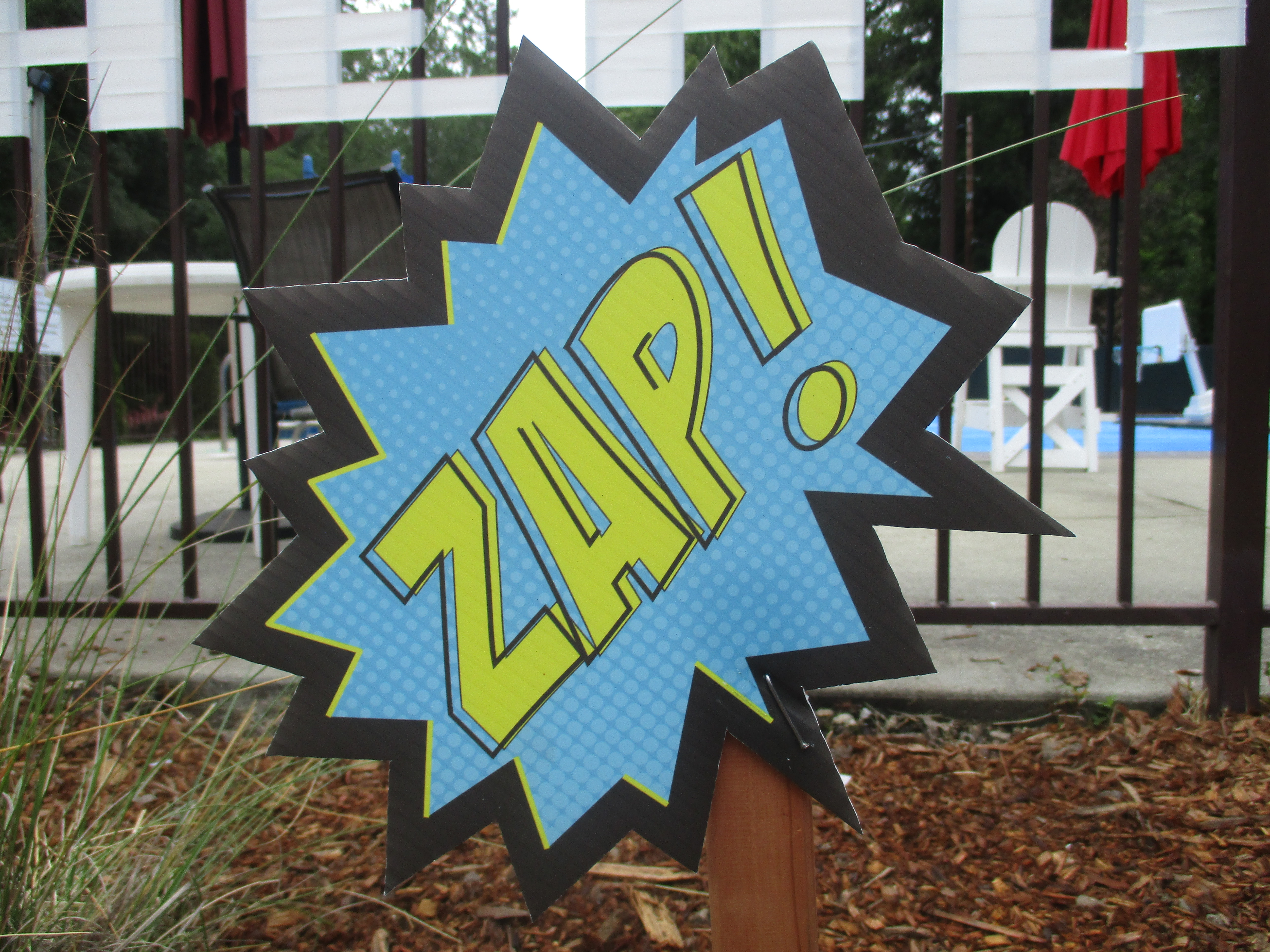
Batman and Robin were here!
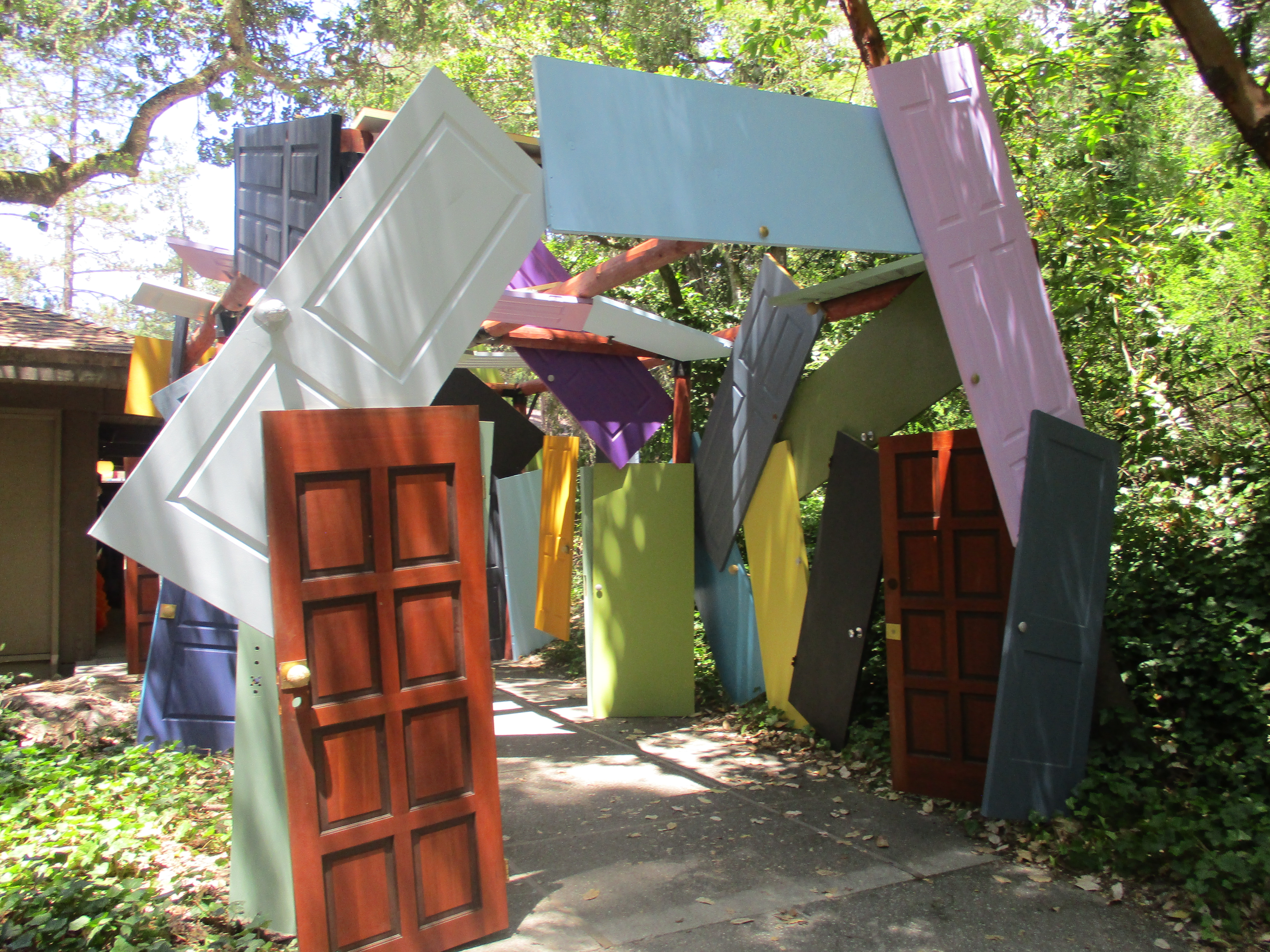
. . . well, not quite. It is decoration for summer camp. We never know what we will find in the landscapes that we maintain here. Those who work at camp arrive before guests, so that they can get ready, and of course, to decorate. Guests only started to arrive two weeks ago. It makes our work more interesting, as we try to work around the traffic and events, but it is SO gratifying to see so many guests enjoy the facilities that we maintain!
Those who work at camp enjoy being here too. It is obvious in all the work they put into preparation. It gets pretty wild and colorful, as I was reminded when I found what had been done in a grove of coast live oak just outside of one of the main auditoriums. Last year, I pruned and groomed the trees to expose their naturally sculptural trunks. I thought they were rather exemplary; but apparently, there was some room for improvement.
There is more to the wardrobe of a well rounded tree than mere ‘trunks’. One might select stylish attire such as this. Really though, I am not certain if this tree is feeling ‘Absolutely Fabulous’ or totally embarrassed.
This one went for an old fashioned veil.
English ivy on the ground below the grove is wearing too much makeup.
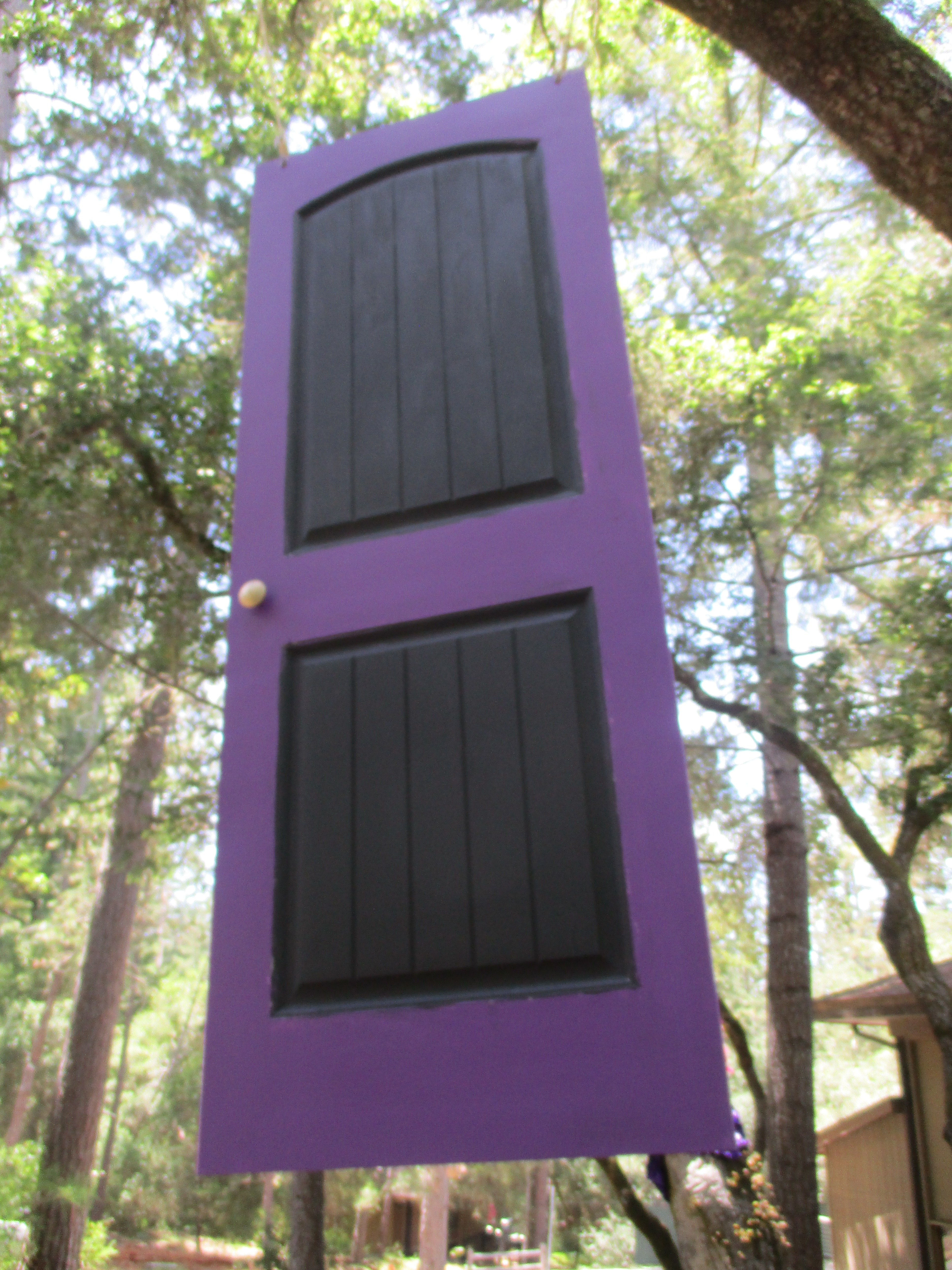
It is not really makeup of course. It is paint from this mysteriously hovering door . . . as if that somehow makes more sense. It was locked.
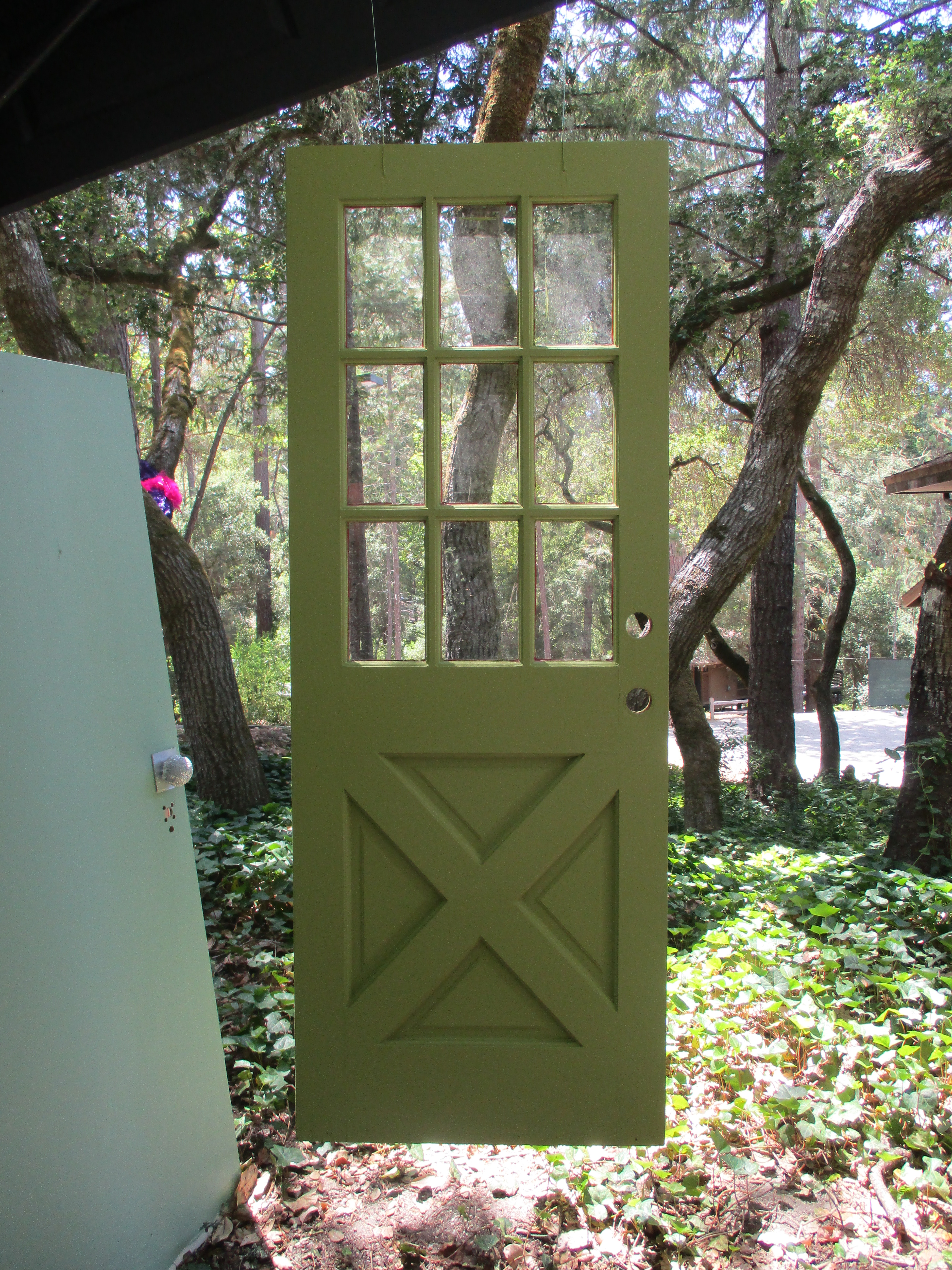
This one is more my style, and it has a window. There is no need to open it to see what is outside . . . or inside.
If neither of those are good enough, there are plenty of others to choose from.
I am no designer. I am merely a horticulturist. I grow things, and I know how things should be grown in landscape situations.
My colleague Brent Green is a landscape designer, as well as a horticulturist. He knows how things should be grown in landscape situations too, but more importantly, he knows how to assemble the landscapes that they grow in. He creates the sort of landscapes that most people think that all horticulturists strive for. (A few pictures of his home garden can be found in a former article, as well as another similar article that it links to: https://tonytomeo.com/2019/04/06/six-on-saturday-brents-garden/ .)
Brent and I have two completely different sets of standards for landscape design, to say the least. His ideal landscapes are very lush and inviting, with abundant color and fragrance. Mine are very simple and structured, with abundant fruits and vegetables. He strives to bring the ambiance of wild jungles into very urban settings. I try to instill formality and structure into the forests. Yet, we both agree that landscapes must be functional.
That means that landscapes must work for those using them, whatever they are using them for. Almost all of Brent’s clients use their landscapes as extensions of their homes, so want them to function as such.
I do not design landscapes, but I do happen to work in some. Most are in public spaces, and some are comparable to athletic fields. They function very differently from those in residential situations.
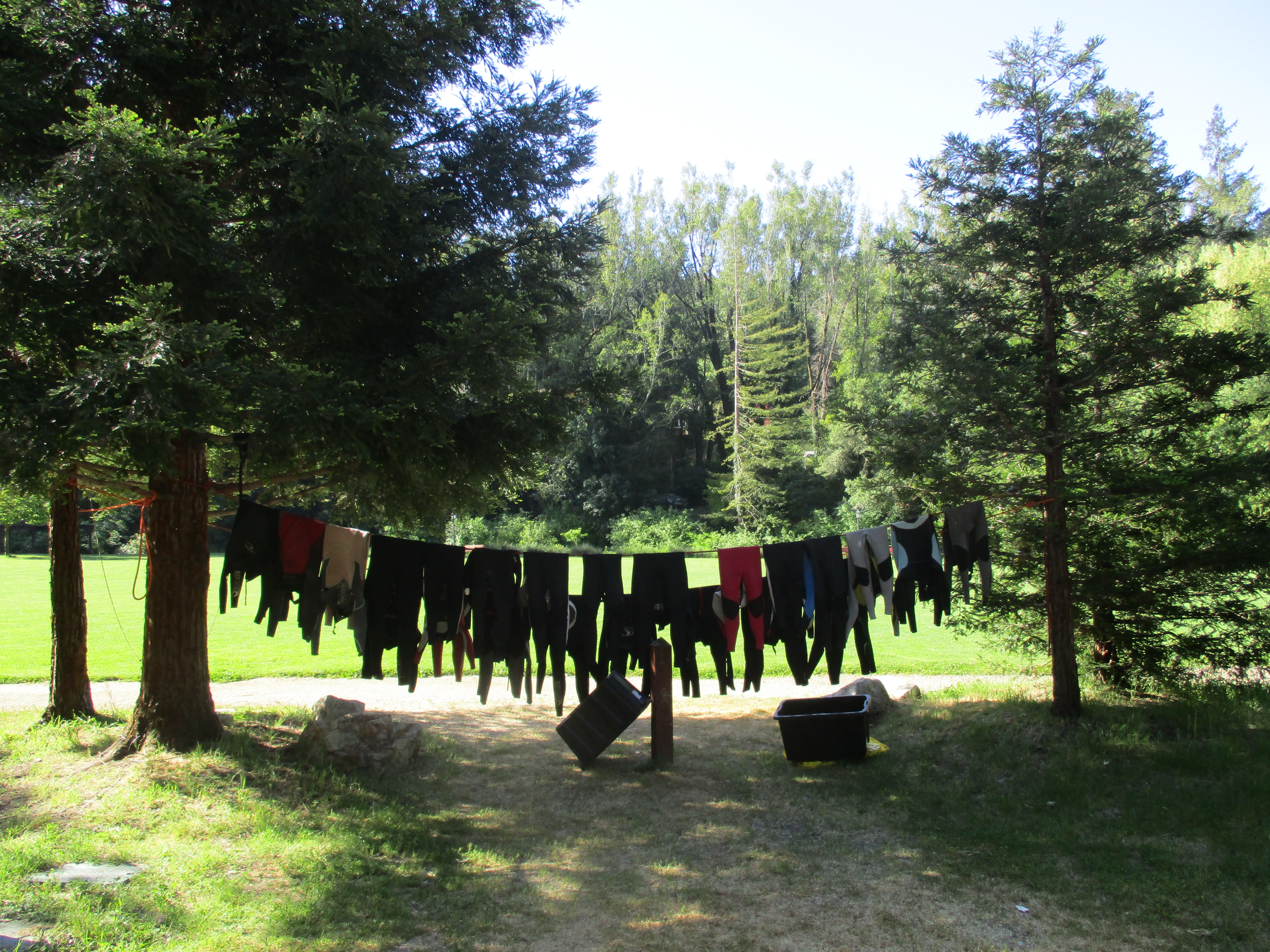
The unexpected way that these three small redwoods are functioning in this landscape was just too amusing to not get a picture of. I have no idea where all these wet suits came from, or why they are hung in this particularly prominent location, but it is the last thing I expected to encounter here.
This is likely the worst illustration that I have ever used. It is sort of what it looks like; a mud puddle. What I mean by ‘sort of’ is that this is no ordinary mud. It is a now solidified slurry that was rinsed from a concrete delivery truck. Yes, solidified, right there next to an embankment covered with carpet roses. The curb near the top of the picture is where the embankment starts. The small pile of debris to the upper left is some of what I was pruning from the roses. There was another solidified puddle of slurry just a few yards away. They were just dumped there as if no one would notice.
What makes this even more infuriating is that there is a sign on the main gate into the site, as well as a few others throughout the site, explaining to everyone coming and going that they must wash mud or other crud from their vehicles before leaving the site, so that they leave nothing on the roadway outside. This refers mainly to mud on the tires, but really includes anything that makes a mess. There are washing stations within the site for those who must wash their tires before leaving. There is also a site for slurry such as this, that can not be rinsed into culverts that drain into the adjacent creeks. The management of the project did everything necessary to prevent this sort of thing from happening. Yet, here it is.
A smaller but more destructive puddle of slurry was dumped into my downtown planter box by tile setters working in an adjacent shop. https://tonytomeo.com/2017/11/04/my-tiny-downtown-garden/ That mess needed to be broken apart and removed, but could not be separated from the perennials that is flowed around before solidifying. All of the canna foliage, some nasturtiums and some of the aloes were destroyed.
The insensitivity is ridiculous. I could not imagine leaving debris from pruning roses where the new concrete was installed, as if no one would notice. Yet, such disregard for landscaped areas is quite common. That is why trees that are to be salvaged on a construction site need to be fenced. Even with fencing, they are very often damaged or ruined by those operating machinery. Wouldn’t that be comparable to an arborist cutting a tree down in the most efficient manner, even if it fell onto an adjacent house?
We learned it young from Schoolhouse Rock. Those of us who studied Landscape Design were compelled to learn why, and assume that it is always true.
Well, I am not a landscape designer. I am just a horticulturist and arborist. I can see why three is the best number for groups of trees, and that five is probably the second best option for larger groups, followed by seven, and then nine, and so on. I sort of understand why two, four, six, eight and so on are not so desirable. However, these rules are not absolute.
When I was a kid, many suburban front yards were outfitted with three European white birch trees. Such groups were typically in a corner of the rectangular yards, just outside of the curvacious mowing strips that were designed to make the rectangular spaces seem to be more irregular than they really were. Individually, the groups of three birches were appealing. Collectively, they were cliché. They were supposed to look more ‘natural’; but there is nothing natural about contrived groups of three trees, especially when it is so prevalent. That is not how they grow in forests.
Now, although I am no landscape designer, I do happen to know that good landscape design is compatible with the architecture of the building that it is associated with.
Early American architecture really should be landscaped in the Early American style. This might seem to be simple, just because Early American landscapes are simple and utilitarian, with most of the plant material at a safe distance from the buildings. The difficulty is that such landscapes are very symmetrical, with paired shrubbery and trees, and several paired and evenly spaced trees flanking roadways. The left matches the right. That means quite a bit of twos, fours, sixes, eights and so on. Early American landscape design developed at a time when nature was something to be dominated and utilized in the most efficient manner possible. Not many landscape designers comprehend this philosophy, or would adapt to it if they did understand.
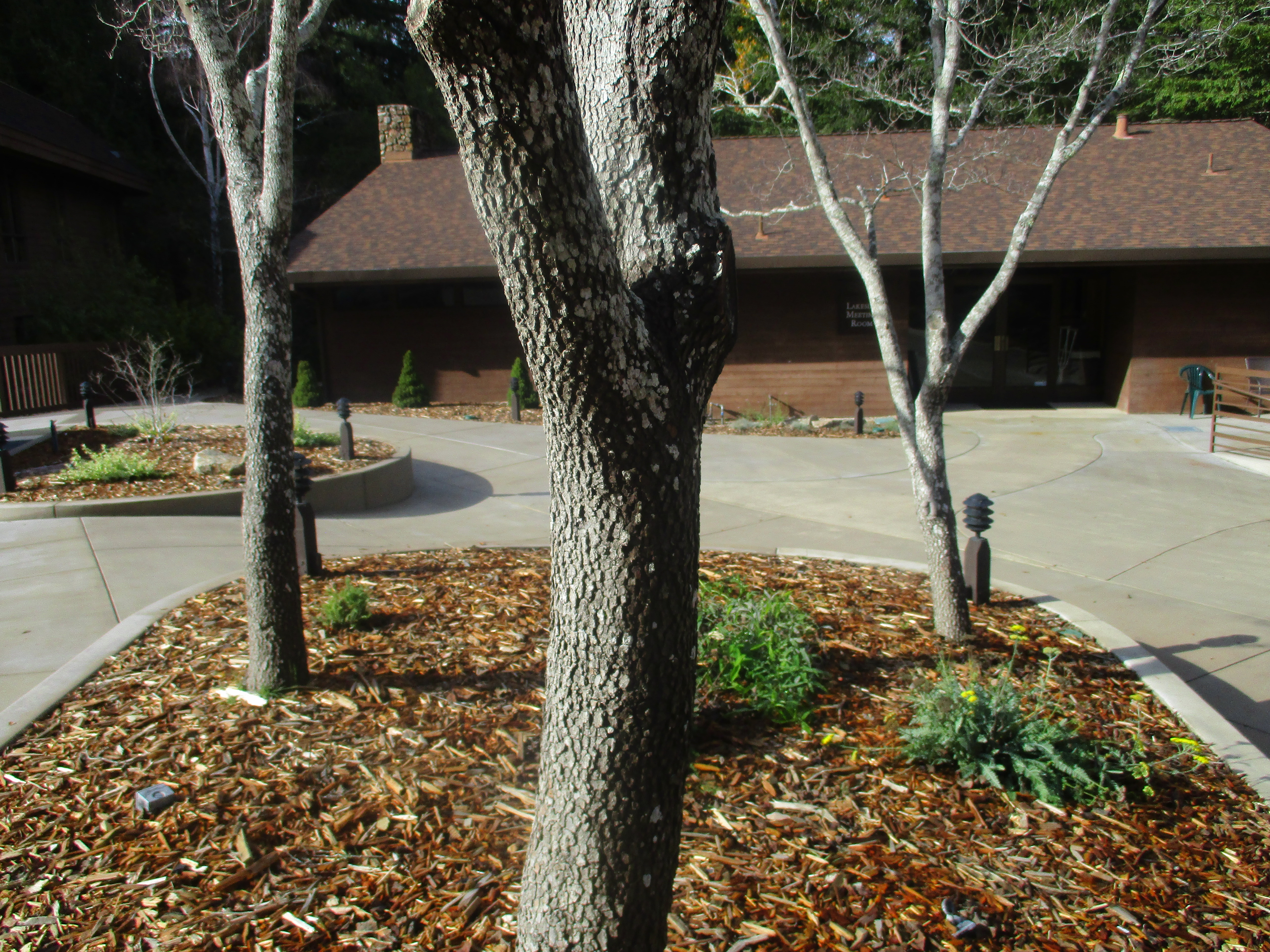
The group of three dwarf Alberta spruce in the picture below was not intended to be a rebellious expression of formality. As you can see, it really is a group of three. Yet, they are also evenly spaced in a straight row that parallels the adjacent wall. Without pruning, they will always be very symmetrically conical. Cool!
One never knows what strange artifacts might be found out in public landscapes. It is amusing enough to find items discarded or simply misplaced long ago by former occupants of a home out in a private home garden. Public landscapes are even more interesting, since they collect debris and artifacts from many more people. Some landscapes have been doing so for a long time.
Besides litter, the most commonly found artifacts are sporting equipment. Frisbees, baseballs, tennis balls, soccer balls, volleyballs and such are commonly lost in dense vegetation. Golf clubs, baseball bats and tennis rackets sort of make one wonder. Chew toys are sometimes left by dogs who go after them, but then return with something they perceive to be more interesting.
Landscapes that are near roadways often feature car parts that might have fallen out of cars as they drove by, as well as a few that cars could not have driven by without. Obviously stolen items, such as purses and wallets, often surrounded by a few credit cards that they likely contained sometimes appear. Stolen mail might fit into that category.
I have yet to find anything as interesting as tickets to a San Jose Sharks game, a big bag of money, Elvis, a purple dinosaur from another plant or a flying saucer that brought it here. However, I have found evidence of time travel!
A retaining wall that holds back an embankment above a parking lot at work was apparently constructed by Mike Menard in 1982, who left his name and the date inscribed into the concrete on top of the wall. That by itself is nothing too remarkable. What IS remarkable is that an adjacent retaining wall was constructed four hundred years later, and three hundred and sixty-four years from now, in 2382!





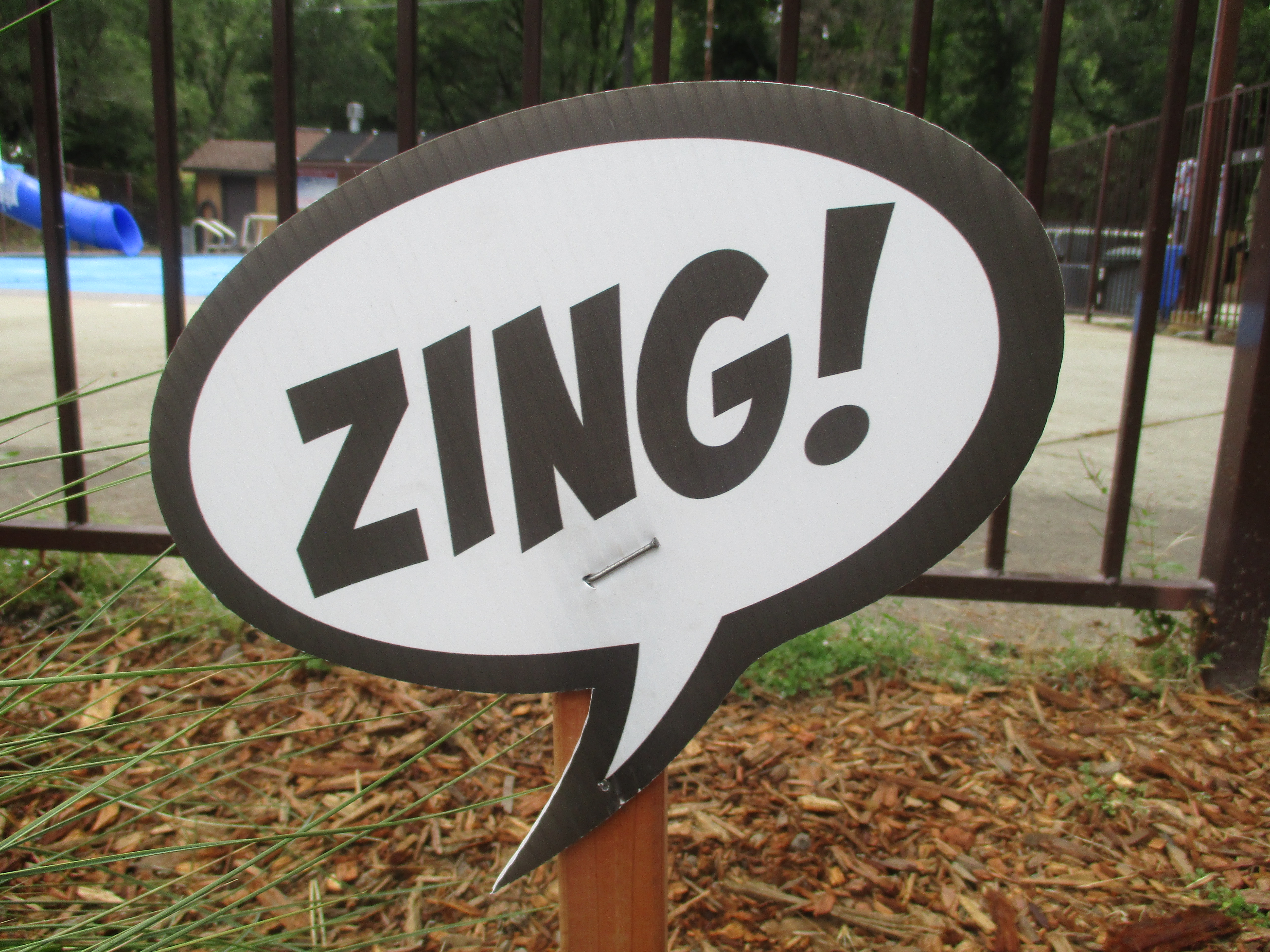 Batman and Robin were here!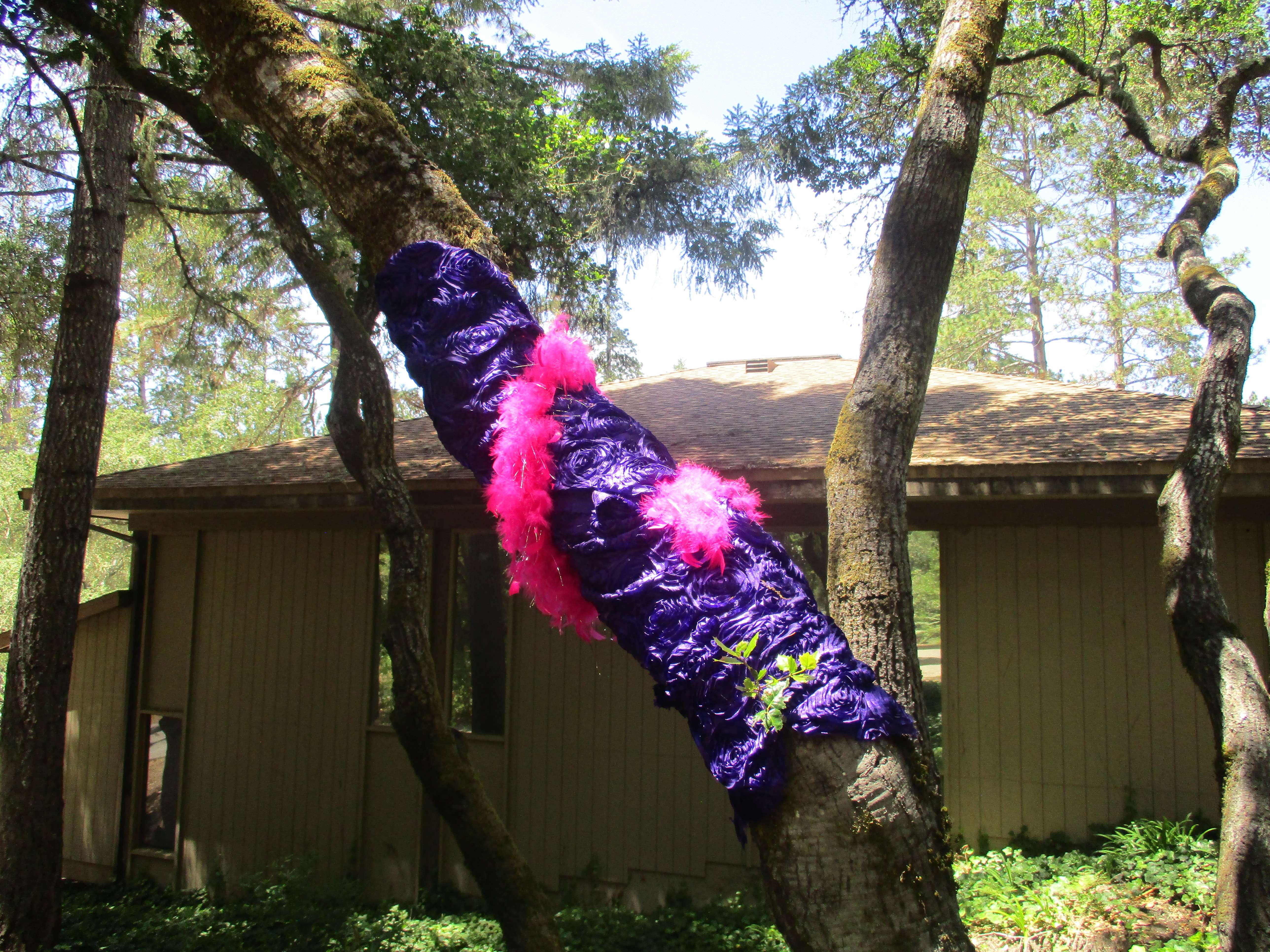


 I am no designer. I am merely a horticulturist. I grow things, and I know how things should be grown in landscape situations.
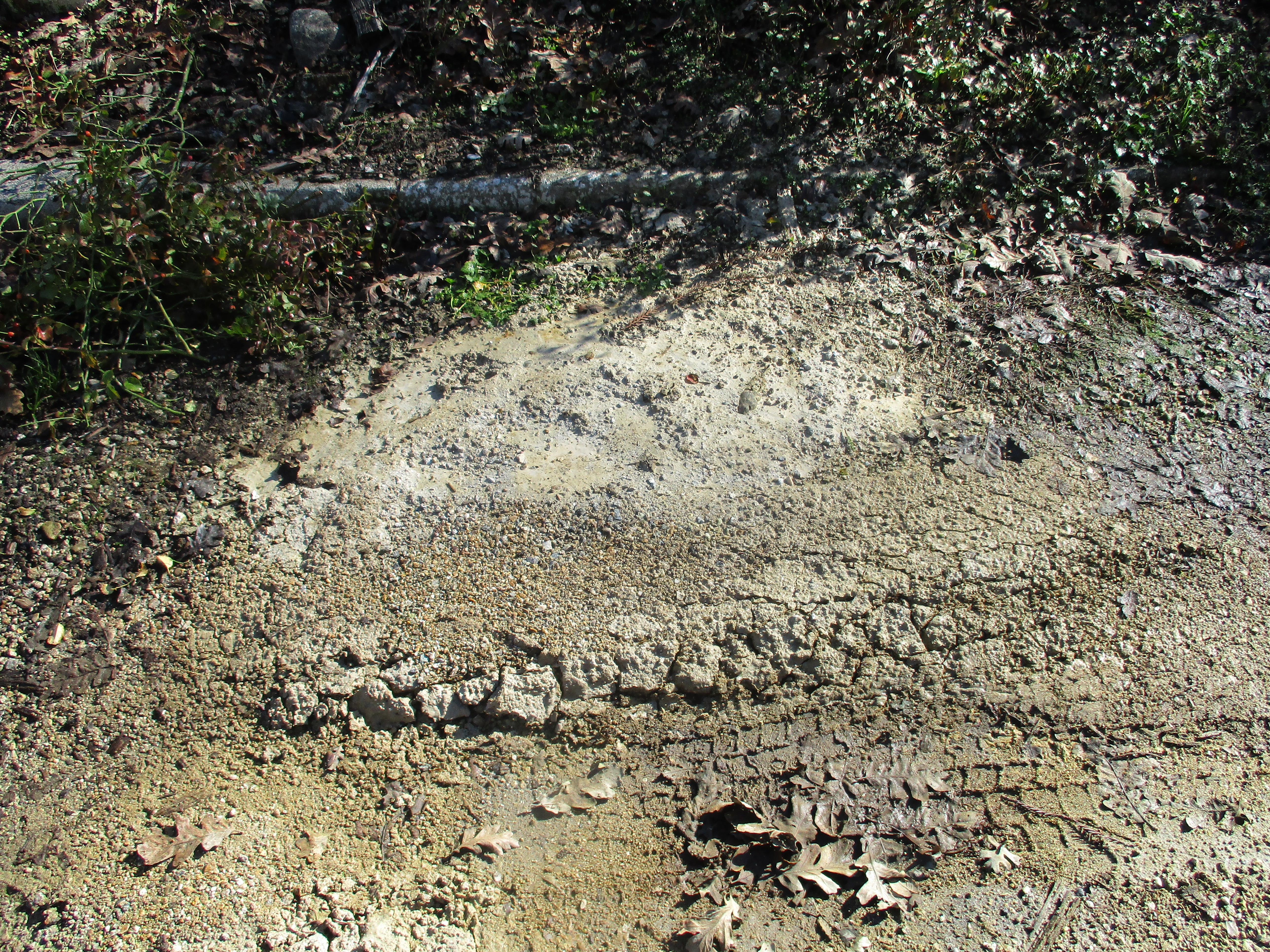 This is likely the worst illustration that I have ever used. It is sort of what it looks like; a mud puddle. What I mean by ‘sort of’ is that this is no ordinary mud. It is a now solidified slurry that was rinsed from a concrete delivery truck. Yes, solidified, right there next to an embankment covered with carpet roses. The curb near the top of the picture is where the embankment starts. The small pile of debris to the upper left is some of what I was pruning from the roses. There was another solidified puddle of slurry just a few yards away. They were just dumped there as if no one would notice.
 We learned it young from Schoolhouse Rock. Those of us who studied Landscape Design were compelled to learn why, and assume that it is always true.
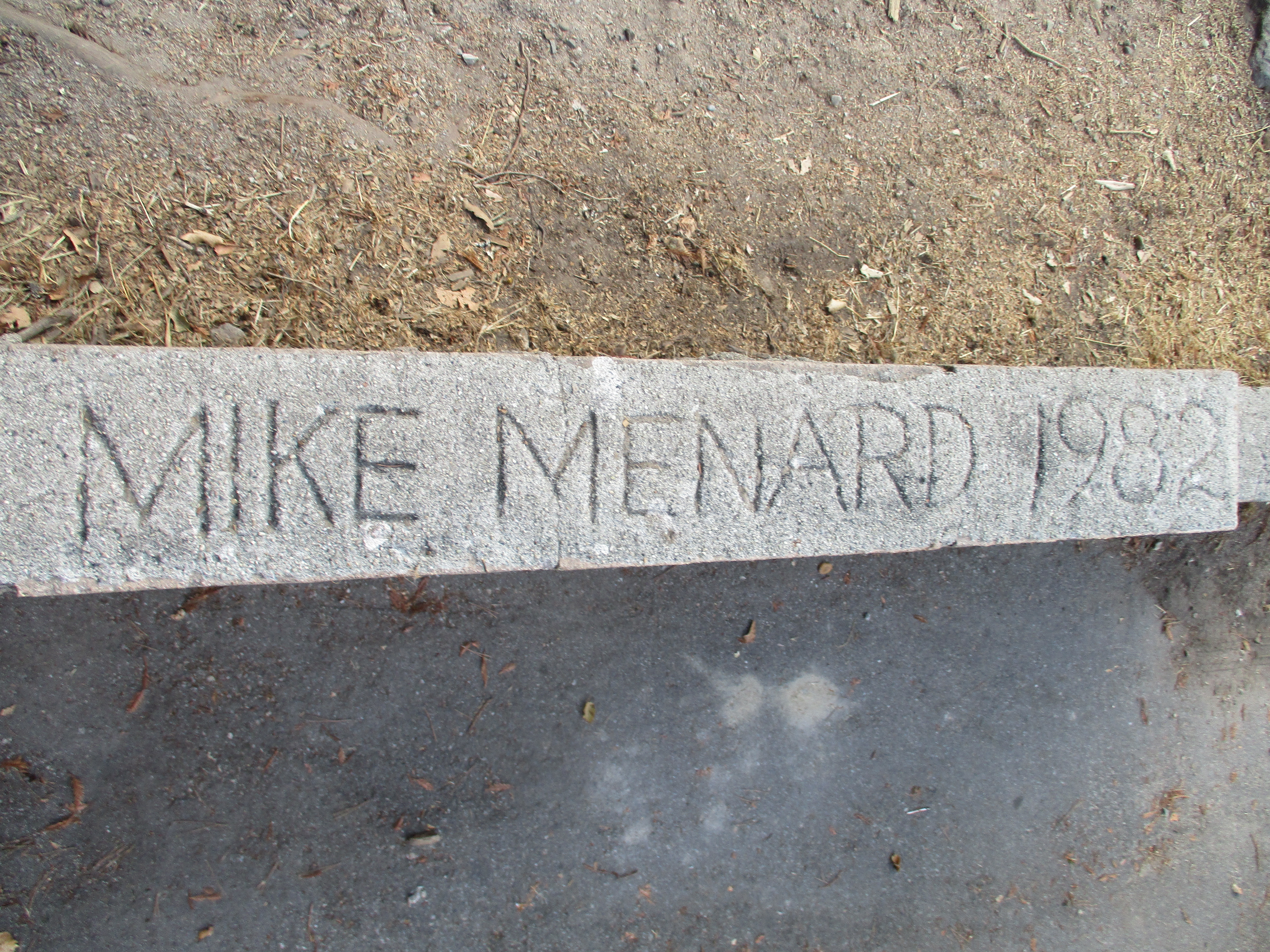 One never knows what strange artifacts might be found out in public landscapes. It is amusing enough to find items discarded or simply misplaced long ago by former occupants of a home out in a private home garden. Public landscapes are even more interesting, since they collect debris and artifacts from many more people. Some landscapes have been doing so for a long time.
 Tony Tomeo