Median Landscapes

P80311Medians are nice on the widest of boulevards. They break up the expansiveness of otherwise contiguous lanes. They make a four lane boulevard seem more like a pair of two lane roadways. Berms and other obstacles within medians limit the potential for head on collisions with traffic from opposite sides of the medians. Trees shade and cool some of the pavement when the weather gets warm. Besides all that, medians that are modestly landscaped simply look nice.

Notice that I said ‘modestly’ landscaped. There really is no need to get carried away with landscapes in medians. No one is really looking too closely at them anyway. People are driving past them, and really should be paying more attention to the road ahead rather than what is blooming to the side. Even passengers who are not driving probably are not seeing much of what goes into median landscapes. Color in such landscapes is nice; but no one cares if the color is provided by plants that are expensive and consumptive to maintain, or plants that can more or less survive on their own. It other words, resources should not be wasted on medians. Expensive and consumptive public landscapes should be installed only in parks or other places where they can be seen and appreciated.

Then there are those who must perform the maintenance. It is not safe for them. It will of course be necessary for crews to go out to maintain medians sometimes, and sometimes they might need to block a lane to do what needs to be done; but they should be out there as little possible. They should not be out there deadheading roses, pruning wisteria or planting petunias. They certainly should not be mowing lawns that no one can use! High maintenance features, like formal hedges, fountains, espaliers, trellises, arbors and beds of seasonal annuals, have no business out in medians! Such features require too much attention from those who must interact with traffic to attend to the maintenance.

Turf uses too much water anyway. It is useful in parks and athletic fields, but should be limited to situations where it can actually be useful for something. It is not useful in medians.

Trees are perhaps the best features of median landscapes, but even they are often not well thought out. They should be proportionate to the roadways that the get installed into, and get high enough for adequate clearance above truck traffic. Vertical clearance is not important if small trees can fit between the curbs of wide medians, but such wide medians should probably be outfitted with larger and taller trees. Trees in medians should exhibit complaisant roots that are less likely to damage curbs and pavement.

Landscape design takes serious work; and there is a lot to consider when designing landscapes for medians.

Tent City

P80224KIn the autumn of 1989, small and temporary tent cities appeared in parks and other public spaces around the San Francisco Bay Area and the Monterey Bay Area, where many homes had been damaged or destroyed by the Loma Prieta Earthquake. They were necessary at the time, but were not intended to be permanent features of the landscapes. For a while, they were unpleasant reminders that some people could not go home until their homes were repaired or rebuilt.

In more recent history, ridiculously expensive real estate and rents have increased homelessness in the same regions. Even gainfully employed people are homeless because they can neither purchase nor rent a home, either because of expense or because of a lack of availability. Those who live in homes complain about the unsightliness and other problems associated with the homeless living in homeless encampments and small tent cities.

We get it. Tents are bad.

So then, what is this small tent city on one of the main roadways in town?

Good planning and bad planning.

First the good. Each of the shop spaces in the contemporary retail building behind this tent city needs its own water meter and valve manifold. Each of these meters and manifolds must be easily accessible. Because they are accessible, they are also exposed, so they need to be insulated so that they do not freeze during the very rare occasion (in our mild climate) that the weather gets cold enough to do so. This explains why the water meters are next to the sidewalks, and the upright valve manifolds behind them are covered with these billowed tents.

The bad? Good landscape design should have been considered with the location of these meters and manifolds. A water main line should have been routed so that this whole complex could have been constructed within a utility closet or shed, or even a small utility yard that could have been fenced in a less prominent location. If constructed inside a utility closet or shed, the insulating tents would not be necessary. Now that it is too late for that sort of planning, there is not even enough clearance from the sidewalk for hedging or low fencing to obscure the meters and manifolds without obstructing access. It really would not have taken much of a landscape modification to obscure the view of all this infrastructure, if only more space had been made available where it is needed.

Sadly, landscape design was not a priority on this building. Although the water meters and manifolds are completely exposed, shrubbery obscures window and more appealing features of the buildings, such as ornamental stonework. The view from inside many windows is of the unsightly backsides of pointlessly shorn shrubbery. Trees were crowded and planted directly in front of signs, even though there is plenty of frontage without signs where trees could have been planted. It is amazing what some landscape designers get away with.

Dreamscape at the Jungalow

B80128The Jungalow is my colleague Brent’s bungalow home, surrounded by a jungle of a landscape, just about a block off of the Santa Monica Freeway in Mid City Los Angles.

This picture very effectively illustrates that Brent has no business taking pictures . . . and that he should have had a V-8.

The landscape really is spectacular though. You might have seen bits and pieces of it in Sunset Magazine or other horticultural magazines. Pictures of specific flowers and plants were used to illustrate the Sunset – Western Garden Book.

Brent likes his garden to be spectacular. He uses it to trial a few plants before using them at the homes of clients, and to demonstrate how effectively his home garden functions as a lush jungle oasis in the middle of the city. The dense hedging obscures views of neighboring homes, and muffles the sound of the Santa Monica Freeway and La Brea Avenue. Fountains obscure more of whatever outside noise that happens to get through. Although the situation is completely synthetic, and includes species that were imported from all over the World, to be pruned, groomed and trained to do unnatural things, Brent likes to think that it mimics nature. The straight lines, square corners and flat surface of the compact urban lot are invisible behind curvacious borders, terraces, lush foliage and sculptural trees. There is way too much material for such a compact space. It is all so completely contrary to the big city that surrounds it.

Three hundred and fifty miles to the northwest, on acreage in the forests of the Santa Cruz Mountains above Los Gatos, my garden could not have been more opposite. Despite the abundance of more space than I could possibly use, the area used for gardening was quite confined to less than an eighth of an acre. The hilly terrain was flattened as much as possible, and surrounded with straight retaining walls and walkways. Native vegetation was removed to allow more sunlight through. There was no need for hedging because there was nothing beyond the garden to obscure the view of. There was no need for fountains to obscure outside noise because the only outside noise was that of Zayante Creek at the bottom of the garden. For efficiency, plants were installed in rows and grids, and very evenly spaced. It was completely contrary to the surrounding forest.

That is why Brent is a landscape designer and I am just a horticulturist and nurseryman. Who is right? I am.

Is That A Body?!

P71118

It seems that changes in fashion are sometimes partly motivated by rebellion against what they are changing from. The comfortably loose and pendulous ladies outfits of the 1920s that were so unflattering to the human form while revealing more of it than ever before were probably a rebellion to the impractically uncomfortable and strenuously refined ladies fashions of the late Victorian period that were designed to enhance the ideal of feminine form while also obscuring it. The simple and squared landscapes of the 1950s that were so neatly tailored that they would be considered to be bleak by modern standards were replaced through the 1970s and into the 1980s by a much more relaxed and curvaceous style with sculptural trees, shaggy foliar textures, hills and boulders. Ah, the boulders. They were still cool when Brent and I were studying horticulture at Cal Poly. We had to get some.

While Brent’s friend William was visiting from Los Angles, we drove out behind campus, and into the narrow and rocky Poly Canyon. Big serpentinite rocks often fell down the hillside above and into and sometimes blocking Poly Canyon Road. We found the smaller of the two rocks collected that day almost immediately and still within view of the campus. The second and much larger boulder was obtained closer to the gated end of the narrow one lane road. It took all three of us to get it into the trunk of the old Dart. We could not close the tailgate with the rocks back there, so we covered the rocks with an old wool army blanket from the Korean War, and tied the tailgate down against the rocks with an old hemp rope. We drove to the end of the road where we could turn around, and started to return home with out boulders.

We did not get far before we encountered a dusty white Maverick coming into the canyon. We simply pulled off into a turnout to let it by. Instead, the Maverick stopped next to the front of the Dart so that we could not leave, and the driver got out. She was an earthy looking hippie with long and flowing chestnut hair and lots of brown wooden beads that she clutched out of her way as she walked towards us. She looked concerned. She came over and asked loudly and seriously in an almost rude fashion (and none of us three will ever forget this) “Is that a body?”.

Now, consider this. On a secluded road without any witnesses around, a thin young lady encounters three healthy young men who she thinks have a body in their trunk . . . and she stops.

I was dumbfounded. Seriously, I could not say anything because I did not know how to respond to here craziness. It took me a moment to comprehend what she was asking. Brent’s response was exactly the opposite. He yelled at her to get out of the way, and that we only had a rock in the trunk, and then continued to say that if it were a body, that she would end up back there with it. William could only laugh, and laugh, . . . and laugh out loud uncontrollably. I was still trying to figure out what was going on.

To make matters worse, the hippie went to the rear of the car and started to untie the tailgate! Brent got out and tried to get here to stop literally by trying to shoo her away like a naughty dog. She was persistent and said that she wanted to make sure we were not dumping a body, and even told Brent, “I thought I saw it move.”. The crazy thing about it is that she seemed to be serious. Brent finally pulled the army blanket back enough to show her that it really was a rock. Brent continued to express his annoyance by shouting how stupid she was as she went back to her car and drove away. William was still laughing uncontrollably. I was still dumbfounded.

After all that drama, the big rock broke into smaller components when I unloaded it into my mother’s garden. They are nice pretty rocks nonetheless, and represent my little pieces of San Luis Obispo. The rock in the picture is one of the pieces of what my mother knows as the ‘body rock’. Incidentally, just in front of the rock are bits of the ‘Yellow Karma’ iris from ‘The Colors Of Karma’ at https://tonytomeo.wordpress.com/2017/09/12/the-colors-of-karma/ . The little terrier who is obviously unimpressed by any of this is Bill.

Politically Incorrect Horticulture

P71008Landscape Designer, Brent Green and I are both very professional at work. Brent is particularly well dressed, well groomed and well spoken. I happen to be simpler and plainer, but it works for the clients who respect my expertise. What our clients do not see is how we interact with each other. It would be very easy to be offended. Yet, we consult with each other almost daily, usually when Brent is driving somewhere . . . alone. We get loud, obnoxious, rude, crude, potty mouthed and just plain nasty!
Years ago, when Brent got his telephone connected to the stereo in the car, he made the mistake of driving up to a drive through window at a fast food establishment while talking to me. I listened to him place his order, and then shouted, “THIS IS A HOLDUP! GIVE ME ALL YOUR MONEY!”.

Last year, while stuck in traffic on southbound Highway 17 with the top down in the old Chrysler, I took a call from Brent. I was using some weird hands-free device at first; but when Brent started rapping about some very objectionable subject matter, I just had to share. I disconnected the device so that the call was coming through on the stereo, and turned the stereo up very loud. I just sat there calmly and tried to look as if I did not know where all the commotion was coming from, although it was obvious. I just didn’t care. Neither did Brent. He was 350 miles away.

However, not all of our nonsense is so senseless. We have developed quite a bit or our own private vocabulary and horticultural slang. It works for us because we share so much common experience. Much of the slang applies to ‘ethnic horticulture’, which refers to the gardening styles of particular ethnic groups. Brent’s favorite ethnic group to invent ethnic horticultural slang for is of course mine. Although I am only halfway of Italian descent, I can really identify with Brent’s observations of the gardening habits of people of Italian descent.

My ancestors have been here so long that the ‘old country’ refers to Sunnyvale (California). Yet, somehow, some traditions continue through many generations. My great grandfather grew many of the plants that are very stereotypical of Italian American gardening. My pa is more cosmopolitan, but he and I still enjoy some of what we learned from my great grandfather.

This is some of the slang that Brent developed for some of what I grow in my garden:

  • dago pansy – nasturtium
  • dago begonia – geranium
  • dago sunflower – dahlia
  • dago rhododendron – oleander
  • dago tomato – tomato (duh)
  • dago wisteria – grape
  • dago plum – fig
  • dago berry – olive
  • dago spruce – Italian cypress
  • dago firewood – any fruitless tree
  • dago ghetto grass – Astroturf (not in my garden)
  • dago groundcover – red lava rock or white moonrock

Big Tree In A Small Town

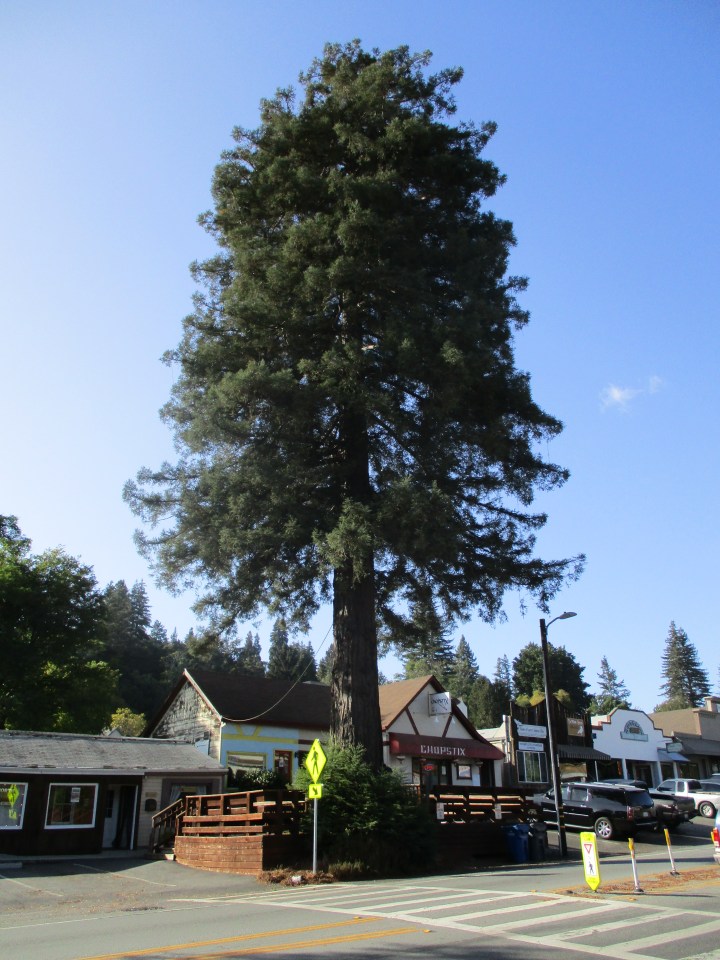
P71005Trees get planted all the time. Apparently, nature does not do the job adequately. Trees get put into specific locations to provide shade, produce fruit, enhance a landscape, obscure a view, or for any of a vast number of reasons. It is amazing that they are as accommodating as they are. It is rather presumptuous for us to think that they actually want to live with us in our synthetic environments as much as we want to live with them.
The coastal redwood is the tallest tree in the world. It can live for thousands of years. An individual tree can produce enough lumber to build a small house. It is no wonder that they are so impressive to anyone who sees one for the first time.

Many towns within the natural range of the coastal redwood were established for the redwood lumber industry. Felton, in the Santa Cruz Mountains, is one of those towns. George Featherstone of Ottawa came to Felton in 1888, and was so impressed with the coastal redwood trees, that he planted one in the middle of town only a few years after his arrival. This tree was only a teenager when redwood harvesting increased to supply lumber to rebuild San Francisco after the Great Earthquake and Fire of 1906, and then to develop the rest of the San Francisco Bay Area.

More than a century later, the Featherstone Tree is still here, and is the biggest thing in the small downtown. The Community Deck was built around it by volunteers from the Community many years ago. It is not as tall as trees in the forest are, but only because it does not need to compete with them. It is shorter and stouter, and really seems to enjoy being the center of town. It is quite the celebrity.

Mr. Featherstone had no idea of how important the tree he planted would become. It would be nice if we all could do such nice things for our communities, but then the world would be much too shady.

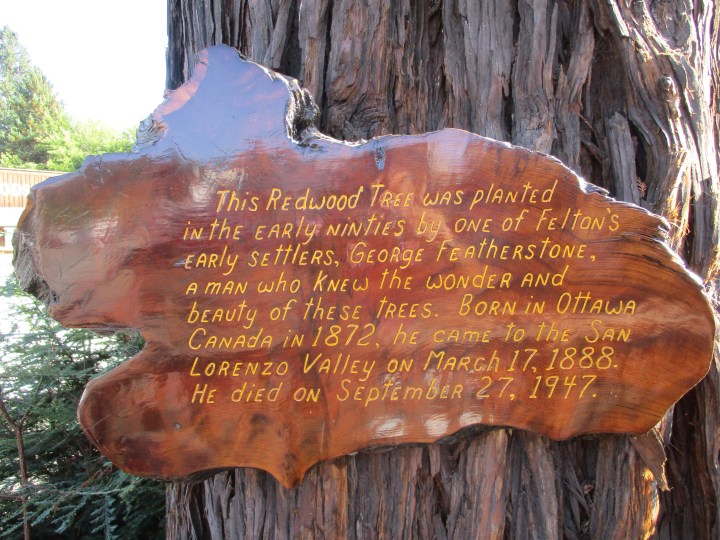
P71005+(‘ninties’ means the 1890s.) This Redwood Tree was planted in the early ninties by one of Felton’s early settlers, George Featherstone, a man who knew the wonder and beauty of these trees. Born in Ottawa, Canada in 1872, he came to the San Lorenzo Valley on March 17, 1888. He died on September 27, 1947.
War Of The Worlds

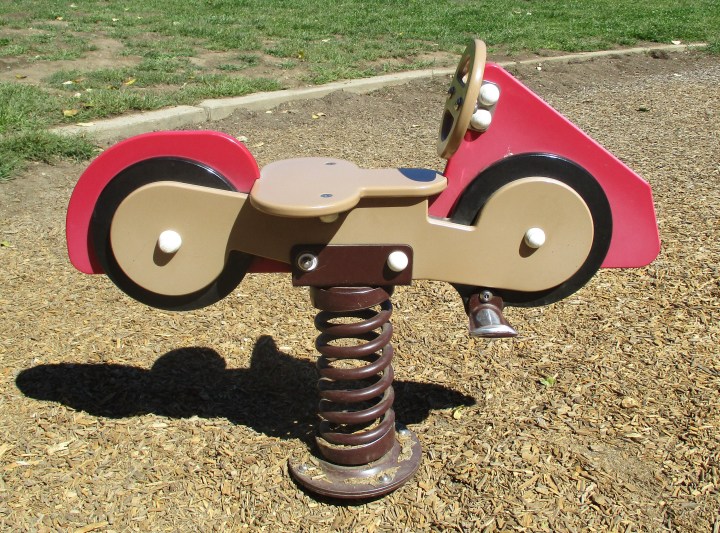
P71003To a little kid, it really had the potential to be a scary movie. I did not understand all of it, but I got the important parts. Mars was red, so was probably near Oklahoma. Apparently, the people from Mars had big scary machines that destroyed anything and anyone that was in their way. I did not perceive much of a threat because my parents let me watch the movie. (We children could not watch really scary movies.)
Shortly after watching War of the Worlds, I went for a long walk with my older sister and some of her friends into the last remnant or orchard that was such a prominent part of our world. We went out onto a new section of roadway beyond where our street used to end, and turned east on a completely new street that was not there before. The fresh new pavement and neat curbs seemed so flat and desolate . . . and expansive compared to the orchard that it now divided. I wondered how the trees got out of the way of this thing. Obviously, some moved to the left, and others moved to the right.

We eventually arrived at a larger clearing off to the left of this new street. Within this clearing, there were huge concrete rectangles with short pieces of rebar sticking up from their perimeters. One of the concrete rectangles lacked rebar, but was outfitted with four tall poles that curved on top. They looked something like those scary weapons on top of those machines that came from Mars. My sister confirmed my suspicions by explaining that the big concrete rectangles where where the flying machines landed when they arrived. Now I was getting a bit scared.

A few days later, we started to hear strange noises coming from the orchard. I was not allowed to go that far into the orchard without my sister, and was too afraid to go investigate anyway. The noises were mechanical and metallic, mixed with the sound of what seemed to be a big diesel engine and wood breaking. I dismissed them as not ‘too’ terribly threatening at first; but by the next day, they were closer! Each day, they got closer, until I could actually see motion through the trees. Something yellow was moving around in there, and small puffs of black smoke sometimes squirted out above the trees. I was terrified! I told my mother that the mean people from Mars were out there destroying everything like in the War of the Worlds!

She explained that there were no mean people from Mars in the orchard, but that a new park was being built on the site. Well that did not help much. What is this ‘park’? My mother explained that it would be a place where kids could play and run around and climb things and play games . . . and you know. Well duh, that is what the orchard is for. She said that it would be better. I wondered what could possibly be better than the orchard. This is something that I need to see!

Well, for the next two days or so, as they tore out the last two rows or so of trees, it became apparent that they yellow machines from Mars that spurted out black smoke were bulldozers gouging the trees right out of the ground. No one even bothered to cut up the firewood to leave on the side of the road like was typically done. The trees were unceremoniously piled up and burned. I was no longer terrified. I was saddened and confused. I could not understand why anyone would want to do this to the most important part of our world.

The big concrete rectangles with rebar protrusions were not landing pads for the flaying machines from Mars. They were the foundations and floors of the Recreation Center for the new park. The concrete rectangles with the four curved poles that seemed to be an assembly site for the weaponry from Mars simply became two basketball courts. The curved poles were outfitted with backboards and hoops. The orchard, devoid of trees, was leveled in most areas and mounded in others, and mostly covered with a vast lawn. New trees were planted around the perimeter and within landscaped areas around the Recreation Center. I suppose as far as parks go, it was a nice one.

The only problem with it was that we did not know what to do with it. The new trees were too small to climb or hide behind or really to do anything with. The lawn was nice, but there was way too much of it. The Recreation Center was nice inside, but we wanted to be outside. Eventually, we learned how to enjoy our park, and it really was nice; although it will never be an adequate substitute for an orchard. Our suburban (or some might say ‘rural’) world was invaded and, unlike in the movie, conquered by a more urban culture.

I would not say that one culture is any better than the other. However, I will say that I believe that there was a certain advantage to knowing the orchard and some of the nearby undeveloped wildlands the way that we did. I really believe that it was more educational than the refined and synthetic landscape of the new park. The maintenance of the park certainly required some degree of horticulture. There are trees, lawn and all sorts of shrubbery and perennials. The orchard had only trees and mustard. We interacted with it differently somehow. This is something that I can not explain adequately. It can only be experienced.

Felony Garden

blog11Brent and I met in college, when we were assigned to the same dorm room in Fremont Hall at Cal Poly in San Luis Obispo. Our similarities were remarkable. He came two hundred miles north from west of Los Angeles. I came two hundred miles south from west of San Jose. We were both the middle of three children, although I had just acquired an extra younger sister the year before. While the other boys we grew up with were playing with Hot Wheels, Brent and I were busy planting miniature trees around the miniature roadways. His childhood dog was Speckles. Mine was Freckles. We were weirdly similar prior to September of 1986, but have been perfecting our differences since then.
Brent is now a famous landscape designer in West Hollywood. He has landscaped some of the most prominent homes in the region, including the Osbourne Residence of formerly popular realty show, ‘the Osbournes’. Many of the streets of Los Angeles are now outfitted with street trees that Brent installed. He regularly installs mature plants and large boxed trees, without giving much thought about where they came from.

I just grow things. Back in the early 1990s, I grew citrus trees. By 1995, I was involved with the production of mostly rhododendrons, as well as azaleas, camellias, pieris, and a few other minor crops of similar cultural requirements. I provide the plant material for landscapers like Brent, but do not give much thought about what they do with it.

While we were in school, Brent and I would often see plants around town that we wanted to grow in our own gardens. Sometimes they were old fashioned plants that we could not find in nurseries. Sometimes they were plants from other regions that we did not have access too. Usually though, they were just plants that we wanted but could not afford as starving students.

Being the grower that I am, it was up to me to procure pieces or seeds of these desired plants to propagate. Sometimes, we got entire plants. I did all the work; but usually by the time the copies were produced, Brent would take them back to Los Angeles, where many died because he did not care for them properly. However, in the Miracle Mile neighborhood, there is still a coastal redwood that Brent and I procured on one of our adventures. It does not like the climate much there, but it is surviving.

Our techniques were not as bad as stealing the un-pink bearded iris. (see The Colors Of Karma, https://tonytomeo.wordpress.com/2017/09/12/the-colors-of-karma/.) We merely took pieces that no one would miss. We got several types of succulents and geraniums. (I had actually acquired my favorite geranium years before I ever met Brent, so I knew how easy they were.) We sometimes took plants from compost piles and trash bins, and plants that were to be discarded from a nursery where Brent worked. You can imagine my delight when San Jose started curbside greenwaste recycling! I got piles of bearded iris; and I did not care what color they were. I got yuccas, New Zealand flax, African iris, banana trees, cannas, calas, bergenias and really too many cool plants to list.

Well, as tradition dictates, Brent had to come up with something derogatory to say about my gardening style. After all, even though he benefited more from out techniques of acquiring plants, more of mine survived. His garden was lavishly landscaped with plants that he purchased from nurseries, while most of what he got from me got shaded out. My garden was meagerly landscaped almost exclusively with plants I had propagated and grown. Well, making the observation that very few plants in my garden were acquired ‘legally’, he named the main part off my garden the Felony Garden. Yes, and to the south of that was the White Supremacy Garden. (See White Supremacy, https://tonytomeo.wordpress.com/2017/09/21/white-supremacy/.) Out back, we kept the Fruits and Nuts. Oh, the joy of gardening!

No Respect

IMG_0417Horticultural industries are full of them; those who changed their respective careers half way through to do something ‘green’. We hear it all the time. “I used to be a ______ (Fill in the blank.), but I got so tired of ______ (Fill in the blank again.) and decided to get into landscaping.” Really?!? That is what you think of the landscape industry? Anyone who flunks out in your industry can ‘easily’ make it in landscaping?

While driving the delivery truck (because we could not hire a frustrated brain surgeon to do it for us), I had to deliver truckloads of rhododendrons to a ‘landscaper’ who did several jobs in Alameda and Contra Costa Counties. This ‘landscaper’ would walk through the nursery and tag whatever looked good at the time, and then assemble the landscape when the selected material arrived on site. Of course, he selected material that was in full bloom at the time, so the flowers were deteriorating by the time they arrived. His ‘landscapes’ were atrocious! The material was just tossed together so randomly, with plants that needed shade out in full sun, and full sun plants in the shade of big trees that were not pruned before the landscape was installed.

I can distinctly remember a job in the Oakland Hills that had two big Canary Island date palms that had not been groomed for many years. Decaying fronds were sagging low enough to mingle with the carcasses of agave blooms that were still sort of standing (or not) around the perimeter of the yard. Below these two palms (and I mean ‘below’, and within only a few feet of the trunks), the ‘landscaper’ had installed a few Colorado blue spruces, even more saucer magnolias, and about as many Japanese maples. These poor trees were literally pressed up against each other, and the rhododendrons that were getting delivered still needed to be stuffed in with them! Well, I could go on about how bad the ‘landscape’ was, but you probably get the point. Really, agaves and rhododendrons.

While unloading, the ‘landscaper’ explained to me, using the classic line mentioned above, “I used to be a chiropractor, but I got tired of all the stress and decided to get into landscaping.” He then continued to explain to me what made his career so stressful. After unloading the truck, I explained how frustrating it is to not be able to hire anyone to drive the truck or do the hard work at the farm. I hate working the irrigation through the middle of the night when summer gets hot. I am tired of the mud and rain in winter. Perhaps I should become a chiropractor!

Well, he did not like that much. He said that the two industries are completely different. Okay, I get that. He had to go to school for many years to earn his degree. Okay, I get that too. He had to work long hard hours for his career. Okay, I am still following here. It is a very stressful job that is not for everyone. Okay, have you worked out in the summer heat and dust, or winter cold and mud, until the sun went down, and sometimes into the night? Can you drive a tired old tractor or operate a chain saw? Do you even know how a shovel works?

The more he tried to explain to me that a chiropractor can become a horticultural professional, but a horticultural professional can not become a chiropractor, the more I realized how qualified I was for his former job. Yet, the horticultural industries are crowded with those who should be in other industries, or who simply do not take their work as seriously as it should be.

Myrtle

70920After many centuries of cultivation, myrtle, Myrtus communis, has not changed much. It was one of the more traditional plants for formally shorn hedges in Victorian gardens. It functions somewhat like a drought tolerant boxwood. Unshorn plants can grow as gnarly small trees not much higher than the eaves. ‘Compacta’ gets only about three or four feet high and wide, even without pruning.

The finely textured evergreen foliage is very aromatic and darker green than boxwood foliage. Individual leaves are not much more than an inch long. Not many of the tiny white flowers that bloom in summer develop if plants are shorn regularly. Unshorn plants that are allowed to bloom can produce small bluish black berries which might be messy on pavement. Foliar density is best in full sun. Shade can cause bald spots. Established plants may not need watering, and might live longer than anything else in the landscape.