This is an old and redundant topic. I should know better. Some vegetation is not worthy of salvage. Even that which is worthy can become excessive if too much is salvaged. The problem is that I find it very difficult to discard vegetation that I can relocate to another landscape, or grow in the recovery nursery whether or not we have use for it.
A few stumps of shrubbery needed to be removed from a small landscape of one of the buildings at work. With one exception, the shrubbery was common Photinia X fraseri, which had been cut down some time ago, and had not grown back much. The one exception was a common Escallonia rubra, which had been cut down even earlier, so had grown back about five feet tall, with a few distinct trunks.
I had no problem discarding the Photinia X fraseri. The stumps came up with mostly severed large roots, and very minimal fibrous roots that they needed to survive. If I really want to grow more, it would be more practical to grow it from cuttings. I am none too keen on the species anyway.
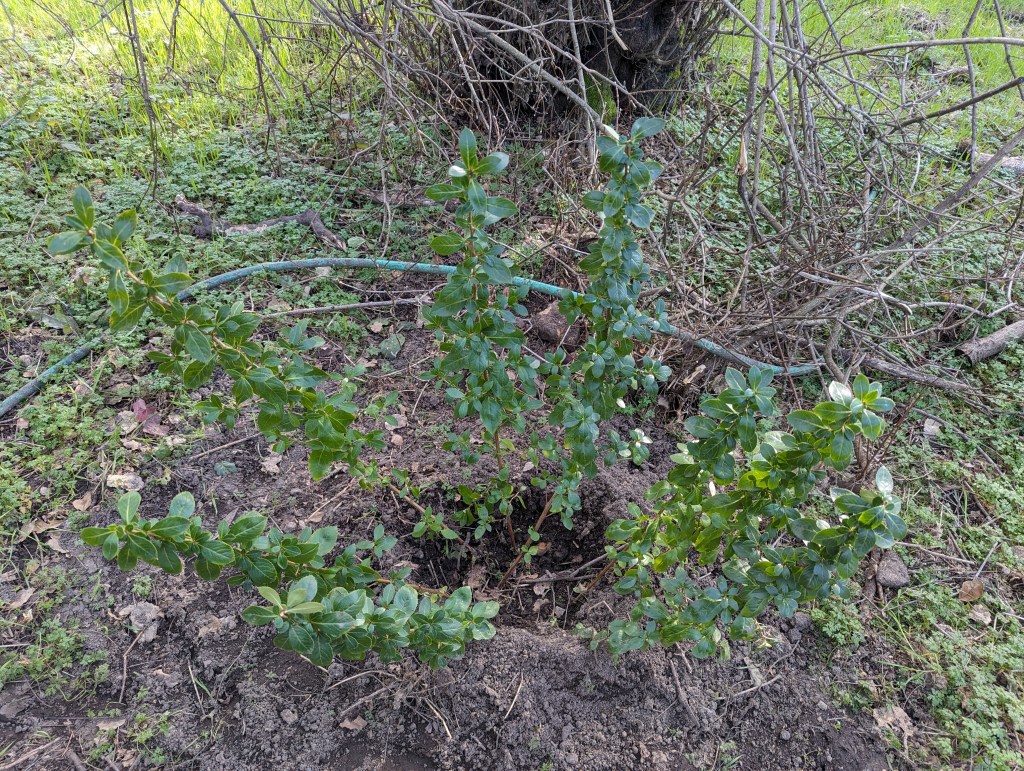
The Escallonia rubra was not so simple. Although I was determined to discard it all, and I am no more fond of the species than I am of Photinia X fraseri, it came out with more than enough fibrous roots to survive relocation. What is worse is that the several trunks were easily divided into several individual well rooted specimens, with several more layered stems attached to them. I assembled an even dozen well rooted specimens as a hedge outside a fence of our maintenance shops, and nine smaller rooted cutting to alternate between cypress trees outside another similar fence. Although pleased with the results, I should have discarded them.


 Tony Tomeo