Unexpected Lemon

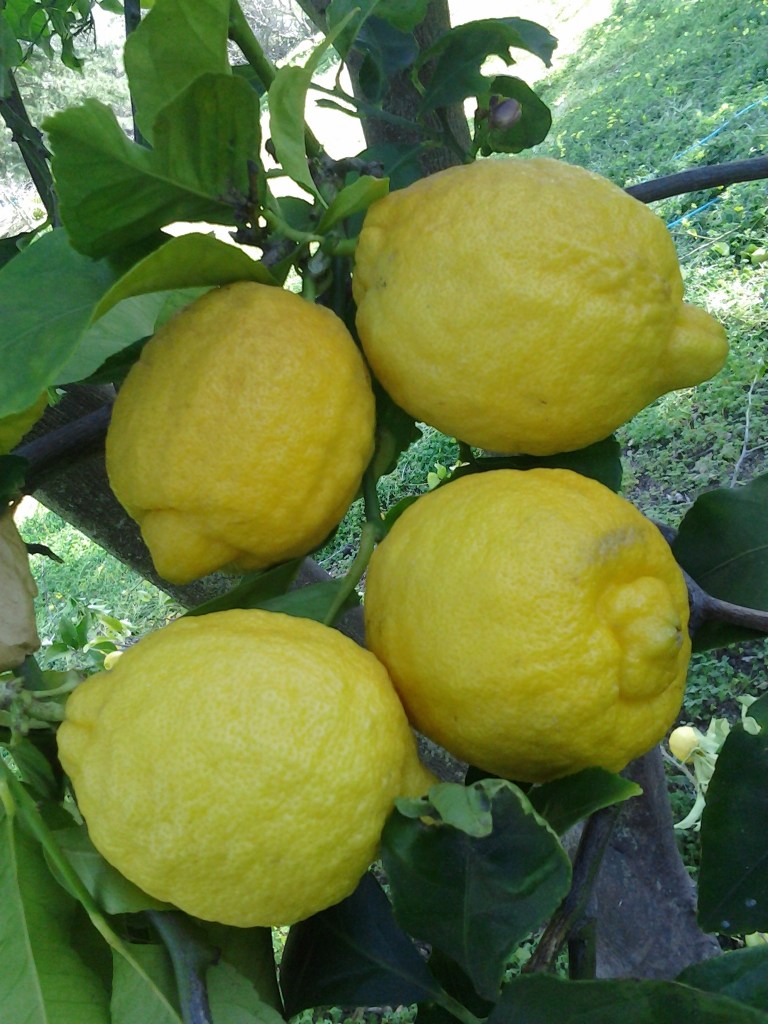
‘Meyer’ lemon was never my favorite lemon. However, when I grew citrus trees in the early 1990s, it was the most popular of forty or so cultivars. There really is nothing else like it. Relative to other lemons, its fruit is distinctively less acidic, more richly flavored, and sometimes ridiculously abundant. All other lemons are more sour but less flavorful. Besides ‘Meyer’ we grew ‘Lisbon’, ‘Eureka’, ‘Variegated Pink’ and ‘Ponderosa’. Of these four others, only ‘Ponderosa’ is not a mutant of ‘Lisbon’, although its comparably mild flavor and robust acidity suggest that it is. All four grow as small but upright trees. Only ‘Meyer’ naturally grows broader than tall, sort of like shrubbery.

‘Eureka’ lemon inhabits one of the landscapes at work, where it produces enough average lemons for those of us who know about them. I grew cuttings from it for my own garden, but am concerned that, since they are not grafted onto dwarfing understock, they could eventually grow quite large. I also grew an ungrafted cutting of ‘Ponderosa’ lemon for the same landscape at work that the ‘Eureka’ lemon already inhabits, because it happens to be at the Ponderosa Lodge. ‘Ponderosa’ lemon grows with an upright form, but because it naturally stays smaller than ‘Eureka’ lemon and its relatives, I am not too concerned about it growing too large.

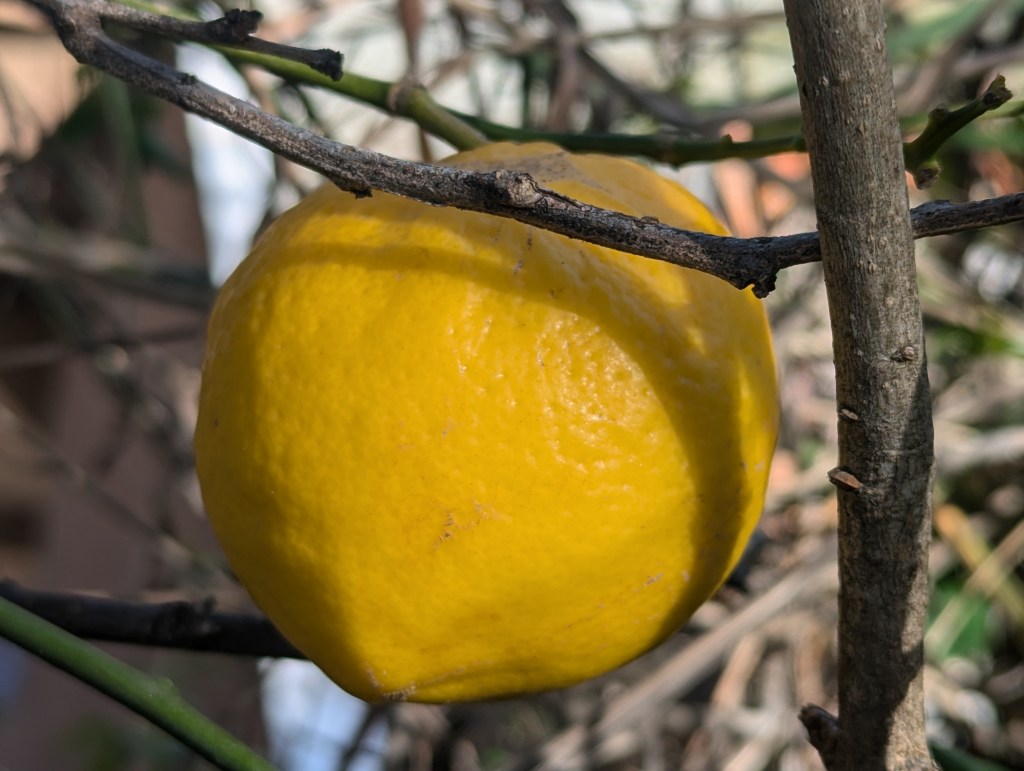
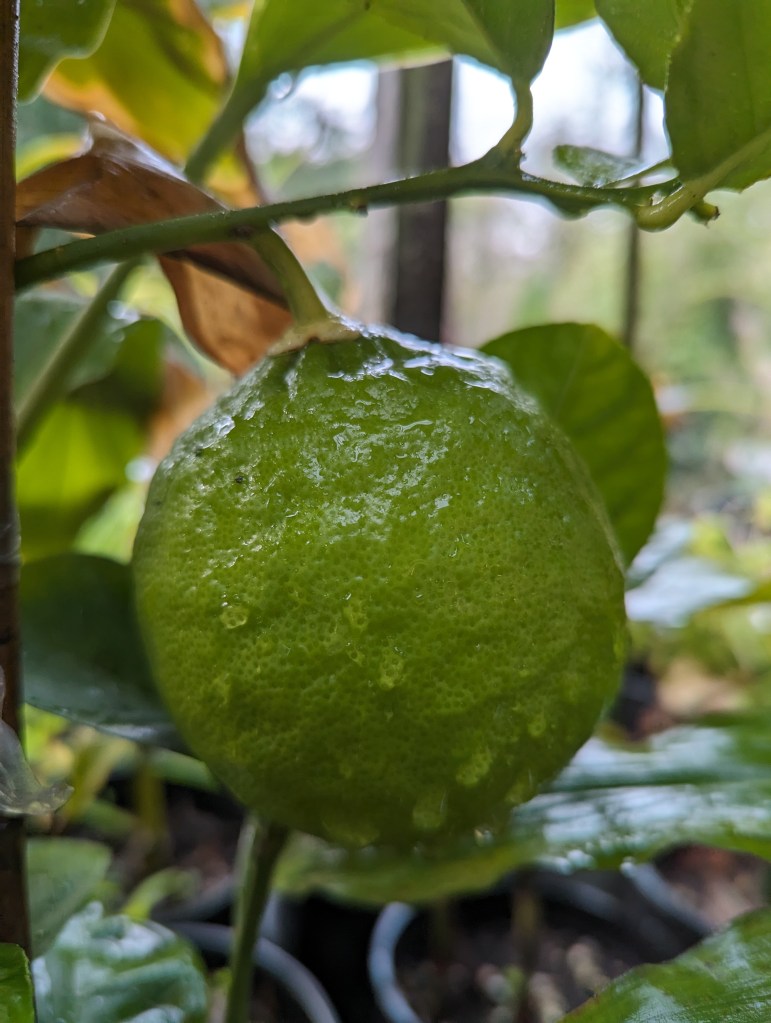
‘Meyer’ lemon came to my garden like a stray cat. Well, it is a bit more complicated than that, but it involved about as much planning. The history of how it came to its previous home is too extensive to describe here. To be brief, I installed it into a garden a few years ago because someone wanted it there after previous unsuccessful attempts to grow the same. Then, it needed to be removed prior to the sale of the home. I did not know what to do with it, so brought it here. I canned it and set it aside until space becomes available for it. I really did not expect it to do much until then. I sort of hoped that someone else would want it for their garden, but after we had been through so much together, I also sort of hoped that it would stay here. Anyway, while I was busy ignoring it in its partly shady and less than ideal situation, I noticed that it had produced this single lemon for me over winter. Well, I suppose that it will be a permanent feature of my garden now.
Merry Christmas!

This was much more awesome than gold, frankincense or myrrh!

Happy Birthday Jesus!

What is a suitable birthday gift for Someone Who has no use for anything worldly, but lived like He did? Gold, frankincense and myrrh seemed like good ideas in the beginning, although they were presented a year prior to His first birthday. Contrary to modern commercialism, a Lexus or Mercedes Benz might not be so appropriate for Someone Who preferred to come into town on a colt, and not the Dodge sort. Perhaps that is why it is customary to present gifts to others instead. Such gifts are Christmas gifts because so few have the same birthday.

Although overly elaborate or abundant gifts are a tradition that I find to be objectionable, I enjoyed many relatively minor gifts when I was a kid. Within my first few years, although I do not remember exactly when, I received my first tree, which was a seedling of Calocedrus decurrens, California incense cedar, from Amador County. A year or two afterward, I received a ‘Meyer’ lemon tree. During the same time, I received seed for many types of vegetables and a few flowers, as well as a set of child-sized gardening tools of premium quality. They lasted long enough for my mother to use the shovel to clean ash from the woodstove long after I graduated to a real shovel.

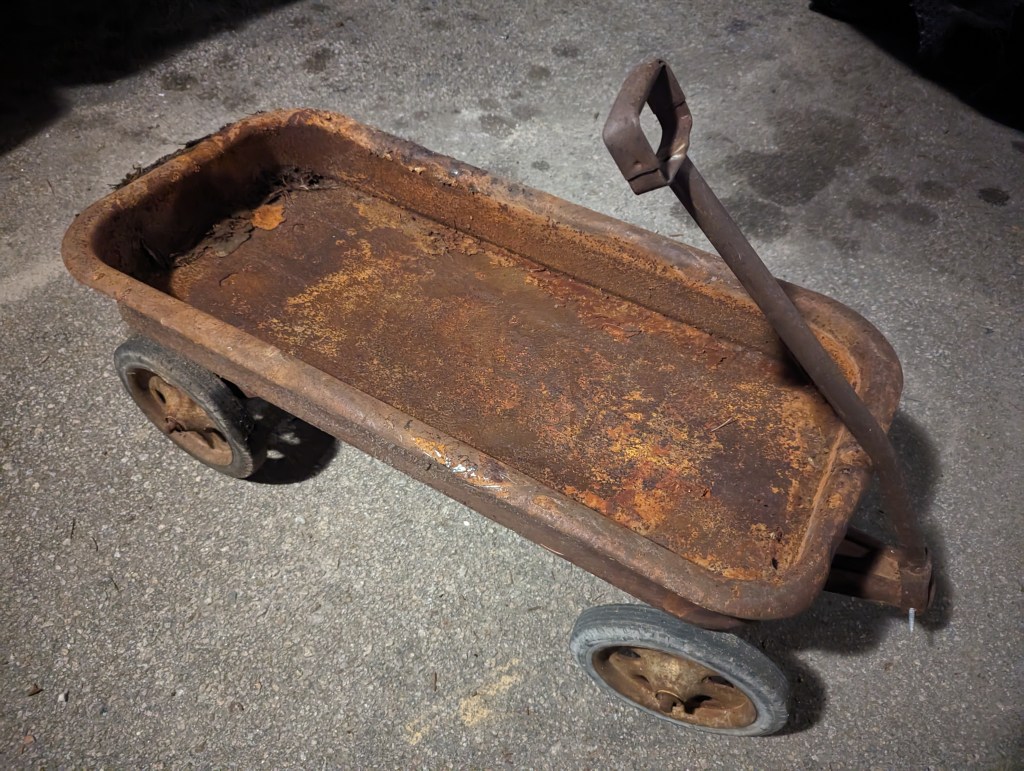
The most awesomely awesome Christmas gift that I received back then was my deluxe Radio Flyer wagon! It was my first luxury sedan that worked like a pickup! It was as durable as the other gardening tools. After I went to college, my mother used it to bring in firewood. It is out back right now, more than half a century after I received it new. It may continue to work in my garden as long as I do.

Ponderosa

‘Ponderosa’ for the Ponderosa

Citrus ripen through winter. This ‘Ponderosa’ lemon is taking its time, probably because it is still growing. Individual ‘Ponderosa’ lemons commonly weigh two pounds, and can potentially get a bit heavier than five pounds. That is heavier than some of Rhody’s chihuahua friends. I doubt that this particular lemon will get much larger than it is now, but it is already bigger than an average ‘Eureka’ lemon. It is about as big as a baseball.

The problem with this fruit is that it is on a tiny lemon tree in a #1 can. It is one of two fruits. I should not have allowed them to develop as much as they have. I should have removed them when they first appeared in order to divert resources into vegetative growth, rather than fruit development. Now that they grew this much, I sort of want them to finish ripening. It would be a waste to remove them now. After they ripen, I can prune their stems from the tiny tree, and process them as cuttings to grow more new trees.

I would like to install this little ‘Ponderosa’ lemon tree into a landscape at Ponderosa Lodge. Not only is its name appropriate, but the weirdly huge fruit might be interesting to the children who come to ‘Outdoor Science’ school there. Contrary to the huge size of its fruits, ‘Ponderosa’ lemon trees do not grow very large or very fast. However, a mature ‘Eureka’ lemon already inhabits the garden there, and we recently installed a ‘Bearss’ lime. Another lemon tree would redundant. We would prefer to grow a more edible citrus within the limited space that is available, such as a sweet orange, Mandarin orange or kumquat. For now, we will just enjoy this tiny lemon tree with its huge lemons right here.

Merry Christmas!

This was much more awesome than gold, frankincense or myrrh!

Happy Birthday Jesus!

What is a suitable birthday gift for Someone Who has no use for anything worldly, but lived like He did? Gold, frankincense and myrrh seemed like good ideas in the beginning, although they were presented a year prior to His first birthday. Contrary to modern commercialism, a Lexus or Mercedes Benz might not be so appropriate for Someone Who preferred to come into town on a colt, and not the Dodge sort. Perhaps that is why it is customary to present gifts to others instead. Such gifts are Christmas gifts because so few have the same birthday.

Although overly elaborate or abundant gifts are a tradition that I find to be objectionable, I enjoyed many relatively minor gifts when I was a kid. Within my first few years, although I do not remember exactly when, I received my first tree, which was a seedling of Calocedrus decurrens, California incense cedar, from Amador County. A year or two afterward, I received a ‘Meyer’ lemon tree. During the same time, I received seed for many types of vegetables and a few flowers, as well as a set of child-sized gardening tools of premium quality. They lasted long enough for my mother to use the shovel to clean ash from the woodstove long after I graduated to a real shovel.

The most awesomely awesome Christmas gift that I received back then was my deluxe Radio Flyer wagon! It was my first luxury sedan that worked like a pickup! It was as durable as the other gardening tools. After I went to college, my mother used it to bring in firewood. It is out back right now, more than half a century after I received it new. It may continue to work in my garden as long as I do.

Highlight: ‘Meyer’ Lemon

‘Meyer’ lemon is an interesting hybrid.

Of all the cultivars of citrus that are popular for home gardens, the ‘Meyer’ lemon is likely the most popular. However, it is not overly common in markets. That may be an incentive for growing it at home. Technically, it is not totally lemon. It is an odd hybrid of lemon and orange. Hence, its fruit has a distinctly rich flavor, but a bit less acidity than other lemons. 

‘Meyer’ lemon is distinct among citrus trees. It grows more like rigid shrubbery, with a few irregular trunks. Because it naturally develops compact form, it does not require dwarfing understock. Most old trees therefore grew from cuttings on their own roots. Modern trees commonly grow on understock though, so can develop suckers below their graft unions.

‘Meyer’ lemon fruit is abundant during autumn and winter. Minor quantities ripen through spring and summer also. All ‘Meyer’ lemon trees from nurseries nowadays are ‘Improved Meyer’, whether or not their labels say so. Their improvement was selection of stock that lacks a particular tristeza virus that was inherent to the original cultivar prior to the 1940s. 

Citrus Trees Are Dutifully Fruitful

Citrus are most abundant through winter.

Winter is the primary season for citrus fruits. Some ripen significantly earlier. Some ripen significantly later. Many citrus trees continue to produce a few fruits randomly throughout the year. Nonetheless, citrus fruits are collectively most abundant during winter. It seems odd that trees that are vulnerable to frost are so productive during the coolest of weather.

Citrus trees are fortunately only marginally susceptible to frost in only the cooler climates here. They mostly recover from minor damage where they get a bit too much chill. Those in coastal climates may never experience damaging frost. Some types of citrus are more resilient to frost than others. Vulnerable citrus trees may need frost protection when new.

Home garden citrus trees are different from orchard trees. Most orchard trees, particularly older trees, are ‘standard’ trees. They grow on standard rootstock that allows them to get larger, and therefore produce more fruit than ‘dwarf’ trees. Most home garden citrus trees are ‘dwarf’ trees. They grown on dwarfing rootstock that keeps them dense and compact. 

Furthermore, the many cultivars of citrus that are available for home gardening are more diverse than those that commonly grow in orchards. ‘Lisbon’ lemon is very profuse within season, so is preferable for orchards. ‘Eureka’ lemon, although a bit less productive, may be a preferable option for home gardens because it produces a few random fruit all year.

Now that citrus are in season, some last longer than others. Grapefruit can hang on their trees for months. They actually develop richer flavor with mellowing tartness as they age. Conversely, Mandarin orange and tangerine are the most perishable citrus. Because the rind is loose, their pulp within begins to oxidize after ripening. Lime eventually gets pithy. 

Although this is the time of year to enjoy fresh citrus fruits, it is not the season to do much else with citrus trees. Pruning and application of fertilizer will be more timely after winter. Premature pruning or use of fertilizer is likely to stimulate premature growth. Such growth either languishes through cool weather, or succumbs to mild frost.

Citrus Fruits Ripen Through Winter

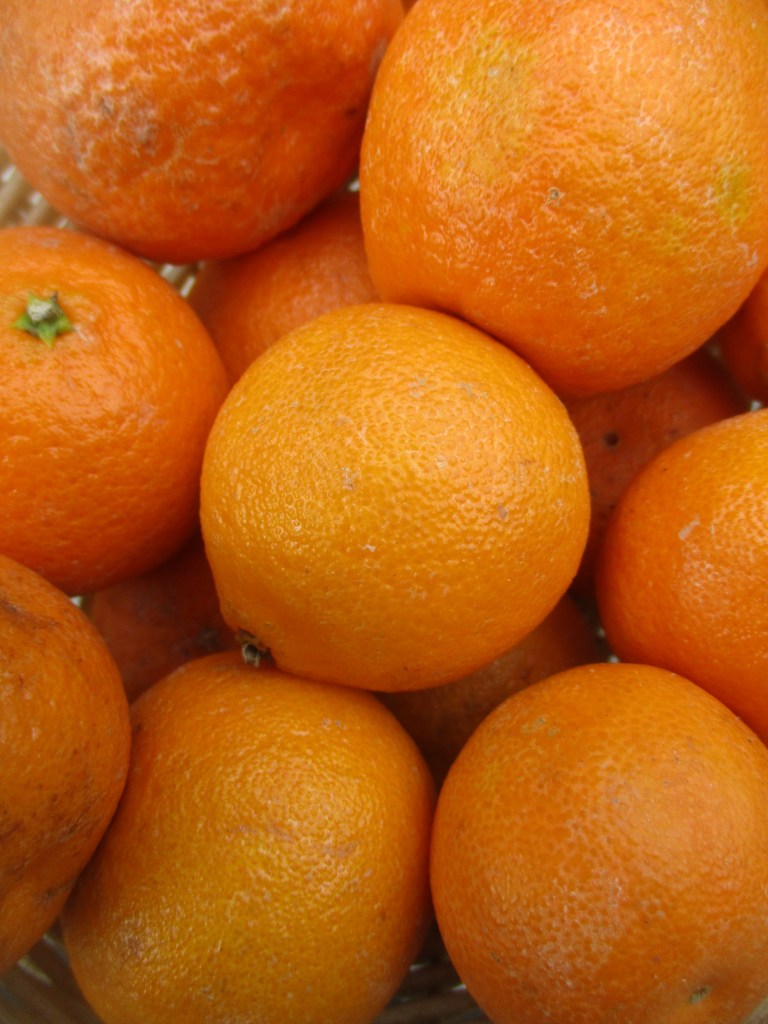
Mandarin oranges are at their best.

Winter seems like an odd time for fruit to ripen. Winter weather is cool enough to inhibit vascular activity in plants. That is why most plants are dormant to some extent through winter. Most familiar fruit trees are deciduous, so defoliate in winter chill. Stone fruits ripened through early summer. Pome fruits ripened through late summer and autumn. Nonetheless, citrus fruits are now in season.

The various citrus fruits and their cultivars ripen at various times through their season. Like stone fruits and pome fruits, they are on distinct schedules. Furthermore, climate affects ripening. Citrus fruits that ripen earlier than other cultivars in a particular climate may ripen after the same other cultivars in another climate. A few cultivars produce sporadically, or notably later than citrus season.

Such cultivars are justifiably popular. For example, ‘Eureka’ lemon is a mutant of ‘Lisbon’ lemon. ‘Lisbon’ lemon works well for orchards because all the fruit ripens within a limited season. ‘Eureka’ is more practical for home gardens because it instead produces sporadically throughout the year. A few fresh lemons are always available. The winter crop is abundant, but not too overwhelming.

Mandarin oranges are the first citrus fruits to harvest, even if they are not the first to completely ripen. Because their rinds fit so loosely, they are the most perishable of citrus fruits. They will oxidize and dehydrate before they rot. Tangerines are the same, since they are merely American descendants of Mandarin oranges. ‘Rangpur’ lime is not a lime at all, but a sour Mandarin orange hybrid.

Oranges, lemons and grapefruits, although ripening now, can remain on their trees for quite a while. The tartness of grapefruits mellows with age, and might be preferable after a few months. The same applies to the acidity of lemons. However, too many lingering citrus fruits can inhibit bloom. Some limes are supposedly best before totally ripe. All citrus fruits stop ripening when harvested. Juice of the various citrus fruits can be frozen for storage if necessary.