Horridculture – Mail Order Glitch

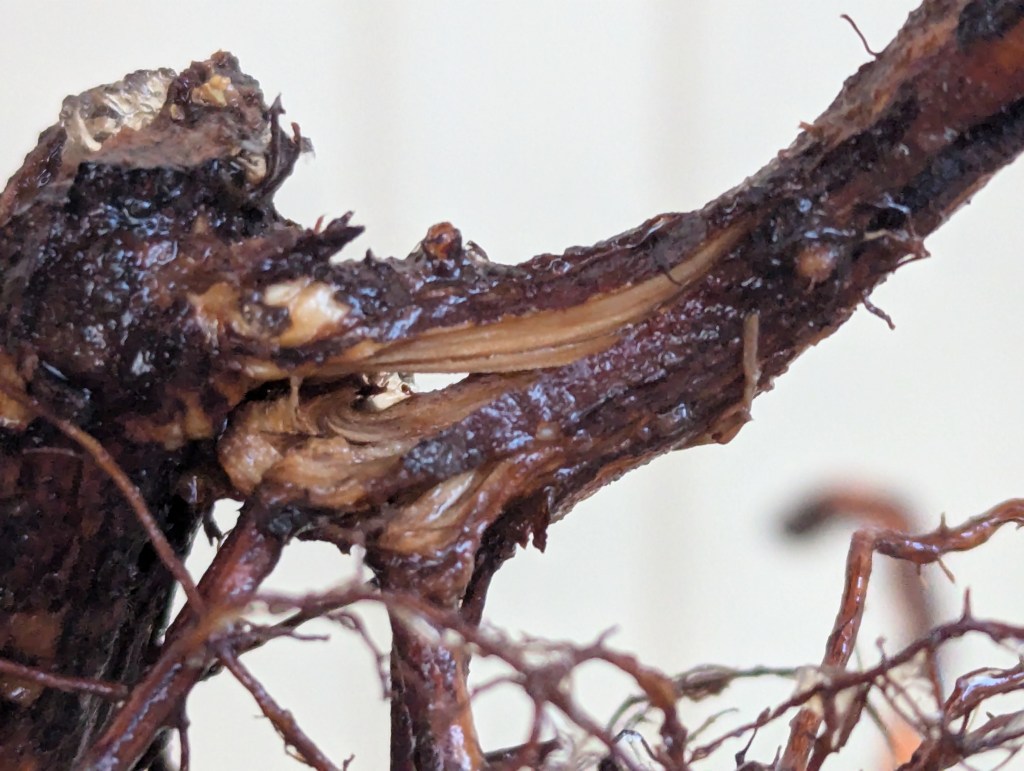
Of a dozen or so items of a mail order purchase that included various cane berries, mulberries, grapes and mayhaws, only a ‘Cumberland Black’ raspberry was less than exemplary. Unfortunately, it was majorly less than exemplary. It was broken at the base of its newest cane, just above where it extended from the older cane that the cutting was made from. If only it had not been broken, it would have been an excellent bare root specimen, with more roots than typical, and a substantial cane with several plump and turgid buds. I realize that it could either extend new canes from latent buds just below where it broke, or extend new roots from the base of the younger cane just above where it broke; so I should simply wait to see what it does. It could even do both, to provide me with two specimens for the price of one. However, I also realize that it could potentially do neither, but instead succumb to its damage. Regardless, its recovery from such damage should not be my concern. It is not in a condition that I intended to purchase it as. The provider should either provide a replacement, or refund what was paid for this particular item. Instead, I was instructed to wait to see if this damaged raspberry cane recovers. Well, at least I got a response. Perhaps that is all that is necessary. I am now more intent on keeping this raspberry cane alive, partly because I doubt that its purchase would be refunded if it succumbs to its damage, and partly because I would likely be to embarrassed to request such a refund if it becomes justifiable. Besides, as I mentioned, all other items of the purchase are of exemplary quality. I should be satisfied with that.


Horridculture – Diet

Dinnerplate dahlias should be about ten inches wide.

Mail order scams are a topic that I have been avoiding. I do not want to consider that some of a few items that I purchase by mail order may not be what they were sold as; and, if so, I will not know until they grow, bloom or produce fruit. Furthermore, I want to believe that if such items are not what they were sold as, that the situation is merely accidental.

This was no accident.

It began with the purchase of thirty rhizomes of ‘Red King Humbert’ canna last year. They were the cheap sort that become available after their primary season. I did not expect them to be of exemplary quality. Nor did I expect them to bloom. I only wanted them to grow a bit during the remainder of their season so that their rhizomes could survive winter dormancy to grow and bloom for the following season, which would have been last spring.

They grew as expected, but seemed to be virused. I tried to believe that the supplier would not send me virused stock, and that the striations of their foliage were normal. However, as growth resumed last spring, the foliage was very obviously virused.

Also, as they grew, they were very obviously not ‘Red King Humbert’. They grew only about two feet tall, and bloomed with scrawny orange flowers. ‘Red King Humbert’ gets about six feet tall, with big and billowy orangish red bloom.

The supplier gave me a credit for the expenditure, to spend on more of their products, I should have requested a simple refund. Instead, with the credit and a slight bit more for the difference in price, I purchased two dozen rhizomes of assorted dinnerplate dahlias.

As with the canna, I did not expect exemplary performance from these dahlias so late in the season. I only wanted them to survive and grow enough to store enough resources to survive their winter dormancy, to grow and bloom for the next season.

Most were completely necrotic and mummified upon arrival. Because this was after my experience with the canna, the supplier agreed to refund what I spent, but then only refunded a random amount of a dollar and a few cents. When I asked about the refund, I was informed that it was comparable to the cost of the one rhizome that I sent a picture of, as if I was expected to send a picture of every rhizome that I wanted a refund for. I explained that almost all of the rhizomes were comparable the the one that I sent a picture of, but received no more response.

I still have heard nothing about it. I decided to be satisfied with the few rhizomes that survived, and just accept the loss. The time that I had already wasted on pursuing a refund was worth more than any refund that I would have gotten.

So, . . . a few of the dinnerplate dahlia rhizomes survived and generated a bit of growth to partially recharge their resources prior to their next dormancy. Two actually bloomed. Apparently, these are very special dinnerplate dahlias. Instead of producing blooms that are about ten inches wide, the largest bloom is less than three inches wide. I have never seen such a dinky dinnerplate.

My niece loves Reneesgarden.com!

My neice finds seeds for most of her favorite vegetables, flowers and herbs, like this prolific chamomile, at Renee’s Garden.

Even after a few years of trying most of the seeds available from Renee’s Garden Seed catalog, my niece still wants to grow them all every year. Sadly, her compact garden and landscape designer father who thinks he owns it can not accommodate all the seeds that she wants. She is therefore forced to limit selection to her favorites and those that she has not yet tried.

‘Cupani’s Original’ and ‘Perfume Delight’ are still her favorite sweet peas because they are so very fragrant. The big softly blushed pale yellow flowers of ‘April in Paris’ are a close second. Although not as fragrant, I wanted her to try ‘Electric Blue’ for its shaggier darker green foliage and smaller but refined deep blue flowers.

Perhaps as a strategy for an alliance, my niece’s oppressive father planted ‘Buttercream’ nasturtiums, which was a new variety with semi-double cream colored flowers. She rebelled with the brilliant red shades of ‘Copper Sunset’. The softer orange shades of ‘Creamsicle’ was a diplomatic compromise.

Both could agree on the soft lavender and pink shades and white of ‘Gulf Winds’ alyssum, the rich deep pinks of ‘Mountain Garland’ clarkia, and the traditional ‘Mrs. Scott Elliot’ columbine, since all three are so complaisant with mixed annuals and perennials. Taller and more vigorous cosmos got their own space. ‘Dancing Petticoats’ provided a mixture of cheery pink shades. ‘White Seashells’ looked sharp against the deep green privet hedge.

Since utilitarian vegetable plants are inconsistent with such a designer landscape, my niece grew vegetables that are as flashy as foliage plants. I suggested richly colored ‘Scarlet Charlotte’ chard, with a bit of ‘Italian Silver’ that exhibits distinctive white petioles and veins. She went for the more colorful ‘Garden Rainbow’, ‘Neon Glow’ and ‘Bright Lights’.

Some (but not all) of Renee’s Garden vegetable seed mixes have a distinct advantage of color coding. The various seeds withing these mixes are dyed with different colors so they can be planted separately if desired. Since seed packets usually contain more seeds than are actually needed, vegetable seed mixes are a practical way to get fewer but enough of a few different types of seed in single packets.

More varieties of seeds are available from the online catalog of Renee’s Garden Seed at www.reneesgarden.com than at retail nurseries. Yet with so many fun varieties to try, the retail seed racks certainly have more selection than any garden really needs. If it were at all possible to try them all, my neice would have figured out how to do it already.

Mail Order Fakes And Realities

Succulent cuttings are readily available online.

Sea-Monkeys are one of the most famous of mail order scams. Their original $0.49 price was not cheap for children who made the first purchases in 1957. They were nothing like their playful portrayals in comic book advertisements. They were minuscule brine shrimp who were incapable of building castles, playing tennis, or even just smiling for a camera.

Nonetheless, Sea-Monkeys were lucrative for their enterprising inventor. For many such capitalists, profit is the priority. It is no different for the many mail order scams that involve seed and plants. They range from the rare monkey face orchid to multicolored tomatoes. Consumers get either nothing or random seed or plants that are nothing like they expect.

Most mail order scams that involve seed or plants are on e-commerce sites. They mostly include popular buzz words such as ‘rare’, ‘organic’ and ‘bonsai’, even in regard to plants that are not conducive to bonsai culture. Associated illustrations are obviously faked, but somehow convince enough consumers to sustain their deceptive mail order exploitation.

Fortunately, the vast majority of online seed and plant suppliers are very trustworthy and reputable. They provide precisely what they claim to provide. Their commodities become available prior to the season that is best for delivery. Then, delivery happens early during the regionally best season for planting. Products are not marketable out of their seasons.

Many seed catalogs and plant catalogs enact more than seasonal or climactic limitations to their sales. For various reasons, particular species are not admissible within particular states or counties. Some may be potential vectors of disease. Some may be too likely to naturalize and interfere with natural ecosystems. Species limitations are fortunately rare.

Much of the seeds and plants that are available from e-commerce sites such as eBay are from the home gardens of those selling them. The sellers are generally quite trustworthy and reputable, but can make mistakes. It is easy to misidentify some species, especially by common names. Also, such sellers are very often unaware of marketability limitations.

Seed Of Doubt Gains Popularity

00513thumb
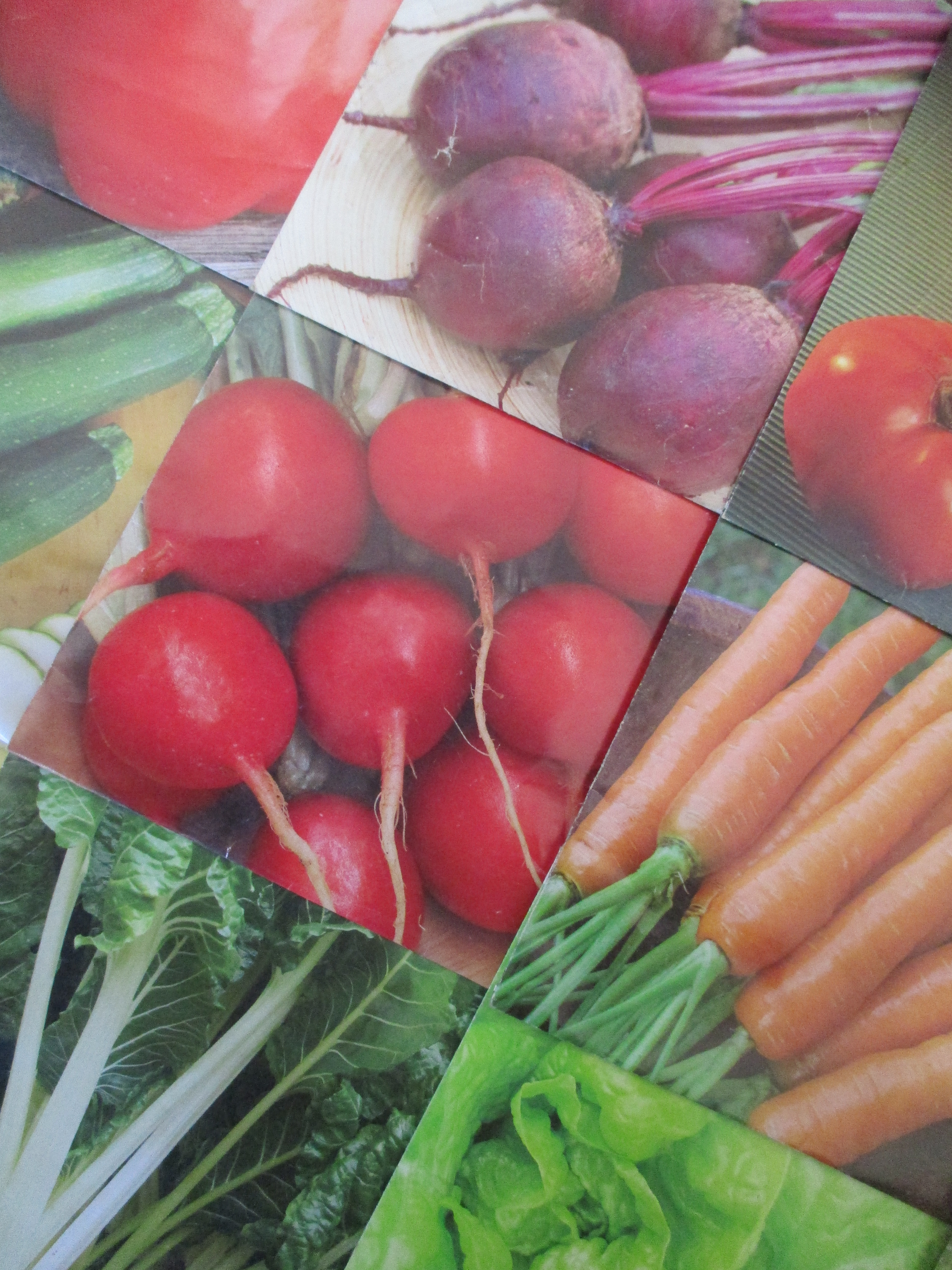
Seed for vegetable gardening is scarce.

Many of us who are still sowing spring seed know the doubt. Seed for warm season vegetables and bedding plants is presently scarce. Consequently, we doubt that all the varieties that we want are still available. Many unusual varieties that we purchase by mail order or online are sold out. Some more popular and reliably obtainable varieties in supermarket seed racks are going fast too.

Home gardening is very suddenly more popular than it had been for a very long time. Those who can not work at their respective professions have much more time to work in their gardens. Many want to grow a bit more produce at home, in order to shop amongst others in supermarkets less frequently. Many who have never enjoyed gardening before are now taking a serious interest in it.

This adds a few more complications to planning the garden. Choices really are limited. Some of us must be satisfied with what we get. Instead of trying new and unusual varieties, we might need to try old and common varieties. It might be a new and unusual experience, and an interesting way to learn why they have been so popular for so long. This applies to young plants as well as seed.

Although more varieties are available online and by mail order, it is now more important to purchase them early. Delivery is not as prompt as it was prior to this increase in popularity of gardening. Seed providers are overwhelmed by the demand. Since it is already late in the season, it is probably too late to order seed that start in spring. It is not too early to start procuring seed for autumn.

It is also a good time to share surplus with friends and neighbors who may be experiencing the same scarcity of seed and seedlings. Although it is too late to wait for delayed delivery of seed that gets sown in spring, it is not too late to sow some types if they are already available. If left outside to avoid personal interaction with recipients, seed might need protection from rodents and birds.

Anyone who is experienced with gardening knows that it involves challenges. This is certainly a new one.