Mediterranean Climate Is Quite Californian

New Zealand natives perform well here.

“Mediterranean” translates from Latin to “middle of land”. The Mediterranean Sea is in the middle of the land of those who named it. Other regions were either unimportant or unknown to them until the Sixteenth Century. Nowadays, most people of the World are aware of many other regions. A few of such regions also enjoy a Mediterranean climate.

Such climates are obviously not confined to the regions of the Mediterranean Sea. They merely resemble such climates. Some extend eastward into Western Asia. Others are in eastern and southern Africa, southwestern South America and Columbia. Larger regions of such climate are in southern Australia. The closest are here in western North America.

Even these limiting regional designations are debatable. Many horticulturists consider climates of New Zealand to be typical Mediterranean. Such climates are mostly between thirty and forty five degrees north and south. However, some might exist within northern India and southern China. Ultimately, climate is meteorological rather than geographical.

Mediterranean climates receive almost all of their rain during winter. Rain is very minimal through summer. Even if it is twice as abundant in other similar climates, it conforms to a similar schedule. Although winter chill is adequate for many species that need it, frost is mostly minor. Locally, summer weather does not often become too uncomfortably warm.

Native species know what to expect from local climate. So do exotic species from similar climates. Some may prefer more or less winter rain, summer heat or winter chill. Almost all can tolerate warm summers without rain, though. Such weather conditions are normal for them. Therefore, the most adaptable exotic species locally are from similar climates.

This includes species of Eucalyptus, Pittosporum and Callistemon from Australia. Aloe, Agapanthus and Morea are from South Africa. Phormium and Leptospermum are from New Zealand. Oleander and the various species of Lavandula are truly Mediterranean. In the past, a few exotic species adapted too efficiently to become invasively naturalized. Horticulturists are now careful to not import such potentially aggressive species.

Superbloom Highlights Local Mediterranean Climate

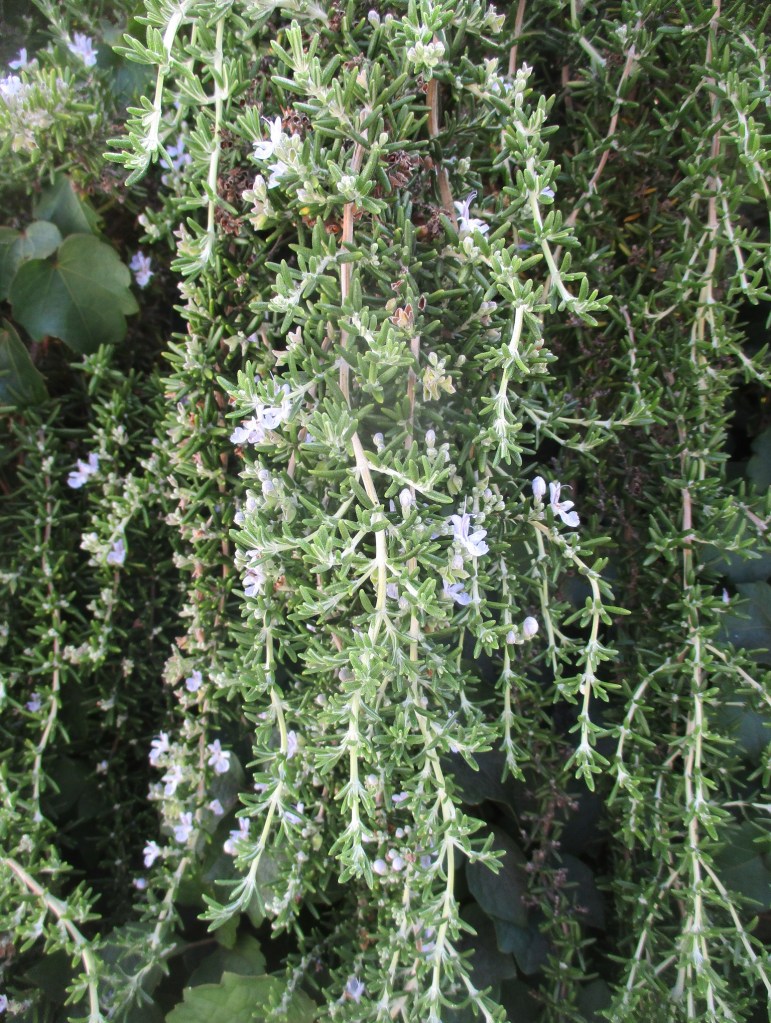
Rosemary can bloom longer with irrigation.

It does not happen often. The average frequency is about ten to fifteen years. However, it occurred in both 2017 and 2019, prior to this spring. That is enough for thirty to forty-five years! The current superbloom is only now finishing locally. It may continue through most of May near the coast farther North. The best bloomers enjoy the Mediterranean climate.

Climate is the typical and seasonal weather pattern of a region. The local Mediterranean climate is typically mild and somewhat arid. Almost all rain occurs between late autumn and early spring. Rain is otherwise rare. Winters are cool but not too cold. Summers are warm but not too hot. Native and some exotic flora knows how to exploit such climates.

Some exotic flora that prefers other climates also seemed to demonstrate a superbloom. Some merely responded to the unusually cool weather last winter. They appreciate more vernalization than they typically experience here. Some species enjoyed the unusually abundant rain last winter. Some species enjoyed both extra rain and extra vernalization.

Native species and exotic species from similar Mediterranean climates are a bit different. Their superbloom happens at the same time, and is also a response to earlier weather. However, it is also a response to later weather. They know that Mediterranean climates get warm and arid through summer. They are in a rush to finish blooming while they can.

Superbloom is how many species accomplish all their annual bloom within a brief time. They begin as soon as cool and stormy wintry weather finishes. They finish before warm and dry summer weather desiccates their flowers. Of course, such bloom may not be so spectacular after typical winters. It is only superbloom after exceptionally wintry winters.

Some species that exhibit superbloom in the wild bloom later for irrigated home gardens. This includes some exotic species from similar Mediterranean climates elsewhere. Such climates are present in small portions of Australia, South America and Africa. Obviously, most Mediterranean climates are around the Mediterranean Sea. Most exotic plants that are most adaptable here are from such climates.

Olive

Olive trees are compact but gnarly.

For millennia, olive, Olea europaea, dutifully produced oil and edible fruit for civilizations of the Mediterranean region. During the last several centuries, it migrated to do the same in other regions of similar climate throughout the World. At least two centuries ago, it got to California, and became a major agricultural commodity. Now, it lives in home gardens. 

The abundant and oily fruit that justified cultivation of olive trees for thousands of years is ironically a potential nuisance for home gardens. Few people harvest and process them. Olive fruit can stain pavement and attract rodents. Fruitless or mostly fruitless cultivars of olive, and dwarf cultivars, have been increasingly popular for only the past few decades.

Olive trees are not big, but slowly develop grandly sculptural trunks. Some might be little more than twenty feet tall when mature. Few get more than forty feet tall. Most have a few leaning trunks, which become furrowed and distended with age. The narrow and grayish evergreen leaves are about two or three inches long. Olive fruits are about an inch wide.

Weather Is All About Climate

00909thumb
Summer weather continue into autumn here.

Weather has no thermostat. There is no automation. It is naturally variable. Weather is constantly changing like, well . . . the weather. We take what we get when we get it. It is impossible to predict how this summer will end. Others in the Northern Hemisphere are already getting ready for autumn. It is likely to arrive bit later here than elsewhere. That is the nature of the Mediterranean climate.

Summers here are naturally long, dry, and somewhat warm. Rain is rare between spring and autumn. Almost all of the rain happens during the naturally mild winters. Springs and autumns both are naturally quite brief. Such weather may seem to be boring, but is excellent for gardening. It is why the summer growing season is so long. Unfortunately, it is also why the fire season lasts too long.

Indian summer is something of a misnomer here. This is not India. Nor is it Indiana. Besides, Indian summer in other regions of North America describes an unusual weather pattern, not the usual. It is unseasonably warm and dry weather after a first frost of autumn. Alternatively, it is unseasonably early warm and dry weather in spring. Locally, it is merely typical summery weather of autumn.

This weather pattern and climate were assets for agricultural commodities that grew here a long time ago. They are still assets for those who now live here, especially those who enjoy gardening. However, such weather necessitates certain accommodations. Irrigation for actively growing plants is important later into autumn than it is in other climates. Autumn planting happens later as well.

Nights continue to get longer and cooler though. It is not so obvious because gardening happens during the day. Warm season vegetables notice the difference, and slowly decelerate production. Some deciduous plants may slowly begin to discolor. Roses continue to bloom as they slowly begin to shed lower foliage. Eventually, they will get their last applications of fertilizer until next spring.

Warm season annuals may start to to look tired as fresher cool season annuals move in.