In The Zone

Climate is regional.

We all know how excellent the local climate is for gardening. As we travel around the area though, we also realize that there is more than one climate. Locally, there are at least three of the standardized ‘Sunset’ garden zones, with several more within only a few miles. There are countless microclimates too.

Elevation, terrain, latitude and the proximity of the ocean or large bodies of water all influence the climate. Even though the Santa Cruz Mountains are not very high, they sometimes get snow on top because higher elevations are a bit cooler. When the Summit and Santa Clara Valley floor are cold in winter, the slopes in between are not quite as cold because cold air drains away downhill. The areas closest to the San Francisco Bay stay much cooler through summer because of the insulating quality of the water. 

More localized variables like forests, lakes, direction of slopes and infrastructure affect microclimates. Older neighborhoods with mature trees are shadier and cooler than newer neighborhoods with smaller trees. The west facing slopes to the east get warmer than the east facing slopes to the west. In Downtown San Jose, tall buildings create cool and shady microclimates to the north; and some reflect enough solar radiation to significantly warm areas to the south and west.

It is important to know what climate zone any particular garden is in to be able to select appropriate plants. Besides that, it is important to know the microclimates within the garden to know where each plant will be happiest. Tropical plants that would be happy in Los Angeles might succumb to even mild local frosts. However, plants that might succumb to frost if too exposed may be safe in sheltered microclimates.

Generally, Campbell, most of San Jose, southern Sunnyvale, northeastern Cupertino, northeastern Los Gatos and Union City are all within Sunset Zone 15. Most of Saratoga, southwestern Los Gatos, southwestern Cupertino and Mission San Jose are in Zone 16. Santa Clara, Alviso, Milpitas, northern Sunnyvale and western Fremont are in Zone 17.

None of these zones are too severe. Because of the marine influence of the San Francisco Bay, Zone 17 can actually be relatively boring and not so great for plants that want winter chill or summer warmth. Zone 16 is very similar to Zone 15, but comprises hillside thermal belts where cold air drains away in winter, and also gets a bit warmer in summer. Above and below Zone 16, Zone 15 gets cool enough for plants that want winter chill, but may not get warm enough in summer for plants that crave heat. The Sunset Western Garden Book not only describes the climate zones in detail, but also specifies what zones every plant is adaptable to.
Superbloom Highlights Local Mediterranean Climate

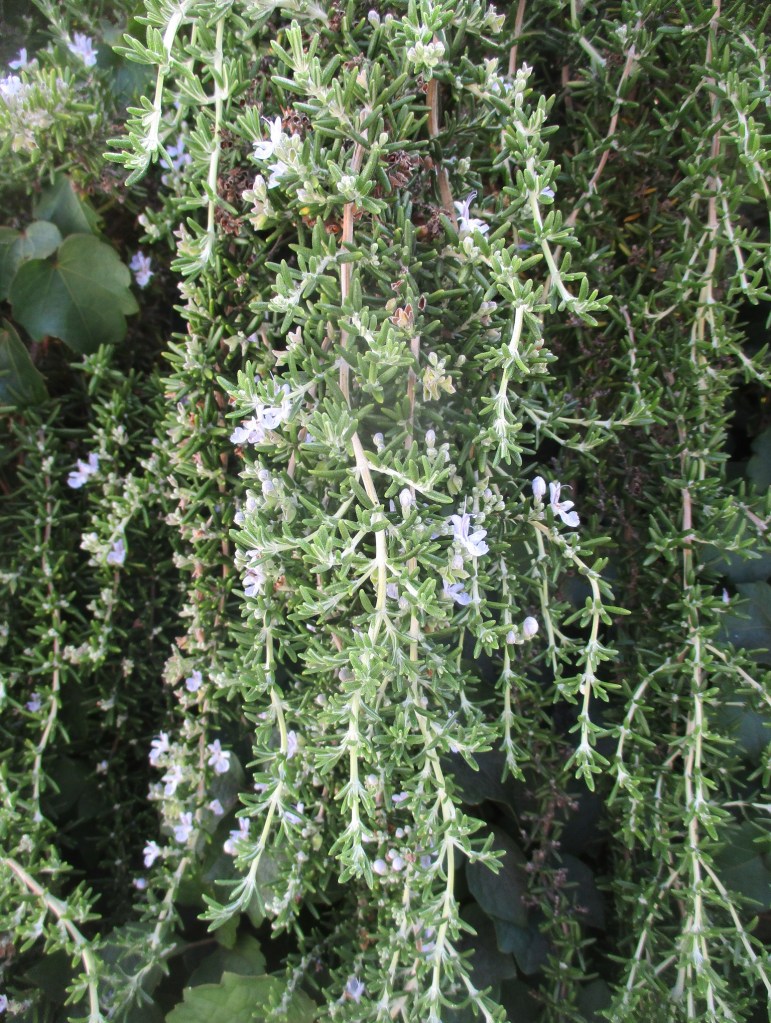
Rosemary can bloom longer with irrigation.

It does not happen often. The average frequency is about ten to fifteen years. However, it occurred in both 2017 and 2019, prior to this spring. That is enough for thirty to forty-five years! The current superbloom is only now finishing locally. It may continue through most of May near the coast farther North. The best bloomers enjoy the Mediterranean climate.

Climate is the typical and seasonal weather pattern of a region. The local Mediterranean climate is typically mild and somewhat arid. Almost all rain occurs between late autumn and early spring. Rain is otherwise rare. Winters are cool but not too cold. Summers are warm but not too hot. Native and some exotic flora knows how to exploit such climates.

Some exotic flora that prefers other climates also seemed to demonstrate a superbloom. Some merely responded to the unusually cool weather last winter. They appreciate more vernalization than they typically experience here. Some species enjoyed the unusually abundant rain last winter. Some species enjoyed both extra rain and extra vernalization.

Native species and exotic species from similar Mediterranean climates are a bit different. Their superbloom happens at the same time, and is also a response to earlier weather. However, it is also a response to later weather. They know that Mediterranean climates get warm and arid through summer. They are in a rush to finish blooming while they can.

Superbloom is how many species accomplish all their annual bloom within a brief time. They begin as soon as cool and stormy wintry weather finishes. They finish before warm and dry summer weather desiccates their flowers. Of course, such bloom may not be so spectacular after typical winters. It is only superbloom after exceptionally wintry winters.

Some species that exhibit superbloom in the wild bloom later for irrigated home gardens. This includes some exotic species from similar Mediterranean climates elsewhere. Such climates are present in small portions of Australia, South America and Africa. Obviously, most Mediterranean climates are around the Mediterranean Sea. Most exotic plants that are most adaptable here are from such climates.

Shasta Lake

Shasta Lake is a large reservoir on the Sacramento River. It contains water for flood control and to generate electricity. Some of the water within is used for agricultural irrigation and, to a relatively minor degree, to supply regional municipal water.

It is a very common misconception that the volume of water within Shasta Lake is necessarily relative to ‘drought’ conditions. Low water level is supposedly indicative of a ‘drought’. High water level is supposedly indicative of ‘normal’ weather conditions, including adequate precipitation. This same misconception seems to apply to all reservoirs in California.

Well, after the rainiest winter since 1982 and 1983, Shasta Lake is still not full. The level fluctuates, so might have been full earlier, or might be full later, but regardless, is not presently full. Water must be released prior to expected rainy weather, which can still occur during spring, in order to accommodate more water to control flooding. Less water may be released as drier weather is expected. Shasta Lake could therefore be fuller or completely full for summer, when almost no rain is expected. The presently observed water level does not indicate deficiency of water any more than a potentially higher water level during summer indicates surplus.

Most of California has a chaparral climate. Some of California has a desert climate. Such climates are naturally dry through summer. It is quite normal. It does not constitute a drought. A drought is an unusually dry weather pattern. It is not so normal.

Contrary to popular belief, California is NOT in perpetual drought. Although droughts occasionally happen, they are not annual events. Dry weather that occurs annually every summer is normal climate. If there is a deficiency of water here, it is because there are nearly forty million people relying on a limited supply of water.

Mediterranean Climate Is Something Special

90925thumbThe climate here is pretty cool, at least in winter. Right now, it is pleasantly warm. It does not often get uncomfortably cold or hot, and when it does, it does not stay like that for too long. In between the warmest days of summer, the nights typically cool off nicely. In between the coolest nights of winter, the days typically warm up nicely. Humidity is normally minimal. Rain is adequate in season.
We have here what is known as a ‘Mediterranean’ climate. Obviously, it is similar to many climates of the Mediterranean Basin. Beyond the Mediterranean region, there are not many other places in the World that enjoy such reliably temperate weather. Most of such places are in southern and southwestern Australia, the Western Cape of South Africa, central Chile, and evidently, right here.

This particular region of Mediterranean climate is quite large, and extends into northern Baja California. Native plants know how to live here, and many of those that are adaptable to landscapes and home gardens can survive quite nicely with little or no irrigation. Some exotic (non-native) plants want climates with more warmth in summer, more chill in winter, or more rain through the year.

The best, as well as the worst, exotic plant species for local landscapes are those that are native to other Mediterranean climates.

The worst are those that are so happy in the local climate that they naturalize and become invasive to native ecosystems. Without pathogens or competing species that inhibited their proliferation within their respective native ranges, many naturalized species are detrimentally aggressive in ecosystems that they invade. Pampas grass, broom and Acacia dealbata are familiar examples.

The best exotics are not so threatening. Australian fuchsia, kangaroo paw, coprosma, westringia, bottle brush, grevillea, dracaena palm and eucalyptus originated from Australia. Lemon verbena, mayten and some salvias are from Chile. African iris, lily-of-the-Nile, bird-of-Paradise and all of the aloes came from South Africa. Olive, oleander, cistus, and all the lavenders are Mediterranean.

Krispy Kritter

P80715KThis really is the best climate here. Winters are just cool enough for many plants that require a bit of a chill, but not unpleasantly cold. Summers are just warm enough for most plants that need warmth, but the weather does not stay too unpleasantly hot for too long. Warm weather here typically lasts no more than a week, and is accompanied by light evening breezes and cooler nights. Minimal humidity typically makes the worst of the heat a bit more tolerable.
While much of North America and parts of Europe were experiencing abnormally and uncomfortably warm weather earlier in summer, our weather somehow stayed relatively mild. For a while, it was significantly warmer in Portland than here. It certainly was nothing to complain about. Vegetable plants that crave warmth were not too inhibited by the mild weather. Flowers that typically deteriorate in warm and arid summer weather lasted a bit longer than expected.
Then the weather changed. It did not get too unseasonable warm. In fact, the weather merely did what is typical for this time of year. The problem was that it happened so suddenly. The weather went from pleasantly mild and somewhat humid, to more seasonably warm and arid overnight. Flowers faded and warm season annuals wanted for more water.
The worst of it was that exposed foliage of some plants got roasted. English laurel and rhododendron were particularly susceptible Because we had no way of anticipating the sudden change of weather, we had just shorn a large hedge of English laurel, just in time for the warm weather to cook the freshly exposed inner foliage.
At about the same time, new plants were being installed into a small newly landscaped area. The transition from the cool and comfortable nursery on the coast to the warm and arid landscape where they were surrounded by black groundcloth (prior to the installation of chips) was too much of a shock for some of them. We could not water them enough to prevent some of the foliage from desiccating.
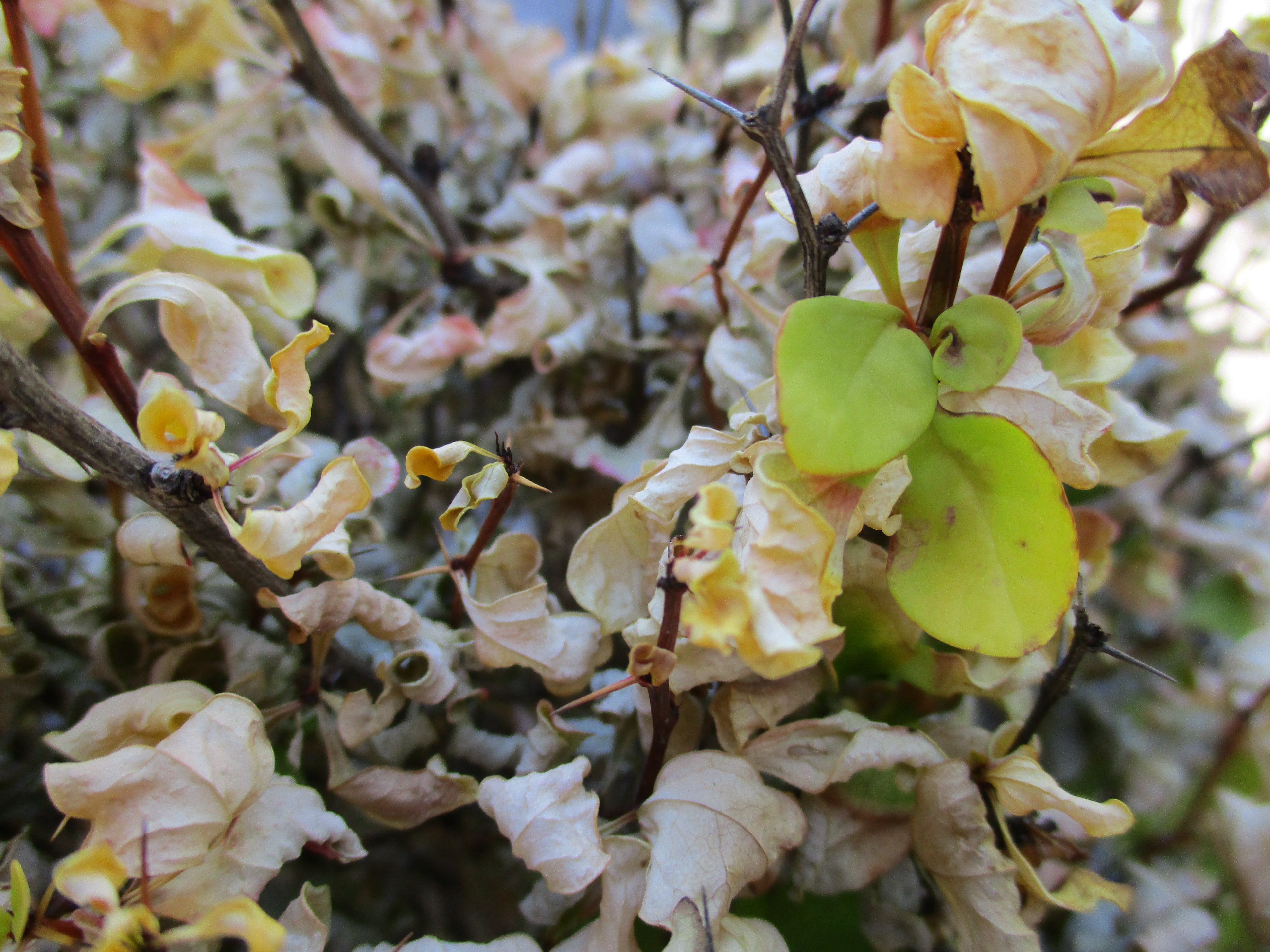
This crispy barberry is fortunately not as dead as it seems to be. Only the outer foliage is roasted. The stems and buds do not seem to be damaged. It will probably foliate again before defoliating in autumn. Even if it induces premature dormancy, it should recover as next winter ends.
Nonetheless, such damage on new plants is disconcerting.


My Internship Was NOT In Australia

P80106Australia, New Zealand and South Africa were the hip and trendy places to do internships in horticulture back in the late 1980s. Everyone who was anyone was doing it; which is sort of why I was not that interested in doing what everyone else was doing already, even if I could have afforded to go to any of those exotic places. I did my internship in Saratoga.

All I knew about Australia was Olivia Newton John, Helen Reddy, eucalyptus trees, and that it is the place where summer goes when it leaves here.

Since writing online and learning a bit more about horticulture in Australia, I incidentally found that Australia is stranger than I would have imagined.

There are no Pontiacs in Australia! Seriously! When someone asked about what to do with a surplus of peaches that were too overripe and squishy to can, I suggested that they get thrown at the neighbor’s Pontiac. It was such a fun tradition among kids in the Santa Clara Valley back in the 1970s. I did not expect to be taken seriously; but I did not expect to be informed that there are no Pontiacs there! How totally primitive! I did not even ask about Buicks. If they lack Buicks, I REALLY do not want to know about it. I did happen to ask if cars were driven on the left side of the road, which they are; not that it matters. Without Pontiacs, who cares?P80106+

Then there are these terrifying animals known as wallabies! They look like humongous rats! They come out early in the morning and again in the evening, when their victims are most vulnerable. They always stare at whomever is taking their picture, as if plotting revenge. They aim their ears too, in order to hear everything that is being said. They are watching and listening right now!P80106++

The middle of Australia is known as the Red Center, which sounds rather like Oklahoma. Uluru is a huge red rock at the center of the Red Center. It really is the color of Oklahoma, and sort of shaped like the 1979 Pontiac Bonneville in the other picture above. You should have seen the pictures that another blogger posted of this fascinating place, and nearby places! The geology alone is fascinating, and mixed with it are all sorts of eucalyptus trees just growing wild. I mean wild, as in they are native there; not exotic like they are here. It is weird to see them out in their natural environments, like valley oaks and coast live oaks here. Wallabies do not seem to bother them much. Most of Australia seems rather flat. There are not many high mountains, and they are not really all that high.P80106+++

Queenslander is an architectural style developed for the climate of Australia. It is named for the northeastern state of Queensland; so has nothing to do with slandering an unpopular queen. I did not know that it was all that different from the Ranch architecture that is common here until someone explained that the homes are up off the ground to allow for air circulation underneath. Some are up high enough for another story to fit below. I suppose that the lower floor could either be at ground level, or elevated as well. Unlike Ranch architecture, Queenslander can be either one or two stories. Also, they tend to be somewhat bisymmetrical, with the front door and steps in the middle, and the left side matching the right side. Some have extra rooms, such as a solarium, on one side. Porches extend at least across the fronts of the homes. Many extend around the sides as well. Simple Queenslander homes tend to be rather square, with only four sides. Their roofs are also rather square, sloping toward all four sides, instead of just sloping to the front and back like roofs of common Ranch architecture often do. One advantage over Ranch architecture is the hood over the steps to the porch. It diverts rain to the sides if there are no gutters. Queenslander homes do not seem to have prominent garages visible from the front, perhaps because Australians lack Pontiacs or other cars that are worth showing off.P80106++++

Australia is less populous than California is, and almost everyone lives near the coast. That is something that I was sort of aware of. What I did not know is that there are FIVE cities that are more populous than San Jose! BOTH Melbourne AND Sydney are more populous than Los Angeles! How are there enough people left over to live anywhere else? Adelaide is one of the five major cities, and also has a climate remarkably similar to that of San Jose. It even sort of looks like San Jose, with the East Hills in the background. It does not look as big as San Jose though. Adelaide seems to be a bit more centralized, with more high density development, and less urban sprawl. This might be a result of a lack of Pontiacs or other nice cars to drive to suburban areas. Perhaps people just prefer to live closer to town because wallabies live on the outskirts. Queenslander homes seem to be on suburban parcels that are probably on the outskirts, but they are also outfitted with those distinctive fences.