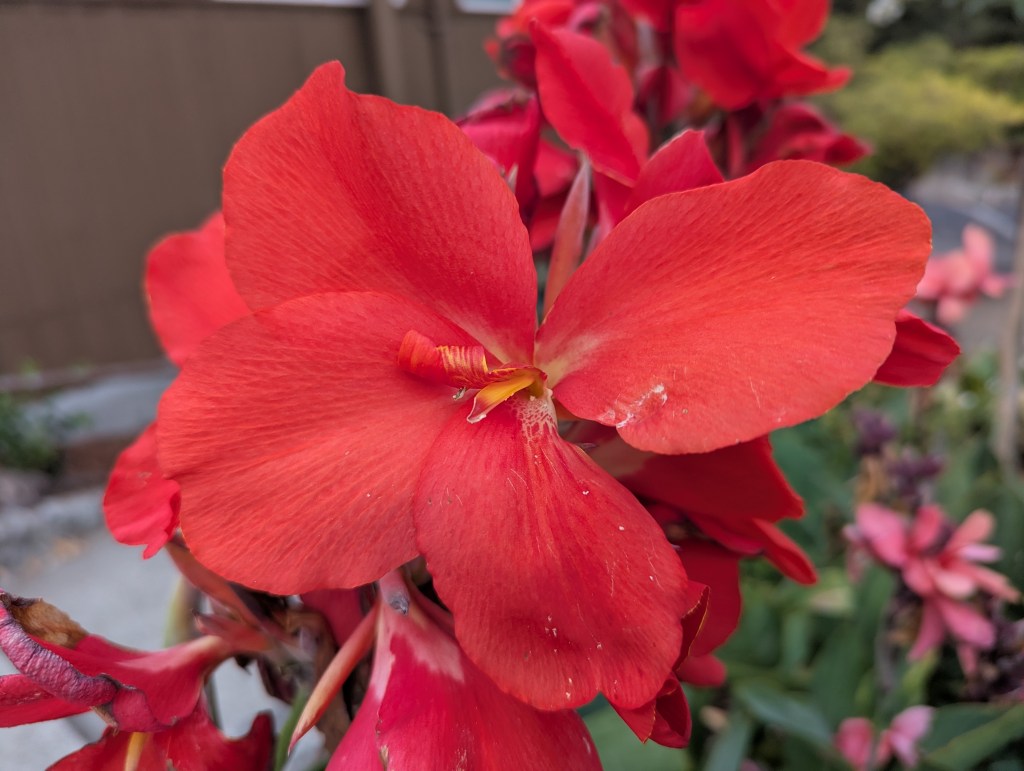
Sunday Best – Zinnia


Nearly everything in my garden has history of some sort.
1. Aloe arborescens, candelabra aloe came from the home of a friend in the East Hills of San Jose about twenty years ago. It is the only one of these six that was not just planted.

2. Aloe barbadensis, aloe vera came from my former neighborhood in town. I relocated decades ago, but got pups from a former neighbor who also took some to her new home.

3. Hesperaloe parviflora, red yucca came from Surprise, to the northwest of Phoenix in Arizona, near the new home of my former neighbor who gave me the few aloe vera pups.

4. Yucca desmetiana ‘Blue Boy’ yucca was a Christmas gift several years ago. It had been confined to its can within partial shade for too long. It already has stout but bare trunks.

5. Yucca glauca, soapweed grew from seed that I collected at a gas station somewhere in New Mexico on the way to Oklahoma in late 2012. It must be happy to be in the ground.

6. Yucca arkansana, Arkansas yucca, contrary to its name, came from Newalla, just east of Oklahoma City in Oklahoma, not long after I acquired the soapweed seed in late 2012.

This is the link for Six on Saturday, for anyone else who would like to participate: https://thepropagatorblog.wordpress.com/2017/09/18/six-on-saturday-a-participant-guide/

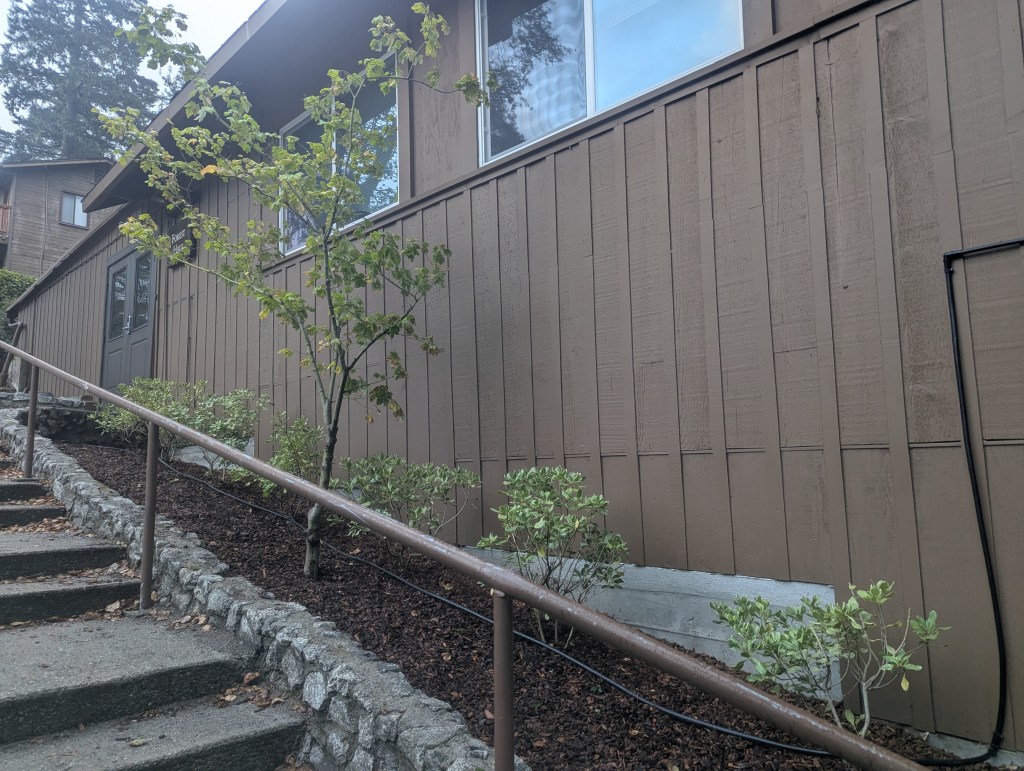
Several large trees needed to be removed at work.
1. The steeple of the Mount Hermon Memorial Chapel (el Catedral de Santa Clara de Los Gatos) is now visible. It had been mostly obscured by a big Douglas fir and a big tan oak.

2. This new view of stately redwoods is also visible behind the Mount Hermon Memorial Chapel. It had previously been cluttered with tan oaks, bays and another big Douglas fir.

3. Logs were still strewn about when I took these pictures on Wednesday. Unfortunately, a few redwoods needed to be removed also. The largest trunks will be milled for lumber.

4. The stump to the lower right was cut last Monday or Tuesday. The stump to the upper left was cut when the redwoods were harvested, prior to 1906, more than 120 years ago.

5. Alyssum, wax begonia and zonal geranium should perform much better with so much more sunshine. (Stock will be removed for summer.) They had always been in the shade.

6. This rose, although irrelevant to the topic, is the token flower of my Six for this week. It is too colorful to omit. I have no idea what cultivar it is. It was red, then faded to pink.

This is the link for Six on Saturday, for anyone else who would like to participate: https://thepropagatorblog.wordpress.com/2017/09/18/six-on-saturday-a-participant-guide/

Gardening is full of surprises. These are a few that I noticed last Thursday. I could have found more surprises, but that would have been more than six.
1. Jasminum humile, yellow jasmine is a real dud. It does not bloom nearly as profusely as I expected it to. Upon closer inspection, though, the flowers are surprisingly fragrant.

2. Lobelia erinus, lobelia self sowed and grew amongst weeds. However, no lobelia grew in the surrounding landscapes. The source of the seed is a mystery. What a nice surprise.

3. Digitalis purpurea, foxglove blooms either white or bright pink. Occasionally, lighter pink blooms are observed. This feral specimen, though, is surprisingly light peachy pink.

4. Aquilegia canadensis, columbine refuses to grow well where we plant it, but manages to bloom enough to toss seed to grow where it wants to. It should be no surprise but it is.

5. Dianthus caryophyllus, carnation was planted as a cool season annual a few years ago but has been retained, and surprisingly lives as a perennial as annuals change around it.

6. Camellia japonica, camellia bloomed well through winter, and then seemed to finish, just before surprising us with this last errant bloom. This is my favorite of the camellias.

This is the link for Six on Saturday, for anyone else who would like to participate: https://thepropagatorblog.wordpress.com/2017/09/18/six-on-saturday-a-participant-guide/

The nursery at work should not be as much work as it is. It produces more than we use.
1. Musa ingens, oem, or giant highland banana, is pupping, with three new pups poking through the jade plant that covers the medium around the base of the original specimen.

2. Pulmonaria officinalis, lungwort covers the medium around the base of a specimen of ‘Mekong Giant’ banana. This plant blooms pink, and is from Tangly Cottage Gardening.

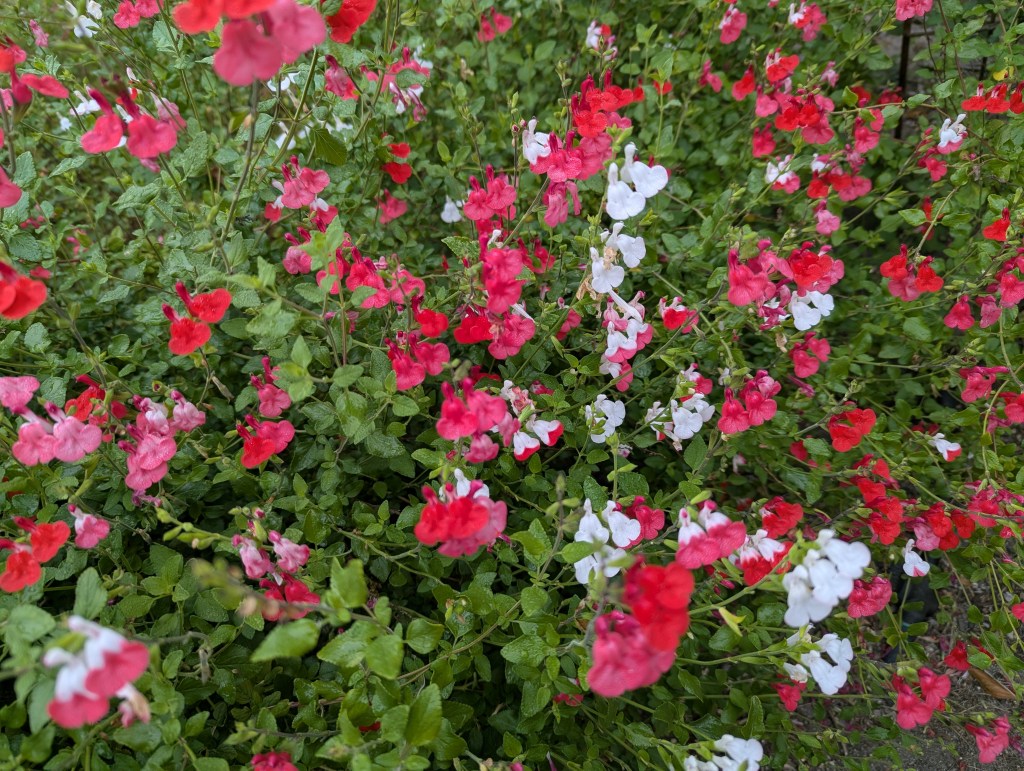
3. Salvia greggii, autumn sage grew in a vacant pot of otherwise empty medium. It may be useful within one of our landscapes. Its parent is ‘Hot Lips’. It is very likely the same.

4. Cydonia oblonga, quince is one of a few small rooted cuttings of an understock sucker of a pear tree. It is useful for grafting certain pears, but I will retain one to produce fruit.

5. Hesperaloe parviflora, red yucca is growing from seed that I brought from Arizona. It is considerably more abundant than expected. What can I do with eighty-six red yuccas?

6. Saccharum officinarum ‘Purple Ribbon’ sugarcane grew fast enough from bits of cane last year to produce a short length of new cane. It recently shed old leaves to expose this.

This is the link for Six on Saturday, for anyone else who would like to participate: https://thepropagatorblog.wordpress.com/2017/09/18/six-on-saturday-a-participant-guide/

Rhody’s rhodies have been blooming spectacularly. It is not easy to limit their picture to only six. There are so many cultivars.
1. White is generally my favorite color. However, most white rhododendrons are blushed with another color, so are not pure white. This one usually exhibits a bit of a pink blush.

2. Pink is the most common color among rhododendron cultivars. That certainly can not discredit any of them. They all are pretty. This cultivar eventually fades almost to white.

3. Lavender is one of the lesser common colors among rhododendron cultivars. Purple is more common. I may get a picture of a purple rhododendron for Sunday Best tomorrow.

4. Fuchsia is one of the many colors that many guys can not perceive. This looks pink to me. I guess it is slightly richer pink than the other pink rhododendron, but only slightly.

5. Magenta is another color that many guys have difficulty perceiving. I can merely guess that this is magenta because it resembles the rich color of ‘Barbara Karst’ bougainvillea.

6. Red is an easier color, although Rhody can perceive it no better than pink, magenta or fuchsia. As a canine, he sees just blue and yellow. Regardless, these are Rhody’s rhodies.

This is the link for Six on Saturday, for anyone else who would like to participate: https://thepropagatorblog.wordpress.com/2017/09/18/six-on-saturday-a-participant-guide/