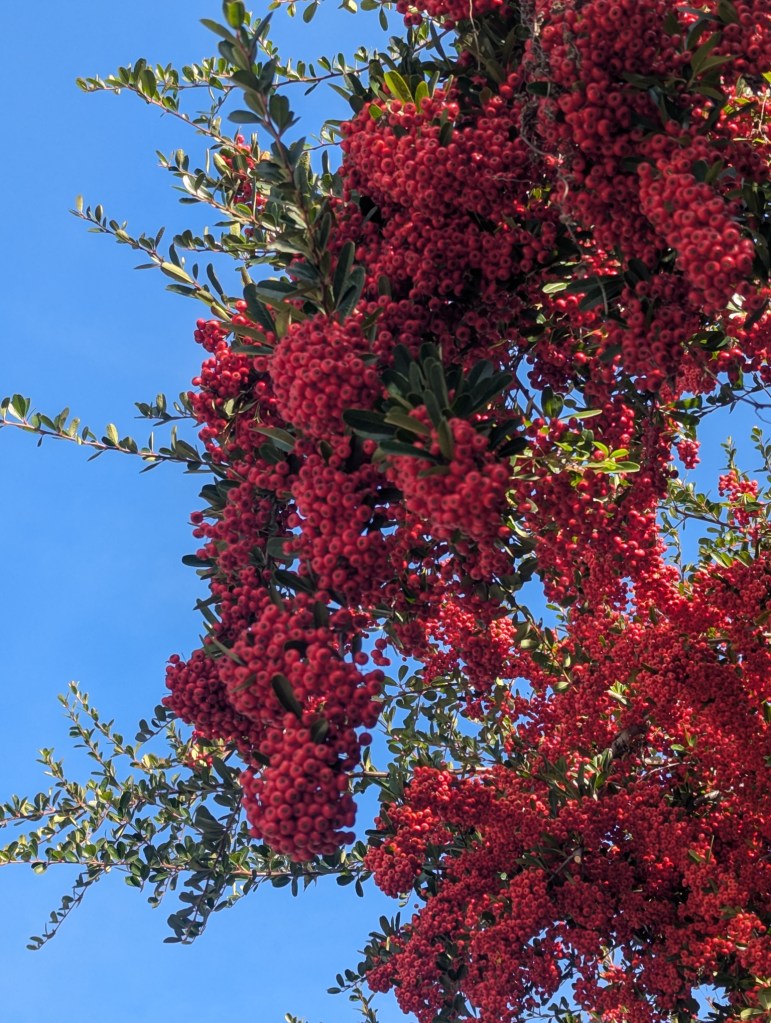
Cool season annuals are less diverse than warm season annuals for one simple reason. Flowers prefer to bloom while their favorite pollinators are most active. Most of the better pollinators are insects that are most active during warm weather. Therefore, most flowers want to bloom while the weather is warm. Many colorful berries are similarly exploitative.
For dispersion of their seed, colorful berries rely on birds. Therefore, many ripen and are most colorful as many birds migrate during autumn. Birds consume the berries but do not digest their seed. Instead, as they migrate, they disperse the viable seed. It is a mutually beneficial arrangement. Birds eat all they want. Seed benefits from thorough dispersion.
As they ripen, autumn and winter berries develop bright colors that attract birds. Most are bright red. Some are bright orange. A few are bright yellow. They are substantial enough to satisfy the birds that eat them. Yet, they are compact enough for such birds to eat them whole. Some are impressively abundant, at least until any birds that they feed find them.
That can be a dilemma for home gardening. Many garden enthusiasts grow autumn and winter berries for the color. Many grow them to attract birds, though. More grow them both for their color and to attract birds. The latter is least disappointing. Typically, such berries ripen to display their color faster than birds can eat all of them. Every season is different.
Unfortunately, there are not many options for colorful autumn and winter berries. Some of the species that produce the most colorful fruit are unfortunately thorny. Firethorn notably produces the most abundant, most colorful and most familiar berries. It is horridly thorny, though. So is English hawthorn, which is deciduous and defoliates to expose its red fruit.
Toyon and various cotoneasters are thornless alternatives for colorful berries. Toyon is a native species that grows rather large. Although cotoneasters are not as prolific, cultivars stay proportionate to home gardens. Hollies are dioecious, so female specimens need a male nearby for pollination. Because males are rare, females produce only a few berries.
 Tony Tomeo