 Pesticides are a topic that I do not talk much about. There really is not much to say about them. Only a few are used at the farm, and only while certain destructive insects or perhaps mites are active. Even less pesticides are used in the landscape. It is not that I have serious issue with them. They are just not as useful for controlling pests as proper horticultural techniques are.
Plants that we would expect to require pesticides simply are not welcome in our landscapes. We know that snapdragons and hollyhocks are very likely to be detrimentally infested with rust. Therefore, we grow neither.
Roses live in some of the landscapes only because we do what we must to help them avoid infestation by the various pathogens that they are susceptible to. They get pruned aggressively in winter so that their new growth grows faster than aphid and mildew that try to infest them in spring. Their fallen foliar debris that fungal pathogens overwinter in gets raked away cleanly.
On rare occasion, we find weeds that we would like to kill with herbicide; but we can’t because they are too close to riparian environments. With two creeks and two streams flowing through here, many of the landscapes are too close to water. We must instead pull the weeds that we can, and hope that more aggressive cover crops overwhelm what remains before they recover.
One of the few insect problems that we sometimes notice is the thrip on the rhododendrons. They are sort of always there, but had been tolerable. Aggressive pruning to stimulate vigorous new growth, and also improve air circulation, should have inhibited the thrip. Instead, the damage has been worse than it has been in a very long time. It was necessary to spray insecticide.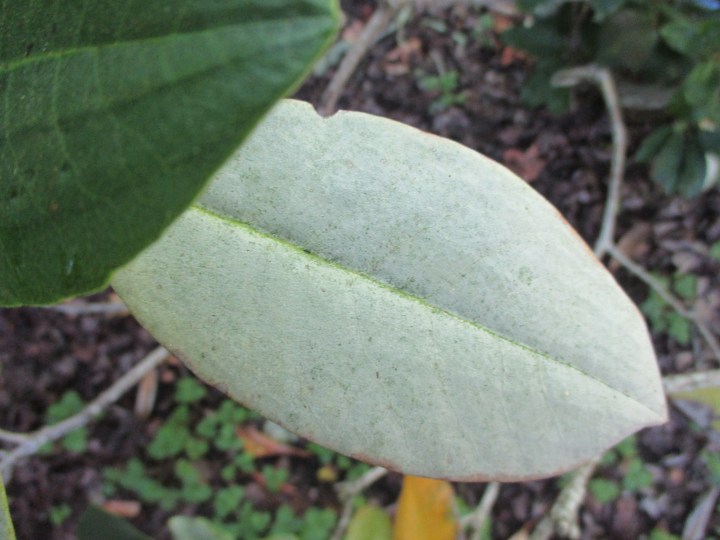 The pictures above and below show the worst of the damage caused by thrip. The picture below compares damaged foliage on the left to undamaged foliage on the right. Thrip rasp the foliar surfaces so that they can lap up the juices within. The process causes silvery discoloration, and ruins the foliage. Young damaged foliage is likely to get crispy around the edges, or get shed.
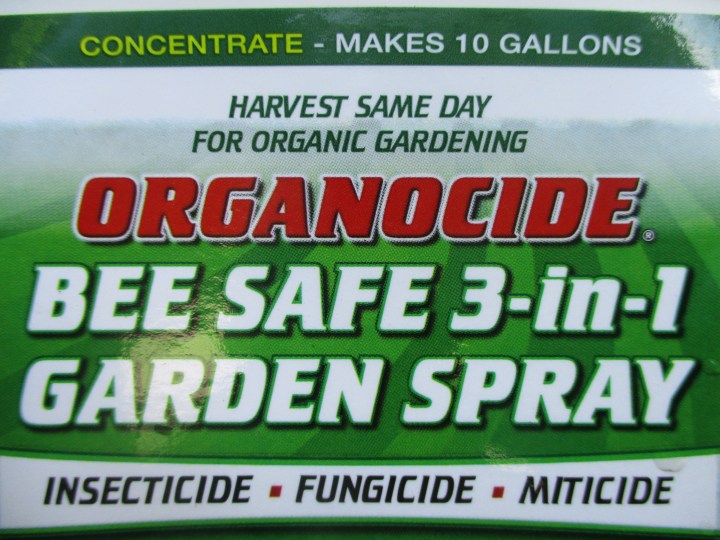
 For this sort of damage, I do not mind using insecticide. However, I have doubts about this particular insecticide, or whatever it is. It is supposed to be three in one; insecticide, fungicide and miticide. How is that even possible? Insects, mites and fungi are physiologically completely different. Anything that kills all three must be very nasty stuff! Yet, it is somehow safe for bees?!
There are several active ingredients, but I do not recognize many of them. I suppose that some could be insecticidal, some could be fungicidal, and some could be miticidal. The label does not explain the functions of the various components. None are hazardous enough to warrant a use permit like we need for agricultural pesticides. This product is available at the hardware store.
I do not doubt that this nonselective ‘pesticide’ is safe for bees, even though it is supposedly formulated to kill just about anything that might bother the rhododendrons. However, since it will not kill bees, and bees are insects, I do sort of doubt that this product will kill many other insects, including thrip.
Incidentally, I am sorry for the delay of posting my weekly ‘Horridculture’ rant, which should have posted yesterday. It normally posts on Wednesdays. The article that posted yesterday really should have posted today instead.
 Perhaps I should see this movie. I hear that it is pretty lame. I sort of wanted to see it because it was filmed in Cambria, about thirty miles to the northwest of where Brent and I were in our last year of studying horticulture at Cal Poly in San Luis Obispo at the time. Yet, I never select movies. I always leave that up to whomever I am seeing the particular movie with. None of my friends ever wanted to see Arachnophobia. The one friend who you would think would want to see it because of where and when it was filmed wanted nothing to do with it. You see, Brent, the famous horticulturist and landscape designer who works outside where spiders live, is afflicted with Arachnophobia.
 Tony Tomeo