Litter Problem

It will not DIE!

We have a litter problem. At least three species of Agave continually have litters of pups. We give almost all of the pups away to friends and neighbors, but more constantly appear. I suppose that we could dispose of some, but that is not easy for those of us who enjoy growing vegetation instead of destroying it.

Pups of one Agave continue to appear where the original was relocated from several years ago. Although I do not know what species it is, it is likely my favorite of the three. However, we can not accommodate all these pups! The original is happy with its new situation, but is beginning to generate a few more pups there as well.

Pups of Agave americana, century plant, got canned because we thought that we could eventually find homes for them. Now, and for the past few years, these maturing pups are producing more pups, some of which are emerging from the drainage holes of their cans! The original is happy to be a neighbor of the unidentified Agave, but could generate more pups at any time.

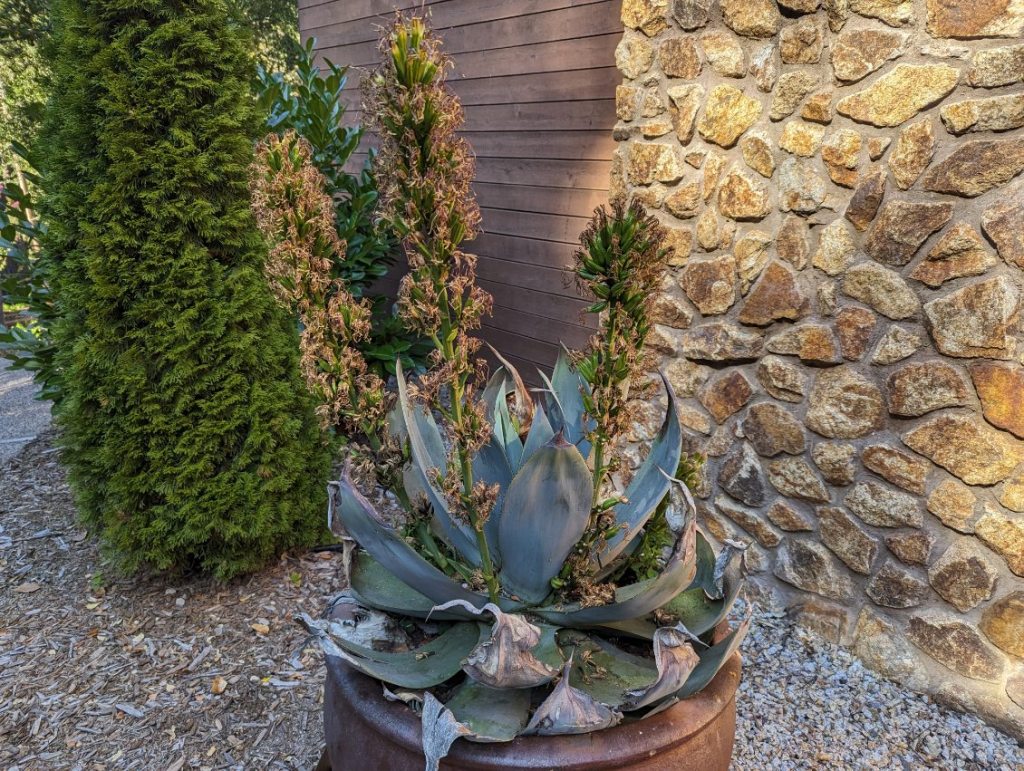
Agave ovatifolia, whale tongue agave, was purchased by the other horticulturist for a specific situation. It was a striking specimen that was worth what was spent on it. However, it began to generate pups almost immediately after installation, and then suddenly and unexpectedly bolted and bloomed. It was disappointing for such an expensive specimen of a monocarpic species. We removed it after bloom, with the intention of replacing it with one of its several maturing pups. Of course, I could not simply dispose of its carcass. I canned it like a dormant perennial, just in case it did something. Well, now it is doing something! It is bolting and blooming from the grave! I expect more pups soon. We really should get all the Agave spayed!


Agave really should be spayed!

Unhappy Fishtail Palm

Now that the foliar color has improved, the foliar density is deteriorating.

Fishtail palm is never completely happy here. It is not much happier in Southern California. Even the happiest are discolored to a minor degree. Many are more significantly discolored. Some are so very discolored that they are visually unappealing.

No one seems to know why. I suspect that they would prefer more humidity. Perhaps they prefer more humid warmth. They may dislike the pH of the soil.

Furthermore, fishtail palms are monocarpic. Each trunk dies after bloom. Clumping sorts develop new trunks prior to the demise of a blooming trunk. Those that do not develop replacement trunks die completely.

The illustration above is obviously not of exemplary quality. I took it from the car while driving. This was on northbound Highway 101, at the northern extremity of Pismo Beach. The palm to the upper left of the sign for Spyglass Pointe, with the yellow arrow pointing at it from above, is a fishtail palm. Until recently, it had been famously chlorotic.

Colleagues who drove through Pismo Beach typically asked me about this palm after seeing how chlorotic it typically had been. This it he least chlorotic that I have ever seen it. However, it may be naturally deteriorating after its primary bloom. Although I have not observed any bloom, I can see that new leaves are not developing on the same rate that They had in the past. This picture shows it with only a single open leaf, with another foliar spike extending from the terminal bud.

This particular fishtail palm is not very old. I can remember when the associated residential buildings were constructed less than two decades ago. landscapes and associated trees were added shortly afterward. Since then, the fishtail palm had been unhappy. This likely why fishtail palm is not more commonly available here than it is.

Monocarpic?

Agaves refuse to die.

Monocarpic species bloom only once. They die afterward. Many annuals are monocarpic by default. After bloom and production of seed, they have served their purpose of perpetuating the next generation. Some may bloom more than once within their respective season, but realistically, do not expect to live for long after doing so.

Agaves are monocarpic. Unlike annuals, some grow for many years before maturing enough to bloom. In fact, the century plant is known as such because, in the wild, it supposedly takes a century to mature enough to bloom and finally die. Of course, they do not take nearly so long to bloom within cultivation.

That could be either an advantage or a disadvantage. Their bloom is awesome, but their death is ugly. Removal of their deteriorating but wickedly thorny foliage is a horrid chore. The sap from their foliage causes a rash that can be comparable to the allergic reaction from poison oak. What is worse is that they are not really monocarpic!

Again, that can be either an advantage or a disadvantage. They provide more than enough pups to replace their deteriorating carcass. However, these prolific pups must be divided from each other and the deteriorating carcass of their parent. They are too numerous to accommodate within the same garden or share with neighbors who likely do not want them. Furthermore, they continue to generate pups long after the parent and first litter of pups is gone. Without intervention, they seem to never die completely. Even with diligent intervention, they can linger for many years.

This particular agave should have remained vegetative for many years, but bloomed after only two or three years. The first litter of pups bloomed immediately afterward, as this picture demonstrates. Ultimately, we would like only a single pup to replace the parent.

Pups Of A Horticultural Nature

Pups are copies of their parents.

Pups of the most familiar type are canine. Most are puppies of domestic dogs. Some are foxes or wolves. A few are seals, otters or various other animals. Garden variety pups do not get much consideration though. They develop into new progeny of plants rather than animals. Unlike animal pups, they are genetically identical clones of their single parents.

Pups of the horticultural sort generally develop from subterranean stems, such as corms, tubers or rhizomes. Most emerge from formerly dormant buds. Some grow adventitiously from roots. Pups appear as basal sideshoots against or close to their parent plants. They efficiently disperse their own roots to eventually survive as new and independent plants.

Most plants that produce pups are perennials. Some are so proficient with the technique that they grow into substantial colonies of genetically identical clones. For some, it is the primary method of replication. They actually prefer to replicate vegetatively than by seed. Some trees and woody plants do the same, but their clones lack the same classification.

For many perennials, propagation by division is merely the separation of pups from their parent plants. Most types of banana trees eventually generate a few surplus pups. Some types generate an abundance of pups to share with anyone who wants them. Separation of their pups is very similar to division of the smaller rhizomes of canna or lily of the Nile.

Individual rosettes of various species of Agave and a few terrestrial species of Yucca are monocarpic. In other words, they die after blooming only once. However, instead of dying completely, most generate several pups prior to bloom. Some produce pups excessively! Such pups can be difficult and hazardous to separate, but can replace their own parents.

Mediterranean fan palm is one of only a few palms here that generates pups. That is why it develops multiple trunks. Surplus pups can survive separation to grow as distinct trees. However, because of their densely fibrous roots, separation of intact pups can be difficult or impossible. Sago palms, which are not actually palms, are more compliant to division, even for rootless pups that develop on their stout trunks.