Monocarpic species bloom only once. They die afterward. Many annuals are monocarpic by default. After bloom and production of seed, they have served their purpose of perpetuating the next generation. Some may bloom more than once within their respective season, but realistically, do not expect to live for long after doing so.
Agaves are monocarpic. Unlike annuals, some grow for many years before maturing enough to bloom. In fact, the century plant is known as such because, in the wild, it supposedly takes a century to mature enough to bloom and finally die. Of course, they do not take nearly so long to bloom within cultivation.
That could be either an advantage or a disadvantage. Their bloom is awesome, but their death is ugly. Removal of their deteriorating but wickedly thorny foliage is a horrid chore. The sap from their foliage causes a rash that can be comparable to the allergic reaction from poison oak. What is worse is that they are not really monocarpic!
Again, that can be either an advantage or a disadvantage. They provide more than enough pups to replace their deteriorating carcass. However, these prolific pups must be divided from each other and the deteriorating carcass of their parent. They are too numerous to accommodate within the same garden or share with neighbors who likely do not want them. Furthermore, they continue to generate pups long after the parent and first litter of pups is gone. Without intervention, they seem to never die completely. Even with diligent intervention, they can linger for many years.
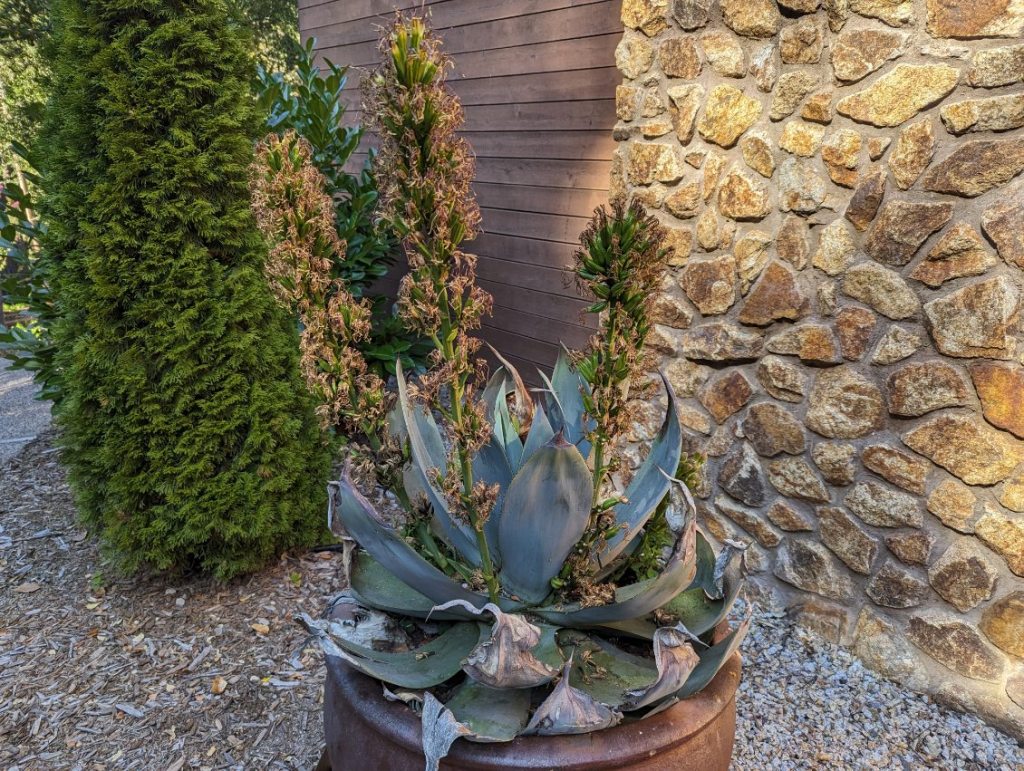
This particular agave should have remained vegetative for many years, but bloomed after only two or three years. The first litter of pups bloomed immediately afterward, as this picture demonstrates. Ultimately, we would like only a single pup to replace the parent.
 After providing remarkably striking foliage for many years, the biggest and boldest agaves bolt with spectacularly tall floral stalks that support horizontal pads of flowers. These stalks can bloom for months, and stand for months after bloom is finished. Then things get ugly. The foliage around each bloom folds back, desiccates and dies. There is no nice way to describe it. Bloom is death.
 Tony Tomeo