Pink Melaleuca

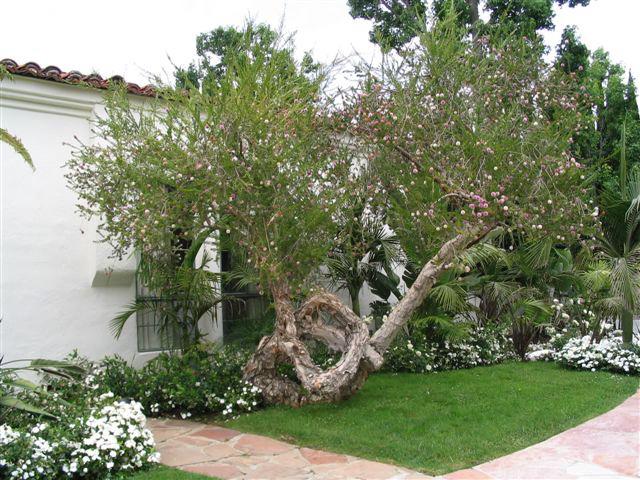
Pink melaleuca can be impressively sculptural.

            Golden Gate Park in San Francisco has some of the most impressive mature specimens of pink melaleuca, Melaleuca nesophila, outside of their native homeland in Australia. Although most are naturally less than twenty feet tall and wide, their disproportionately bulky trunks are remarkably gnarled and sculptural, as if they have been growing there for centuries. Pink melaleuca actually grows and develops trunk and limb structure rather fast while young, without ever becoming too obtrusively large. Spongy pale tan bark covers the distinguished trunks and limbs like a thick parka.

            Sculptural small trees are not the only function of pink melaleuca. They also make nice informal hedges and screens, and can be shorn occasionally if necessary. The round inch long leaves are quite thick. Round inch wide trusses of small staminate flowers bloom slightly purplish pink and fade to pale white through most of the year, except where shorn. (Staminate flowers are showy because of distended stamens instead of petals.) Hummingbirds are grateful for the flowers while not much else blooms through winter. Hard seed capsules that remain in dense cylindrical formation on twigs after blooms are long gone are sometimes used as dried flowers. Like all melaleucas, pink melaleuca is easy to care for, and tolerant of harsh exposure, inferior soil, minimal watering and neglect.
Big Shrubbery or Small Trees

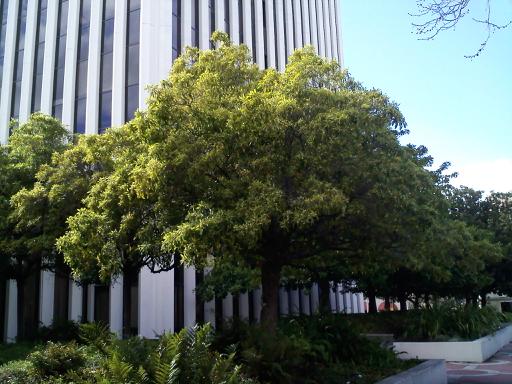
Pittosporum undulatum is a large shrub that can become a small tree.

            Shrubbery behaving badly can be a problem. Many seemingly innocuous shrubs get planted in situations where they do not fit, and soon get too big for the space available. Others do not get shorn or pruned as they should, or simply get neglected, and eventually get overgrown. Many others have sneaky ways of sowing their seeds in awkward places where they would not otherwise get planted by anyone who knows better.

            Most home improvement shows on television would simply recommend removing obtrusive, overgrown or inappropriate shrubbery and replacing it with something more proportionate, appropriate and stylish. What a waste! Hidden within overgrown shrubbery, there are sometimes potentially appealing small trees that only need to be released from thickets of overgrowth.

            Overgrown Australian tea tree, sweet olive (Osmanthus fragrans), xylosma, glossy privet, ‘Majestic Beauty’ Indian hawthorn, and larger types of oleander, holly, pittosporum, cotoneaster and juniper are often easily salvaged by aggressive selective pruning rather than indiscriminate pruning for confinement. Lower growth that has become obtrusive, disfigured or otherwise unappealing can be thinned or removed to expose substantial sculptural trunks within. Upper growth that is out of the way can be left intact or thinned as necessary, but should not shorn or pruned indiscriminately. This creates informal small trees with distinctive trunks from what had been overgrown shrubbery.

            Some shrubbery may need some time to grow out of its former confinement, and may be somewhat unsightly during the process. As they develop though, they should require less maintenance, since most of their growth should be up out of the way instead of where it is in constant need of pruning for confinement. 

            Many small trees that often get shorn into shrubbery would similarly do better with selective pruning to enhance natural branch structure and eliminate congested thicket growth. Japanese maples, redbuds, smoke tree, English hawthorn, crape myrtle, parrotia, loquat, strawberry tree, Pittosporum undulatum, and small types of magnolias, acacias, and yew pines (Podocarpus spp.) are notorious for getting shorn into unmanageable shrubbery. Pineapple guava, photinia, toyon, hop bush, larger types of bottlebrush and smaller types of melaleucas are more conducive to being shorn and pruned as large shrubbery, or can be pruned into small trees if preferred.

Blue Palo Verde

“Palo verde” translates to “green stick”.

If “verde” translates to “green”, then what color is blue palo verde, Parkinsonia florida? It is simply a bit more bluish green than other species that are a bit more yellowish. Its bark contains chlorophyll to photosynthesize without foliage. Blue palo verde is deciduous so defoliates for winter. Then, it defoliates in response to dryness through much of summer.

Blue palo verde in the wild may develop and retain foliage only during early spring. With landscape irrigation, it can retain some foliage through summer. It can also produce a bit more prior to late autumn defoliation. However, frequent irrigation promotes vigorous but structurally deficient growth. Few blue palo verdes thrive for a century within landscapes.

Blue palo verde can grow almost forty feet tall, but typically grows only about half as tall. It naturally grows as large shrubbery. Removal of lower growth exposes sculptural trunks for small tree form. With staking, trees can develop single trunks. Light yellow flowers are tiny but profuse during spring bloom. Blue palo verde is the Official State Tree of Arizona.

Vine Maple

Vine maple works like Japanese maple.

Japanese maples became so popular for their novelty that they are no longer novel. The diversity of their many cultivars is their primary appeal now. Vine maple, Acer circinatum, lacks such diversity, but is actually more novel. It is native from Mendocino County to the southwestern corner of British Columbia. Yet, it is very rarely available at nurseries here.

Vine maple has not been in cultivation for nearly as long as Japanese maple has. This is why its diversity is limited to not much more than a dozen cultivars. Its cultivars are even rarer than the simple species. Only a few ever become available, and almost exclusively by online purchase. Consequently, with very few exceptions, they are initially very small.

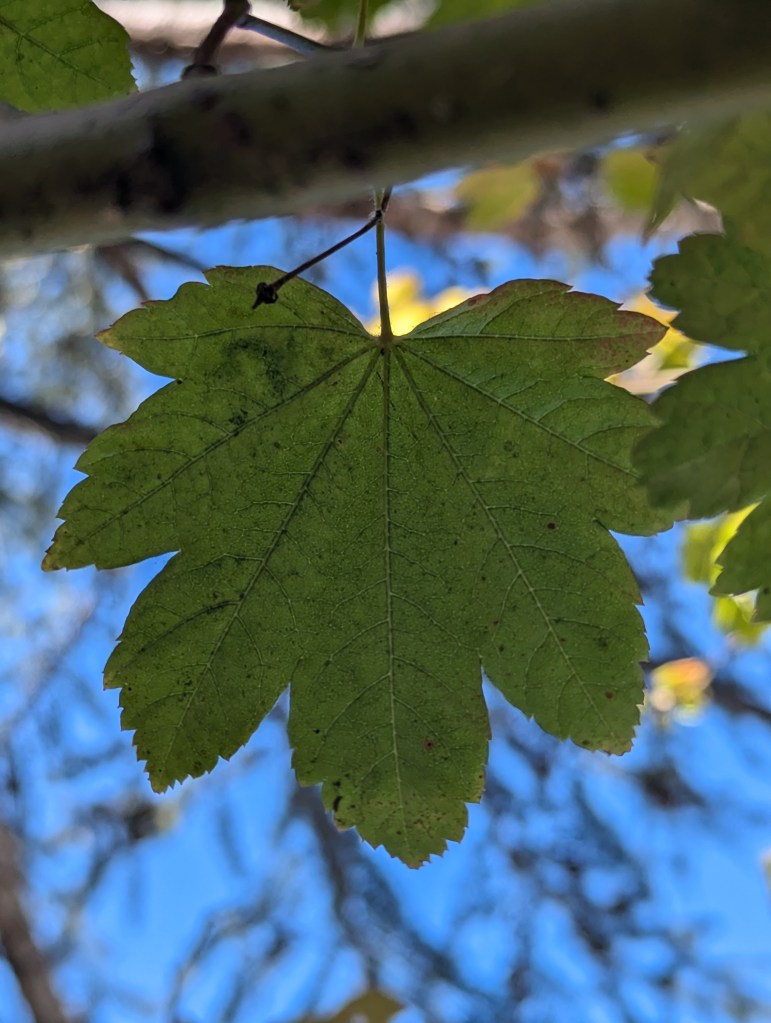
Vine maple grows somewhat like Japanese maple, typically with a few sculptural trunks. With regular pruning, it can stay as short as ten feet. It rarely grows more than twenty feet tall. The lobes of its palmate leaves are wider than those of Japanese maple. Leaves are only about three inches long and wide. Foliage develops bright orange color for autumn.

Saucer Magnolia

Spring color blooms before winter ends.

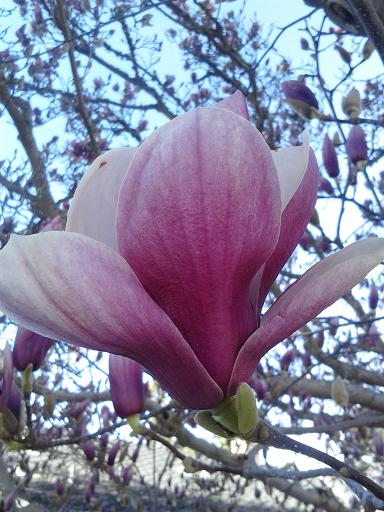
Before the deciduous foliage regenerates, saucer magnolia, Magnolia X soulangeana, is already completely overwhelmed with a profusion of big pastel pink and white flowers. Some of the many cultivars bloom white, paler pink or purplish. Some are more purple than pink. Individual flowers are about six inches wide. Some cultivars bloom with globular flowers that do not open quite so broadly. Others open even wider. The largest flowers can get almost a foot wide. Eventually, fading flowers will be replaced with big and soft lime green leaves. Most saucer magnolia trees are grown with several trunks and low branches to display the bloom more prominently, as well as to display the sculptural branch structure while bare through winter. The flat bark is strikingly light gray.

Himalayan Birch

50805+
The white bark of Himalayan birch is even more striking that that of European white birch.

Himalayan birch, Betula utilis ‘Jacquemontii’, must not be confused with the more traditional European white birch! If young trees get added to established groves of European white birch, they will never fit in. Their trunks stand vertically rather than lean casually. Their limbs are upright and angular instead of softly pendulous. Their bark is actually whiter.

Mature trees can get taller than thirty feet without getting much more than half as broad, and are relatively symmetrical for birches. The form of any single exposed tree is generally conical, although several trees together adapt to develop as picturesque groves with fewer interior limbs. The shade below is not too dark for lawn or moderately shade tolerant plants.

Maintenance is not exactly minimal. Vigorous young trees should be pruned and groomed annually, or at least every few years. Pruning should not be done in early spring when sap is likely to bleed from pruning wounds. Roots want to be watered somewhat regularly, even through the drought. When they fall in autumn, the two inch long leaves can be difficult to rake from fine gravel or bark.

Multi Trunk Trees Seem Natural

00527thumb
Overgrown shrubbery becomes multi trunk trees.

For several years in the late 1960 and early 1970s, European white birch were trendy. Most lived in ubiquitous groups of three. Where three did not fit, a single multi trunk tree, typically with three trunks, was a popular option. Each multi trunk tree provided as many trunks as a few single trunk trees. For these particular white birch, the elegant white trunks were their most appealing feature.

Multi trunk trees, which are popularly known as ‘multis’, are only structurally different from their counterparts with single trunks. Multi trunk crape myrtle are genetically identical to crape myrtle of the same cultivar, but with single trunks. The only difference is that multi trunk trees branch at ground level, instead of at the top of a single straight trunk. Each needs to be pruned to the desired form.

Multi trunk birch, paperbark and lemon gum exhibit appealing bark. More trunks display more bark than single trunks. Multi trunk strawberry tree, olive and oak exhibit appealingly sculptural form. Cork oak and crape myrtle provide both appealing bark and sculptural form. Silk tree, acacia and deciduous magnolia display their bloom more effectively with lower and broader multi trunk form.

Trees get help to develop into a desired form. European white birch, lemon gum and silk tree are more likely to develop single trunks naturally. Coppicing compels them to regenerate with several trunks. Conversely, olive, crape myrtle and strawberry tree develop a few trunks naturally. Single trunk trees need thinning to remove the superfluous trunks, and staking to straighten a single trunk.

In home gardens, multi trunk trees sometimes evolve from overgrown shrubbery. Pineapple guava may be shrubby for may years before lower growth gets pruned away to reveal sculptural trunks within. English laurel that gets too overgrown for containment pruning might become a delightful multi trunk tree instead. It will be pleased to grow freely from the top if lower growth gets pruned off.

Multi trunk trees are no more natural than trees with single trunks are, but they seem to be.