
Horridculture – African

Delegates from Arabia, Africa, Germany Pakistan and (almost) Turkey

‘The Rescuers’ is an animated movie for children from 1977 that features the Rescue Aid Society, which is an international organization of mice. (I am trying to be very brief with this description. Besides, I do not know much about it.) Delegates of the Rescue Aid Society represent various countries, such as Arabia, Germany, Pakistan, Turkey and Africa. Yes, ‘Africa’. Although one can assume that ‘Arabia’ refers to Saudi Arabia, it could refer to the entire region, which includes several countries. Similarly, although one can assume that ‘Germany’ refers to West Germany, it could refer to both West Germany and East Germany, which were still separate countries in 1977. ‘Africa’, though, is not so easily dismissed. It is an entire continent, which includes more countries than any other continent. Horticulturally, Africa does not get much more regard. African sumac, African daisy, African iris, African violet and African tulip tree are all from Africa, but their names reveal no more than that about their origin. Italian cypress, English holly, French lavender, Norway spruce and Grecian bay all have names that are more descriptive about their European origins. Similarly, the names of Japanese boxwood, Chinese elm, Korean fir, Burmese honeysuckle and Indian laurel describe their Asian origins. The names of California fan palm, Oregon grape, Virginia creeper, Texas bluebonnet and Arizona cypress are even more descriptive, by designating individual States within the United States of America, which is within the continent of North America. Here in California, some common names are even more regionally descriptive, such as Monterey pine, Santa Cruz cypress, Santa Barbara daisy, San Francisco campion and Montara manzanita. Although most of these examples are unknown or rare beyond their native ranges, a few are quite common elsewhere. Yet, somehow, most of what was exported from Africa is merely ‘African’.
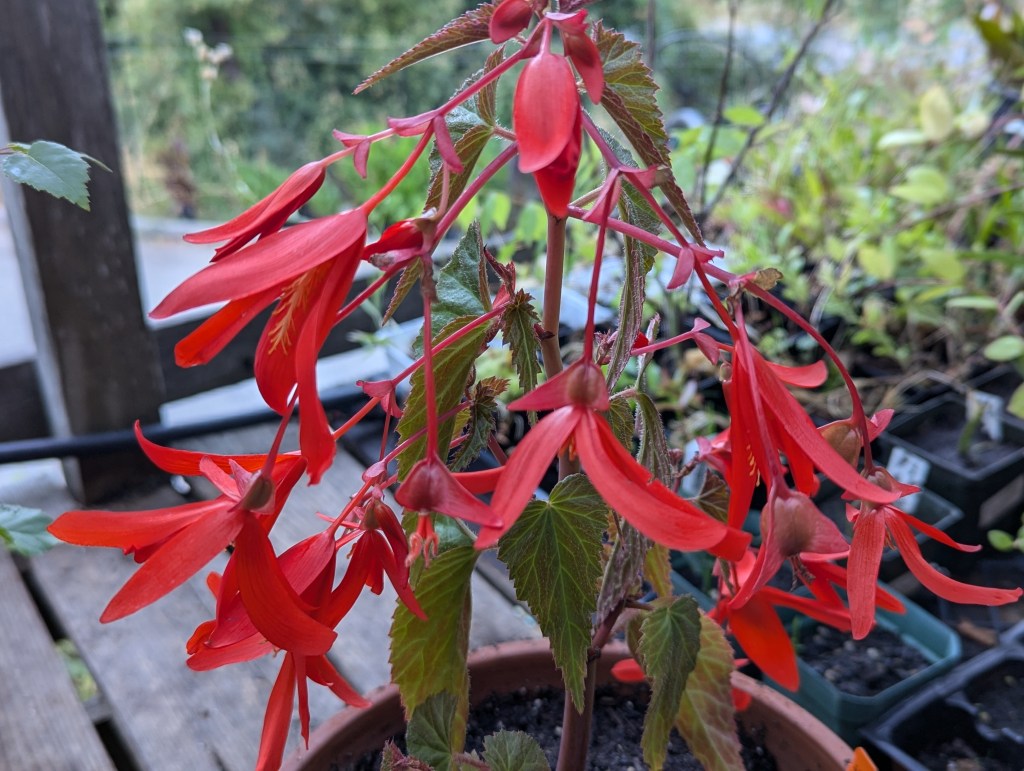
Santa Cruz

Begonia boliviensis ‘Santa Cruz’

Begonia boliviensis ‘Santa Cruz’ is one of those modern cultivars that I am typically not so keen on. It grows vigorously with abundant red bloom. ‘San Francisco’ is similar but with abundant pink bloom. ‘Santa Barbara’ is similarly similar but with abundant white bloom. All perform splendidly, like so many formerly modern cultivars that were trendy before them. I am not so keen on them merely because they are both modern and trendy. Their names do not help either. My colleague purchased ‘Santa Cruz’ from a nursery in Santa Cruz. It now lives here in Mount Hermon, which is a few miles away from Santa Cruz, but still in Santa Cruz County. I suspect that it is more popular locally because of its name. For the same reason, I suspect that ‘Santa Barbara’ is more popular in Santa Barbara, and ‘San Francisco’ is more popular in San Francisco. I also suspect that I would be less resistant to these modern cultivars if they had more appealing names, such as ‘Los Gatos’, ‘San Jose’ or ‘Palo Alto’. Perhaps the names are for the counties rather than the cities within the counties. All three of my recommendations are within Santa Clara County.

Horridculture – Dried Plums?

00115
Dried prunes are experiencing something of an identity crisis.

Nomenclature used to be more predictably standardized than it is now. When I write about how it works, I compare it to the names of cars. For example, ‘General Motors’ is just a family. ‘Buick’ is a genus. ‘Electra’ is a species. ‘Limited’ is a variety. Well, my Sebring was labeled as a Chyrsler but made by Mercedes Benz. Modern horticultural nomenclature is no more accurate.

With all the promiscuity going on nowadays, it is impossible to know who the parent of some of our favorite plants are. Many are interspecific hybrids. Some are intergeneric hybrids. Some are so complicated that their species names are merely omitted; and no one seems to notice! That is like driving a Mercury LS without knowing or caring if it is a Grand Marquis or a Lynx.

So, now we can grow such aberrations of traditional stone fruit as as aprium, apriplum, pluot, plumcot, nectaplum, pluerry and peacotum. The first half of the names supposedly indicate who the promiscuous maternal parent is. The second half refers to the male pollinator. Parents who contributed fewer letters to the name were supposedly already hybridized prior to breeding.

For example, an apricot pollinated by a plum creates an aprium; and an aprium pollinated by a plum creates an apriplum. The apriplum gets an extra letter from plum ancestry because it is %75 plum and %25 apricot. A plum pollinated by an apricot creates a pluot; and a plum pollinated by a pluot creates a plumcot. There are, of course, many other complicating combinations.

Sure, the resulting fruit is very good; but is it any better than what it was bred from? If everyone could have tasted the simple, traditional and exemplary stone fruits that formerly grew in the vast orchards of the Santa Clara Valley, there would be no need for all this hooey. Besides, why is there all this interest in creating new and weird fruit while eliminating some of the old?

Prunes and plums, as I explained earlier, are two distinct types of fruits. Japanese plums are the richly flavored and typically more brightly colored fruits that were more popular in home gardens than in orchards, since they are not easy to transport. European prunes are the sweeter but mildly flavored freestone fruits that grew in orchards, generally for drying and canning.

Apparently, the name of ‘prunes’ was not appealing enough . . . or was actually considered to be unappealing. Almost twenty years ago, prunes were consequently reclassified as plums. Dried prunes are now known as dried plums, as if they are dried versions of the classic ‘Santa Rosa’ plums that so many of us grow in our home gardens. Some of them just might be! Who knows?!

Plum juice could be extracted from Japanese plums, which actually make excellently rich juice, but is more likely from fresh (not dried) French or Italian prunes. However, there is still such a beverage that is known as prune juice. It is extracted from, of all things, rehydrated dried plums . . . or dried prunes. These unfortunate fruits get dehydrated, rehydrated, and then juiced!

The juice of rehydraded dehydrated plums or prunes might be the only remaining application of the word ‘prune’. At least it is useful for that; in the sense that it designates the source of the juice as rehydrated dehydrated fruit of some sort, rather than fresh fruit of some sort. Whether such fruit is a plum or what was formerly known as a prune remains something of a mystery.

Nomenclature Is More Than Botanical

90515thumbSimply put, ‘nomenclature’ is how things get named. It is not exactly like naming a child or a dog, or even a new small country in the South Pacific. There is a certain technique to it that is more like naming cars. Well, it ‘was’ like naming cars, a long time ago when cars had simple names rather than numbers and letters. Coincidentally, nomenclature of plants is getting to be just as confusing.

Plants and other biological organisms are assigned Latin names, which for plants, are also known as botanical names. These names are universal, for everyone, everywhere in the World. Almost all plants also have common names that are more or less regional. That is why what is known as Norway maple here is known as sycamore in England, but both are Acer platanoides everywhere.

The first part of a Latin name designates the ‘genus’, which is the more ‘general’ of the two parts of the name. (genus = general) For example, all true maples, including those that are known as sycamores in England, are within the same genus of ‘Acer‘. Genus names are like ‘Buick’, ‘Oldsmobile’ and ‘Pontiac’ for cars. They distinguish a general group, but are no more specific than that.

The second part of a Latin name designates the ‘species’ which is the more ‘specific’ of the two parts of the name (species = specific) For example, within the genus off Acer, the Norway maple is designated as Acer platanoides. Species names are like ‘Electra’, ‘Riviera’ and ‘Skylark’ for cars. They designate specific cars within the big general group that is collectively known as ‘Buick’.

There are of course more general and more specific classifications as well. Just as Buick, Olsmobile and Pontiac are within the group known as General Motors, the genus of Acer is within the family known as Sapindaceae along with Aesculus (horse chestnut) and Litchi (Lychee). ‘Schwedleri’ is a cultivar (cultivated variety) of Acer platanoides, just as some Buick Electra are ‘Limited’.

Incidentally, rules of proper nomenclature dictate that Latin names are italicized, and that the genus name is capitalized, while the species name is not.