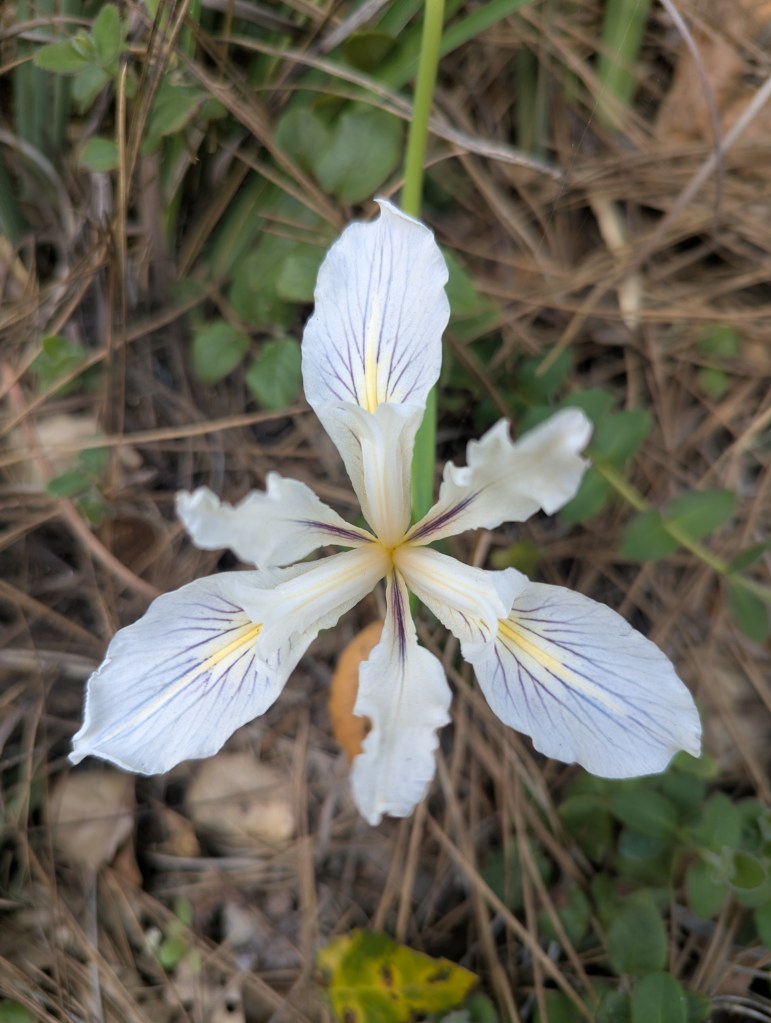
The natural range of Fernald’s iris, Iris fernaldii, is actually rather limited. It is endemic to only the Coast Ranges from Mendocino County to Santa Cruz County. Although it grows well beyond its natural range, it is quite rare in cultivation. Within chaparral climates that are warmer than its range, it prefers afternoon shade. Its foliage is greener with irrigation.
In the wild, Fernald’s iris develops sparse colonies, typically mixed with other vegetation. Colonies are more compact with cultivation and exclusion of other species. Propagation is very easy by division, or simple separation of wayward rhizomes. Fernald’s iris can be satisfied with shallow soil or soil of inferior quality. Too much fertilizer may inhibit bloom.
Fernald’s iris grows only about a foot tall, with slender, grassy and grayish green leaves. Floral stalks stand a bit more vertically and slightly above the foliage. The typically white flowers are paired on each floral stalk. Flowers might be pale or buttery yellow, or, rarely, pale lavender. Roots are thin but tough. Rhizomes, relative to those of other iris, are slim.
Vegetation has always been here. Wildlands outside of urban development demonstrate that noplace is or was without it. Native species lived here before any home gardens did. Whether intentionally or unintentionally, some of it still does. Some sneaks in like weeds. Some arrives by invitation. A few old trees never left as the area around them developed.
Native species perform well locally because they are adapted to local climates and soils. It is all very natural to them. In fact, many dislike major modifications to their climates and soils. Although most tolerate or even appreciate a bit of supplemental irrigation, some do not. Many rot if irrigation is too generous. Also, many do not want much soil amendment.
Some native species might be a bit too natural, though. Because they are from chaparral climates, they can get somewhat scraggly by summer. It is not because of a lack of water or other environmental deficiency. It is their natural behavior, and how they survive in the wild. Many wildflowers that bloom so well for spring are completely dormant by summer.
The advantage to this is that almost all native species do not demand much water. Many want none at all. Once established, they get all they need from natural rainfall. Therefore, landscapes of mostly or exclusively native species conserve water. Since native species are adapted to endemic soil, they require no fertilizer either. They are quite conservative.
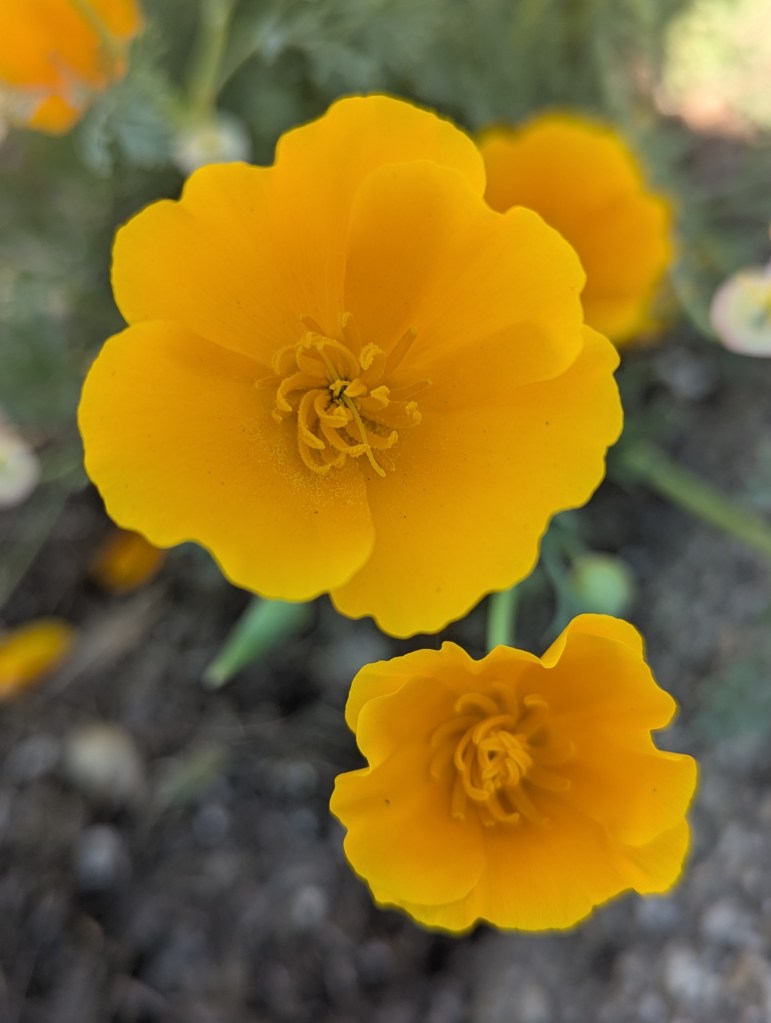
California poppy, which is the State Flower of California, is a very familiar native annual. Unlike other native species, it appreciates supplemental irrigation after the rainy season. It typically blooms only for spring, but may bloom into summer with occasional irrigation. Sky lupine is another native annual that blooms for spring, with contrasting blue flowers.
Various salvias, bush lupines, penstemons, irises and grasses are native perennials. So are sticky monkey flower, Oregon grape, tree anemone and tree poppy. Toyon, silk tassel and various California lilacs are native shrubbery. So are flannel bush, coyote brush and coffeeberry. California sycamore, coast live oak and redwoods are common native trees.
Vegetables and annuals should be growing well with such pleasantly warming weather. Soon enough and into spring, most should be growing like weeds. Unfortunately though, they are not alone. Undesirable vegetation competes with them for limited resources and space. It is a sadly unavoidable problem, even among the most refined of home gardens.
According to their simplest definition, weeds are undesirable vegetation. Obviously, most of the familiar sorts are annuals or perhaps perennials. However, trees, vines and shrubs can be weeds as well. Silver wattle is an invasive tree which can be difficult to eradicate. English ivy is an invasive vine among many forests. Glossy privet is invasive shrubbery.
With few exceptions, weeds are exotic. In other words, they are not native locally. Native species are generally complaisant within their natural ecosystems. They become weeds only if they become undesirable. For example, native poison oak may grow within home gardens. Native bay trees and some oaks frequently appear where they are undesirable.
Most exotic weeds were not always so undesirable. Some were formerly popular for their ornamental qualities, and then naturalized. These include pampas grass, yellow flag iris, Hottentot fig and periwinkle. Wild mustard likely naturalized from home gardens where it grew as a vegetable. Many naturalized grassy weeds were originally fodder for livestock.
The smaller but prolific weeds are the most problematic for home gardens. They include dandelion, purslane, burclover, various spurges and various thistles. Of course, there are too many to list. They grow and disperse their seed much more efficiently than desirable vegetation. That is how they invade home gardens and become such a prolific nuisance.
That is also why it is so helpful to remove weeds as soon as possible. Their subsequent generations will be less profuse if they disperse less seed now. Besides, they are easier to pull while only beginning to disperse roots within moist soil. They will be more difficult to pull when more established in drying soil later. Weeding may be tedious nonetheless.
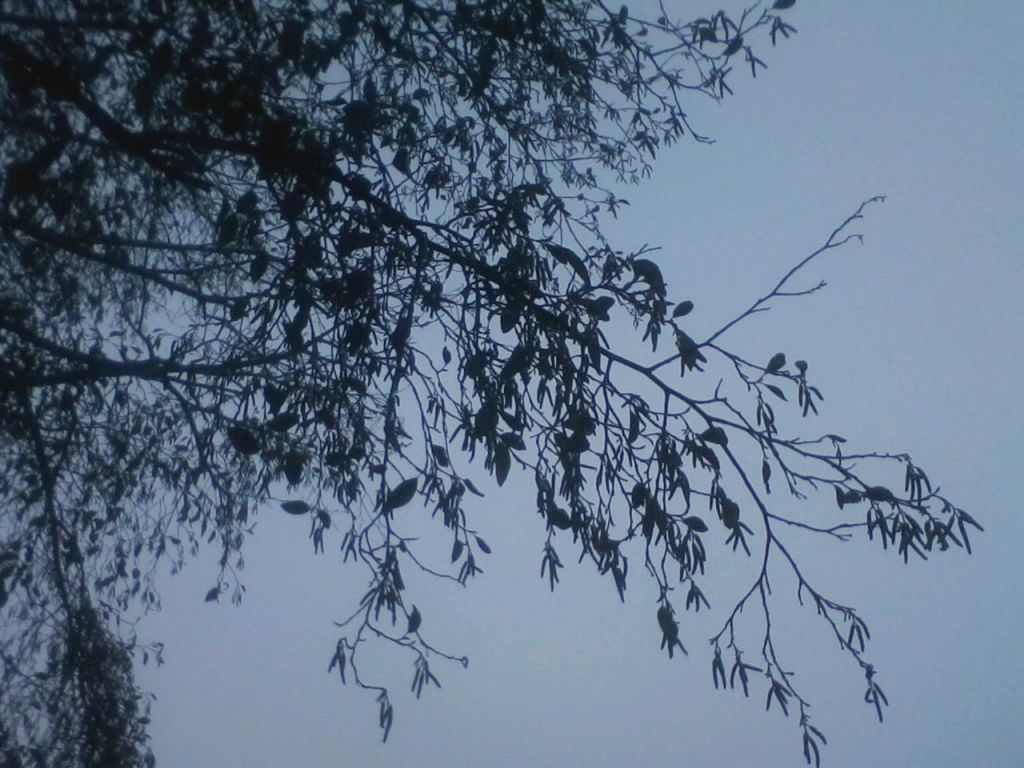
During the summer, the native white alder, Alnus rhombifolia, is a nice shade tree that looks bigger than it really is. By late winter, the bare deciduous canopy has an appealingly picturesque silhouette. This time of year is actually when white alder is typically less appealing, with dead foliage that provides no interesting fall color, but lingers until knocked down by rain or late frost. Yet, even now, it sometimes surprises with these funny looking floral structures that are interesting both in the early winter landscape, and with cut flowers.
In past decades, white alder was an ´expendable’ tree that was put into landscapes for quick gratification while slower but more desirable trees matured. By the time the desirable trees matured, the alders were removed to make more space for the desirables. This technique was practical because, like many fast growing trees, alders do not live very long, so start to deteriorate after about twenty five years anyway. However, alders often live longer than expected.
Mature alders are usually less than fifty feet tall where they are well exposed. They can get at least twice as tall where shaded by other trees or big buildings. Their plump trunks with mostly smooth silvery gray bark make them seem larger than they really are though. Too much water promotes buttressed roots which can displace pavement.
Feral flowers are technically not the same as wildflowers. As their designation suggests, wildflowers grow wild. They always have, without intervention. They are naturally native. Their native ranges can fluctuate, but do so naturally as associated ecosystems change. Their status as wildflowers does not change within home gardens or refined landscapes.
Feral flowers are progeny of cultivated flowers. Almost all are exotic, or nonnative. Some are true to type, which means that they are indistinguishable from the originals. However, because of extensive breeding, many revert to a more genetically stable state. Some can naturalize, or perpetuate without intervention. Then, they seem to behave as wildflowers.
For example, most home garden nasturtiums begin as garden varieties. They bloom with particular colors because of their breeding and selection. Their progeny, however, bloom with more natural floral color. After a few generations, they may bloom only basic orange and yellow. Such feral flowers can naturalize within riparian ecosystems like wildflowers.
Because they are not native, naturalized nasturtium are technically not wildflowers. They are merely naturalized feral flowers. Although they are rarely aggressively invasive, they can interfere with natural ecology. They might compete with native species for resources and space. They can sustain organisms that are pathogens to native vegetation species.
California poppy is a genuinely native wildflower. However, a few home garden varieties developed from selection and breeding. Initially, such varieties bloom with unusual floral colors like white, lavender, pink or red. After a few generations, though, their colors revert to their more natural orange. Although wildflowers, they are also technically feral flowers.
Many of the most noxious weeds here escaped from home gardens and naturalized. For example, common pink pampas grass became popular during the Victorian Period. Now, it is quite naturalized and compromising ecosystems throughout the West Coast. Its feral flowers are appealing, but perpetuate infestation. They are surely not native wildflowers. Water hyacinth and yellow flag are other examples.
Pacific wax myrtle is the native version of bayberry.
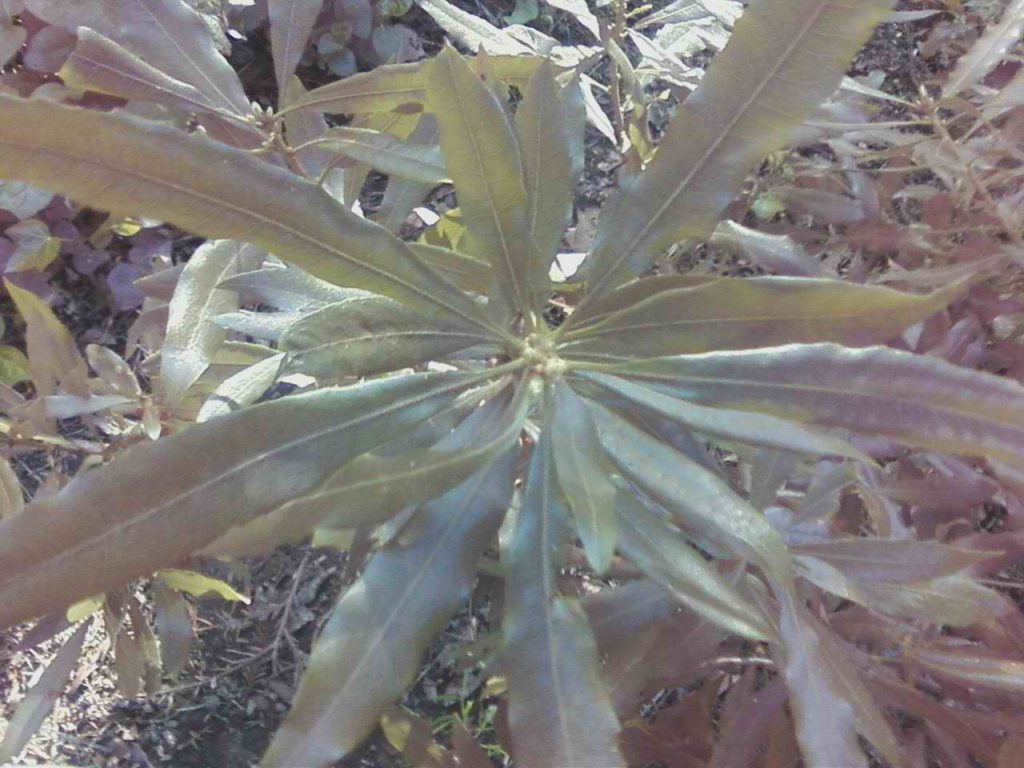
From Washington to Southern California, the Pacific wax myrtle, Myrica californica, is native to coastal regions. It is the western counterpart to the bayberry, Myrica pen(n)sylvanica (or caroliniensis), of the East Coast. It makes a nice informal hedge with only occasional shearing, or an informal screen that only gets trimmed back when it gets too big. Mature plants can get nearly thirty feet tall in sheltered areas, but rarely get half as tall and wide, even if allowed to grow unimpeded. The glossy three inch long leaves are narrow with slightly undulate margins with small teeth.
Pacific wax myrtle functions something like glossy privet or some of the pittosporums that make good hedges, but is not so resilient to frequent shearing. Big stems that get cut back to not always produce new growth. The advantage of Pacific wax myrtle is that it is native, so does not want much water once established, so is happy in out of the way places that do not get watered or maintained. Like privets and pittosporums, Pacific wax myrtle can be pruned up as a small tree with multiple exposed trunks.
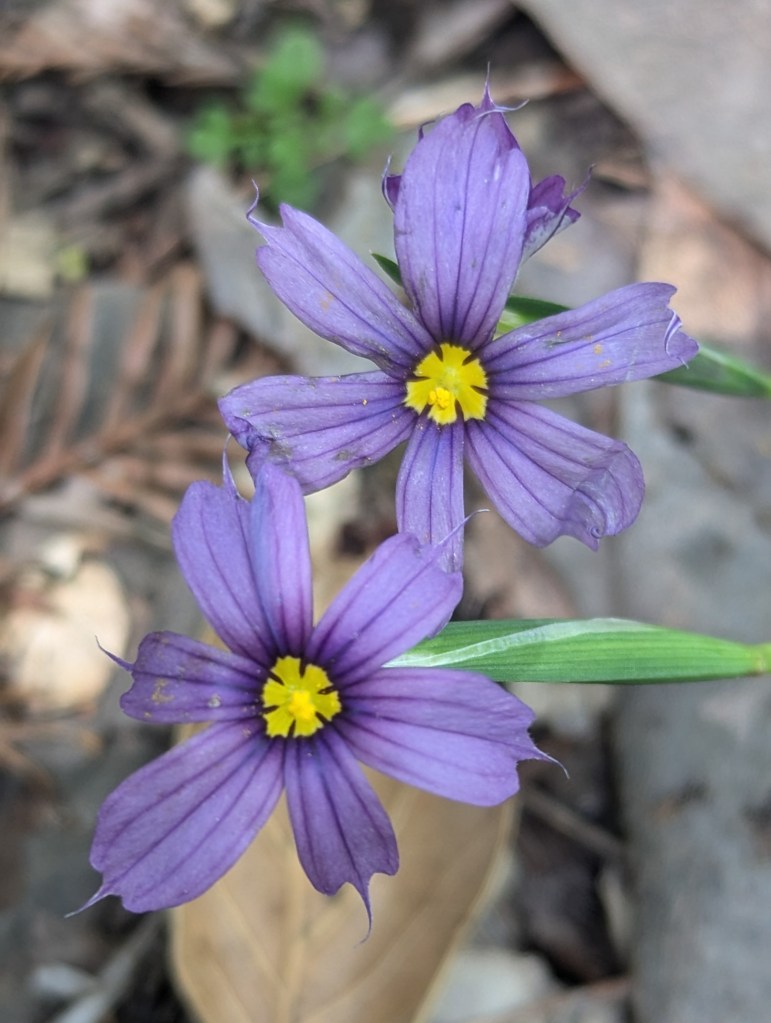
It is not a grass, and lacks eyes, but it is native to most of California and western Oregon. Blue-eyed grass, Sisyrinchium bellum, is related to iris, which actually sounds ocular. Its tiny flowers are typically rather purplish, but can be clear sky blue, or rarely white. Bloom continues through spring until summer dormancy. All foliage then dies back until autumn.
Blue-eyed grass develops small foliar tufts that expand quite slowly. It propagates easily from division of its thin rhizomes as it resumes growth in autumn. Plugging newly divided rhizomes adjacent to original foliar tufts accelerates expansion. Blue-eyed grass can self sow, but typically does so only sparsely. Its grassy foliage is typically less than a foot tall.
Although native and impressively resilient, blue-eyed grass appreciates a bit of moisture. However, it may never require irrigation, since it is dormant through the summer season. Irrigation might maintain foliage through much of summer, but if excessive, can cause rot. Blue-eyed grass prefers sunny and warm exposure, without contention from other plants.
California lilac grows wild throughout California.
Wildflowers are only part of the story. They are happy enough with the chaparral climate here to bloom for spring or summer. A few are naturalized exotic species, though. In other words, they are not native to California. They merely behave like they are, likely because they are from similar climates. Native species are happy here because they are at home.
More than the most abundant wildflowers are native. Many trees, vines, shrubs, annuals and perennials are also. They were here long before Spanish explorers imported the first exotic plants after 1542. They were as satisfied with local soils and climates then as they are now. This is why many are more suitable for home gardens than many exotic plants.
Native plants are less popular than exotic plants only because a few are a bit too natural. Since they are from chaparral climates, some may get a bit scraggly and dry by summer. They survive arid weather by being partially dormant through some of it. Most appreciate irrigation through summer. However, some are susceptible to rot with generous irrigation.
Conversely, there are several advantages to native plant species. They naturally require less irrigation than most exotic species. Once established, some expect none at all. Only species from other chaparral or desert climates might be less demanding. Landscapes of exclusively native species therefore conserve water. Some get all they want from rainfall.
Also, native species are more compatible with natural ecosystems. Any that self sow into nearby wildlands will be where they belong. They do not compete unfairly for pollinators that other native species rely on. Nor do they compete unfairly for possibly limited space and resources. Furthermore, they contribute habitat and sustenance to wild native fauna.
California poppy and sky lupine are probably the most familiar of native annuals. Various salvias and bush lupines may be the most familiar native perennials. California lilac and flannel bush are familiar native shrubs. California sycamore, coastal redwood and coast live oak are familiar native trees. Many native species are practicable for home gardens, and landscaping.
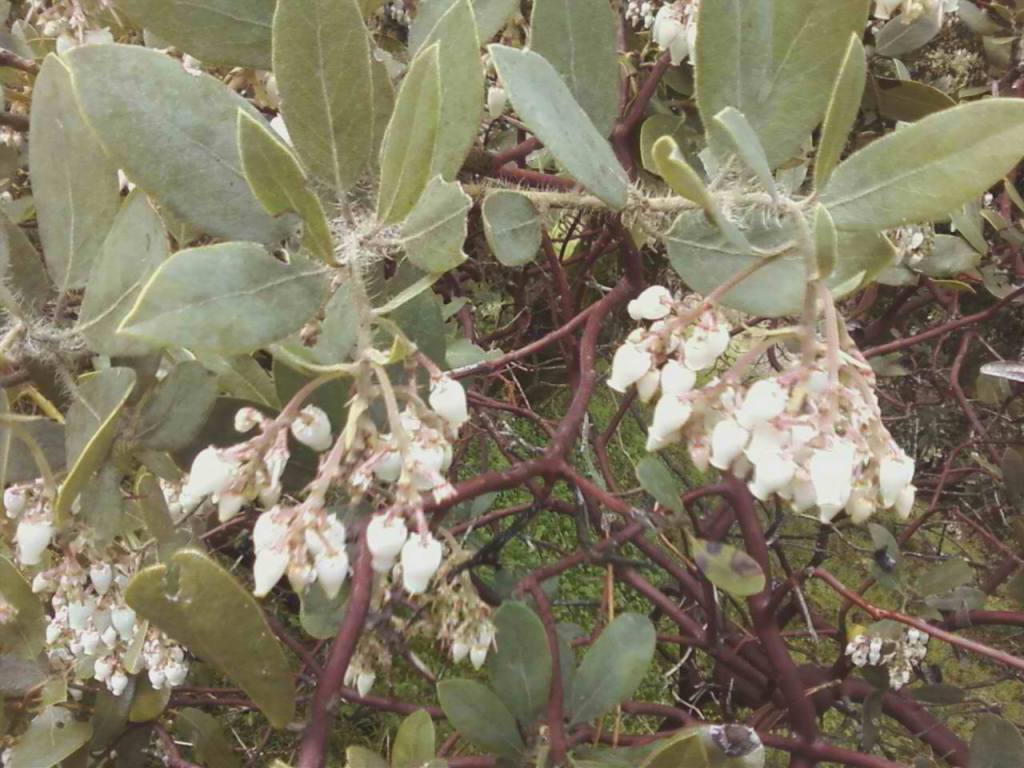
Mature common manzanita, Arctostaphylos manzanita, can get more than fifteen feet tall and about half as wide, so can be rather large shrubbery or small trees. Pruning away lower growth exposes their interestingly sculptural and smooth cinnamon red stems and trunks. The rather stiff light green leaves make light shade that smaller plants can live with. Waxy pinkish buds bloom into small pendulous clusters of tiny white lantern like flowers as winter becomes spring.
Manzanitas prefer to be neglected. They should not be pruned too much, and certainly should not get shorn. Obtrusive stems should be pruned out completely, since stems that get cut back do not regenerate. New plants should only be watered once or twice weekly through the first summer. Mature plants plants only want to be watered monthly or even less. After all, they are native to the surrounding hillsides, so are very satisfied with annual rainfall.
Cat’s tongue might be a more fitting name. Pacific hound’s tongue, Cynoglossum grande or Adelinia grandis grows where it wants. It can grow from cracks in pavement, and then be difficult to remove. It grows easily through decomposed granite, gravel or wood chips. Yet, it is not readily available from nurseries, or as seed. It is sporadic in its native range.
Pacific hound’s tongue may be uncommon because it takes a few years to bloom well. It does not bloom for its first year from seed and then blooms thinly for its first few years. By its third year though, its resilient perennial taproot should be very established. Its foliage dies back soon after late winter bloom. It stays significantly longer with garden irrigation.
Bloom resembles that of forget-me-not, but relatively sparse and on vertical stems. Floral stems are about a foot tall, or can be two feet tall. They are more numerous in cultivation. The small blue flowers are less than half an inch wide. Foliage develops basal rosettes, which may prefer a bit of partial shade. The biggest leaves are less than six inches long, like a hound’s tongue.



 Tony Tomeo