Oregon grape, Mahonia aquifolium, is the Official State Flower of Oregon. Fruit such as this develops after its bright yellow bloom. It is nothing like grapes, though. It is edible, but unimpressive alone and fresh. Locally, it is not abundant enough to bother with collecting for culinary application, such as jelly. Wild plants are both rare and scarcely productive. Landscape plants are not much better. That justifies growing it in a garden where fruit production can be promoted. Perhaps it requires specialized pruning, like other species that are grown for fruit. Perhaps, like cane berries, it would be more productive if its old canes get pruned out annually. I really do not know, and am therefore receptive to suggestion. I already intend to grow it, although it will take a few years to get enough fruit to do anything with. Not so long ago, I was similarly intrigued by the native but ignored blue elderberry, which I found to be as useful as black elderberry of the East. My blue elderberry jelly won more ribbons than I can remember at the annual Jelly Competition of the Boulder Creek Harvest Festival. A blue ribbon for Oregon grape jelly would be excellent!
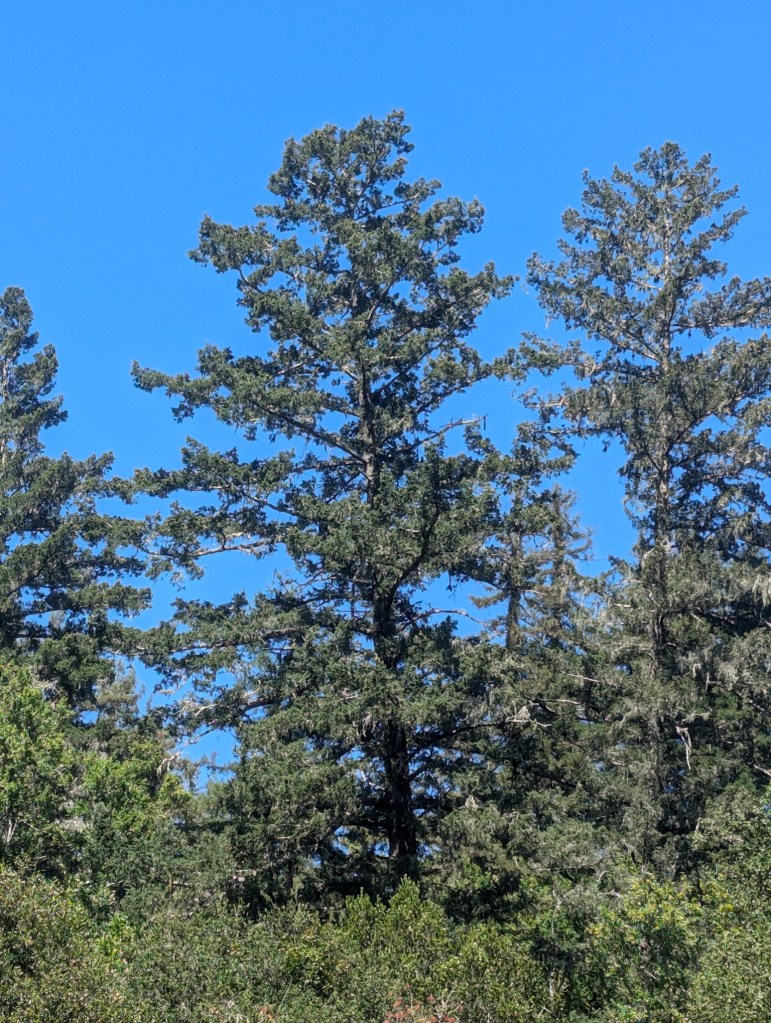
Within home gardens, Douglas fir, Pseudotsuga menziesii is very rare. So is the bigcone Douglas fir, Pseudotsuga macrocarpa of Southern California. However, they are not rare in the wild. Sometimes, suburban or rural home gardens develop around them. They can be awkward to accommodate. They are magnificent trees, but simply grow much too big.
Contrary to its rarity among home gardens, Douglas fir is actually common within homes. after all, most houses are constructed mostly of Douglas fir lumber. Most Christmas trees here are plantation grown Douglas fir. It is a major lumber plantation commodity in Chile, Argentina, New Zealand and Europe. Douglas fir is the Official State Tree of Oregon too.
Douglas fir is a grand tree in the wild. Old trees can grow more than two hundred feet tall with trunks eight feet wide! Their limbs may extend more than thirty feet from their trunks. It is obviously disproportionate for home gardens. Its soft evergreen foliage is delightfully aromatic, though. Its flattened, two-ranked needles are less than an inch and a half long. The female cones exhibit uniquely lacy scales.
Some wild lilac can grow quite large, but lives only about thirty years.
There are many different forms of wild lilac, Ceanothus spp., ranging from low sprawling ground cover types that get only about two feet deep, to dense shrubs that get a few feet tall and broad, to relatively open and irregular shrubs that are a bit larger. The largest can become a small tree with multiple trunks as tall and broad as twelve feet. Wild lilac flowers can be any shade of blue ranging from deep dark blue to soft pale blue. Only a few have white or pinkish flowers. Some wild lilacs have leaves that are glossy and round like nickels. Others have small but thick and roughly textured leaves, like bacon bits.
However, almost all bloom in early spring, are evergreen, and want well drained soil. Only a few lose their leaves where winters are cold. Most prefer infrequent irrigation or none at all, although some of the ground cover types like to be watered occasionally through summer. Wild lilacs do not like to be pruned, and really do not want to be shorn, so should be planted where they have room to develop their natural forms. Sadly, wild lilacs are not permanent, and typically die within ten years or so.
Hooray for Hollywood! It was formerly Hollywoodland because of the California holly that still grows wild there. California holly is not actually holly, though. It formerly classified as hawthorn and two different photinia. It then became two other species of the genus that it is now. Ultimately, but perhaps just temporarily, it became toyon, Heteromeles arbutifolia.
Toyon is native to all but a few counties of California. It is therefore quite happy within the chaparral climates here. Once established, it needs no more water than it gets from rain. Occasional irrigation enhances foliar color and vegetative growth. Excessive or frequent irrigation can cause roots to rot. Fire blight can sometimes become a significant problem.
Toyon is unlikely to grow more than twelve feet tall with sunny and warm exposure. It can grow more than twice as tall if it competes for sunlight with larger vegetation. The simple evergreen leaves are narrow and somewhat serrate. Billowy trusses of tiny white flowers bloom for early summer. Trusses of bright red berries feed birds through autumn.
Western cottonwood is better in the wild than within refined gardens.
The brilliantly clear yellow autumn color of Western cottonwood, Populus fremontii, is best in the higher elevations and inland areas of its extensive range, which spreads from the coast of California to the Rocky Mountains and as far south as Mexico. Although it thrives in local riparian areas, particularly Coyote Creek and Guadalupe River, mild temperatures in both summer and winter do not allow it to get as colorful as it does in Nevada. It is almost never planted intentionally, but has a sneaky way of sometimes growing from seed in well watered gardens.
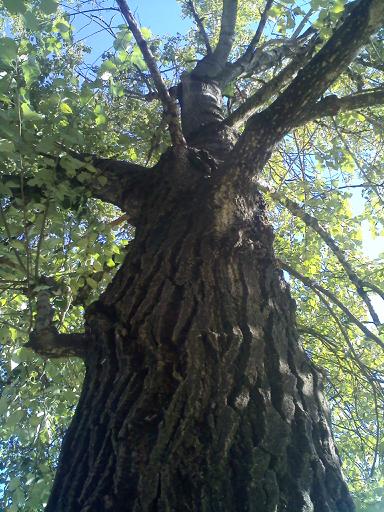
The bad news is that Western cottonwood grows big, fast and aggressively. The shallow roots displace pavement, compete with other desirable plants and damage septic and drainage systems. Large trees produce an abundance of annoyingly fuzzy seeds that adhere to anything. After causing so much damage, Western cottonwoods survive only a few decades, leaving big deteriorating carcasses that need to be removed before collapsing. Consequently, Western cottonwood is really suitable only for large open areas or in the wild.
Mature trees can be more than fifty feet tall and more than half as broad. Their somewhat thick leaves are almost triangular, with paired angular lobes on the sides and blunt tips. ‘Nevada’ is a male cultivar that does not produce fuzzy seeds.
Although almost never planted intentionally, elderberries occasionally appear in strange places, wherever their seeds get dropped by the birds or rodents who eat their berries. The blue elderberry, Sambucus mexicana / caerulea, is native and most common between California, British Columbia and the Rockies. The American elderberry, Sambucus canadensis, is more common elsewhere, and also appears in the west where it had historically been imported for berry production. Some modern cultivars (cultivated varieties) with gold, bronze, or lacy foliage are actually related to European elderberries.
Except for compact cultivars, elderberries grow rampantly to about fifteen feet tall and wide. Aggressive pruning in winter keeps them looking fuller and more densely foliated. Overgrown plants can be rejuvenated by getting cut to the ground. The big leaves are divided into seven leaflets that are two to six inches long. Blue elderberry foliage is softly serrate and a bit more variable, with five to nine leaflets that may be as short as one inch.
Wide flat trusses of pale white flowers that bloom in late spring or early summer produce small but potentially abundant and richly flavored berries. Blue elderberries are dark blue dusted with white powder on trusses to about six inches wide. American elderberries are darker and more purplish on trusses that can be wider than eight inches. (Red elderberries are toxic!)
(Some of the information within this article is very outdated because the article was recycled from several years ago.
Valley oak, as well as coast live oak, were the two most common native non-riparian tree species of the Santa Clara Valley.
Bringing nature to the garden is generally very unnatural. Before urban development of the Santa Clara Valley, there were a few valley and coast live oaks spread out sporadically over open chaparral, with a few sycamores, maples and other riparian specie only in the creeks and Guadalupe River that run through it. There are vastly more trees and plant life here now than there ever have been, and specie from every region of the world. Since exotic (non native) plants are from other climates and soils, they require unnatural accommodations, such as watering and fertilizers, to keep them happy.
The most natural gardening is done with native plants, which are naturally adapted to local climates and soils. Natives are not as demanding of amendments, fertilizers or pesticides as some exotic plants are, since they know how to get they want with the local resources available. Because most are satisfied with natural rainfall, they do just fine with minimal watering (once established).
All sorts of native plants will be available at the Native Plant Sale at Hidden Villa Ranch in Los Altos Hills in only ten days on October 16, from 10:00 a.m. to 3:00 p.m.. Deergrass, monkey flower, redbud, blue-eyed grass, buckwheat, sedums and native lilies and orchids will all be there and accurately labeled. Volunteers from the California Native Plant Society will be available to talk about alternatives to law, including native perennials, shrubs, wildflowers and grasses. Books about native plants, as well as posters and note cards featuring native plants will also be available.
From 1:00 to 2:00 p.m., Stephanie Curtis of Curtis Horticulture will give a free hour lecture about tips for planting success and maintenance for natives. Admission is limited to 25 people though, first come first served.
Hidden Villa Ranch is located at 26870 Moody Road in Los Alton Hills, two miles west of the Moody Road and El Monte Road interchange at Highway 280. Plant selection is best early in the day. All sales must be by cash or check, since credit cards are not accepted. It helps to bring boxes to carry purchased items. More information can be found at www.cnps-scv.org or cnps_scv@yahoo.com or by telephoning 650 – 260 3450. Incidentally, autumn is a good time for planting, since the warmest part of summer is over, and the rain will arrive soon to settle soil around the roots of newly planted plants.
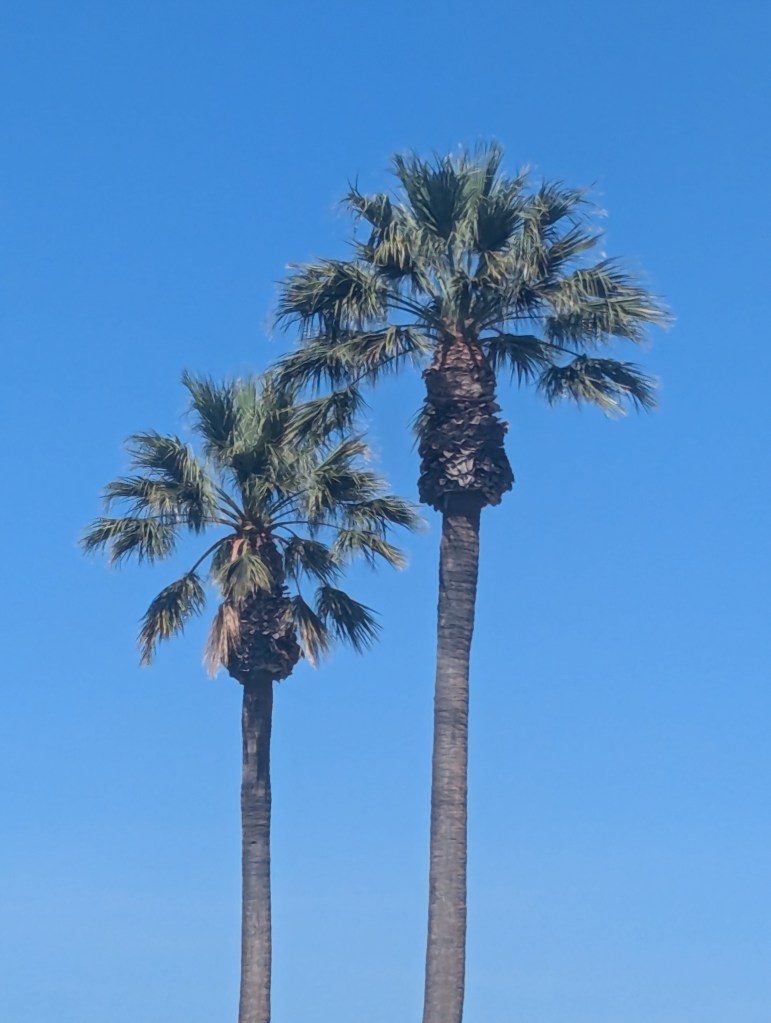
California fan palm, Washingtonia filifera, is the only palm that is native to California. It is naturally exclusive to very distinct ecosystems, though. It inhabits isolated riparian oases of the Colorado Desert. Some also inhabit the Mojave Desert and the Sonoran Desert. It prefers arid warmth. Unfortunately, it may not perform as well within milder climates here.
Otherwise, it is a stately palm that is more adaptable than most are to formal landscapes. It resembles Mexican fan palm, but is shorter and stouter, with a fluffier canopy. It tends to stand straighter, with neatly bare gray trunks. Groomed trees rarely retain petiole stubble. Alternatively, they are handsome, although combustible, with full beards of dried leaves.
California fan palm grows about fifty feet tall, and taller in the wild. Its canopy may be ten to fifteen feet wide. If flattened, its fronds, or complete leaves, might be more than ten feet long. Stiff petioles, with rigid and sharp teeth, are a bit more than half of their total length. The species name filifera describes filaments that hang from the clefts of fronds, and new bud growth.
California poppy is the Official State Flower of California. It is native to all but Yuba, Sierra and Imperial Counties within California. It is also native to portions of Oregon, Washington, Nevada, Utah, Arizona, New Mexico, Alaska, Sonora and Baja California.
Although rare elsewhere, a few isolated colonies inhabit several other states and Canada. It naturalizes efficiently in many other regions of other continents.
California poppy naturally blooms almost exclusively orange. Modern varieties that bloom yellow, red, lavender and creamy white were developed relatively recently. Naturally white and lavender California poppies are extremely rare in the wild. To Californian children, they are supposedly good luck, like-four leaf clovers are to Irish children. I remember finding a few of each at the Portola Monument in Montara when I was a kid. I did not see either again until I found a white California poppy at work a few years ago. Of course, modern varieties take the fun out of that tradition.
California poppies are now blooming splendidly. Unfortunately, they are neither as common nor as profuse as they were only a few decades ago. They are displaced by naturalized exotic vegetation, including naturalized forage crops and cover crops. Also, exotic vegetation, including flowers within home gardens and orchard trees, distracts the pollinators that they rely on for pollination. We dispersed California poppy seed at work while the weather was still a bit rainy, so should get more blooming later in spring. Hopefully, they will disperse a bit more seed for the following spring, although I suspect that they would already be naturally established there if it were a good situation for them.
California poppies can get somewhat unkempt within refined landscapes, particularly if they stay long enough to disperse their seed. That is why we want more within unrefined areas.
Ceanothus of all sorts are collectively known as California lilac. A few uncommon species are also known by alternate names that might confuse those who are unfamiliar with them. Most species happen to be native to California, although most are not exclusive to California, and a few are not native to California. The species with the most extensive range is native to the eastern half of America, which does not include California. Incidentally, it is known more familiarly as New Jersey tea.
Ceanothus is not actually related to lilac. It merely blooms within the same season, with tiny flowers in floral trusses that are smaller but sort of shaped like those of lilac. The most traditional lilac bloom with lavender floral color, but a few cultivars bloom with pale blue floral color that sort of resembles that of some of the Ceanothus. Most Ceanothus bloom is richer blue, and some is pale white. The most fragrant of Ceanothus bloom is only mildly fragrant, and only in abundance. Most Ceanothus bloom lacks fragrance or smells rather dusty. Lilac, of course, is famously fragrant.
California lilac is therefore neither notably Californian nor a type of lilac. Nonetheless, during spring, we appreciate its bloom, both within refined landscapes and in the wild. It does not last for long, but it can be impressive, particularly among wild specimens that can grow larger than those within confined landscapes. The blue floral color of the majority of wild specimens and perhaps all cultivated specimens is comparable to that of native lupines, and contrasts splendidly with bright orange California poppies that bloom at about the same time. California lilac that grows wild need no maintenance, and although individual specimens do not last long enough to get old, they reliably replace themselves like so many native species do.







 Tony Tomeo