Aw NUTS!

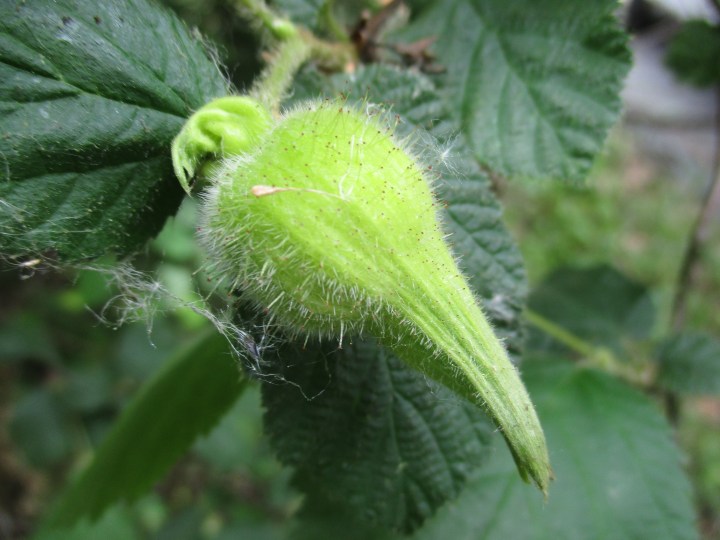
P90602Not just any nuts, but precisely the sort that I recently discussed with a colleague, as I explained how they do not grow here. The nuts that is. The big thicket forming shrubs that are supposed to produce them not only grow here, but are a relatively common native. I just rarely see even a single nut on them. I sort of wondered how they mange to procreate with such rare seeds that invariably get taken by unconcerned rodents or birds.
They are the beaked hazelnut, Corylus cornuta. You can see why they are known as such. The elongated nut husks look like Big Bird. The very rare nuts within are quite small with good rich flavor, like hazelnut concentrate, and develop only on the biggest and most distressed old hazelnut shrubs.
However, the young and healthy hazelnut shrub that produced the nut in this picture actually produced quite a few. They were just not close enough to each other for me to get more than one in a picture. A few other young and healthy hazelnut shrubs are doing the same at the same time. There are more hazelnuts now than I have seen collectively in many years. I can not explain why.
Some species of oak tend to produce an overwhelming abundance of acorns every several years or so, only to limit acorn production for the several years in between such abundance. All trees of the same species within a region somehow know to do this collectively at the same time. They do not do it often, but when they do, they do it together.
The oaks who do this supposedly produce just enough acorn to sustain a healthy squirrel population without promoting overpopulation. When they occasionally produce an excess of acorns, the squirrels instinctively bury many more acorns than they normally would, just because the acorns happen to be available. Since the squirrels can not consume all that they bury, many more stay buried to germinate and grow into trees later.

Box Elder

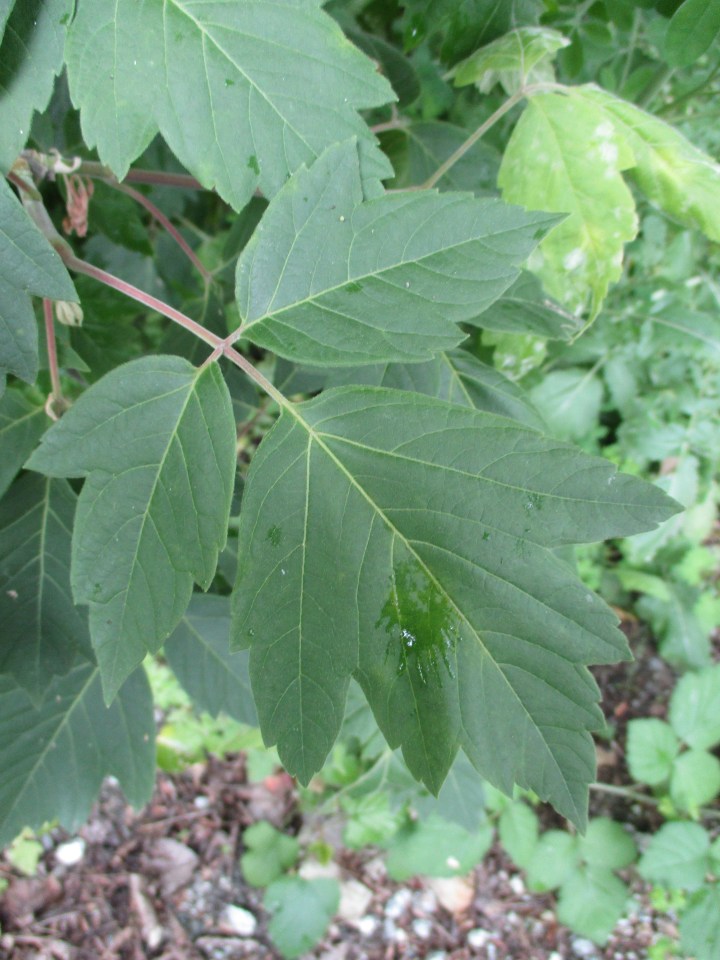
90605This ain’t no ordinary maple. Although there are other maples with trifoliate leaves (divided into three distinct palmately arranged leaflets), box elder, Acer negundo, is the only maple with pinnately compound leaves (divided into three or more distinct leaflets that are arranged pinnately on a central rachis). Leaflets might be solitary too. Almost all other maples have palmately lobed leaves.

Box elder is considered to be the ‘trashy’ maple. It grows fast, but only lives for about half a century. The happiest barely get to be twice as old. Because it gets more than forty feet tall, possibly with multiple trunks wider than two feet, it can become quite a big mess as it deteriorates and drops limbs. Yet, it is aggressive enough to have naturalized in many regions where it is not native.

Despite all this, and the lack of good foliar color where autumn weather is mild, a few cultivars of box elder have been developed for landscape use. ‘Flamingo’, which is likely the most popular, is variegated with white through summer, after pink new growth fades. ‘Violaceum’ develops smoky bluish growth in spring. ‘Auratum’ starts out yellowish. Mature leaflets are about three inches long.

Wild Roses

60518Compared to extensively bred garden varieties, wild roses are not much to look at. Their tiny flowers do not get much wider than two inches, and may not get much wider than those of blackberry, with only about five petals. Flower color ranges only between pale luminescent white and pale pink. Bloom is typically rather brief in mid spring. Only a few healthy specimens bloom again later.
The main advantage to wild roses is that they are ‘wild’. Once established, they do not need much more water than they get from annual rainfall. Without pruning, canes of larger varieties develop into intimidating thickets that bloom annually. Smaller types stay short, but are intimidatingly thorny nonetheless. The deciduous foliage is not bothered too much by mildew, blackspot or insects.

Some types of wild roses appreciate a bit of pampering that might be offensive to other wild plants and most natives. Winter pruning, occasional summer watering, and perhaps a bit of fertilizer improve bloom. Alternatively, pruning after spring bloom may stimulate a second phase of bloom. Long canes can grow roots where they touch the ground, and grow into new spreading plants.

Santa Cruz Island Ironwood

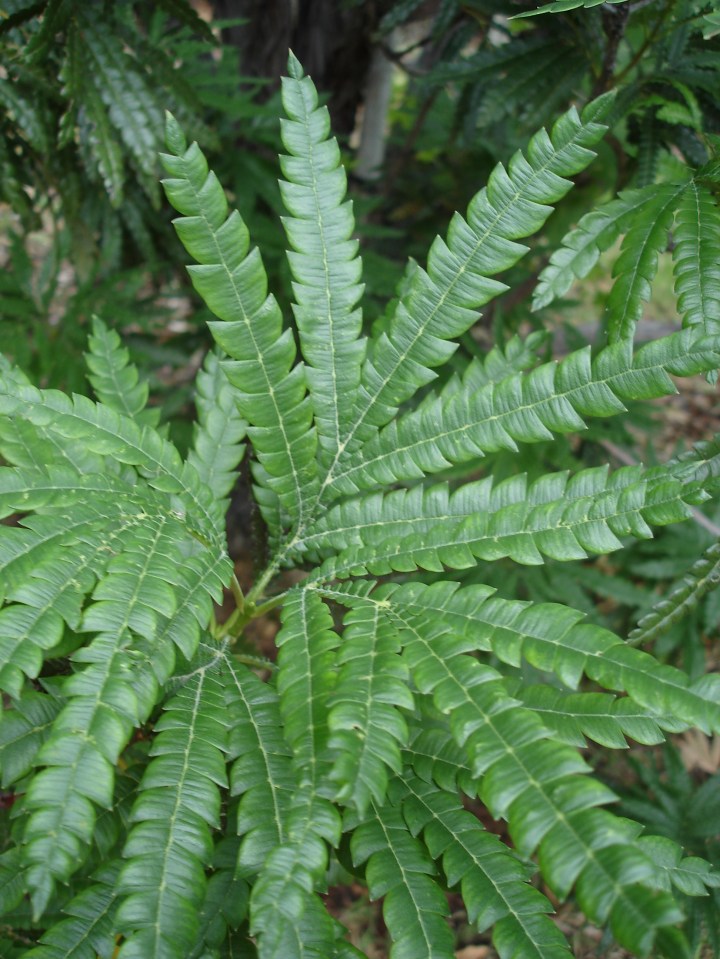
60504A few years ago, it was known as Santa Catalina Island ironwood. However, the rare subspecies native to Santa Catalina Island lacks the distinctively angular foliar lobes of the Santa Cruz Island ironwood, Lyonothamnus floribundus ‘aspleniifolius’. The evergreen compound leaves are about five inches long and four inches wide with three or five narrow leaflets, and look like chicken feet.

Young trees can grow at an impressive rate, but rarely get to thirty feet tall, which is only half as tall as they get in the wild. Most stay rather narrow, and shorter than a two story house. They work nicely in groves, but not as symmetrical groupings. Each tree has a unique personality and form, and some stay smaller than others. The finely shredding bark fades from cinnamon brown to gray.

Six inch wide trusses of tiny white flowers bloom late in spring or early in summer. These circular trusses are flattened, similar to those of toyon but larger. They fade to brown and can hang among the foliage for years. Older trees bloom more than vigorous young trees do. Deteriorating older trees can be cut to the ground and allowed to regenerate with fresh new growth from their stumps.

Some Plants Should Stay Wild

P80804+Native plants should be the most sensible options for local landscapes and home gardens. It seems natural that they would be the most sustainable, since they survive in the wild without watering, soil amendment or fertilizer. Once established in landscapes, they should be satisfied with the moisture they get from annual rainfall. Plants that are not native are considerably more demanding.

However, even native plants are not perfect. Some of the same qualities that help them survive in the wild are not so desirable around the home. To make matters worse, adapting to unnatural landscapes and home gardens can be as difficult for native plants as it would be for many of the common exotic (non-native) plants to adapt to the natural climate and endemic soils without help.

Natives obviously do not need much water. They certainly do not get much in the wild. They are resistant to drought because they disperse their roots so efficiently. The problem with this technique is that it does not work while plants are confined to cans (nursery pots). Once planted, new plants might take a bit of time to disperse their roots enough to survive without supplemental watering.

This might not seem like much of a problem for those who do not mind watering new native plants while they get established. New native plants still use less water than established exotic plants. The difficulty is that too much water can rot roots before they disperse! So, new native plants need to be watered regularly, but also need to not be overwatered! Monitoring them can be a hassle.

It might seem that larger new plants would be more resilient than smaller plants would be, but it is quite the opposite. Smaller plants (such as #1 or 1 gallon) disperse roots more efficiently, so get established sooner than larger plants (such as 5 gallon). Roots contained within small volumes of media (potting soil) are damaged less when planted than roots in larger volumes are. Roots of native plants, although efficient at dispersion, are innately sensitive.P90309+++++

The Overlooked Trillium

P90407Other species must be more interesting than what is native here. There are supposedly as many species of Trillium as there are of Yucca; forty-nine. All but ten are native to North America. The others are in eastern Asia. They are desirable and respected perennials to those who are familiar with them. White trillium is the official wildflower of Ohio, as well as the official floral emblem of Ontario. Ours would not likely qualify for such status.
The few around here appear only briefly about this time of year, and bloom with these small purplish burgundy flowers. They are only a few inches high, so are easy to miss. By the time they get noticed they are finished with their bloom. Their foliage lasts only until the weather starts to get warm in late spring or early summer. During their brief season, they somehow manage to store enough resources to repeat the process for many years.

This particular species is supposedly known as ‘giant wakerobin’, or Trillium chloropetalum. It is so diminutive, that I can not help but wonder about those that are not ‘giant’. Others that I see around here have more rusty red or ruddy brown flowers that stay closed most of the time. Western trillium, Trillium ovatum, lives here too; and I may have seen its foliage without distinguishing it from giant wakerobin, but I have never seen it bloom.

The trilliums that are native here live in partial shade out in forests, but away from more aggressive plants. They do not transplant easily, and do not like refined gardens.

Other trilliums in other regions bloom with bigger flowers in white, pink, red, purple, pale yellow or green. They must be more impressive than ours, and should at least be more adaptable to home gardens and landscapes.

Corndog Orchard

P80728KUrban sprawl replaced the formerly vast orchards of the Santa Clara Valley a long time ago. Nowadays, it is difficult to imagine that they were ever here. Apricots, prunes, cherries, almonds, walnuts and all that the region was once famous for are all now rare commodities.
Only a few minor corndog orchards remain. They survive only because they are not actual orchards that are grown on land that is useful for something else, but instead grow wild on otherwise useless marshland and along the few creeks that flow through the region. Some marshland that could not be converted into usable space was developed into parks, and within many such parks, the remaining marshlands are protected as native habitat.
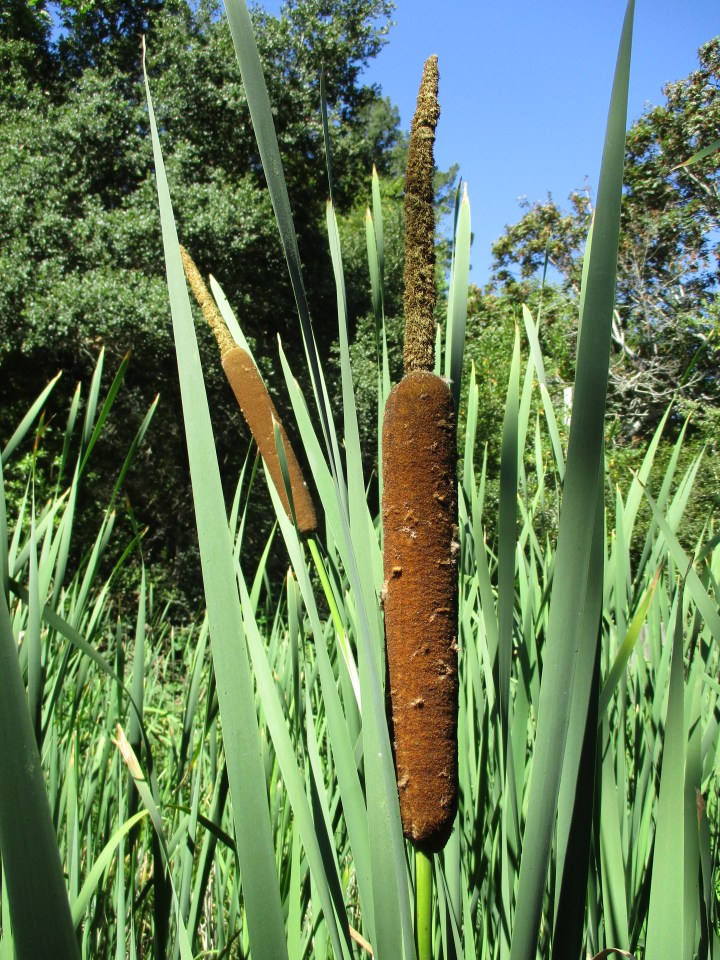
Vasona Lake County Park and the small Vasona Lake within were once a large marshy area that sustained what was probably the biggest corndog orchard within the Santa Clara Valley. It is at the transition where the Los Gatos Creek flows swiftly from the slopes of the Santa Cruz Mountains, and then slows as it reaches its flat alluvial plain within the Santa Clara Valley. Although not nearly as abundant as they were prior to development, corndogs still inhabit the banks of Los Gatos Creek and Vasona Lake. We know them as cattails.
Because they are a native species that had historically been more common locally than anywhere else nearby, and because of their common name that is coincidentally associated with cats, cattails had been nominated to be the official Town Flower of Los Gatos (which is Spanish for The Cats). There are not many natives that would be as appropriate, and the only comparably culturally significant flowers would be those of the old fruit orchards, such as apricot blossoms. No other flower is both native and so culturally significant.

Western Azalea

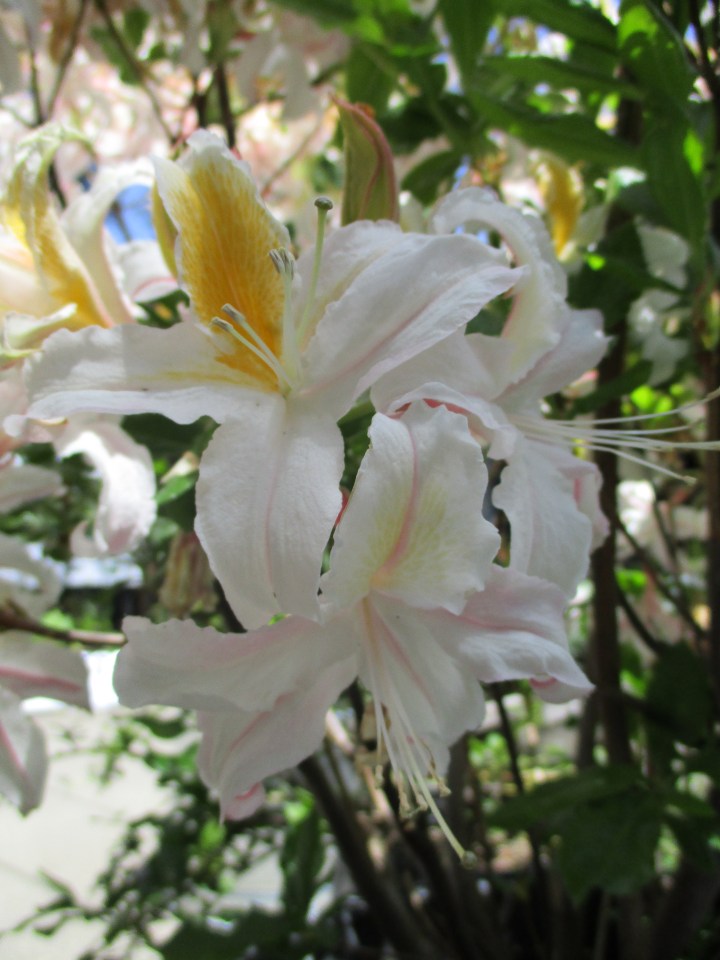
70607We think of rhododendrons and azaleas as being from cooler and moister climates. After all, that is where they do best. Yet, there does happen to be a native western azalea, Rhododendron occidentale, that lives in the Sierra Nevada and coastal ranges from San Diego County to just southwest of Portland, Oregon. (Azalea and Rhododendron are varied specie of the same genus.)

Bloom is mostly white, with pink, pale yellow or golden orange. Some of the fancier garden varieties bloom clear white, or with more vibrant color. The lightly fragrant, two inch wide flowers bloom in groups of two or three on open conical trusses. Each truss produces as many as a dozen flowers in sequence, so a new flower replaces a fading flower for a bit more than a week each spring.

Western azaleas plants are unfortunately not much to look at after bloom. They grow somewhat slowly and irregularly to about three to five feet tall. The two or three inch long deciduous leaves that can turn yellow and orange where autumn is cooler are more likely to turn an unimpressive grayish brown here. Foliage can fade prematurely if the weather gets too hot and arid through summer.

Honeysuckle

P80526K

This is no ordinary honeysuckle. It is quite less than ordinary. It is not available in local nurseries. No one here wants it. Although it might be available from nurseries that provide native plants within the native range of this honeysuckle, most of those who find it in their garden probably do not want it there. After all, there are plenty of more desirable honeysuckles to grow. Some have more fragrant bloom. Some have more colorful bloom.

As you can see, this honeysuckle is not very impressive. It is about as shrubby as it is vining, and does not get very big. The small white flowers lack fragrance, and are not very abundant.

What I like about this honeysuckle is that it came all the way from Oklahoma. ( https://tonytomeo.wordpress.com/2017/11/19/oklahoma/ ) It is native there. I do not remember what honeysuckle it is at the moment. I brought it back with all sorts of seed and a few native plants that I obtained while there, including Arkansas yucca, Eastern red cedar and prickly pear. I can still remember sorting and packing some of the ‘specimens’ at a table outside a coffee shoppe on the bank of the Oklahoma River in downtown Oklahoma city, in Oklahoma County, in . . . Oklahoma.

When I grew rhododendrons, I knew people who bragged about rare cultivars that they and only a few of their friends and colleagues had obtained. Most were very pretty, with impressive bloom and bright color. Some were not so appealing; but no one wanted to say so. Sometimes, it seemed that the rarity of a cultivar was more important than any actual attributes.

I can remember many rare cultivars of rhododendron.

However, I know of none as rare as my honeysuckle from Oklahoma. I have the only one.

Fleabane

P80513Erigeron karvinskianus

Is it really supposed to be the bane of fleas? If so, why? I learned it as Santa Barbara daisy. Is it native there, or was a particular variety of it named for Santa Barbara? Is it a weed? Is it native? Is it a native of somewhere else in California that merely naturalized here? There are so many questions about this simple little flower that is growing wild under a cyclone fence at the backside of a motorcourt at work.

Whether it really is native or not, or whether it is a straight species or a selected variety of one, fleabane happens to do well in drought tolerant landscapes composed of native plants. It naturally spreads out to form shallow but wide mounds. If it gets cut back in its off season, it comes right back. Although it dies after only a few years, lower stems typically form roots and grow into new plants before the original one dies, essentially replacing itself before anyone notices.

If it is a weed, it is polite about it. Stray plants that appear where they are not wanted are easy to get rid of, and do not regenerate too aggressively to be managed. Those that happen to appear in out of the way situation can be left to bloom without much concern of profuse seed dispersion. Weed or not, it is preferred to other nastier weeds that it might prevent from growing simply by occupying the space.

It happens to grow in my planter box downtown. ( https://tonytomeo.wordpress.com/2017/11/04/my-tiny-downtown-garden/ https://tonytomeo.wordpress.com/2018/01/06/six-on-saturday-my-downtown-planter-box-again-and-up-close-this-time/ ) I certainly did not plant it. It was there long before my time, and remain, even if merely in a minor degree, just in case the person who planted it years ago ever stops by to check in on it.