Godetia

All but one species of Clarkia are native somewhere in California.

Like California poppy, sky lupine and various other native wildflowers, godetia, Clarkia amoena, seems to prefer its own space. However, it is somewhat more adaptable than some other natives are to regular irrigation and coexisting with exotic (non-native) wildflowers that are not too overpowering. It is a common component in wildflower mixes, and is more likely than most to naturalize after the other wildflowers have died out. 

It is best to sow godetia seed in autumn, directly where the flowers are wanted, so that the seed get watered in by rain and begin to grow through winter and early spring. Bloom begins later in spring or early summer. In areas that do not get watered regularly, occasional watering prolongs bloom. Fertilizer can actually interfere with bloom though. As bloom finishes, deteriorating plants should be left to disperse seed for the following year.

The two inch wide flowers are typically pink or purplish with red blotches or veining. Some are very pale pink or nearly white with deeper pink blotches at their centers. Most godetia are only about a foot or two tall. ‘Dwarf Gem’ stays less than a foot tall. Taller types get nearly three feet tall. The lanky stems are adorned with narrow light bluish green leaves that are about half an inch to one and a half inches long.   

North & South

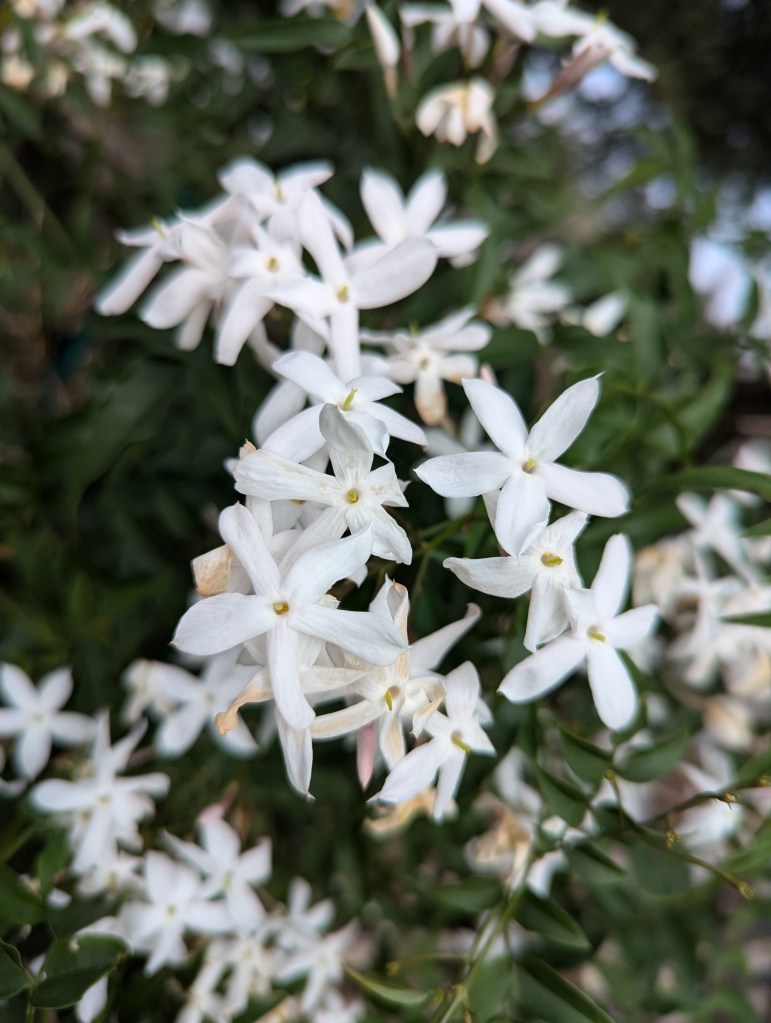
pink jasmine, Jasminum polyanthum

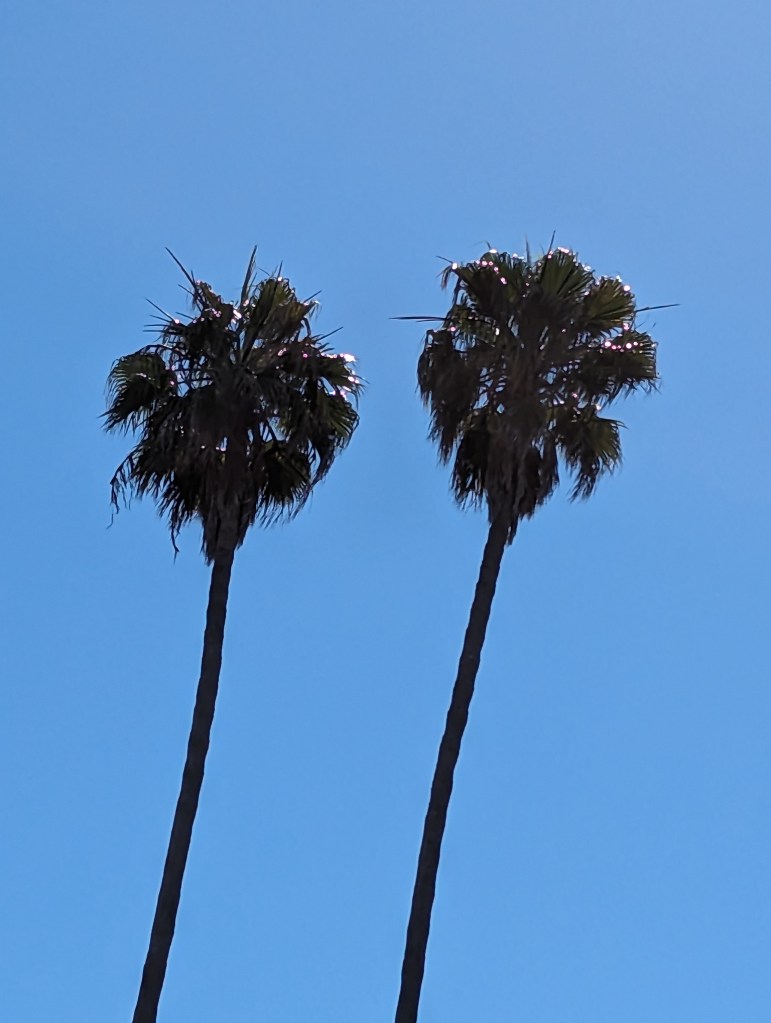
Brent and I studied horticulture through the second half of the 1980s at California Polytechnic State University at San Luis Obispo, which is known more simply as Cal Poly. San Luis Obispo is exactly halfway between where each of us came from. He came from the region west of Los Angeles, two hundred miles to the southeast, which is considered to be south by the standards of California. I came from the region west of San Jose, two hundred miles to the northwest, which is considered to be north by the standards of California. He considered San Luis Obispo to be within Northern California. I considered it to be within Southern California. Consequently, when either of us encountered a species with which we lacked prior experience, we assumed it to be regionally popular within the respectively unfamiliar half of California. Such assumptions were accurate for some species. For example, Brent was as fascinated with redwoods as I was with desert fan palms. He knew that redwoods are more popular here than in Southern California, and eventually went to experience them growing wild within their native range near Santa Cruz. I knew that desert fan palms are more popular in Southern California than here, and eventually went to experience them growing wild within their native range near Palm Springs. Pink jasmine, Jasminum polyanthum, was an odd one. Because Brent had never encountered it before, he assumed that it had been popular in Northern California. Because I had never encountered it before, I assumed that it had been popular in Southern California. In actuality, it only became commonly available throughout California at about the time that we encountered it, so had previously been popular neither here nor there. Nonetheless, to Brent, it is still as northern as it is southern to me.

Six on Saturday: Surprise

Surprise is a town northwest of Phoenix that I encountered between late April and early May. These six are different sorts of horticultural surprises which I encountered at work.

1. Platycerium bifurcatum, common staghorn fern, Tillandsia usneoides, Spanish moss and two other unidentified species of Tillandsia combined for a surprisingly compelling epiphytic platter. The staghorn fern is from Brent’s garden. The Spanish moss should be fuller as it grows. The two unidentified Tillandsia should be displaced as the fern grows.

2. Brugmansia X cubensis ‘Charles Grimaldi’ angel’s trumpet is no surprise. A picture of it posted here last Sunday. Its richer than typical yellow floral color is a surprise though. It is also from Brent’s garden, and was from one of his projects years ago. Brugmansia X candida ‘Double White’ and Brugmansia suaveolens ‘Single White’ both bloom nearby.

3. Brugmansia, angel’s trumpet of an unidentified cultivar demonstrates why the yellow floral color of ‘Charle’s Grimaldi’ is so surprising. Both were about the same pale peachy color last year, with the same fragrance. I thought that they may be the same. Obviously, but actually surprisingly, they are not. I do not know what it is, but I know what it is not.

4. Persicaria amplexicaulis ‘Firetail’ arrived here with Persicaria bistorta ‘Superba’ and perhaps Persicaria affinis ‘Dimity’ from Tangly Cottage Gardening early last April. I can not distinguish the cultivars, which is why I do not know if they include ‘Dimity’. It was a surprise to see ‘Superba’ bloom immediately after relocation. ‘Firetail’ is a surprise now.

5. Mimulus guttatus, seep monkey flower is blooming with surprising abundance where the stream from Redwood Springs flows into the drainage pond. The location should not be a surprise since, as its common name implies, this species prefers damp situations. It is surprising only because I somehow neglected to observe so much bright yellow earlier.

6. Rosa, rose of an unidentified cultivar would not be so surprising if I were not aware of how it got here. Someone who does not work in the landscapes removed it from where it was obstructing access to one of his projects. I saw it in his pickup as he was about to discard it. I am surprised that it survived, blooms well and seems to be a hybrid tea rose.

This is the link for Six on Saturday, for anyone else who would like to participate: https://thepropagatorblog.wordpress.com/2017/09/18/six-on-saturday-a-participant-guide/

No Shame

Nature still does what it wants to.

Squirrels are annoying. I do not care that gray squirrels are native, or that their ancestors were here before mine. They are still annoying. They ruin bulbs, seedlings, fruits, nuts and vegetables. Although I do nothing to exclude them from my garden, I do not want them there.

Some native vegetation is also annoying. It grows like weeds where I want other vegetation to grow. Like for squirrels, I do not care if it is native. It is still annoying, and I do not want it trying to infest my garden where I grow vegetation that I want to grow.

I have been told that native species can not be invasive merely because it was here before I was. That is completely false. If it aggressively invades my garden, then it is invasive. Claiming otherwise is comparable to claiming that I can move into any home here that I choose simply because I am native.

Everyone who lives here inhabits space that was formerly occupied by native flora and fauna. So does all the infrastructure. Anyone who disapproves should leave, and relocate to where they do not occupy space that was formerly occupied by native species. I do not know where that is, but perhaps they do.

Realistically, I do my part. I live very simply, in compact and minimally consumptive homes. Although I enjoy gardening, I do not use much more space than is necessary to sustain my simple lifestyle. I do not live so simply because I would feel guilty about living more lavishly. I do so because it appeals to me, and allows me to feel less sheltered from the same sort of nature that some might accuse me of being inadequately protective of. Ultimately, nature does what it wants to here, with or without my assistance.

Some Exotic Annuals Self Sow

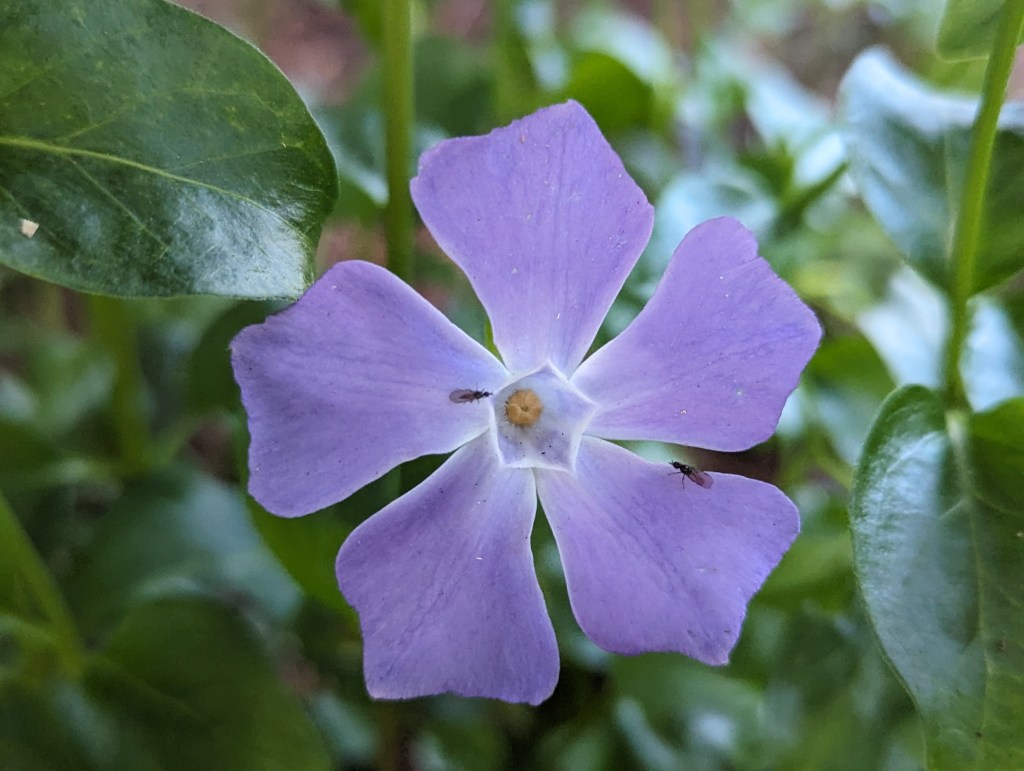
Periwinkle can naturalize a bit too aggressively.

It is impossible to say how long native wildflowers have adorned the natural landscape of California. Various lupines, California poppy and evening primrose had always been the most colorful wildflowers locally until they began to be displaced by exotic (non-native) plants only in the past two centuries or so. Although natives are remarkably resilient to dry summers and occasional wildfires, they are not very competitive with more aggressive and prolific invaders. What the natives and exotics have in common though is that they are so well adapted to local environmental conditions that they are able to perpetuate without much help.

Lupines, poppies and evening primrose, as well as native yarrow, godetia, and fleabane, may unfortunately need a bit of help if exotics want to move into their territory. In areas that are regularly or even only sometimes watered, weeding to remove more aggressive exotic plants helps the natives stay in control. They should otherwise do well on their own. Although without irrigation their growing season is much shorter, natives are slower to be displaced, since so many of the otherwise competitive exotics are not adapted to dry summers.

Many exotic flowering annuals are prolific enough to almost become naturalized, but are not quite aggressive or adaptable enough to get very far from cultivated landscapes. Cosmos, nasturtium, alyssum, catchfly (silene), four o’clock, gaura and foxglove self sow so readily that they are considered by some to be invasive. Some of us instead consider them to be ‘reliable’. They can be useful for unrefined parts of the garden that we do not mind watering, but otherwise do not want to put much effort into.

However, foxglove and even nasturtium can actually become noxious weeds in coastal areas not too far from here. I think that forget-me-not, feverfew, baby tears and English daisy can be problematic anywhere that they get enough water. Also, most annuals eventually revert to more genetically stable forms; which is why all varieties of dwarf nasturtium eventually bloom with the same yellow or orange single flowers. Yet, if we can distinguish between the plants that we can appreciate for their reliability and those that can be too invasive, native and exotic wildflowers and not so wild flowers can make gardening a bit easier.

Mediterranean Climate Is Quite Californian

New Zealand natives perform well here.

“Mediterranean” translates from Latin to “middle of land”. The Mediterranean Sea is in the middle of the land of those who named it. Other regions were either unimportant or unknown to them until the Sixteenth Century. Nowadays, most people of the World are aware of many other regions. A few of such regions also enjoy a Mediterranean climate.

Such climates are obviously not confined to the regions of the Mediterranean Sea. They merely resemble such climates. Some extend eastward into Western Asia. Others are in eastern and southern Africa, southwestern South America and Columbia. Larger regions of such climate are in southern Australia. The closest are here in western North America.

Even these limiting regional designations are debatable. Many horticulturists consider climates of New Zealand to be typical Mediterranean. Such climates are mostly between thirty and forty five degrees north and south. However, some might exist within northern India and southern China. Ultimately, climate is meteorological rather than geographical.

Mediterranean climates receive almost all of their rain during winter. Rain is very minimal through summer. Even if it is twice as abundant in other similar climates, it conforms to a similar schedule. Although winter chill is adequate for many species that need it, frost is mostly minor. Locally, summer weather does not often become too uncomfortably warm.

Native species know what to expect from local climate. So do exotic species from similar climates. Some may prefer more or less winter rain, summer heat or winter chill. Almost all can tolerate warm summers without rain, though. Such weather conditions are normal for them. Therefore, the most adaptable exotic species locally are from similar climates.

This includes species of Eucalyptus, Pittosporum and Callistemon from Australia. Aloe, Agapanthus and Morea are from South Africa. Phormium and Leptospermum are from New Zealand. Oleander and the various species of Lavandula are truly Mediterranean. In the past, a few exotic species adapted too efficiently to become invasively naturalized. Horticulturists are now careful to not import such potentially aggressive species.

Oakland

Oregon white oak, Quercus garryana

Oakland, fifty miles north of here, was named for the oaks that formerly inhabited it. Imagine that! Although valley oak, Quercus lobata, is native, and assumed to be the origin of the regional name, coast live oak, Quercus agrifolia, was likely more abundant there at the time.

Of the many other towns in California with horticultural names, a few are also named for unspecified oaks, including del Rey Oaks, Oakdale, Oakley and Thousand Oaks. Encinitas, Live Oak and the Encino neighborhood of Los Angeles are named more specifically for coast live oak. Paso Robles is named more specifically for valley oak.

Oakland and Oakridge are the only two towns that I could find in Oregon that are named for Oaks. I suspect that Oakland is named for Oregon white oak, Quercus garryana, only because that is the most prominent species of oak there. It is also native here, although I am not aware if I have ever encountered it locally. It resembles small specimens of valley oak, which, incidentally, is also known as California white oak.

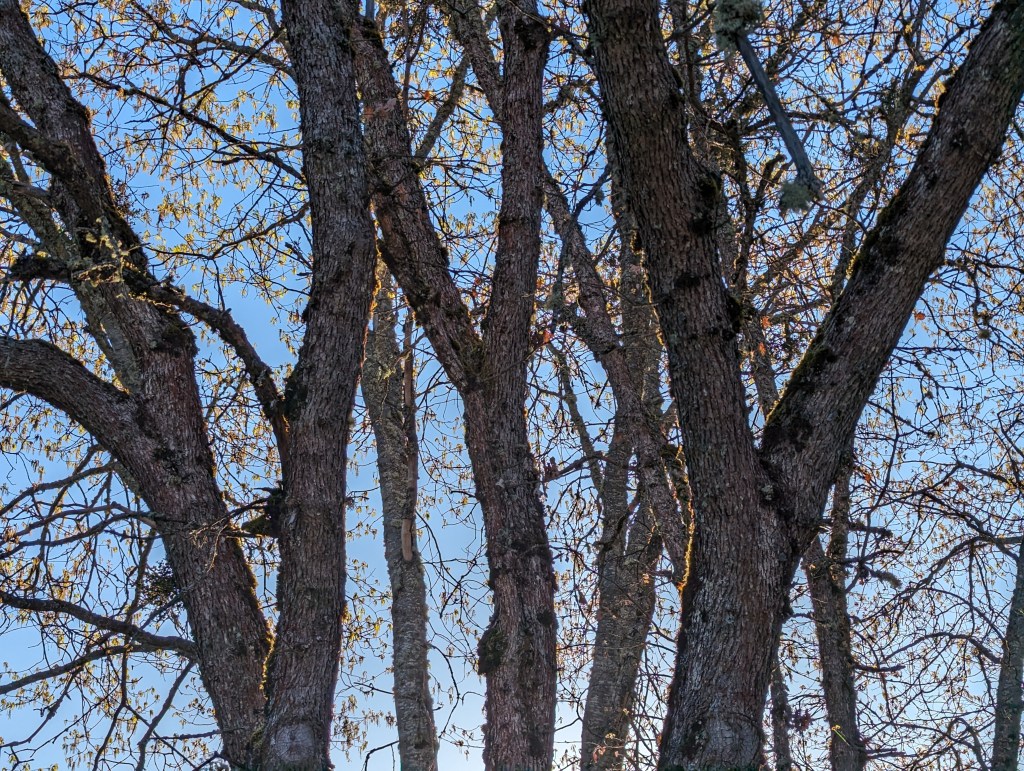
This picture of a few main limbs of an exemplary specimen of Oregon white oak is from Cabin Creek Rest Stop on Southbound Highway 5, just north of Oakland in Oregon. To me, it looks sort of Californian, like something that, a long time ago, was more prominent in Oakland here in California, on ‘the Bright Side of the Bay’.

Sky Lupine

Sky lupine grows wild here. (This may actually be arroyo lupine.)

If California poppy were not the State Flower of California, sky lupine, Lupinus nanus, might be. Even though the perfect blue of sky lupine is the opposite of the perfect orange of California poppy, both of these brightly colorful flowers have several similarities, and are often sown together in autumn or winter for their early spring bloom. Both are native to western North America, but are very commonly displaced by exotic (non native) plants. As natives, they can easily self sow if competing specie are controlled. Both are satisfied with annual rainfall. As long as they are not watered too much in poorly draining soils, they are not too discriminating about soil. They do want full sun though.

Sky lupine is an annual that does not get very large, no more than two feet high and half as wide. It seems to be more colorful where it is kept less than a foot high by good sun exposure and wind. The finely textured, palmately compound foliage (divided into smaller leaflets that are arranged in a palmate pattern) gives it width, but only the lower half of its height. The upper half is its narrow spikes of small, neatly arranged ‘pea-shaped’ flowers.

Blue Eyed Grass

It is more like an iris (of the floral sort, not the ocular sort) than a grass.

Contrary to its common name, blue eyed grass, Sisyrinchium bellum, is not a grass at all, but is like a diminutive iris. The modern cultivars that are more commonly found in nurseries are somewhat more colorful than the wild plants that are native to coastal areas between about Santa Barbara and Portland. Yet, even these are rather subdued, with small half inch wide blue or light purple flowers delicately suspended above bluish grassy foliage that may be as low as only a few inches, and is rarely higher than a foot. They bloom best in sunny but not too hot areas. Once established, blue eyed grass is not too demanding, but naturalizes and slowly spreads more reliably if watered occasionally through summer. However, they can rot if watered too generously or too frequently.  

California Black Oak

California black oak defoliates through autumn.

Only a few counties within California lack native California black oak, Quercus kelloggii. Yet, it is not prominent where it is native locally. It generally inhabits mixed forests within the Coastal Ranges. It is rare among home gardens, and rarely available from nurseries. Within the Sierra Nevada, it is common enough to be harvestable as a hardwood timber.

With good exposure, mature California black oaks may get no taller than thirty feet. They can get twice as tall where they must compete with tall trees. The largest trees are higher than a hundred feet. Their elegantly upright trunks are generally less bulky than those of other oaks. Few are more than four feet wide. Gray bark darkens and roughens with age.

The deciduous foliage of California black oak is almost brownish drab green. It becomes brownish yellow prior to defoliation. Cooler weather enhances brighter yellow or orange color, but also accelerates defoliation. Foliage can linger into winter with milder weather. The handsomely lobed leaves are about four inches long, and bigger on vigorous stems. The docile roots are vulnerable to rot with frequent watering.