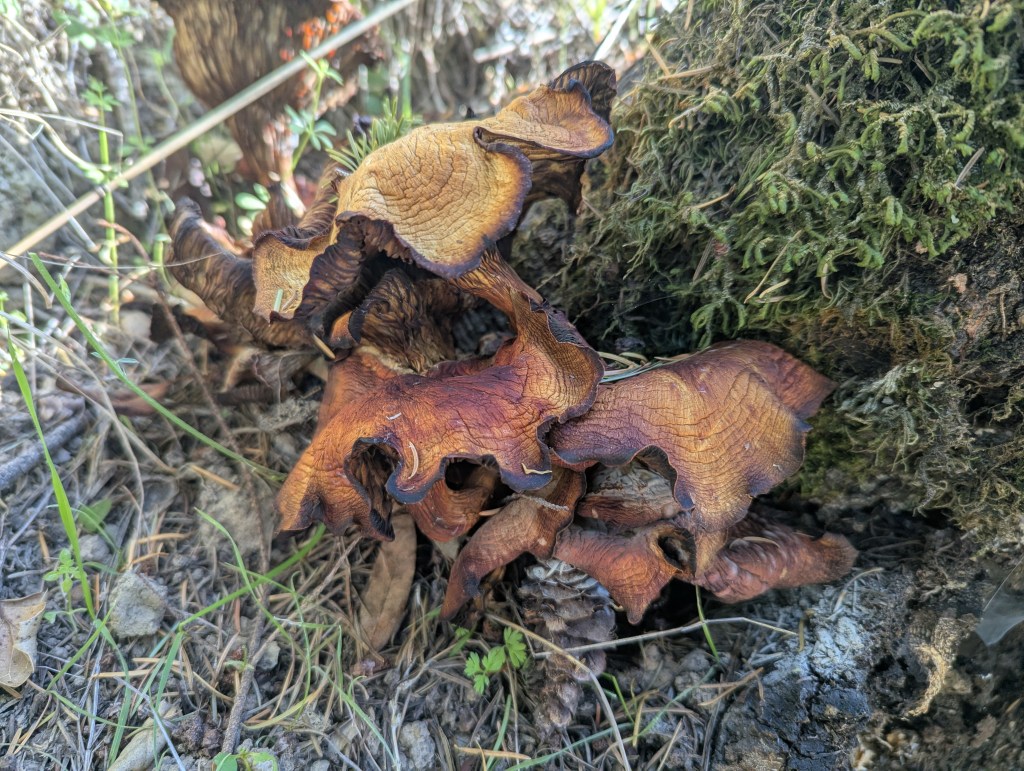
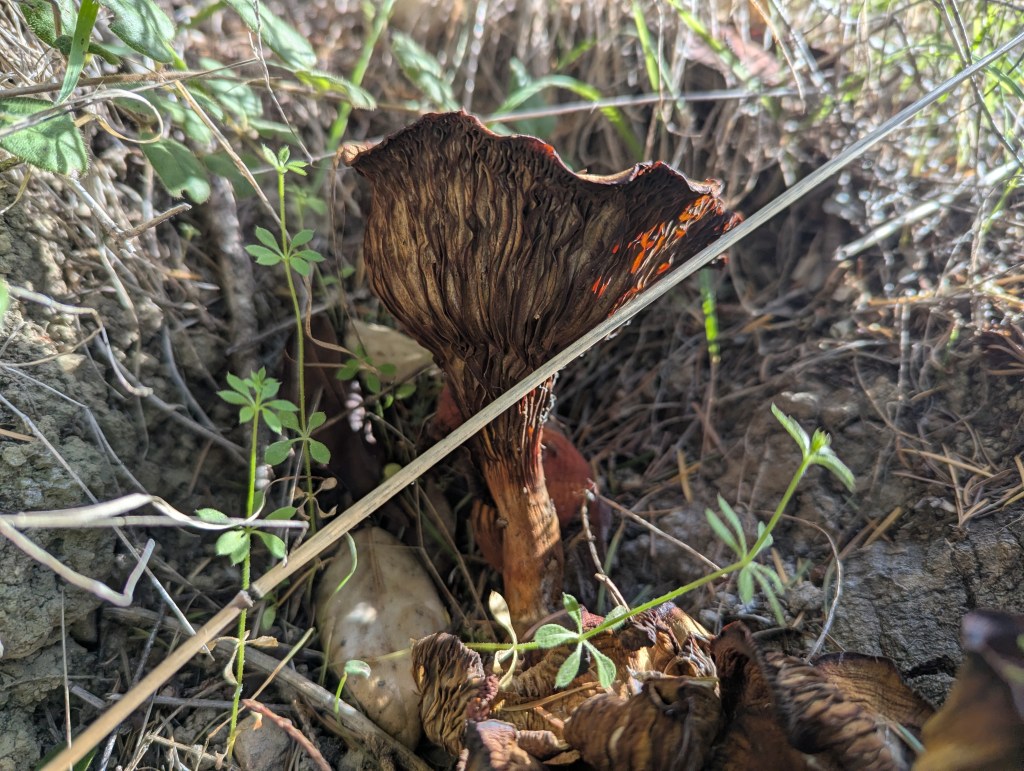
Are these chanterelles? I found them at the base of a dead and rotting coast live oak on the Upper East Side. I took their picture because friends had been asking me if there are any chanterelles to collect there. Apparently, chanterelles can be sold for quite a sum to restaurants. I really should have been more observant when I took these pictures, to see how many more of the same, if any, were in the area. I will not return to the area anytime soon, unless I need to show someone else where it is. It is quite a hike to get there, with a very steep incline. It is likely too late to collect chanterelles anyway. They supposedly emerge after the first autumn rain, but finish through November, which is likely why these look so deteriorated and dried. However, locally, they can continue to appear throughout winter if weather conditions are favorable. I am certainly no expert. After all, even if these are chanterelles, this is my first experience with them. We are barely acquainted. I do not trust them enough to taste them. Nonetheless, I would be pleased if friends could collect real chanterelles for a profit.
(Some of the information within this article is very outdated because the article was recycled from several years ago.
Valley oak, as well as coast live oak, were the two most common native non-riparian tree species of the Santa Clara Valley.
Bringing nature to the garden is generally very unnatural. Before urban development of the Santa Clara Valley, there were a few valley and coast live oaks spread out sporadically over open chaparral, with a few sycamores, maples and other riparian specie only in the creeks and Guadalupe River that run through it. There are vastly more trees and plant life here now than there ever have been, and specie from every region of the world. Since exotic (non native) plants are from other climates and soils, they require unnatural accommodations, such as watering and fertilizers, to keep them happy.
The most natural gardening is done with native plants, which are naturally adapted to local climates and soils. Natives are not as demanding of amendments, fertilizers or pesticides as some exotic plants are, since they know how to get they want with the local resources available. Because most are satisfied with natural rainfall, they do just fine with minimal watering (once established).
All sorts of native plants will be available at the Native Plant Sale at Hidden Villa Ranch in Los Altos Hills in only ten days on October 16, from 10:00 a.m. to 3:00 p.m.. Deergrass, monkey flower, redbud, blue-eyed grass, buckwheat, sedums and native lilies and orchids will all be there and accurately labeled. Volunteers from the California Native Plant Society will be available to talk about alternatives to law, including native perennials, shrubs, wildflowers and grasses. Books about native plants, as well as posters and note cards featuring native plants will also be available.
From 1:00 to 2:00 p.m., Stephanie Curtis of Curtis Horticulture will give a free hour lecture about tips for planting success and maintenance for natives. Admission is limited to 25 people though, first come first served.
Hidden Villa Ranch is located at 26870 Moody Road in Los Alton Hills, two miles west of the Moody Road and El Monte Road interchange at Highway 280. Plant selection is best early in the day. All sales must be by cash or check, since credit cards are not accepted. It helps to bring boxes to carry purchased items. More information can be found at www.cnps-scv.org or cnps_scv@yahoo.com or by telephoning 650 – 260 3450. Incidentally, autumn is a good time for planting, since the warmest part of summer is over, and the rain will arrive soon to settle soil around the roots of newly planted plants.
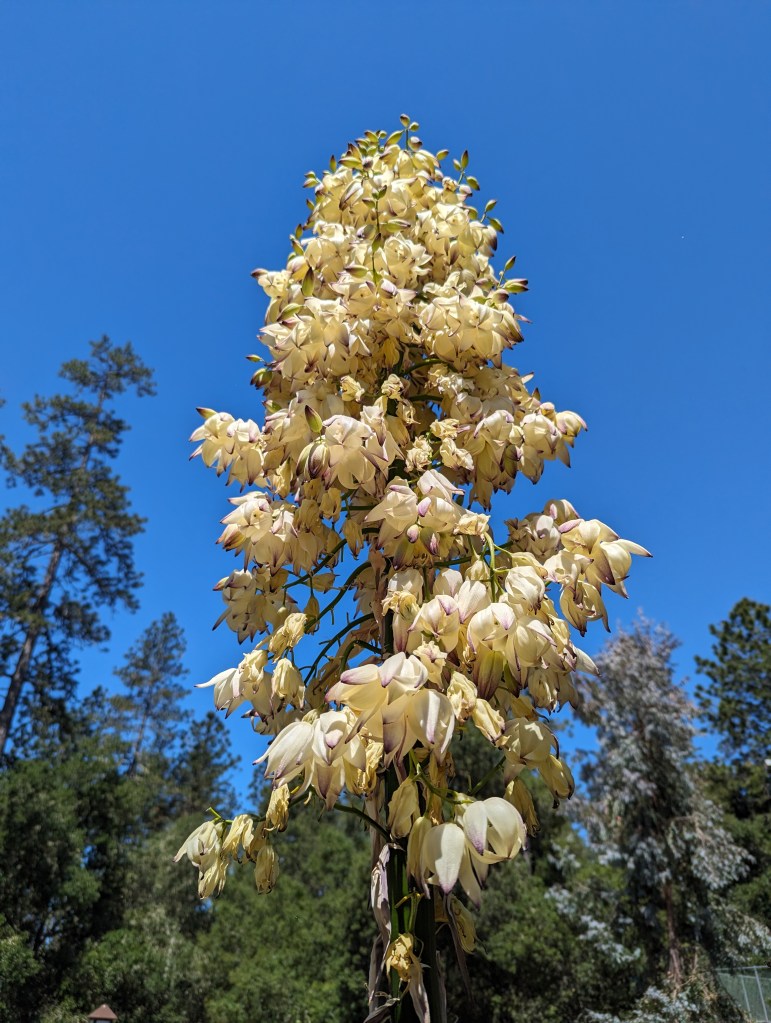
(Hespero)Yucca whipplei has an identity crisis. My contemporaries and I learned it as Yucca whipplei. Botanists now insist that it identifies as Hesperoyucca whipplei, although, like any and all other species of Yucca, it can hybridize with any and all other species of Yucca. (If it is a different species of the same genus, such hybrids would be interspecific hybrids. If it is a different genus, such hybrids would be intergeneric hybrids, which is even weirder.) Also, my contemporaries and I learned its common name as Spanish bayonet. Botanists prefer to designate it as chaparral yucca. It is alternately known as foothill yucca, Quixote yucca or our Lord’s candle. Because it was the only species of the genus that was locally native, we typically referred to it merely as yucca. Later, I learned that Spanish bayonet is a general designation for a few arboriform species of Yucca, which develop trunks and perhaps limbs, such as Yucca aloifolia, and that Spanish dagger is actually more commonly a generic designation for a few species that lack significant trunks or limbs, such as this particular species. Anyway, regardless of all this nonsense, I had been wanting to grow this species since encountering it while studying horticulture at California Polytechnic State University in San Luis Obispo, but could not find an appropriate situation in which to do so. It is too wickedly spiny for most landscapes. I was told that a specimen inhabited one of the landscapes at work, but because it did not look familiar, I was sceptical. It adapts so efficiently to whatever situation that it grows into, that its foliage here is somewhat different from how it develops in the wild around San Luis Obispo. Its impressively tall bloom is very familiar though, and is very distinctive of the species.
Giant redwood, Sequoiadendron giganteum, is famously the largest tree in the World. Although not quite as tall as the coastal redwood, Sequoiadendron sempervirens, it is bulkier. It grows taller than three hundred feet, with trunks wider than thirty feet, to weigh more than six hundred thirty tons.
Yet, like many species, it has at least one cultivar. ‘Pendulum’, which is the weeping giant redwood, is nothing like the simple species. It might grow forty feet tall, if it is able to support itself at such a height. It’s canopy might grow a few feet wide, but it really cascades more than it reaches outward. It really is weird. It looks more like a relative of Mr. Snuffleupagus of Sesame Street than like a relative of giant redwood.
Of course, its weirdness is what makes it so appealing. It is sculptural. It is bold. It really makes one wonder what planet it is from.
I got this picture in Kitsap County in Washington, hundreds of miles from the native range of the simple species within the Sierra Nevada. Actually, I see more of this cultivar in the Pacific Northwest than here. It likely performs better there because of the colder winter weather. Furthermore, this weird cultivar is more popular than the simple species, partly because it is so distinctive, and partly because it is more proportionate to home gardens. Simple giant redwoods only fit into very spacious landscapes.
Weeping giant redwood may not be good for anything more than its weirdness, but at least it excels at that. Otherwise, it provides no significant shade. It does not bloom conspicuously. It provides no fruit. It does not even make good firewood. Fortunately, weirdness has certain appeal. Within our home gardens, we can grow what we like, even if merely for its weirdness.
Wild cucumber is not a particularly substantial vine. Except for its tubers, it is quite delicate.
Wild cucumber, Marah fabacea, is also known as manroot because it develops massive tubers that can weigh as much as a man. Such tubers can supposedly weigh more than two hundred pounds, and some sources claim that they can weigh twice as much. That is a lot of storage.
Their thin leaves, slender vines, tiny flowers and fleshy fruit are not very substantial, and can not be very consumptive. They are quite watery, and leave minimal debris when cut and dried, or when they die back after frost.
So, why does wild cucumber store so much resources within their massive tubers? I have no idea. I realize that it is a survival technique, but this is major overkill. No winter is long enough to justify such extreme storage. No summer is dry enough. No wildlife is voracious enough. No forest fire burns the same place more than once in a season. Furthermore, no gardener is diligent enough.
Seriously, these things are impossible to kill. The vines pull up quite easily, with no resistance. The tuber simply makes more. Secondary vines pull up as easily as the first. The tuber simply makes more. No matter how many times the vines get pulled up, the tuber simply makes more. It never exhausts its resources. Removal of the vines deprives it of its ability to accumulate more resources, or replenish what is used to generate the vines, but it has enough to generate vines for many years.
The only way to eliminate these weeds is to dig up their massive tubers, which are fortunately not very deep underground. Even then, the tubers do not die. This one sat around through last summer, and is still viable. I suppose that we should dispose of it with the trash, since we can not compost it.
This wild cucumber tuber is bigger and much heavier than Rhody, but is smaller than average.
Even if bloom is not much to brag about, the rosehips can be pretty and useful.
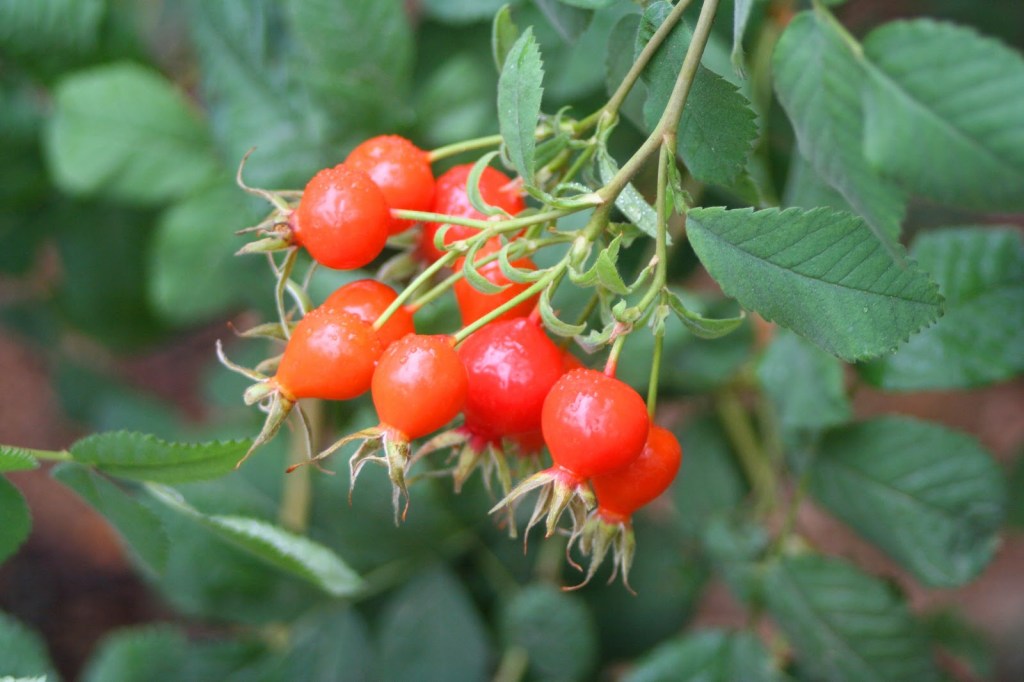
Prickly thickets of California wild rose, Rosa californica, are not often much to look at, even while adorned with small and sparse pink roses in spring and summer. The fragrant flowers can actually range in color from white to rich pink, and may have more petals, but are not abundant enough to be very impressive at any one time. In autumn though, all the flowers that bloomed in the previous few months leave bright orange or red fruiting structures known as ‘hips’, that linger on the bare canes through winter.
The rose hips of California wild roses had historically been used to make herbal tea because they contain so much vitamin C and have a pleasant flavor. (California wild rose is a ‘tea’ rose but not a hybrid ‘T’ rose.) They can also be made into jelly or sauce. The only problem is that birds like them too, so often take them before anyone else has a chance to.
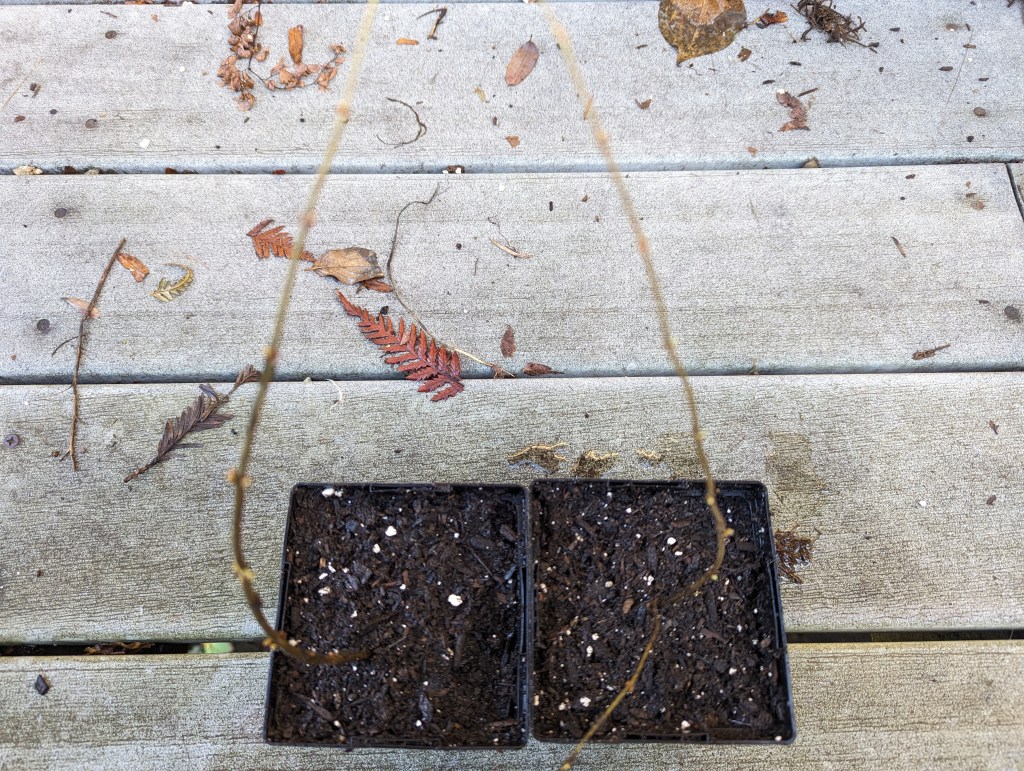
This is why I did not brag about my recently acquired snowberry within the context of my ‘Six on Saturday’ post this morning. They are not much to look at. Even if this illustration were more in focus, these bare twigs are indistinguishable from similar dormant twigs.
Nonetheless, I am pleased with their acquisition. I can not explain why, but I am pleased. The species, Symphoricarpos albus, is native, but not popular. I am beginning to realize why. Not only is it not much to look at in this particular condition, but it will unlikely ever become much to look at. It always looks scraggly, even while generating new foliage for spring. Its foliar color is unimpressively bland light green. Its twigs are very twiggy. Its dinky pale pink flowers are grungy and almost always infested with something or other. Its white berries, which is its primary attribute, are very scarce.
After so gleefully pulling this particular seedling from a landscape that it needed to be removed from, splitting it into two, and canning them as seen here, I realized that a rather large colony of snowberry inhabits another of the landscapes here. I could take as many rooted bits from it as I want without noticeably depleting it. For now, I am very satisfied with these. I have no plans for them, but will figure that out as they grow.
I suspect that snowberry can be more appealing in cultivation than in the wild. I intend to promote growth that is more vigorous than typical, which should enhance berry production. After this first winter, in which I dug and canned it, I will likely cut all of its growth to the ground annually during winter dormancy. I will not notice improvement this first year, but might after two years.
Bay grows wild here. It is native. It is also known as bay tree, laurel, bay laurel, spice tree, pepperwood, myrtlewood, Pacific myrtle, Oregon myrtle and California bay. All these different common names demonstrate why simple botanical nomenclature is useful. In that regard, this native bay is Umbellularia californica.
Bay is also native to the Mediterranean region. Of course, it is a different species, Laurus nobilis. Like the bay that is native here, it is also known as bay tree, laurel and bay laurel. Furthermore, it is known as Grecian bay, true laurel and sweet bay, although it is not at all sweet.
Laurus nobilis is a common culinary herb though. Umbellularia californica is not. That does not mean that Umbellularia californica can not be useful as such. It merely means that it is not commonly used as such, and is very different from the bay that genuinely is. Some of us here in California and southwestern Oregon actually do sometimes find culinary applications for it.
Umbellularia california has a much more pungent and stronger flavor than Laurus nobilis. Although it has potential to be useful for similar applications, it is by no means a substitute, and should certainly not be used in comparable proportions. Most of us who use it are aware of the differences, and know how to use it, generally quite sparingly.
The problem is that fresh foliage of Umbellularia californica is sometimes available as culinary bay from supermarkets, and is typically labeled as sweet bay, true laurel or Grecian bay. This is no problem for those of us who recognize it, but we would not purchase it from a market while we can get it for free from the wild. Those who purchase it likely do so because they believe that it is genuine Laurus nobilis.
These mature oaks can not adapt to the irrigation that the new lawn requires.
Californian climates are impressively diverse. However, most climates here are chaparral or desert climates, or similar to such climates. That means that almost all rain occurs during the rainy winter season, and that almost no rain occurs during the dry summer season. Vegetation that is native to California is very familiar with the climates here. Therefore, it does not expect rain during summer. This should be obvious.
Some native species can adapt to irrigation during summer. Some may grow faster than they normally would without irrigation, but compromise their natural life span in the process. This is acceptable within some landscapes. Many riparian species are not bothered by irrigation.
However, some species adapt less efficiently. Some do not adapt at all. Some that can adapt while young can not do so while mature. Oaks are a common example of this.
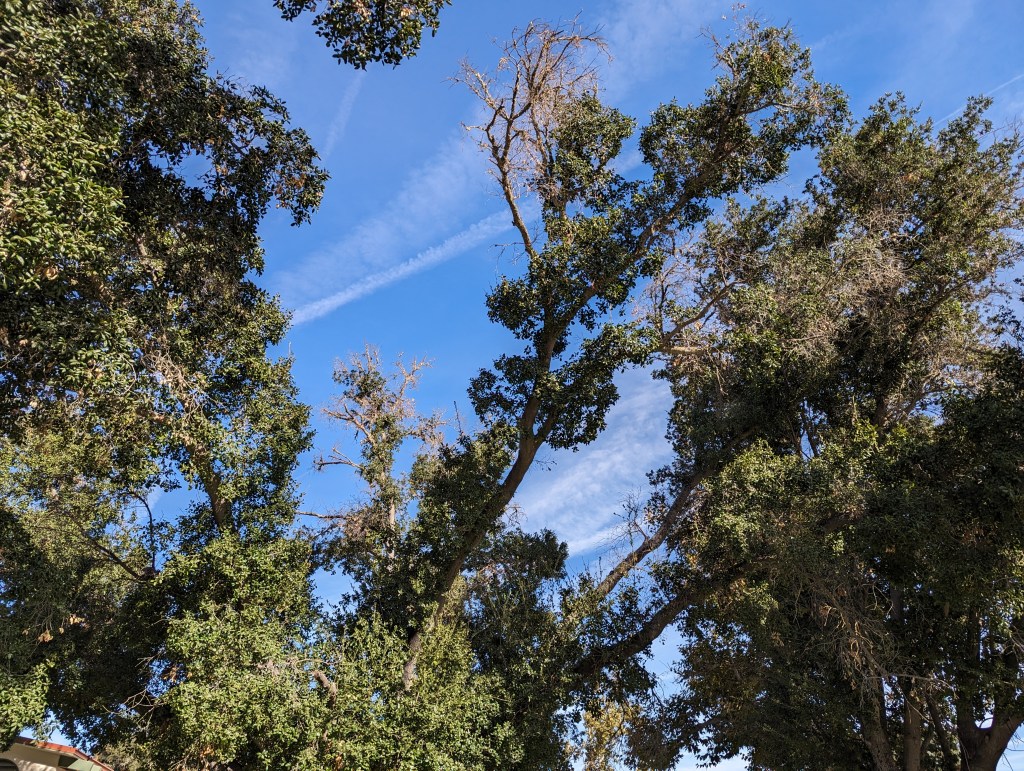
These coast live oaks with a few blue oaks were installed as shade trees within a formerly minimalistic landscape that did not include turf. They were happy with annual rainfall for half a century or so. Then, this generously irrigated lawn was installed around them. They can not adapt to the frequent irritation that the lawn requires. Their roots are succumbing to decay, so will eventually be unable to sustain their foliar canopies. As they deteriorate, decay may eventually compromise their structural integrity and stability. Dieback is already evident within their upper canopies, with lower watersprouts attempting to compensate.
I suspect that the trees will be removed before they deteriorate enough to become hazardous. I also suspect that new trees will systematically replace them prior to their systematic removal. Their eventual demise is likely an acceptable loss, and perhaps expected. Turf with adapted shade trees is likely more important within this particular situation than preservation of these middle aged oaks.
Dieback is evident within the upper canopy. Watersprouts are evident with the lower canopy.
Rhody, Carson and I took Highway 101 for most of our recent trip from here to the Los Angeles region. We typically drive on more of a variety of highways between here and there, but for this trip, I wanted to drive on Highway 101, as was more typical when I was in college in the late 1980s.
Rhody enjoys rest stops, perhaps as much as our destinations. Because the rest stops near Gaviota remain defunct, only the Camp Roberts Southbound Rest Area was in service on our route. We stopped there, of course.
The old facilities that I remember were replaced years ago. I would prefer the old original buildings. I can not imagine why replacement was necessary. Nor can I understand why the more elaborate associated landscape was necessary. This new landscape, with its cliche crape myrtles, carpet roses and a bit of lawn, is irrigated so generously that the old coast live oaks are deteriorating and succumbing to rot. Most are now surrounded by irrigated lawn, after surviving with only annual rainfall for half a century or so. Like so much about California, not much of the familiar remains.
However, besides the deteriorating mature coast live oaks and a few seemingly younger California sycamores that are also within the landscaped areas, a few familiar native oaks remain beyond the landscaped area. Some seem to be older than those within the landscaped area, and if so, were there prior to the development of the rest stop. Most are coast live oaks, and a few are blue oaks.
I met the blue oak in the picture above in 1985. Although it has not grown much since then, the disproportionately large cavity within its trunk has. I am impressed that the trunk can still suspend the healthy foliar canopy above.






 Tony Tomeo