Big Leaf Maple

The sugaring maple of the West!

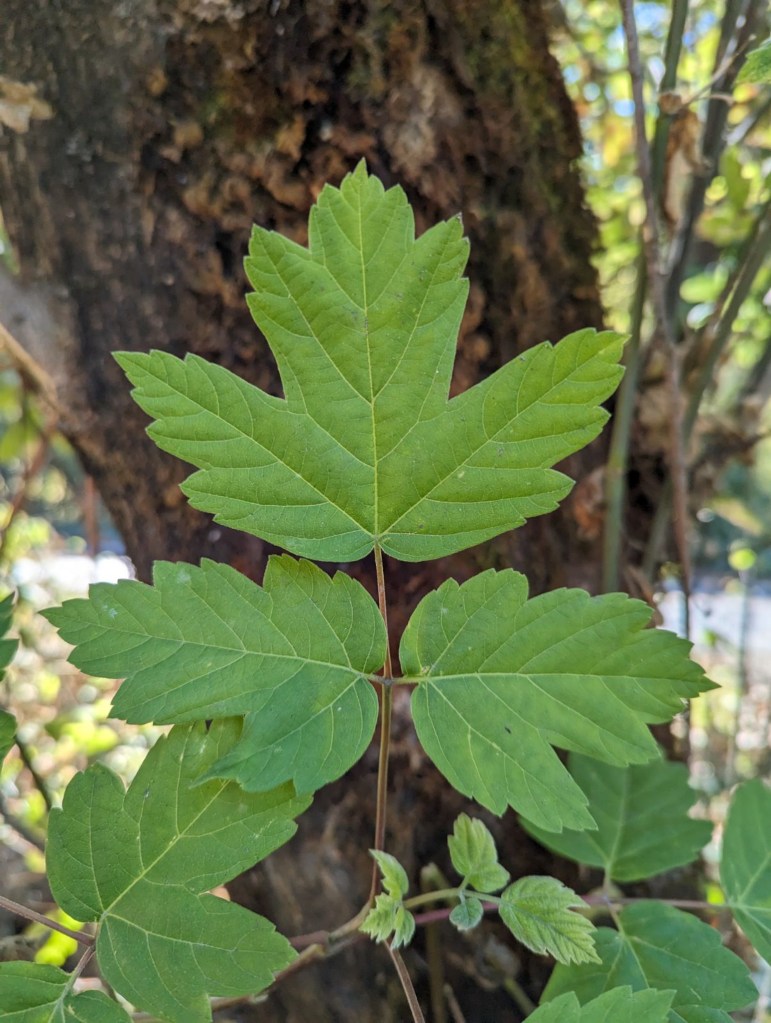
Maple sugar production has not always been exclusive to northeastern North America. In fact, it is not exclusive to sugar maple. Big leaf maple, Acer macrophyllum, also provides maple sugar in British Columbia. It is native from the southern extremity of Alaska to San Diego County. Most of its range is generally coastal but also includes the Sierra Nevada.

Bigleaf maple is one of merely two native maples here. It is more common within riparian ecosystems and at higher elevations. However, it is rare among home gardens because it is so vigorous and grand. Its aggressive roots eventually buttress, and are likely to ruin lawns and pavement. Autumn defoliation of big trees releases big volumes of big leaves.

Bigleaf maple can grow almost fifty feet tall and wide within sunny suburban landscapes. It can grow a hundred feet taller where it competes for sunshine within coastal forests! Its palmately lobed leaves are typically wider than six inches. They can be twice as wide on vigorous stems. Foliage turns yellow for autumn. Seedlings might be annoyingly prolific. Local climate is unfortunately not conducive to practical sugar collection and refinement.
Box Elder

Box elder leaves are pinnately compound.

Leaves of three, leave it be, unless one can see that it is a box elder tree, Acer negundo. This is the most common of the North American maples. It is native to all American states except for only Alaska and Hawaii. Yet, it is also unique as the only maple with pinnately compound leaves. Typical leaves have three leaflets, but might have as many as seven. A few rare maples have palmately compound leaves.

Although common in the wild, box elder is rare within refined landscapes. It grows fast to about forty feet tall, but does not live for much more than fifty years. It typically develops a few plump trunks with casually irregular form. Unfortunately though, such form becomes structurally deficient with age. Autumn foliar color is unremarkable yellow or brown here.

However, a few garden cultivars display distinctly colorful foliage for spring. ‘Flamingo’ is the most popular cultivar. Pink variegation of new spring growth fades to white. ‘Auratum’ displays bright yellow new growth. ‘Violaceum’ displays smoky blushed new foliage with purplish red floral tassels. After pollarding, such cultivars are more compact and colorful, but lack floral tassels.

California Native Plants Grow Wild

Some natives are difficult to domesticate.

California native plants seem like they should be very appropriate for home gardens. In the wild, they require neither irrigation nor maintenance. They are quite satisfied with local climate and soil. Of course, gardening with natives is not so simple. Home gardens are very different from wild ecosystems.

Furthermore, wild ecosystems here are very different from wild ecosystems elsewhere. California is a very big place, with many different ecosystems. Some alpine species from the Sierra Nevada would be unhappy on the coast. Some coastal species from Del Norte County would be unhappy in the Mojave Desert. California native plants should be regionally appropriate.

Therefore, chaparral species are generally most appropriate for local chaparral climates. Many riparian species perform satisfactorily here as well, but expect more irrigation. However, appropriateness to a climate is not the same as appropriateness to a garden. Actually, many chaparral species are unappealing within home gardens. Some are difficult to domesticate.

A few species of California lilac are native here. Any of them are pleased to inhabit local home gardens. However, some grow quite large, and then die after only ten years or so. They may not last even that long with typical irrigation. Few respond favorably to pruning. They prefer to grow wild. Such big, awkward and temporary plants are undesirable within many compact and refined home gardens.

Combustibility might also be a concern for chaparral plants. Some chaparral ecosystems rely on fire for periodic renovation. In the wild, some such ecosystems may burn as frequently as every few decades. After burning, fuel begins to accumulate for the next fire. Even if not copious enough to be hazardous, such accumulation can be unkempt.

Only a few specialty nurseries provide wild California native plants. Most nurseries provide cultivars of such plants that are more adaptable to home gardens. ‘Carmel Creeper’ is a densely sprawling California lilac that gets only a few feet tall. It is commonly available. The original species can get more than fifteen feet tall, with open branch structure.

White Alder

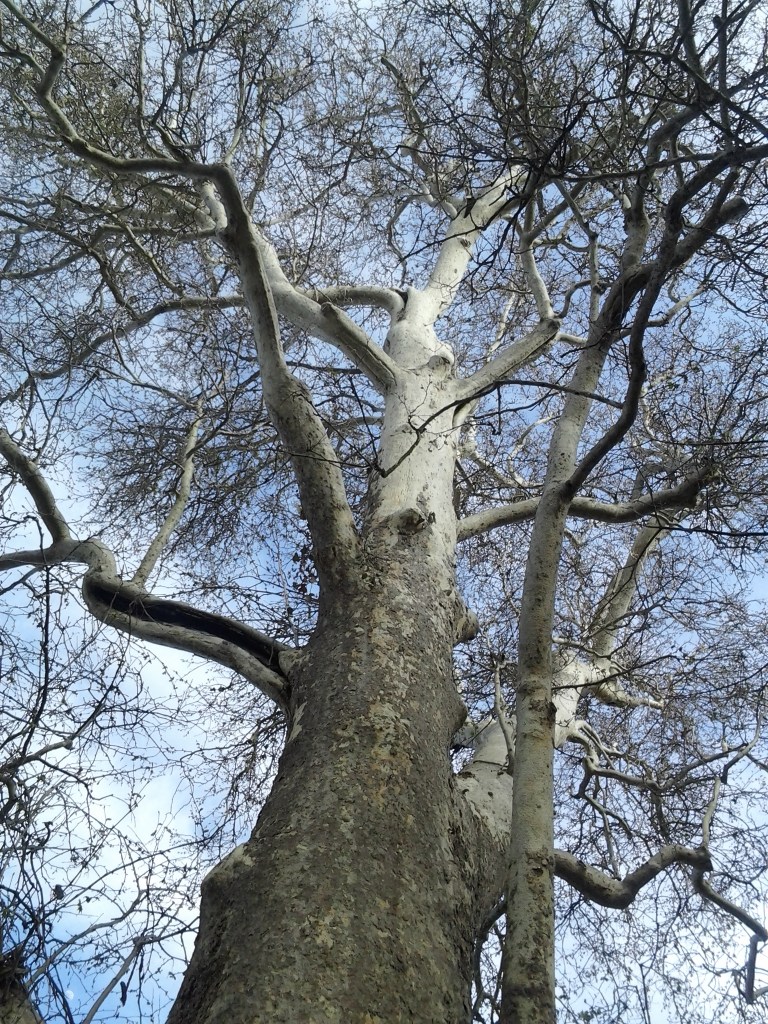
White alder is mostly defoliated by now.

During the summer, the native white alder, Alnus rhombifolia, is a nice shade tree that looks bigger than it really is. By late winter, the bare deciduous canopy has an appealingly picturesque silhouette. This time of year is actually when white alder is typically less appealing, with dead foliage that provides no interesting fall color, but lingers until knocked down by rain or late frost. Yet, even now, it sometimes surprises with these funny looking floral structures that are interesting both in the early winter landscape, and with cut flowers.

In past decades, white alder was an ´expendable’ tree that was put into landscapes for quick gratification while slower but more desirable trees matured. By the time the desirable trees matured, the alders were removed to make more space for the desirables. This technique was practical because, like many fast growing trees, alders do not live very long, so start to deteriorate after about twenty five years anyway. However, alders often live longer than expected.

Mature alders are usually less than fifty feet tall where they are well exposed. They can get at least twice as tall where shaded by other trees or big buildings. Their plump trunks with mostly smooth silvery gray bark make them seem larger than they really are though. Too much water promotes buttressed roots which can displace pavement.

Valley Oak

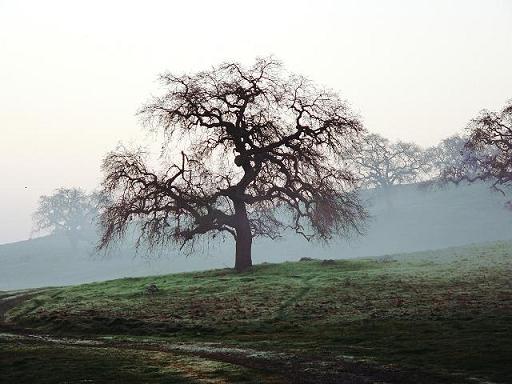
‘Foggy Oak Morning’ by Karen Asherah

‘Foggy Oak Morning’ by Karen Asherah, is another example of the local scenery that I miss while not taking a bus or walking. I drove past this scene for years on my way to work outside of San Martin without ever bothering to take a look at it. This happy tree is a native valley oak, Quercus lobata, like those that had been common throughout the Santa Clara Valley until only about two centuries ago. It is not exactly the sort of shade tree that everyone wants in a compact suburban garden, but is grand enough for large spaces like parks.

Mature specimens may not seem to get as tall as oaks in the Appalachian Mountains, but are actually the largest oaks in North America, and live more than five centuries. The tallest trees are mostly less than seventy feet tall, but can get taller. Trunks of the oldest trees are commonly six feet wide or wider. The distinctively and uniformly furrowed bark is as classically ‘oakish’ as the rounded prominent lobes of the deciduous leaves, and the sculpturally irregular branch structure. Odd stem galls, commonly known as ‘oak apples’, are home to the larvae of tiny wasps that rely on valley oaks for everything they need. Incidentally, Paso Robles, or ‘El Paso de los Robles’ is named for the valley oaks in the area, which Spanish immigrants thought resembled the ‘robles’, the European oaks that inhabit Spain.

More information about ‘Foggy Oak Morning’ can be found at the website of Karen Asherah at karenasherah.com.

Flannel Bush

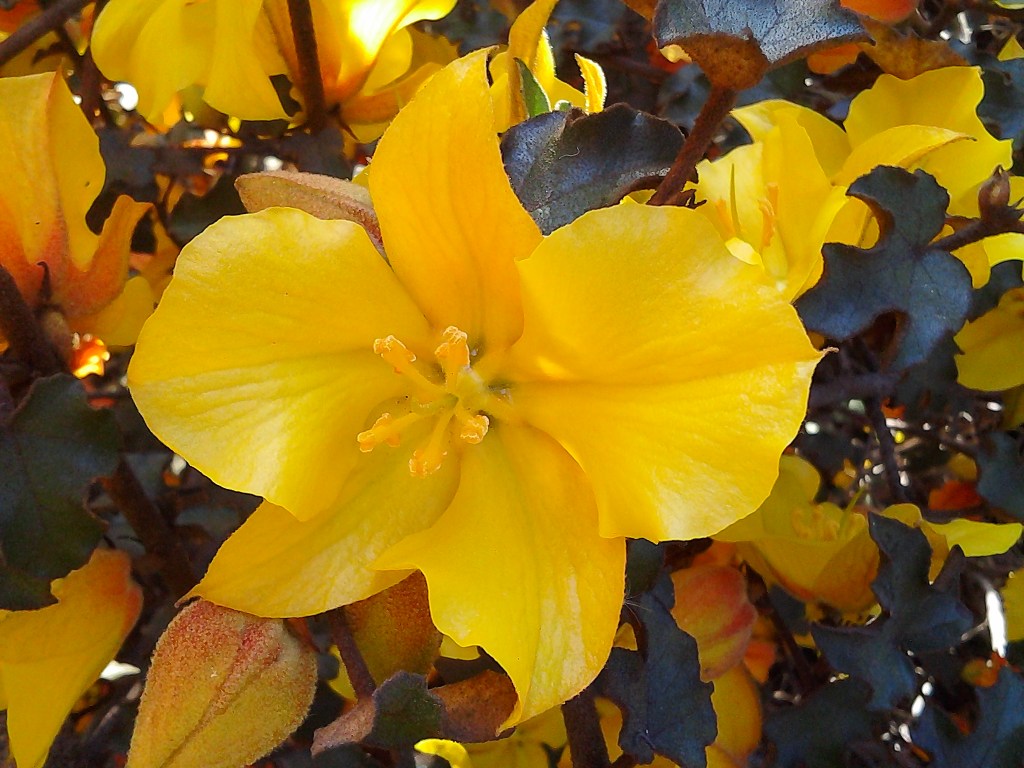
Abundant golden blooms are really spectacular, but because of irritating foliar fuzz, flannel bush should be enjoyed from a distance.

There is no way to say it delicately. Flannel bush, Fremontodendron californicum, is not easy to work with. It grows rapidly and rampantly with awkward form to about ten feet high and broad, but then starts to deteriorate when only about twelve years old. It can deteriorate even sooner if well irrigated. The fuzz on the foliage and young stems is irritating to the skin, especially during warm weather, so is very uncomfortable to handle. Otherwise, for out of the way spots, flannel bush is a striking native plant with impressively abundant bright golden yellow bloom this time of year. Neglected plants that do not get pruned or watered seem to be happier and more colorful, and can get older and much larger.

Cultivars Of California Native Plants

Some natives belong in the wild.

Native plants are obviously happy with local climates and soils. Otherwise, they would not be native. They had been living here long before the first landscapes. They survived without irrigation, fertilizer or any maintenance. Regional varieties adapted to regional environmental conditions. Some of such varieties became cultivars that are now familiar.
A variety is, more or less, a naturally occurring variant. Unnatural selection and breeding produced some varieties. Generally, varieties are genetically stable enough to replicate for at least a few generations. A cultivar is a cultivated variety. It is unable to replicate by natural processes, so propagates by cloning. All clones are genetically identical copies.
Most cultivars grow from cuttings. Some cultivars of exotic (nonnative) plants are grafts. (Not many natives are conducive to grafting.) Regardless of technique, propagation of all cultivars is vegetative (without seed). Seed of some cultivars can produce plants that are similar to the parents, but not indistinguishable. Some will likely be completely different.
Honestly, most native plants are not as appealing in home gardens as their cultivars are. Some are desert or chaparral plants, which can get scraggly through summer. Some are sparsely foliated with irregular branch structure. Like the majority of exotic plants, several native plants benefited from some degree of refinement. It is a fair aesthetic compromise.
This is partly why landscapes of native plants look nothing like forests or unlandscaped areas. The dense and strictly conical form of ‘Soquel’ redwood is very different from that of wild trees. ‘Carmel Creeper’ ceanothus is greener and more densely foliated than wild counterparts. ‘Ken Taylor’ flannel bush is likewise unnaturally dense, low and mounding.
The other primary reason that landscapes of native plants are so different from the wild is that they typically include species from other regions. Some of the penstemons that are popular as native plants throughout California are actually only native to the Siskiyous. Limiting landscapes to true regional natives would produce very different results.

Western Redbud

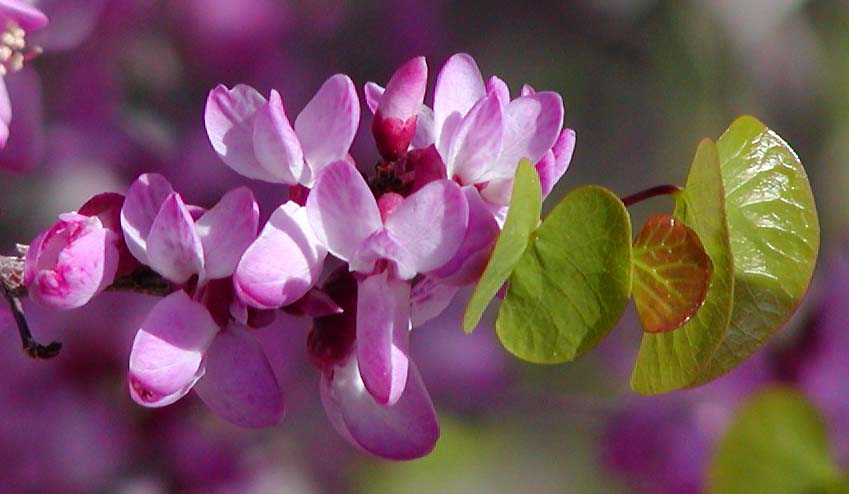
Western redbud is a domesticated native.

The thin stems of Western redbud, Cercis occidentalis, that had been bare through winter are now outfitted with an abundance of tiny but almost offensively bright magenta flowers. Rounded or nearly heart shaped leaves will become more prominent as bloom fades. As foliage yellows and falls later in autumn, coffee colored pods that are about two inches long remain until they get dislodged by winter weather. Pods can be very abundant on older or distressed plants, or scarce on young or vigorous plants.

Western redbud is typically grown as a large shrub or a small tree with multiple trunks. Mature trees may stay less than ten feet tall, and do not often get taller than fifteen feet, although they can get more than twice as tall where they need to compete with other trees. Once established, western redbud does not need to be watered, but seems to be happiest if occasionally watered through summer. Seedlings that appear around mature plants should be moved or potted while dormant through winter, and while young, since they will not want to be disturbed once they have dispersed roots.

Natives Are Right At Home

Some native plants should stay wild.

Long before people came here and imported exotic (non-native) plants from all over the world, native plants had been perfectly happy without any pruning, watering or fertilizing. They had always been perfectly happy with local soils, local climates and even occasional wildfires. Many are still happier in the wild than in seemingly more comfortable refined gardens and landscapes.

It really makes sense though. Most exotic plants need to be watered because they are from climates that naturally get more rain. Some want to be fertilized because they are from regions with different soil types. Some plants prefer cooler winters. Others want more humidity. They crave what they would get in their respective native homelands.

However, plants that are native to California are not necessarily native to here. California is a big place with all sorts of climates and soils. For example, the desert fan palm that is native to warm and dry Palm Springs would not be happy in cool and foggy San Francisco. Big leaf maple that likes the cool winters of the Siskiyous does not like the mild winters near the coast of Los Angeles. The best natives are those that are native to a particular region, or similar region.

Also, there are a few native plants that are not so easy to accommodate in every home garden. Both the giant sequoia, which is the biggest tree in the world, and the coastal redwood, which is the tallest trees in the world, are native to California. Even if the local climate is a good fit, the space available may not be.

One of the most difficult problems for so many natives though, is that they are sensitive to the regular watering that most exotic plants require. The regular watering that lawn needs just to survive is enough to rot the roots of plants that do not expect any water between spring and autumn.

Santa Barbara daisy, penstemon and various salvias are some of the favorite native perennials. Wax myrtle and the various ceanothus and manzanitas are interesting shrubbery. Western redbud and toyon can be big shrubs or small trees. California sycamore and various oaks are big trees for big spaces.

California Native Plants Exemplify Diversity

00729thumb
Redwoods are the grandest native trees.

California native plants are logical options for the gardens and landscapes of California. It is only natural. They are already happy with the climates and soils here. They do not need to adapt quite as much as plants from other regions and climates do. After all, they lived here long before anyone else was here to water and maintain them.

Unfortunately, it is not that easy. California is a very diverse place. There are more climates here than there are within many other states combined, over a much larger area. Plants that are native to the Mojave Desert would not be happy in a rainforest of the Siskiyou Mountains. Coastal plants would be no happier high in the Sierra Nevada.

Within reason, California native plants for landscapes and home gardens should be either locally native, or native to similar climates. Plants from very different climates within California are about as exotic as plants from other continents. Just like foreign exotic plants, they may require special accommodation, such as irrigation, to survive here.

All plants need irrigation when first installed. Irrigation can be slightly complicated for plants that are native to climates with long and dry summers. They certainly need irrigation until they disperse their roots. However, a bit too much can rot their roots. California native plants can be sensitive like that. After all, they do not expect to be moist through summer.

Then, once established, many California native plants do not want frequent irrigation. Many want none at all. Chaparral plants like oak, manzanita, toyon, ceanothus and coyote brush tend to rot with too much watering. Plants that are native to riparian or coastal regions, like redwood, bigleaf maple, willow, cottonwood, elderberry and ferns, tolerate more irrigation.

Most California native plants that are from chaparral or desert climates do not perform well within the confinement of pots or planters. They prefer to disperse roots very extensively and directly into the soil, just like they do in the wild. Once established, they do not transplant easily.