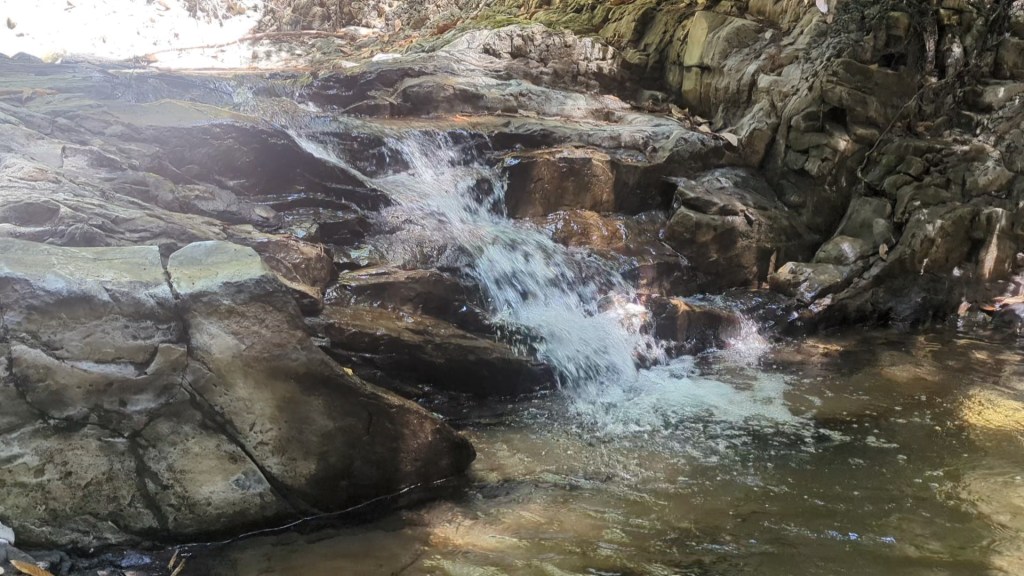
Life was very different where I lived in town in the 1990s. I miss that neighborhood and my garden there very much. However, it was an urban neighborhood, only a few blocks from the interchange of Highway 17 and Highway 85. My neighbors had me build a small solar powered fountain adjacent to a patio of our apartment building to obscure the ambient urban noise. I thought it was a silly component of the landscape, but everyone else was fond of it. Well, sadly, I left that home and garden many years ago, and relocated to a quieter neighborhood a few miles away. Except for a few lights at night on distant hillsides, I can see no other households. I do not hear much more from them than I can see. Air traffic to and from Mineta is the most traffic that I notice, if I notice. In fact, the noisiest noise in my garden is from this creek that flows through it. I flows all day at night, so does not stop when the sun goes down. I can not unplug it. It gets louder during winter. Perhaps I should build another solar powered fountain to obscure the noise.
Squirrels are annoying. I do not care that gray squirrels are native, or that their ancestors were here before mine. They are still annoying. They ruin bulbs, seedlings, fruits, nuts and vegetables. Although I do nothing to exclude them from my garden, I do not want them there.
Some native vegetation is also annoying. It grows like weeds where I want other vegetation to grow. Like for squirrels, I do not care if it is native. It is still annoying, and I do not want it trying to infest my garden where I grow vegetation that I want to grow.
I have been told that native species can not be invasive merely because it was here before I was. That is completely false. If it aggressively invades my garden, then it is invasive. Claiming otherwise is comparable to claiming that I can move into any home here that I choose simply because I am native.
Everyone who lives here inhabits space that was formerly occupied by native flora and fauna. So does all the infrastructure. Anyone who disapproves should leave, and relocate to where they do not occupy space that was formerly occupied by native species. I do not know where that is, but perhaps they do.
Realistically, I do my part. I live very simply, in compact and minimally consumptive homes. Although I enjoy gardening, I do not use much more space than is necessary to sustain my simple lifestyle. I do not live so simply because I would feel guilty about living more lavishly. I do so because it appeals to me, and allows me to feel less sheltered from the same sort of nature that some might accuse me of being inadequately protective of. Ultimately, nature does what it wants to here, with or without my assistance.
Horticulture is unnatural. It involves unnatural manipulation of exotic species that were unnaturally imported from all over the World. It provides unnatural irrigation and unnatural chemical fertilizers and amendments. It involves unnatural containment of many plants within unnatural synthetic media within unnatural plastic cans or other containers. It strives to eliminate much of what is natural, such as pathogens and competition. It is ironic that so many believe that a simple but totally unnatural houseplant brings a bit of nature into their particular environment.
Nature, although quite natural, is dysfunctional. It is messy. It is dirty. It is tragic. It is potentially dangerous. It is overrated. Realistically, it is a hot mess of problems. Somehow though, it seems to be appealing.
That is why so many of us strive to incorporate more nature into our respective lifestyles by very unnatural means. We crave a sort of idealized version of what we believe nature should be. It would likely be easier and more efficient to accept such attempts as unnatural, and exclude what nature might try to contribute.
Some are quite happy to live and work in high rise homes and offices with minimal natural influence. They still breathe natural air, and appreciate natural sunlight and the stabilizing effects of natural gravity, but shelter themselves from what is most bothersome about nature outside, such as weather, wildlife and most insects.
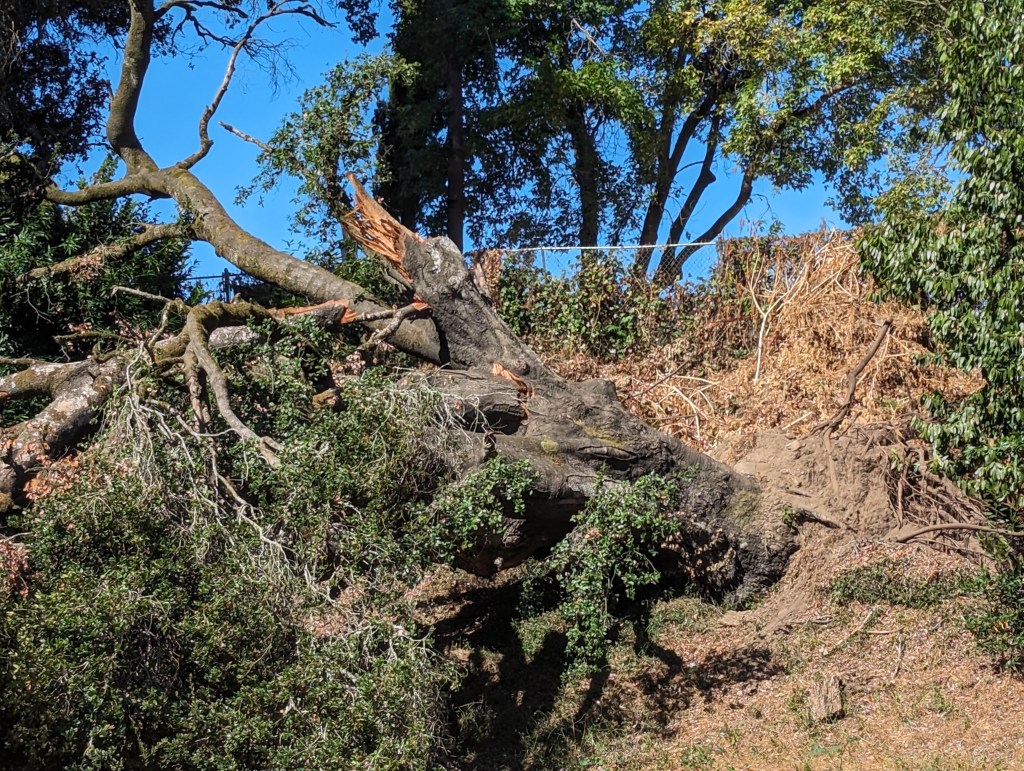
This unfortunate old coast live oak is an exemplary victim of nature. It grew here naturally for two centuries or so. It obtained all that it needed from the natural soil, air and weather. It survived natural insect infestations, and long ago, may have survived natural forest fires. Ultimately though, perhaps in conjunction with a bit of natural wind and natural fungal organisms associated with decay, it succumbed to natural gravity.
This old oak finally succumbed to the same nature that it exploited for centuries.
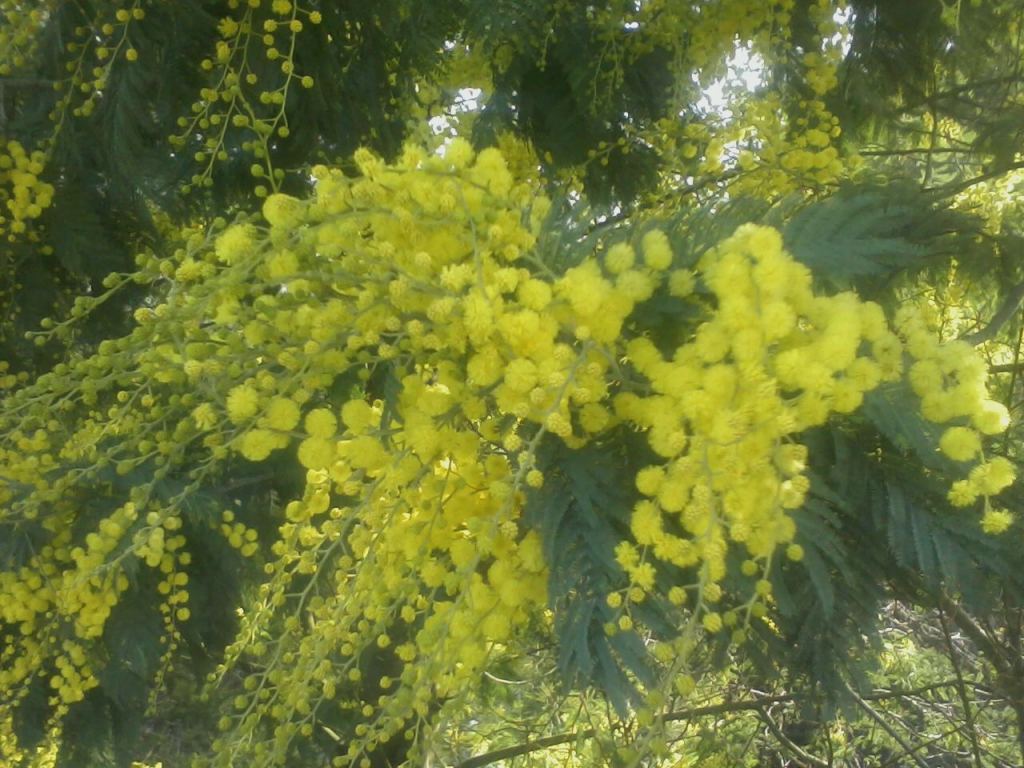
Silver wattle has a weird but effective means with which to clear space for its seedlings.
Why do forests seem to be so peaceful? Perhaps it is because most of what goes on there happens in slow motion . . . very slow motion. It is difficult to see how violent and competitive the various plants are to each other as they grow. Ironically, by bringing the serenity of a forest into our own gardens, we also bring in a certain degree of the natural violence that we are not so aware of.
Vines are some of the nastiest of plants in the forest. Only a few, like bougainvillea, manage to climb to considerable heights by simply leaning harmlessly onto taller trees for support. However, vines like the various ivies and creeping fig, grip tightly to the trunks of the trees that support them. Once such a vine reaches the top of a tree, it develops its own supportive trunk while simultaneously strangling and shading out the tree that supported it.
Some acacias and some willows have figured out how to take out some of their competition simply by clobbering them. For example, Acacia dealbata grows fast and big, but is innately unstable and does not live very long. Old trees invariably fall onto other trees, which clears patches of forest for their own seedlings.
All sorts of cypress, pine and walnut, as well as many eucalypti control their competition by overwhelming seedlings of other plants with foliar debris that leaches herbicidal chemicals into the surrounding soil. Their own seedlings do not seem to mind much, so are able to germinate and grow where space allows.
Monterey cypress, Monterey pine, California fan palm and Mexican fan palm use an even nastier technique, by incinerating their competition during forest fires. They retain as much of their own foliar debris as possible, so that during a forest fire, they burn hot enough to kill other plants and their seeds. Their own seeds though, survive the fire in protective fruiting structures. Monterey pine cones merely get cooked in a fire, and then open to disperse their seed as they begin to cool after a fire.
Like it or not, most gardens include at least some plants that are not as peaceful as they seem to be. Some have the potential to be downright violent. That is why is is important to know how the various plants behave and what they are capable of.
For examples, although bougainvillea can be trained up into arbors and trellises, creeping fig should not be allowed to climb into trees or any structures that might get damaged by its griping and strangling habits. Beards of dead fronds should be pruned from fan palms that are close enough to structures to be hazardous if they burn. Knowing our plants and maintaining them accordingly will promote the sort of harmony that we all want in the garden.
Gardening is quite unnatural. It involves unnatural cultivation of mostly unnaturally exotic (nonnative) species of plants. Irrigation delivers more water than seasonal rain provides. Fertilizers contribute more nutrients than endemic soils provide. Pesticides, if necessary, inhibit proliferation of pathogens. Nature simply could not accommodate such demands.
Not only is gardening unnatural, but it also interferes with established ecosystems. Many aggressively invasive plants were formerly desirable exotic plants that naturalized. Many pathogens arrived with exotic plants. Several naturalized plants have potential to distract native pollinators from native plants that rely on their pollination. It is an ecological mess.
Nonetheless, it works. Gardening within the constraints of nature would be unproductive. Most residents of California inhabit chaparral or desert climates that originally sustained limited vegetation. Such limited vegetation sustained a very limited indigenous populace within relatively vast areas. Modern residential parcels would be completely inadequate.
That is the justification for gardening, whether for sustenance, or merely to beautify home environments. Unnatural breeding continues to improve performance of many useful and appealing plants. Unnatural horticultural techniques generate more desirable vegetation within confinement of urban gardens than would naturally inhabit a few acres in the wild.
Nature remains relevant though. All plants originated within nature somewhere. Besides their basic requirements, exotic plants prefer environmental conditions that are similar to those of their natural origin. Some tropical plants crave more warmth and humidity. Some plants prefer more winter chill. Most popular exotic plants rely on supplemental irrigation.
Physical characteristics of many plants necessitate special accommodations also. Roots of plants that naturally compete in dense jungles are likely to damage pavement. Without adequate pruning, native plants that naturally exploit burn cycles can become perilously combustible. Many vines naturally try to overwhelm nearby vegetation and infrastructure.
Watch your step . . . while there is one to watch!
This is . . . odd. It is like something of the Winchester House. It seems that these steps in the picture above should go down to a lower deck, but there is no indication that there had ever been such a deck down there. The steps are well maintained and swept mostly clean of forest debris, so whatever happened to whatever should be down there must have happened recently.
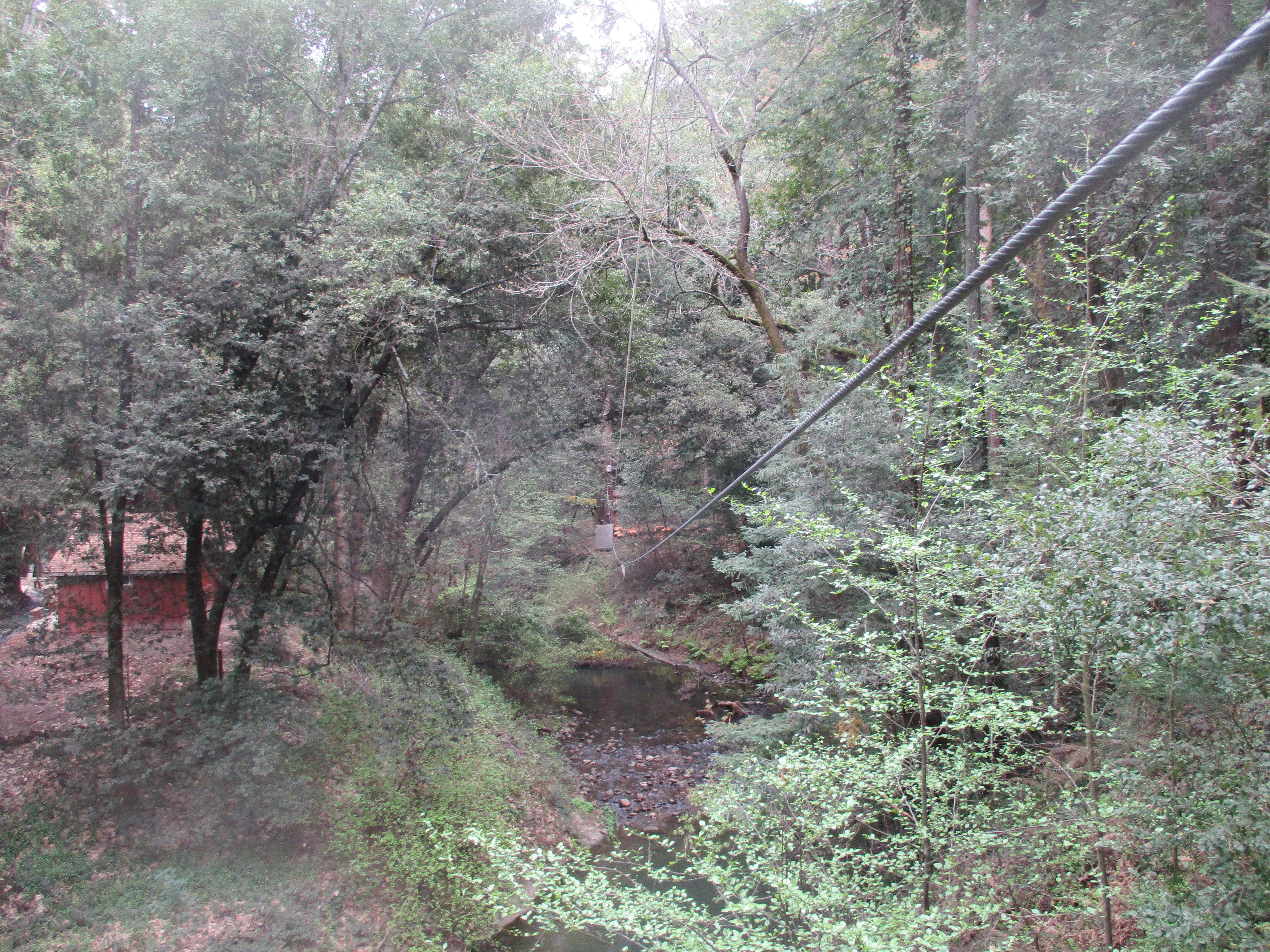
Actually, these steps are for what is above rather than what is not below. The picture below shows that there is a deck associated with these steps, but that it is a considerable distance away, and that the only way to get there is by the cable that extends to it from the upper right corner of the picture, over Zayante Creek. The deck is rather sloped to facilitate arrival.
The cable that extends in the same direction from the middle of the top of the picture is somehow associated with the collective infrastructure, but I do not know how or why. Heck, I do not know how or why anyone would put such a deck so far away while there is plenty of space right here for a luxuriously spacious deck! Apparently, this whole setup is part of a short ‘zip line’ tour.
I don’t get it. It must be fun. It looks terrifying to me. I think that if I were to try something like this, I would rather be terrified someplace with more appropriate scenery, like between the skyscrapers of downtown San Jose! Now that would be RAD . . . and terrifying! In this particular location, I would not want to speed past all this interesting flora without slowing down or stopping to appreciate it.
The lower right quadrant of the lower picture shows young alders. Above and beyond, to the upper right, there are young redwoods with some Douglas firs mixed in. Just to the left of them, at the upper center, is an exemplary bigleaf maple. Most of the vegetation to the left is bay laurels, with some tanoaks, and perhaps madrones mixed in. The undergrowth the lower left is filberts.
I am certainly in no hurry to try this ‘zip line’ tour, and if I do, I seriously doubt that I will be noticing the surrounding flora; not just because of the speed, but because of the terror!
From below, this looks like a shrubby deciduous tree. It is really just a Douglas fir, like those around it. All the defoliated thicket growth is overgrown poison oak. It has likely been climbing the fir tree since it was quite young. Poison oak is not very proficient at climbing bare trunks. It typically climbs into lower limbs, and then into higher limbs before the lower limbs are shed.
No one has bothered to cut this poison oak out of the fir tree because it is not within a landscapes area. That dark margin at the top of the picture is the underside of a bridge, from which, not much of the thicket growth below is visible. The area from which this picture was taken is used for piling greenwaste and parking, where no one is concerned about wild vegetation beyond.
However, now that I sometimes park in that particular parking area, I am finding this mess of poison oak difficult to ignore. There was a similar but even bigger thicket of poison oak up in a redwood tree at the farm, from where it tossed seed into horticultural commodities below. The resulting seedlings added a whole new dimension to weeding the stock. The thicket had to go.
The problem with the thicket in the picture above, although not as serious, is that it too tosses seed into area where people work. Seedlings are likely to grow where greenwaste is processed, and where I sometimes park. Poison oak that grows on the far side of this fir grove will be uncomfortably close to the right field foul line of a ball field that will eventually be restored there.
I have no intention of cutting the poison out of the fir tree. I will merely sever the main trunk at the base, as seen in the picture below. As it deteriorates over several years, no one will mind if it is somewhat unsightly on the industrial yard side. The adjacent fir trees sufficiently obscure it from view from the ball field side. The priority will be preventing seed from proliferating.




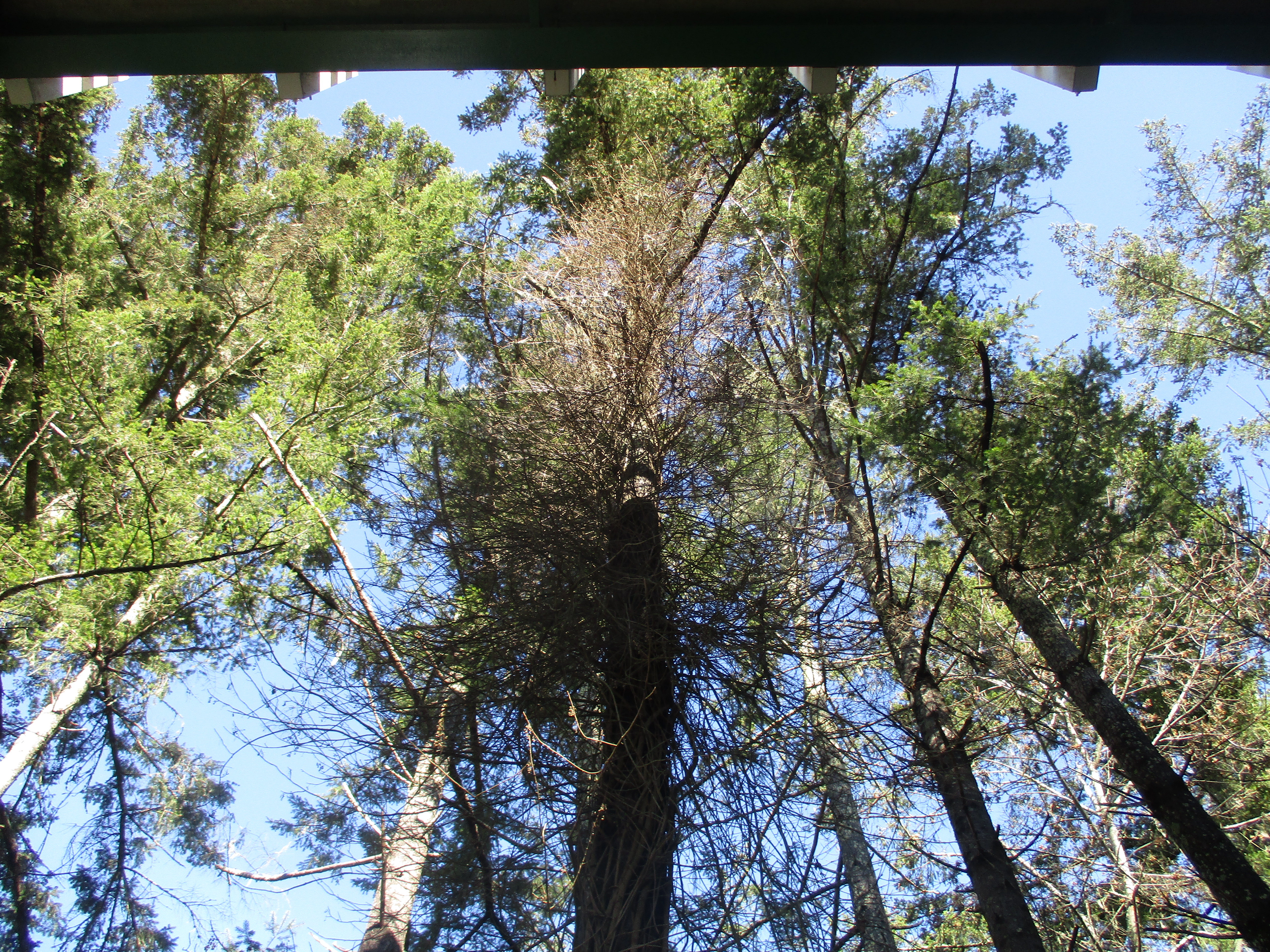 From below, this looks like a shrubby deciduous tree. It is really just a Douglas fir, like those around it. All the defoliated thicket growth is overgrown
 Tony Tomeo