Invasive Weeds Begin Their Invasion

Some invasive weeds are wildflowers.

Wildflowers may not be what they seem to be. California poppy, various lupines, various sages and several others are native species. Saint John’s wort, periwinkle, mustard and several others are not native. They are exotic but naturalized, so can proliferate as if they are native. In other words, several of the most familiar of wildflowers are invasive weeds.

In fact, some of the most invasive weeds were once more popular for their pretty flowers. These includes Saint John’s wort and periwinkle. Pampas grass, various brooms, yellow flag iris and Hottentot fig are more examples. Mustard likely originated as a home garden vegetable. Many grassy weeds were livestock fodder. Not many weeds were accidental.

Nonetheless, invasive weeds are here and established within local ecosystems now. By their simplest definition, weeds are merely unwanted vegetation. Native brambles qualify as invasive weeds as they invade home gardens. Because they are native, though, they are not invasive in the wild. Most of the most aggressive weeds just happen to be exotic.

Invasive weeds become invasive because of their various unfair advantages. Many lack pathogens that limit their proliferation wherever they are native to. Many lack competition from vegetation that they shared their natural ecosystems with. A few may actually prefer local climate to their natural climates. Weeds exhibit too much variety for generalization.

Although, generally, invasive weeds are accelerating their growth with warming weather. Most are proficient at growing faster than their competition and other preferable species. Several bloom and disperse seed before some deciduous species foliate. Weeds exploit resources before desirable species can. Several rampantly overwhelm their competition.

This is therefore a convenient time for weeding, before invasive weeds grow much more. Their roots will disperse more and be more difficult to pull from drier soil later. With more time, most weeds disperse more seed for subsequent generations. Diligence now might not eliminate all weeds for very long, but it helps. Later, weeds should be less abundant.

Periwinkle

Periwinkle is both pretty and a weed.

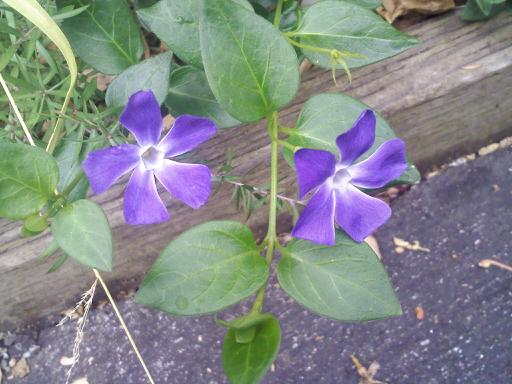
Conflict would likely erupt from any discourse between the city mouse and the country mouse regarding the topic of periwinkle, Vinca major. In rural areas, periwinkle can aggressively invade any area that stays even slightly damp through summer; and it is nearly impossible to eradicate. In urban areas, periwinkle can be a useful and appealing ground cover for difficult situations. It clings to steep embankments, and ventures into shade that is too dark for other ground covers.

Periwinkle can mound up to more than a foot and a half deep with wiry stems and rich green leaves about two and a half inches long. It looks neater and stays lower if shorn or mown down just before new growth develops at the end of winter. Two inch wide sky blue periwinkle flowers bloom mostly as new growth develops through spring, and can bloom sporadically through the end of autumn. ‘Variegata’, with wide white leaf margins, brightens up urns or planters of mixed ferns, and also looks good cascading from planters of mixed annuals or perennials. 

4:00

Mirabilis jalapa is known more commonly as four o’clock. It is spelled with letters rather than as 4:00 with numbers. This refers to the time in the afternoon when its bloom should be at its best. These pictures were taken prior to nine in the morning though. Apparently, it does not adhere to a strict schedule. I took these pictures because I was so impressed with the performance of these particular specimens. Those with yellow bloom above are so large that I came from across the road to confirm their identity. I do not expect this species to grow so large. They are about as big as small oleander! Those with white and pink bloom below are actually the same plant. The species commonly blooms with flowers of different colors, but such colors are typically not so divergent as clear bright pink and clear white. They are more typically blotched with colors of each other, such as white flowers with a few pink blotches in conjunction with pink flowers with a few white blotches. This species is somewhat naturalized here, but politely so. Although it generates copious seed, it is not migrating very far from where it is established.

Perennial Gladiolus

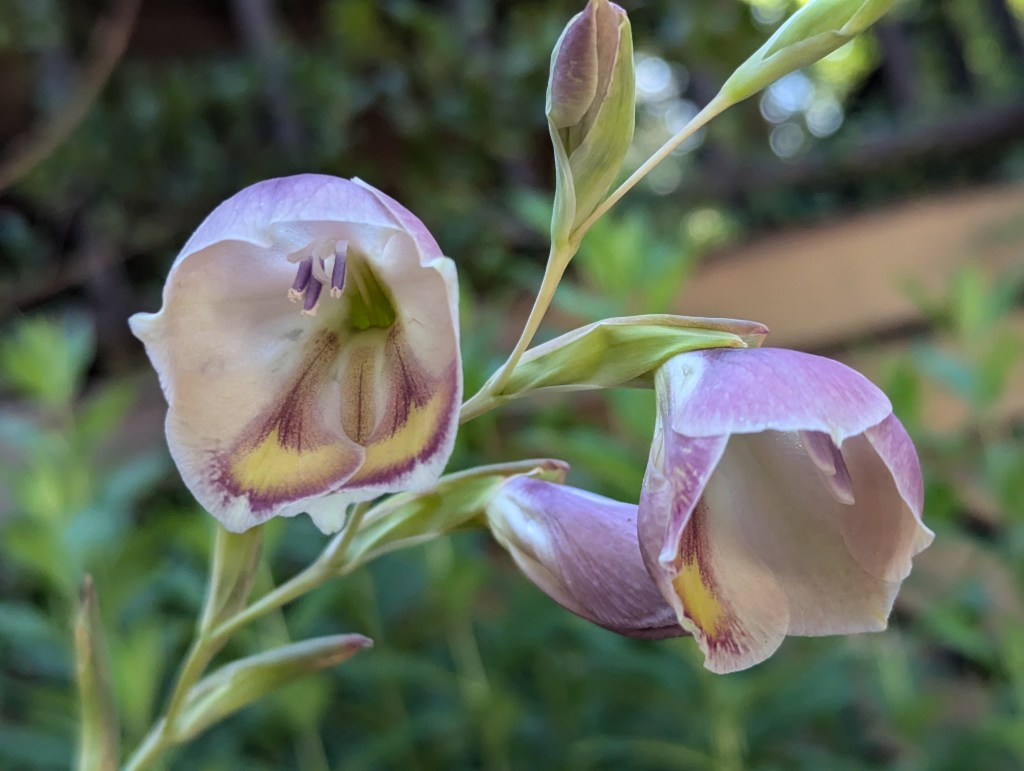
Gladiolus papilio, butterfly gladiolus

Gladiolus papilio, butterfly gladiolus has been performing very well, and, unlike the more common fancy hybrid gladiolus, it has been very reliably perennial. It multiplies and migrates like a wildflower. I know that I brag about it more than I should, and I just posted a picture of it for Six on Saturday last Saturday, but it happens to be one of my favorite perennials now. It was a gift from Tangly Cottage Gardening in the autumn of 2018, almost six years ago. Prior to that, I had been wanting to grow perennial gladiolus for quite a while, although I was not familiar with such species. I was only familiar with the common fancy hybrid sorts, which are generally not reliably perennial. Gladiolus murielae, Abyssinian gladiolus that arrived a few years ago as a gift from a neighbor may eventually inhabit a different portion of the same landscape that the butterfly gladiolus inhabits. It neither multiplies nor migrates as much as the butterfly gladiolus, and is a bit more garish in bloom, but is both reliably perennial and compatible with wildflowers, and technically, is probably more appropriate to that particular refined landscape. Various cultivars of Watsonia, bugle lily, most of which also came from Tangly Cottage Gardening, could also inhabit the same landscape. There is no rush to decide anytime soon, and the refined landscapes at work are constantly evolving. Within my home garden, I can be less concerned with how visually compatible some of such species and cultivars are, and be more concerned with growing what I enjoy. After all, that is how I acquire so many odd species and cultivars with so much history and from so many important gardens, and even from so many natural ecosystems. It is what makes my home garden so important to me.

Perennial Pea

Perennial pea is a naturalized wildflower.

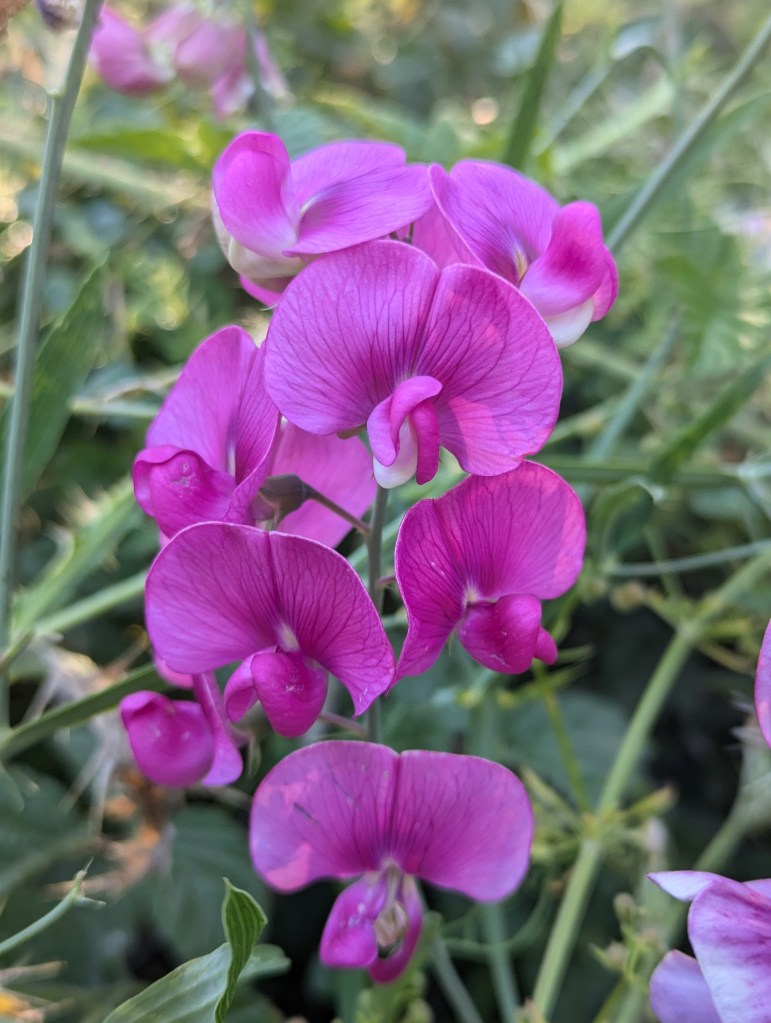
Now that the weather is getting hot, perennial pea, Lathyrus latifolius, is finishing bloom. It needs warmth to bloom, so can begin between the middle or end of spring. However, it shrivels in heat, so can finish between the beginning and middle of summer. Sometimes, it can bloom for almost three months. Sometimes, it finishes almost as soon as it starts.

Perennial pea is more popular as a naturalized wildflower than within home gardens. Its seed is rarely available from nurseries. Young seedlings might not grow very big initially. Mature specimens can vigorously climb and creep more than seven feet in any direction. Their fibrous perennial roots are very difficult to kill. Propagation by root division is easy.

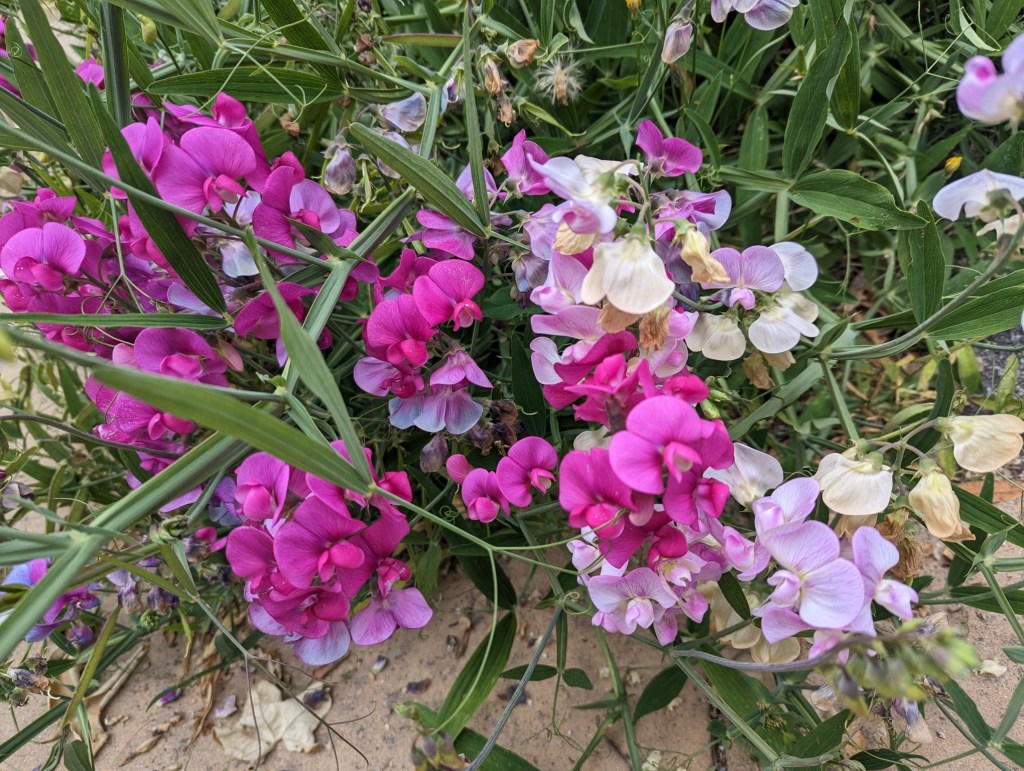
Almost all perennial pea blooms with an abundance of bright pinkish magenta flowers. A rare few bloom with slightly striated light pink flowers. A bit fewer bloom with bright white flowers. Bloom resembles that of annual sweet pea, but is less frilly and lacks fragrance. Slightly bluish foliage and stems have a soft texture, and recover slowly from disruptions. Any parts can be toxic if ingested.

P

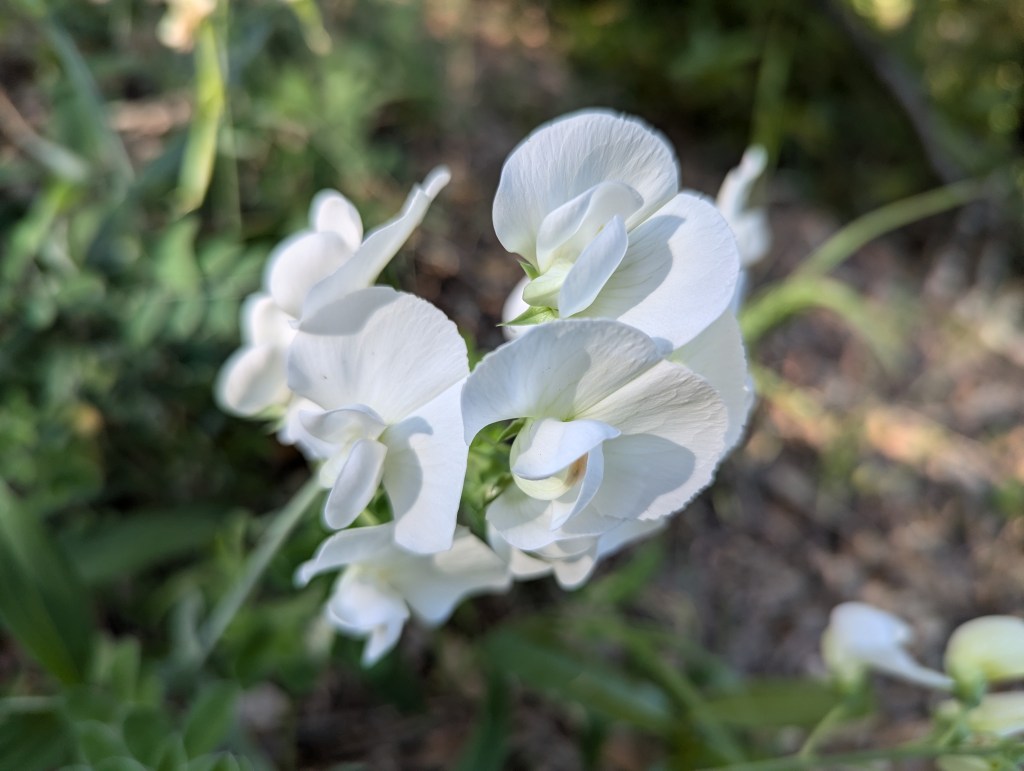
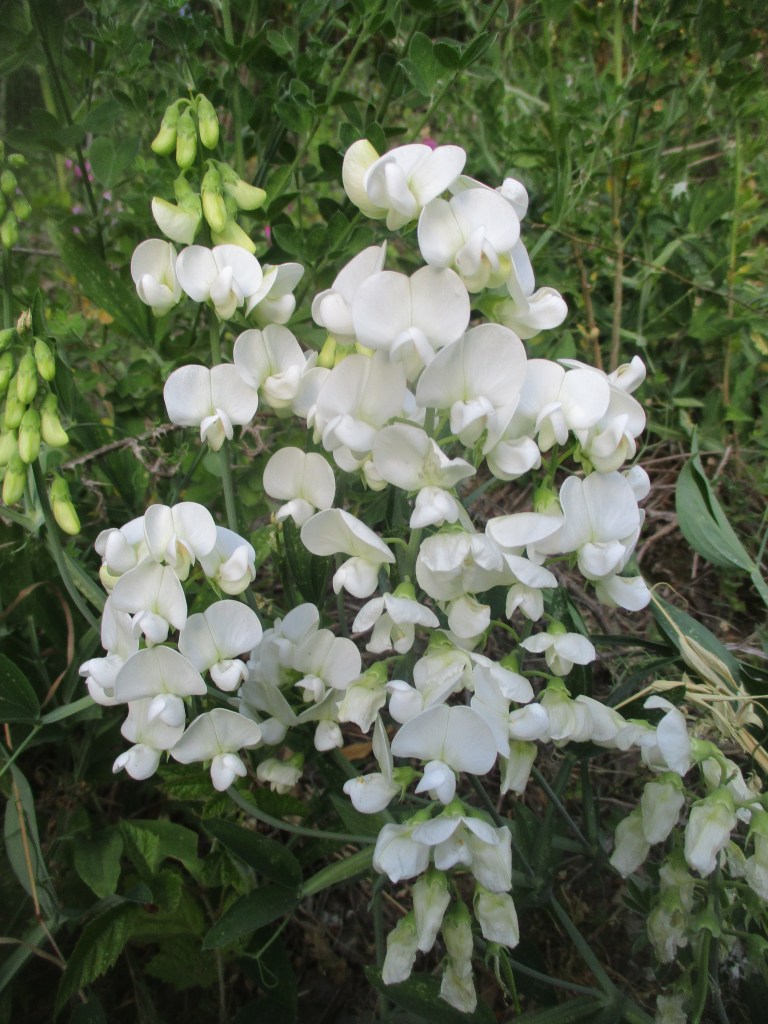
This dinky floral spike was all I needed to identify this as white Lathyrus latifolius.

P is for pea, or more specifically, perennial pea, or Lathyrus latifolius, which does not begin with P, but that is not the point. Perennial pea is a naturalized exotic species here. Within our landscapes, it is difficult to kill. I suspect that it is just as difficult to kill outside of the landscapes, although I have not tried. After all, it is quite pretty, and does not seem to be too invasive beyond situations that it finds to be favorable. Trying to kill what grows beyond the landscapes here would be futile anyway, since there is so much more of it beyond the boundaries of what we have access to. However, I would not want to add any to areas where it is not already established and interfering with local ecosystems. That leaves me with a dilemma. I just acquired a perennial pea that I want to grow more of, but there is no place to grow it. Almost all of the perennial pea here blooms obnoxiously bright purplish pink. Very few bloom lighter pink with a swirly pattern. About as few bloom white. I am told that perennial pea can bloom red, but I am getting to suspect that such red is what I consider to be obnoxiously bright purplish pink. Anyway, I found a perennial pea that blooms white a several years ago, and grew several copies of it. I shared all the copies until none were left. I thought that I could always return to the original source for more. Unfortunately, the source was buried under debris that was removed from a mudslide two winters ago. What a bummer! I had been watching for white perennial pea since then. Then, last Wednesday, I saw it! It was not much, since only one floral stalk was beginning to bloom, but it was enough for identification. I got a good bit of its upper taproot and stems for many cuttings. The base of the taproot remains as a more permanent source if I need it, and if nothing happens to it. I am so pleased with this acquisition, even though I have no idea of what to do with it, like so much of what grows out there.

This is a better picture of the original stock from three years ago.

Butterfly Amaryllis

Hippeastrum papilio, butterfly amaryllis is an uncommon and weirdly epiphytic amaryllis. It may not be as pretty as the countless more colorful hybrids of the genus, but it is more reliably perennial. All of the few specimens that I have observed within home gardens are potted or in the ground, either because they are easier to grow that way, or because those who grow them are not aware that they are epiphytic. After all, that is quite weird.

This specimen, from my Six on Saturday post earlier this morning, is blooming in Brent’s garden. As I mentioned earlier, Brent did not know what it was when he acquired it from a neighbor who left it with him when she relocated. I know that it does not look like much in this picture, but that is only because Brent is an idiot, and takes bad pictures. I intend to get a copy of this butterfly amaryllis for my garden, and may try to grow it epiphytically.

I find this species to be more appealing than prettier hybrids, both because it is reliably perennial, and because it is a simple species rather than a hybrid. This is also why I dug a few naturalized Crinum bulbispermum, Orange River lily bulbs for my garden. They are none too pretty, but will last forever. The same applies to Amaryllis belladonna, naked lady, but they are a bit too prolific and common to not potentially qualify as a weed. Their bright pink floral color can be a bit obnoxious anyway. But of course, that is why I was so very pleased to find a bulb that bloomed white, which is my favorite color. It is multiplying nicely here now, just like I know the butterfly amaryllis will once I get a fresh copy of it.

From the Muddy Banks of the Wishkah

Well, . . . it is not exactly on the muddy banks.

Kurt Cobain was here. So was I. That is how I got this picture of this English holly in this awkward situation within Kurt Cobain Memorial Park, on the muddy banks of the Wishkah River. I wrote about other pictures from there at my other presently discontinued blog, ‘Felton League’, a bit more than a year and a half ago. This particular picture was omitted because it was irrelevant to that particular post. It is more relevant to this horticultural blog.

‘From the Muddy Banks of the Wishkah’ is, incidentally, the second album that the band Nirvana recorded without Kurt Cobain.

English holly is more naturalized on the muddy banks of the Wishkah River and throughout coastal regions of the Pacific Northwest than it is here. There are not many ecosystems that it can not migrate into there. Here, it can infest only ecosystems that retain sufficient moisture through summer to sustain it, such as riparian or coastal ecosystems. Even within such ecosystems, it would not likely survive on top of a piling such as this specimen.

Some of the most prominent vegetation of the coastal ecosystems of the Pacific Northwest is surprisingly similar to vegetation here. Douglas fir, which is sporadically native here, is the most prominent species within the forests there. Bigleaf maple is likewise more common there than here. Naturalized Himalayan blackberry is even more common and more wicked there!

However, to me, the entire region seemed to be riparian. Nothing was far from some sort of waterway. I encountered nothing that resembled a familiar chaparral ecosystem. Someone who is more familiar with the region could distinguish between the various local ecosystems. I should be more observant about the diversity of the ecosystems and their associated vegetation, both native and exotic, when I return late next winter.

White Perennial Pea

Bright pink, light pink, but no white here.

Perennial pea is a somewhat naturalized exotic species here. It may not be aggressively invasive enough to be classified as a weed though. However, I would classify some of it that I can not exterminate from at least one of our landscapes as weeds. Once it gets established, it is very persistent.

It seems to prefer to grow on roadsides or fences. It is not so common in flat open spaces. It rarely gets big enough to overwhelm or otherwise damage other vegetation. It dies back when the weather gets too inhospitable for it. It regenerates when the weather is more comfortable.

Perennial pea certainly is pretty. Almost all of it blooms with typical bright purplish pink flowers. A few uncommon specimens bloom with variations of lighter pink. White is even more rare. Only red is more rare than white. I have never seen it growing wild. Although seed for red perennial pea is available, I know of no one who has actually grown it.

Therefore, until someone can prove that red actually exists amongst naturalized perennial pea, white is the rarest color. It might also be my favorite. I can not decide. White is my favorite color. Also, perennial pea happens to look great in white. Yet, the familiar obnoxiously bright pink is so typical of the species. It is the color that everyone expects to see growing wild on local roadsides.

I was fortunate to find a specimen at work that blooms white. I grew a few copies of it, but kept them canned. I shared some with colleagues in other regions until only two remained here. I was not too alarmed when these last two were overwhelmed by other vegetation and died, since I thought I could grow more copies from the original specimen. That was until I found that the original was destroyed by excavation to mitigate erosion from last winter!

I believe that another specimen that blooms white lives nearby. Its particular colony has already finished bloom for the season. I must therefore wait for it to resume bloom, or look for errant bloom through winter. After getting so involved with it, perhaps it really will be my favorite.

Gaura

Gaura seems to be a wildflower.

Although not native, gaura, Oenothera lindheimeri, can almost naturalize as if it were. All it needs is occasional watering through summer. It performs better with regular watering. Individual specimens live for only about four years. Some may last for only a single year. However, their abundant progeny are likely to replace and perhaps overwhelm them first.

Gaura prefers sunny and warm exposure. Shade causes sloppy form. Naturalized gaura has potential to become weedy or invade other vegetation. Seedlings relocate efficiently. Cutting back old growth as it deteriorates through winter promotes vibrant spring growth. Concurrent removal of the shabbiest old specimens favors vigorous younger specimens.

Collective growth is mostly less than five feet deep, with wispy and lightly foliated stems. Basal leaves are bigger than tiny upper leaves. Airy flowers are only about an inch wide. Floral color is mostly pale pink. Seedlings of cultivars with white or richer pink bloom are not necessarily true to type. Neither are seedlings of cultivars with richly bronzed foliage. Bloom continues from very early spring until cooler wintry weather.