Redgum eucalyptus is famously adaptable and resilient.
Although not quite as aggressive, sloppy, big or structurally deficient as the notorious blue-gum eucalyptus, the red-gum eucalyptus, Eucalyptus camadulensis, is one of the ‘other’ eucalyptus that give eucalyptus a bad reputation. It is realistically too big and messy for refined urban gardens, and can be combustible if overgrown or too abundant. It is consequently probably not available in nurseries, despite being one of the most common species of eucalyptus (second only to blue-gum) in California. Red-gum eucalyptus has the advantage of being one of the most resilient large scale trees for unrefined or semi-wild landscapes, and works well where it has space to grow in many of the local county parks.
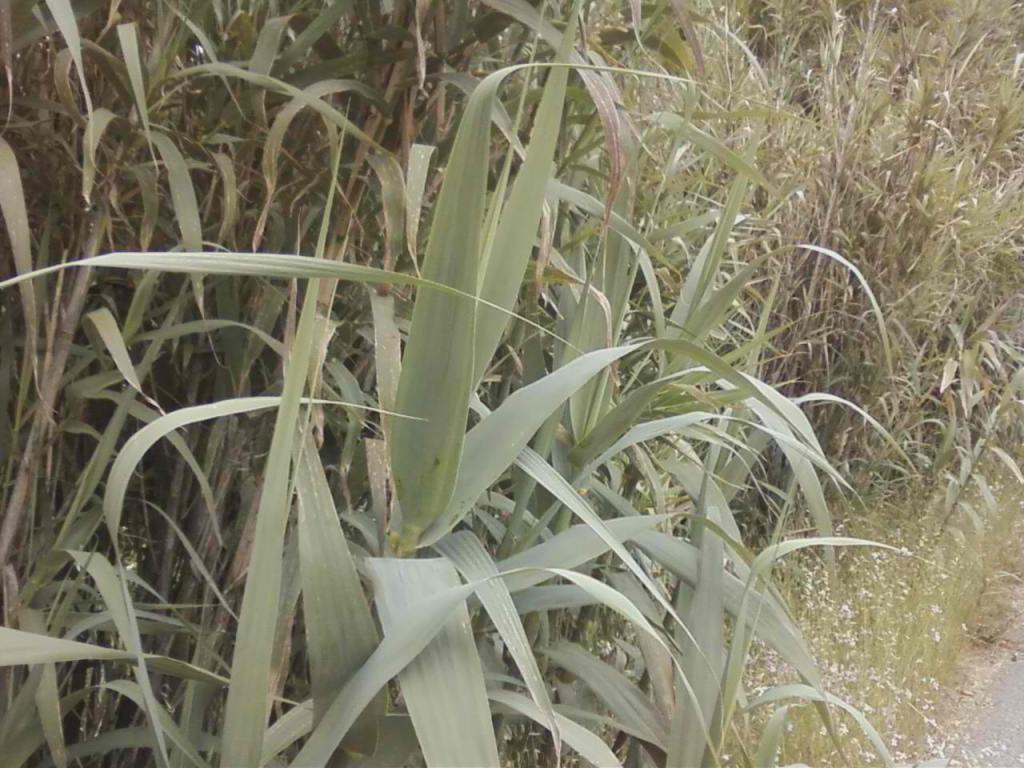
Giant reed is a horrid weed within many ecosystems.
The earliest infestations of giant reed, Arundo donax, that clogged tributaries of the San Joaquin and Sacramento Rivers supposedly grew from pieces used as packing materiel for cargo from China. It was simply dumped into the rivers as cargo was unloaded in port cities like Stockton and Sacramento. How it got to China from its native range in the Mediterranean is unclear.
Because it is so aggressive and invasive, giant reed is almost never found in nurseries. In many rural areas, particularly near waterways, it is listed on the ‘DO NOT PLANT’ list. However, giant reed can sometimes be found in old landscapes where it was planted before it became so unpopular. It can also grow from seed in unexpected places.
Once established, giant reed can be difficult to eradicate or even divide. It spreads by thick rhizomes that resemble the stolons of bamboo, but not quite as tough. It is often mistaken for bamboo. Where it gets enough water, it can get nearly thirty feet tall, with leaves about two feet long.
Where it can be contained and will not become an invasive weed by seeding into surrounding areas, giant reed can provide bold foliage that blows softly in the breeze. ‘Versicolor’ (or ‘Variegata’) has pale yellow or white variegation, and does not get much more than half as tall as the more common green (unvariegated) giant reed. Incidentally, the canes of giant reed are used to make reeds for musical instruments.
It blooms splendidly, and has stayed compact for many years, but I do not trust it.
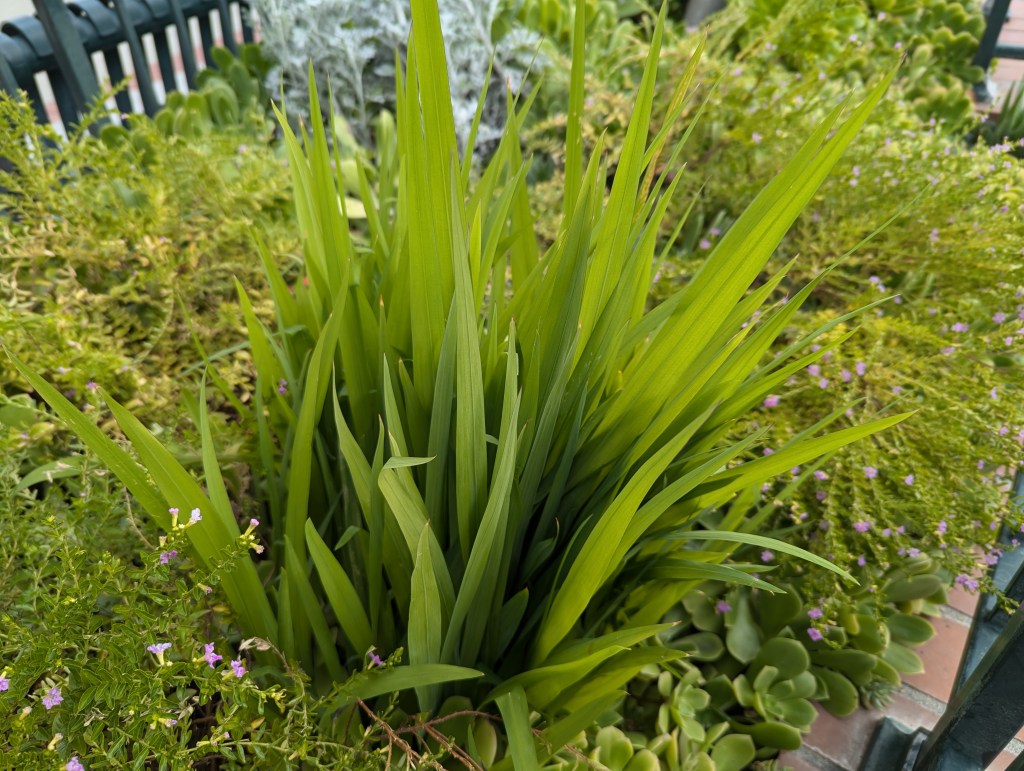
Many exotic species that became aggressively naturalized here escaped from home gardens and landscapes before anyone who enjoyed growing them was aware of how invasive they could be. Although I am aware of this, I was not particularly concerned with it while I lived within a suburban area in town through the 1990s. If I chose to grow something there that had potential to be invasive, it had no place to escape to. I mean that, from my suburban home garden, it could not migrate into a natural ecosystem to naturalize into it. Even if seed from something managed to get into the suburban drainage system, which flows into Los Gatos Creek, it would not be the first. I mean that anything that could naturalize there had likely already done so from seed from the countless other home gardens and landscapes in town. I have not lived within that suburban neighborhood for a very long time, though. I need to be more careful with what I select to inhabit my home garden. For example, the yellow flag iris and montrebetia that I enjoy growing at work can not inhabit my home garden, from which each has potential to escape and naturalize into the wild. The montbretia seems to be sterile and noninvasive, and I have been acquainted with it since childhood, but I just do not trust it. Another variety of montbretia that has inhabited my downtown planter box since before my time, and that I have been acquainted with for many years, also seems to be sterile and even less invasive than my first variety. After all this time, it was tediously slow to migrate outwardly, and provided me with only a few spare bulbs. Nonetheless, I can only enjoy it within the confinement of the downtown planter box.
As their coarse, foot wide basal clumps of foliage turn yellow and start to die down, the solitary two foot tall stalks of money plant, Lunaria annua, develop open clusters of flat, inch wide seedpods that resemble coins. The thin outer casing and seeds within fall away as soon as these coins ripen, leaving tan, tissue paper thin discs that are ideal for dried flower arrangements. Seeds self sow reliably enough to naturalize where conditions are right, but not aggressively enough to be noxiously weedy. Money plant does not need good soil, and wants only a bit more water than related mustard and wild radish. Their small, purple or white flowers that bloom in spring look like radish or mustard flowers but are not as colorful.
Saint John’s wort is the common name of a few species of Hypericum. Hypericumbeanii sometimes gets the distinction of Bean’s Saint John’s wort. That sounds more like carob, Ceratoniasiliqua, though. Carob is the locust bean that sustained Saint John the Baptist in the desert. Mr. Bean was actually a respected botanist of the Royal Botanical Garden.
This Saint John’s wort is not as invasive as naturalized sorts, but is as resilient. Although rarely available from nurseries, it survives in old and neglected landscapes. Established specimens need no irrigation, but perform better with it. This species is likely rare merely because of its resemblance to invasive sorts. It propagates quite efficiently from cuttings.
Hypericumbeanii is a shrubby species, unlike more familiar ground cover types. It grows about two or three feet tall and wide. Its bright yellow flowers are about two inches wide, and bloom through summer. Foliage is deciduous where winter is cooler. Here, it is likely to linger until spring foliage replaces it. Partial shade is tolerable, but might inhibit bloom.
Most consider nasturtium, Tropaeolum majus, to be a warm season annual. Some might consider it to be a cool season annual. A few press its tender stems into moist soil to root and continue growth as a perennial. Plants that bloom for summer can disperse seed for winter bloom. Plants that bloom for winter can likewise disperse seed for summer bloom.
Because they replace themselves so readily, they may seem to be perennial. In actuality, plants from one season, whether warm or cool, may not last long in the next. Seed might be sneaky about spreading. Trailing nasturtiums might naturalize in riparian ecosystems. Nasturtium seedlings are available in cell packs, but do not grow as vigorously as seed.
Nasturtium bloom is diverse shades and tints of yellow, orange and red. Varieties bloom with particular colors within that range, although few are true to type. Their feral progeny bloom only bright orange and bright yellow. Their tender growth does not get much more than one or two feet deep. Trailing varieties can climb as high as first floor eaves though. Nasturtium leaves are almost circular like those of water lilies.
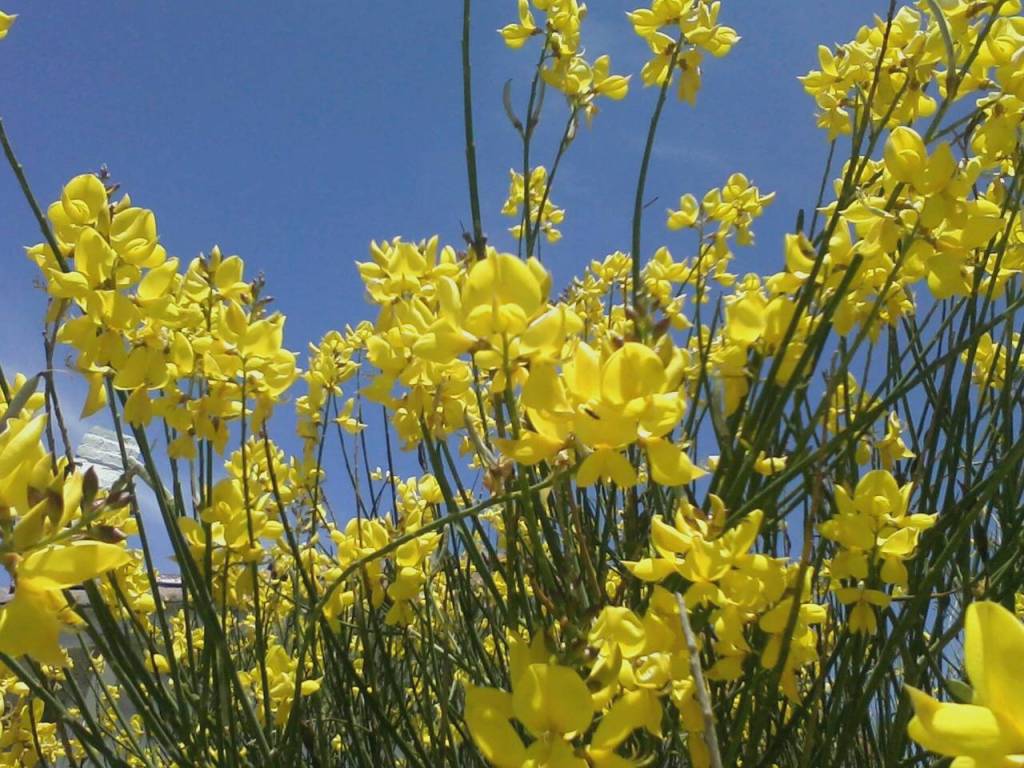
French, Spanish, Mediterranean and common brooms are the most familiar of the brooms because they are among the most invasive and aggressive of weeds in rural areas. Many other brooms (that are primarily within the two genera of Cytisus and Genista) that are tame enough for home gardens unfortunately share the bad reputation, even though many of the modern varieties are hybrids that do not even produce viable seed. Once established in sunny, well drained sites, brooms are not at all demanding.
Broom bloom is almost always bright yellow, although a few varieties of broom have white, pink, pale orange or even purplish flowers. Most have finely textured evergreen foliage. Others are foliated only for a short time in spring before they drop their foliage in early summer to reveal distinctive bare green stems. The most popular modern varieties are fluffy, low shrubs less than four feet tall. Some of the more traditional types get taller than ten feet.
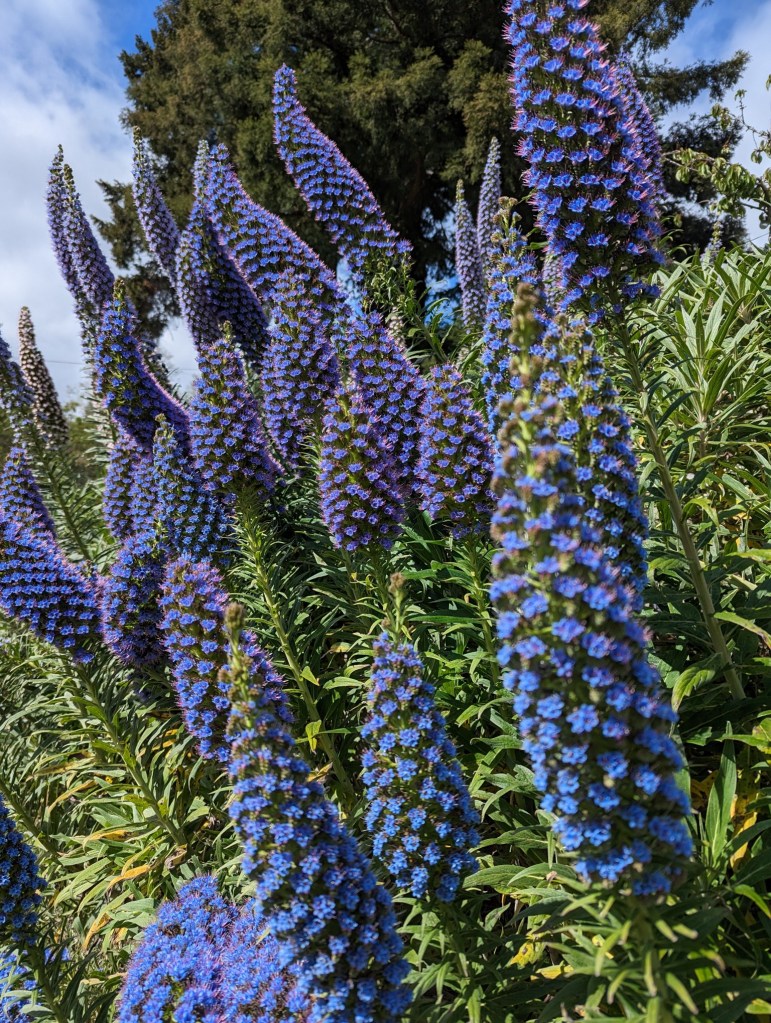
This is most certainly something to be proud of. Pride of Madeira, Echium candicans (or fastuosum), can bloom perfectly blue. Varieties that bloom white or lighter lavender blue are rare locally. Feral specimens might exhibit such floral color variation though. Bloom occurs only annually, but can last through spring. Butterflies and bees are very fond of it.
Pride of Madeira occasionally self sows, but is not too aggressively invasive. It performs exceptionally well within coastal climates. Feral specimens on inaccessible coastal cliffs are only briefly scruffy after bloom. Deadheading within home gardens is tidier and limits seed dispersion. Moderate watering enhances foliar color. Excessive watering rots roots.
Small new specimens of pride of Madeira grow fast, but perform for only about five years. They generally get about six feet tall and eight feet wide. Cool or foggy coastal weather promotes taller and more vigorous growth. Warm exposure might promote more compact growth. The narrow and grayish leaves are rather raspy. ‘Star of Madeira’ is a variegated and compact cultivar.
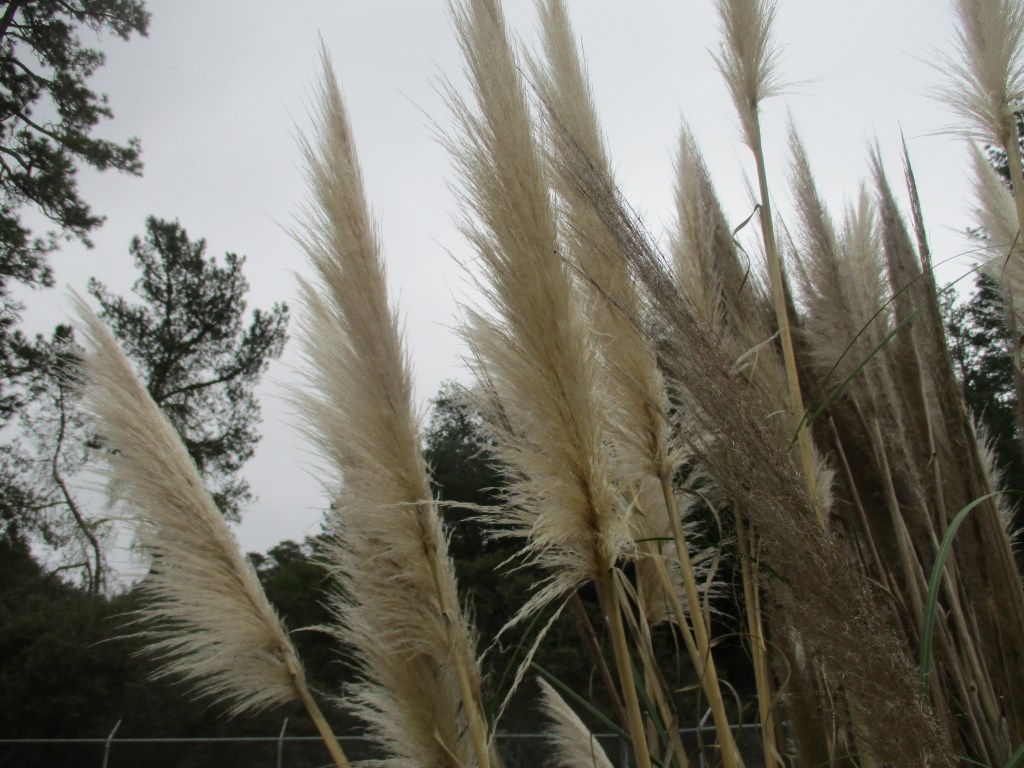
Pampas grass was planted intentionally a long time ago, but then became a weed.
Weeds can be so very sneaky; getting into the weirdest places, and taking on all sorts of forms. They are mostly annuals or perennials that infest lawns and beds, but can be shrubs, vines and even big trees that grow among desirable plants, in untended areas, in cracks in pavement and even in roof gutters and on flat roofs. Many look appealing at first, but then later get out of control and displace the plants around them, or wreck whatever fence, pavement or building they encounter. Heck, I even suspect that it was a weed that stole my neighbor’s Pontiac!
While the soil is still damp from earlier rain, the most common annual weeds that are just developing are easiest to pull. They will put up more of a fight later, after they have dispersed roots, and the soil has gotten a bit more firm. Perennial weeds that were already established before winter will be considerably more stubborn, but not as stubborn as they will be as the soil dries later. Bermuda grass and crabgrass are always nasty.
The biggest, sneakiest and most stubborn weeds are ironically descendents of substantial perennials, shrubs and trees that were once actually planted in gardens. They are sneaky because they look as pretty as their parents when they first appear, in order to dissuade us from pulling them. The problems are that they are often too abundant, and very often get into spots where they will be problematic as they grow.
For example, Acacia dealbata and black locust are rather appealing trees while they are young, especially when they bloom. This is why they were originally planted in local gardens. It is tempting to allow self sown seedlings to grow instead of pulling them when they first appear. However, because they were not actually planted strategically where they can necessarily be accommodated, they grow in random situations, too near to pavement, fences or eaves, or in areas that are already landscaped. As they mature, they can damage these features or the plants around them.
Privet, pampas grass, castor bean and a variety of palms, acacias, ivies and several other plants that do a bit too well in local gardens have certain potential to become invasive or aggressive big weeds. Tree of Heaven, giant reed, the various brooms and the most invasive of acacias have not been available in nurseries for many years because they are so problematic, but continue to be some of the most invasive and aggressive weeds in California.
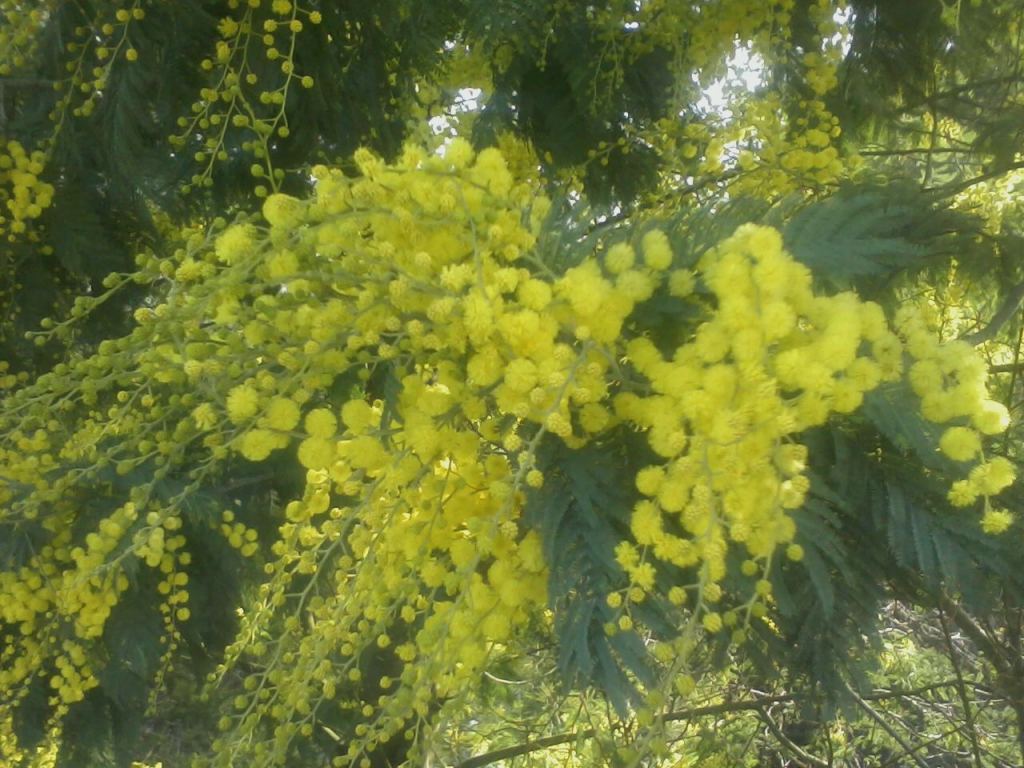
It is an aggressively invasive exotic weed, but at least it is pretty about it.
Some of the worst weeds in California are substantial naturalized trees. The most famous of these is probably the Tasmanian blue gum (eucalyptus), which gets very big very fast, and crowds out other trees and plants in the process. The silver wattle, which is most commonly known locally by the Latin name Acacia dealbata, is even more voracious and prolific. It may seem simple enough to cut down an invading Acacia dealbata before it gets too big, but the seedlings from the original tree may continue to invade unrefined landscapes or wildlands for years afterward.
Even urban Acacia dealbata that lack space to disperse seed are problematic. After only about thirty years, they begin to deteriorate, but can die a slow unsightly death for another ten years! Deteriorating trees are likely to fall without much warning. They can get more than sixty feet tall, and typically fall intact, so can do considerable damage.
The only attribute of Acacia dealbatais that it can be so visually appealing. The somewhat gray, bi-pinnately compound foliage is very finely textured, and provides just enough shade without being too shady. (Bi-pinnately compound leaves are divided into smaller leaflets, which are also divided into even smaller leaflets.) Individual leaves are about three to five inches long. The fuzzy staminate (lacking petals) flowers that bloom in winter are so abundant that most of the foliage is obscured. The floral fragrance that is objectionable to some is appealing to others.



 Tony Tomeo