 Because I sometimes go to Brent’s jobs sites while in the Los Angeles area, people sometimes ask me if I see many famous actors. Well, I try to stay out of everyone’s way, so rarely see anyone at the sites. If I see anyone famous about town, I would not know it. I do not watch enough television or movies to recognize many of them.
However, I did recognize this famous actor from my childhood as the renowned Wile E. Coyote of Looney Tunes. He was just out for a stroll in Franklin Canyon Park in the Santa Monica Mountains above Beverly Hills. It happens to be one of my favorite places in the Los Angeles Area, and has an interesting history.
Even those who have never been to Franklin Canyon Park might have seen it on television and in movies. Franklin Canyon Reservoir was Myers Lake on which Opie Taylor was skipping stones on the Andy Griffith Show. It was also a pond near the Ponderosa on Bonanza, and near where Daniel Boone lived, and on various far away planets on Star Trek. Even the Creature from the Black Lagoon lived there!
There are a few exotic plants that were planted there over the years, and a few that have naturalized. The familiar deodar cedars are of course exotic. So are the few coastal redwoods from farther up the coast. Yet, most of the flora of Franklin Canyon Park is native, and shows what the Santa Monica Mountains were like before the surrounding area became so developed. Large sycamores and cottonwoods live in the riparian area at the bottom of the Canyon. The upper slopes and ridges are much more open, with smaller trees and all sorts of scrub. There were a few toyons, which are also known as ‘California holly’ scattered about. I can not help but wonder if there were more of them decades ago when Hollywood(land) was named after them. I know that there is now more vegetation than there was when fires burned the area more frequently, and some plants are less competitive than others. It is fascinating nonetheless. Sometimes, it can be difficult to imagine that there was ever anything natural in Los Angeles. I am sorry that I have no better pictures.
 Once it gets into a lawn, English daisy, Bellis perennis, can be very difficult to get rid of without leaving bald spots. The thin but tough rhizomes creep along the ground, producing rounded leaves that get no longer than two inches. Mowers barely scratch the surface. English daisy seems to prefer partly shaded areas to drier sunny spots. Although invasive, it can be pretty in informal lawns.
 What an unappealing name! That is probably why so many of us know it simply as ‘wild onion’ or ‘allium’. Few of us bother to get sufficiently acquainted with it to know it by the species name of Allium triquetrum, which is actually not much more appealing than ‘onion weed’. It is not really wild, but has naturalized as an invasive exotic, or in other words, ‘weed’. At least it is a pretty weed.
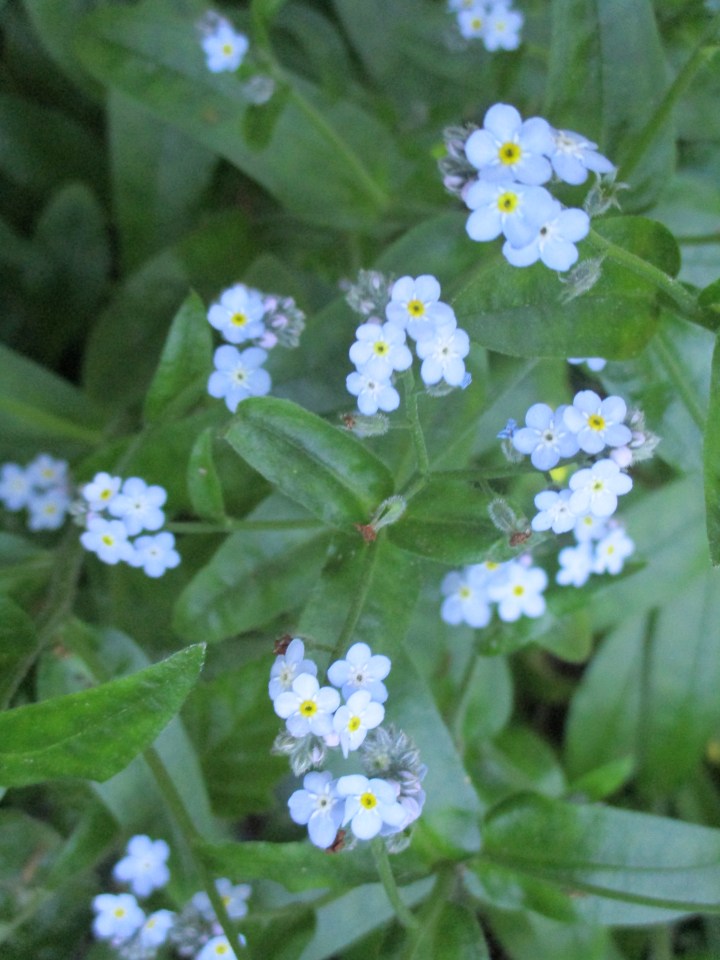 It is not easy to forget annual forget-me-not, Myosotis sylvatica. Even if it dies back early in the heat of summer, it will probably throw plenty of seed to regenerate through next winter, and bloom again by next spring. It can easily naturalize in damp or riparian areas, and might be considered to be a weed; but like nasturtium and foxglove, it is a polite weed that is not aggressively invasive.
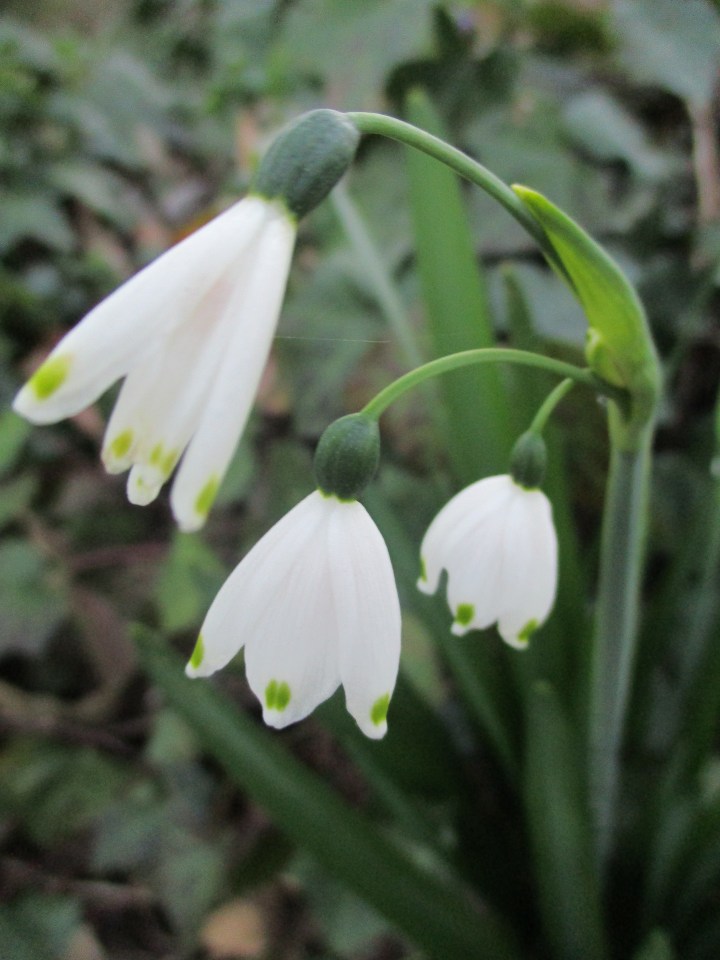 Where winters are more wintry, garden enthusiasts get to brag about their snowdrops as they emerge and bloom through melting snow. Diminutive white flowers against a backdrop of white snow may not look like much to us. We have more colorful flowers through winter, without the snow. Their kind of snowdrops, Galanthus specie, need more winter chill than they would get here anyway.
 Tony Tomeo