Valley Oak

Foggy Oak Morning

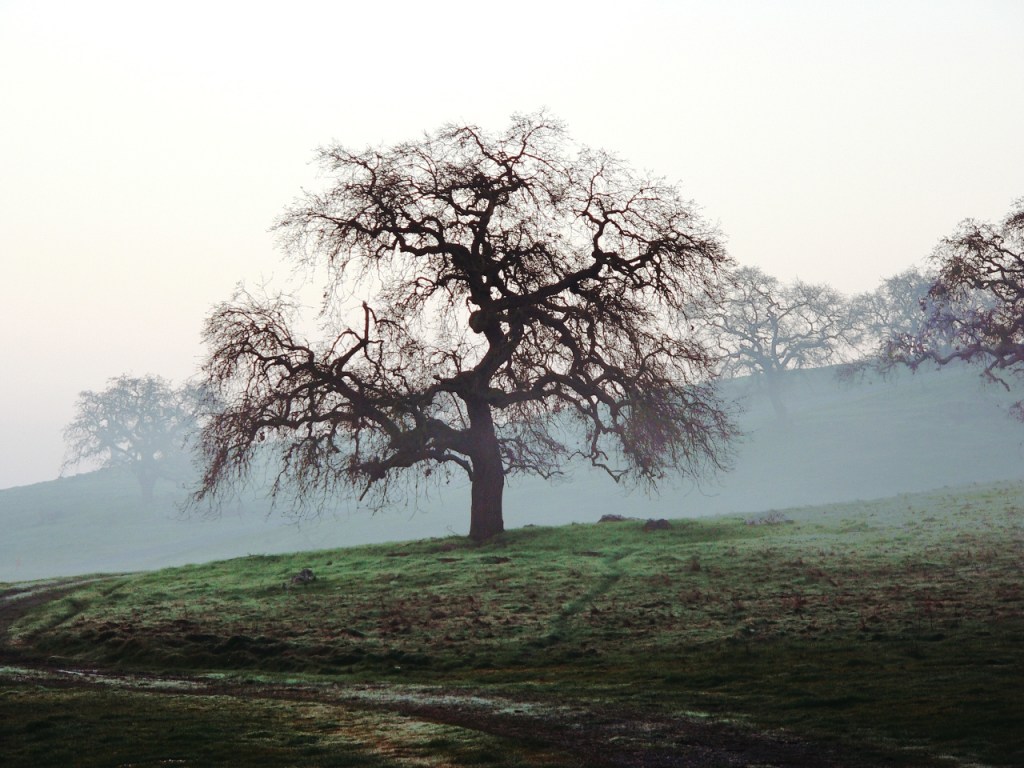
‘Foggy Oak Morning’ by Karen Asherah, is another example of the local scenery that I miss while not taking a bus or walking. I drove past this scene for years on my way to work outside of San Martin without ever bothering to take a look at it. This happy tree is a native valley oak, Quercus lobata, like those that had been common throughout the Santa Clara Valley until only about two centuries ago. It is not exactly the sort of shade tree that everyone wants in a compact suburban garden, but is grand enough for large spaces like parks.

Mature specimens may not seem to get as tall as oaks in the Appalachian Mountains, but are actually the largest oaks in North America, and live more than five centuries. The tallest trees are mostly less than seventy feet tall, but can get taller. Trunks of the oldest trees are commonly six feet wide or wider. The distinctively and uniformly furrowed bark is as classically ‘oakish’ as the rounded prominent lobes of the deciduous leaves, and the sculpturally irregular branch structure. Odd stem galls, commonly known as ‘oak apples’, are home to the larvae of tiny wasps that rely on valley oaks for everything they need. Incidentally, Paso Robles, or ‘El Paso de los Robles’ is named for the valley oaks in the area, which Spanish immigrants thought resembled the ‘robles’, the European oaks that inhabit Spain.

More information about ‘Foggy Oak Morning’ can be found at the website of Karen Asherah at karenasherah.com.

Six on Saturday: This

“This” is the first word of each of these six entries for Six on Saturday this week. There is not much variation among the coast live oak, coastal redwood, California bay, California black oak, big leaf maple and whatever else might be visible in these pictures. Half these pictures happen to feature specific coast live oaks. Therefore, I omitted botanical names. I wanted to show some of what is happening at the new home site, but there is not much to show, and there may not be much to show for a while, except for Rhody.

1. This is where the old home was. The forest wasted no time reclaiming its space. I miss the old home very much, but it was too deteriorated to salvage. I knew it was temporary.

2. This is where the new home will be built. It is less than fifty feet to the west, and faces more to the west instead of south. The upstairs office studio will face into the redwoods.

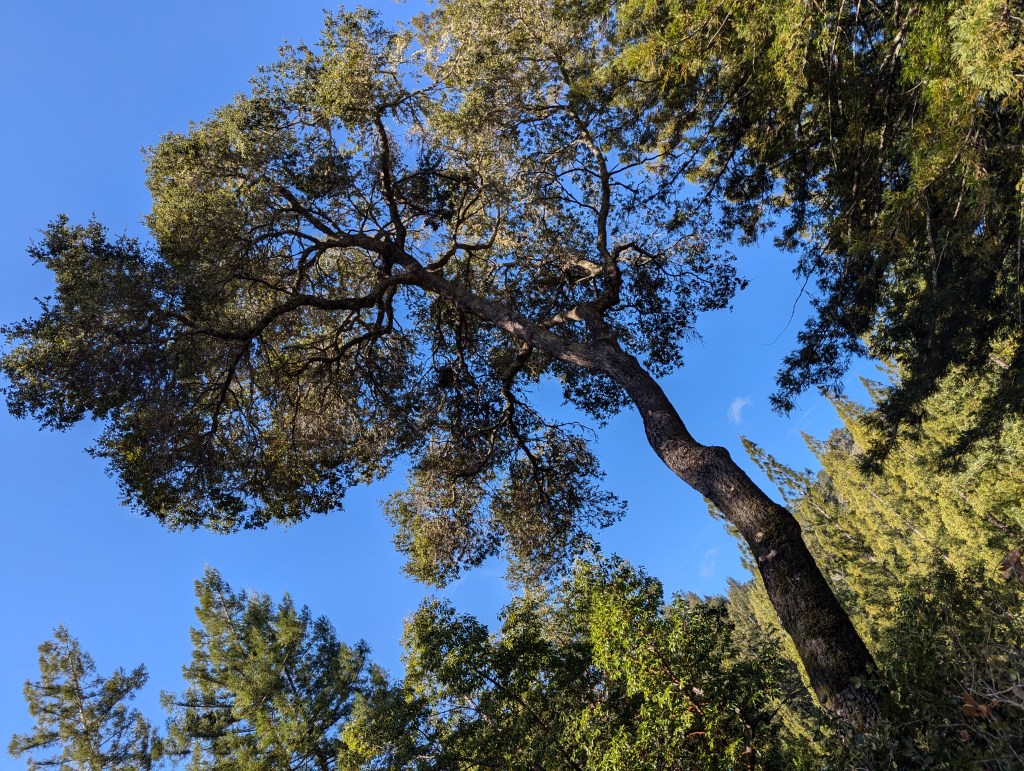
3. This lofty coast live oak stands high over the new home site, but leans to the north and away from where the house will be. It is the biggest of several big oaks in the grove here.

4. This silly coast live oak leans parallel to the driveway. The contrastingly vertical trunk to its right is the same that is on the right border of the first picture of the old home site.

5. This grand coast live oak arches elegantly over the driveway. It can be seen across the upper left corner of the previous picture. It is about perpendicular to the horizontal oak.

6. This is how I manage the overgrown and overly combustible vegetation here. It needs to be planned in accordance with the weather that has been too dry for much too long.

This is the link for Six on Saturday, for anyone else who would like to participate: https://thepropagatorblog.wordpress.com/2017/09/18/six-on-saturday-a-participant-guide/

Messy Mast

This is the mess that remains after acorns get raked or blown off pavement.

Masting is a technique that oaks and many other genera use to both outsmart and exploit squirrels and other wildlife that both consumes and disperses their seed. For several years, oaks here produce enough acorns to sustain a population of squirrels that is limited by their production of acorns. It may not seem to be very effective, since the squirrels consume almost all of the acorns, leaving very few or none to grow into new trees. Then, every several years, the same oaks collectively produce a ‘mast’, which is a crop of acorns that is too excessive for the limited population of squirrels to consume as thoroughly as they typically do. Squirrels instinctually bury many of the surplus acorns anyway. Because they do not return to dig and eat all of their buried acorns, some acorns grow as new trees. This is how the oaks sustain those who disperse their seed, but also get them to disperse their seed without eating all of it. Mast crops of acorns supposedly typically precede exceptionally rainy winters. So far, the mast this year is only coinciding with a messy situation with drippy nut disease. It is caused by bacterial infection of wounds that are caused by filbert weevils, filbert worms or other insects that damage developing acorns. Consequently, squirrels are ignoring many of the unusually abundant but damaged acorns, leaving icky messes of infected acorns and the goo that they exude. When it eventually arrives, the first rain will make this mess even messier. Later rain should rinse some of it away. It is impossible to know how successful this mast will be, since it is impossible to know how many viable acorns will actually contribute to the abundance and grow later, and how many will merely contribute to this unusually messy mast.

Seven Weeks

July 12 & August 30

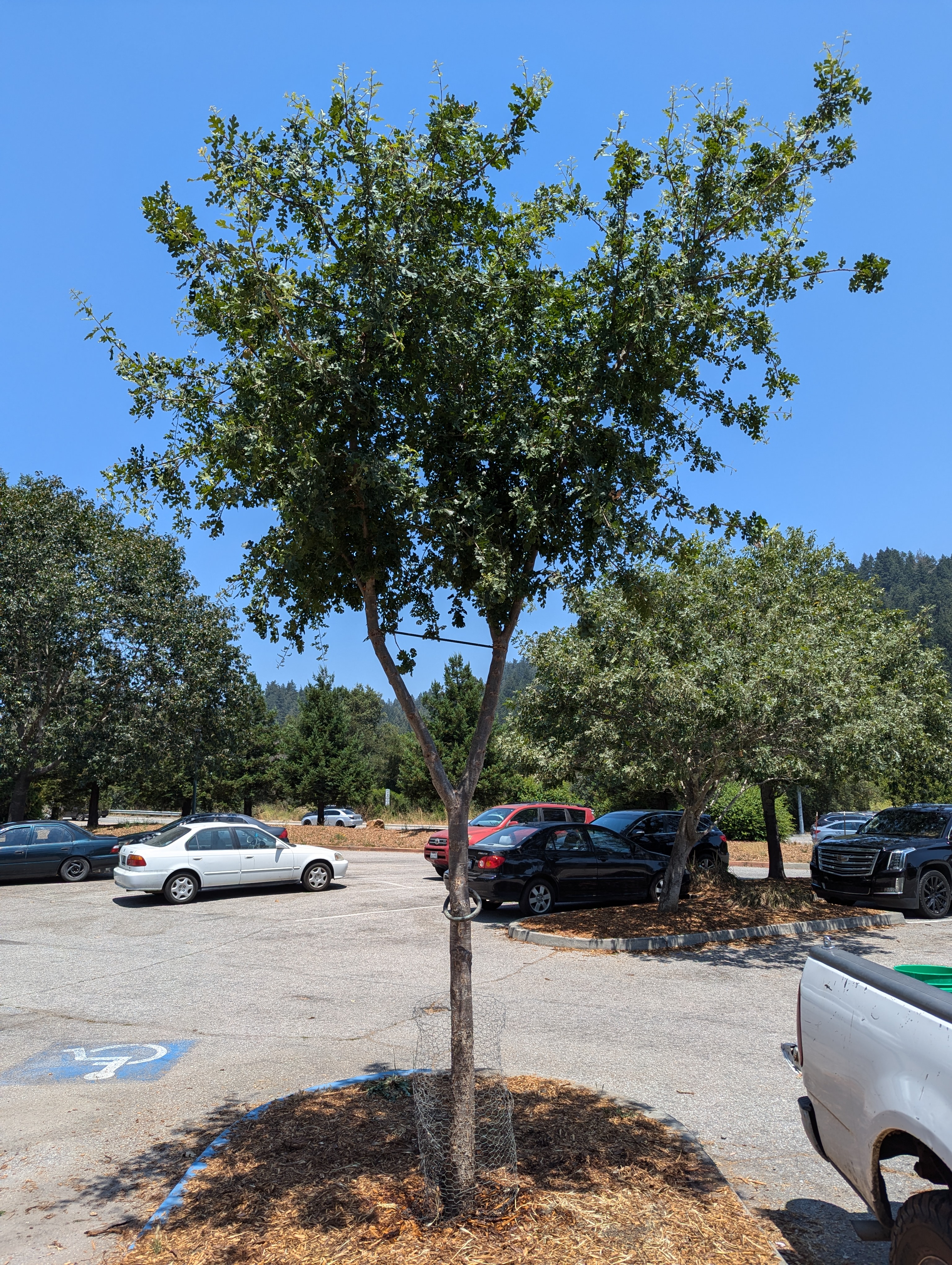
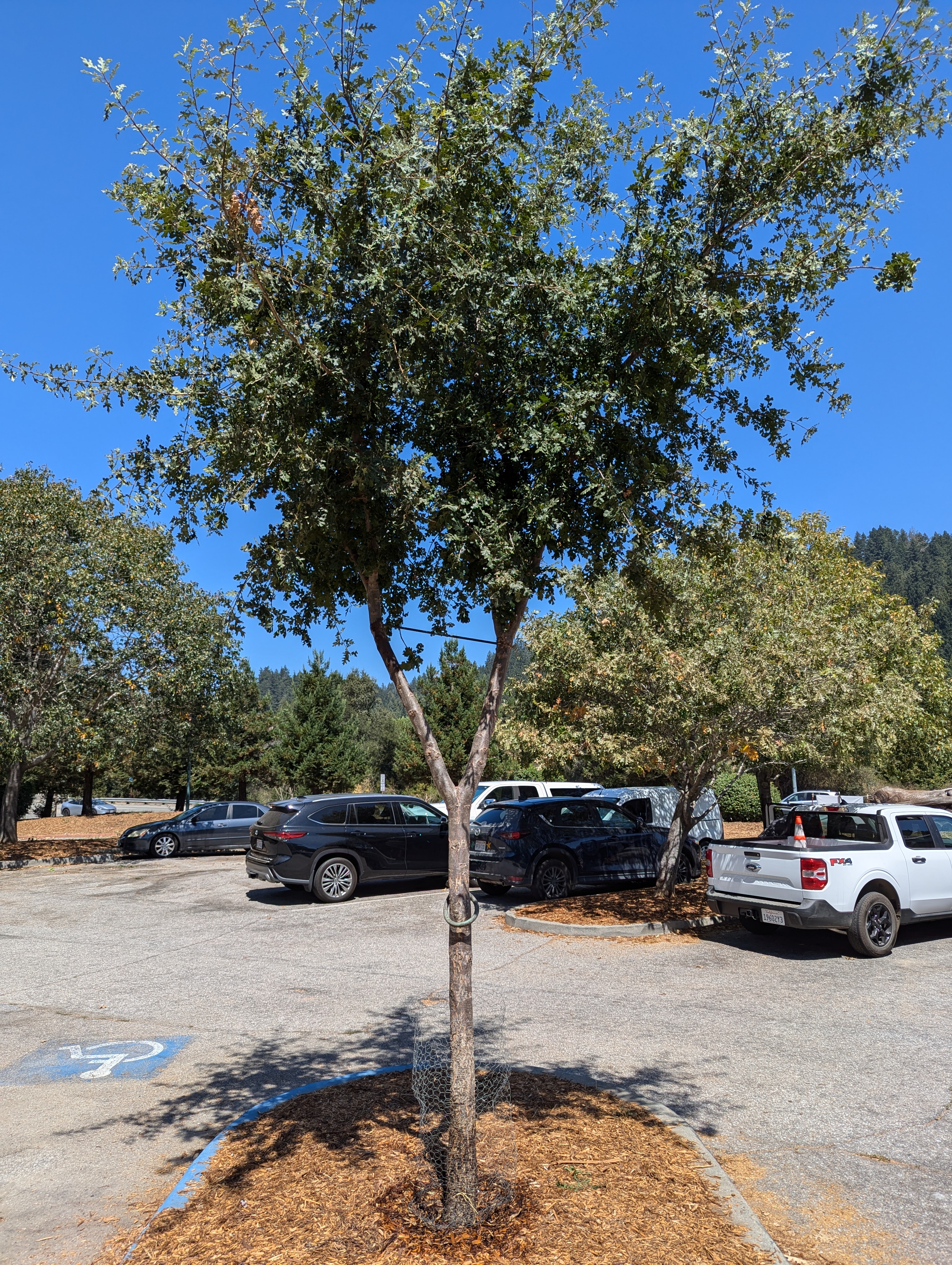
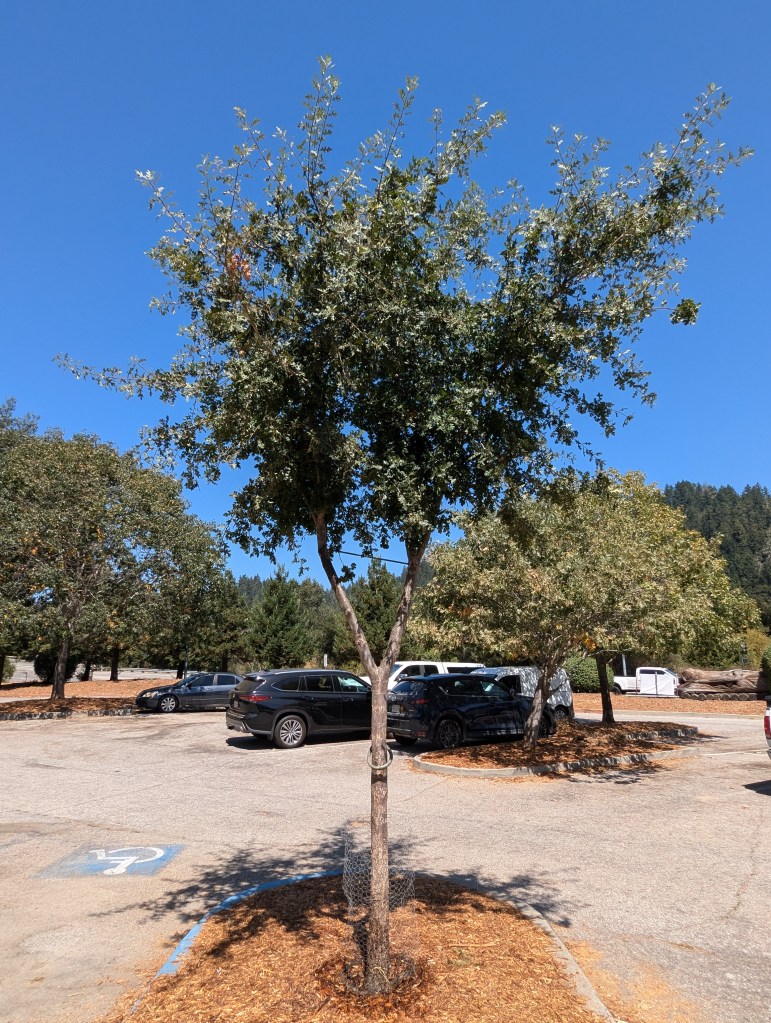
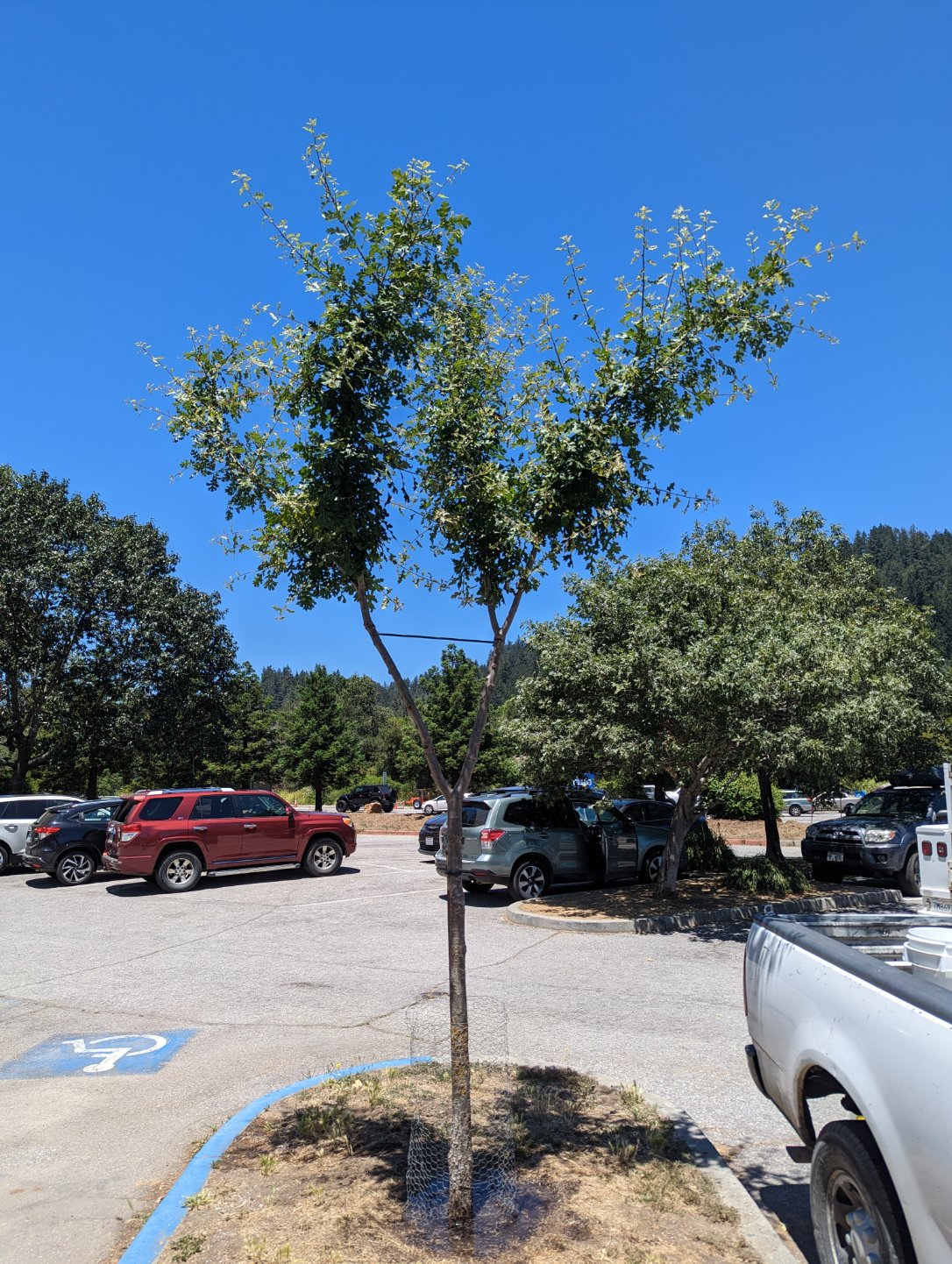
What a difference seven weeks can make! Updates regarding the Memorial Tree in Felton Covered Bridge Park are typically posted annually about the twelfth of July. Growth is obvious after a year. I did not expect it to be so obvious after less than two months between the twelfth of July and the thirtieth of August. I suppose that I should not be surprised. Even after most growth occurs through spring, some growth continues through late summer, and perhaps as late as the beginning of autumn, immediately prior to the slow initiation of dormancy for winter. Specimens of this species, valley oak, Quercus lobata, are innately vigorous and grow faster and more vertically while young. Growth decelerates and redirects itself laterally as trees mature and age. Otherwise, if they continued to grow as vigorously as they do while young, they would collapse from their own weight before they get to be as old as elderly trees get. Some live for more than six centuries, so their technique is obviously effective. Four nearby California black oaks, Quercus kelloggii, are not likely to get to be five centuries old, and are more likely to live for only one or two centuries. Unfortunately, two of them are not in comparably exemplary condition. One must be pruned for removal of major necrosis, and direction of new growth. Another requires major structure pruning. All four should be pruned for clearance above the surrounding parking lot. Perhaps I should be more concerned with these four California black oaks now that the Memorial Tree will need nothing for quite a while. Perhaps I should investigate the condition of the Monterey cypress Memorial Trees within the nearby Memorial Grove, which are growing well enough that surrounding box elders should be pruned away to relinquish more space for them.

August 30 zoomed out

July 12, 2024 – Memorial Tree Update (July 14)

The Memorial Tree is becoming a productive member of its ecosystem!

Every year, there is less to write about regarding the Memorial Tree in Felton Covered Bridge Park. That is because every year, it becomes more independent. It no longer needs structure pruning for clearance above the surrounding parking lot. It no longer benefits from supplemental irrigation. The mesh around the base of the trunk really should be removed. So should the truss between the two lowest main limbs. The stake remains merely as a precaution for strong winds, but is likely completely unnecessary. It can be removed after defoliation next winter. The trunk is quite sturdy. Growth is quite vigorous. The branch structure seems to be rather awkward, but such structure is normal for such young specimens of this particular species, and is very unlikely to compromise structural integrity as the tree matures. The canopy is slightly asymmetrical, but not problematically so. The crew who maintains the park replenishes the mulch within the parking lot island around the tree more regularly than they had in the past, and cuts weeds when necessary. They are very protective of this tree, so pull weeds between the trunk and the surrounding mesh rather than get too close to the trunk with their weed whackers. Recently, a neighbor pulled weeds before weed whacking became necessary. Although oaks can technically bloom and produce acorns after only about five years, almost all delay bloom until they are about twenty years old, and some wait until they are twice as old. A lack of bloom this early is therefore normal. The development of two oak apples was a surprise though. Apparently, an oak apple gall moth considers this tree to be mature enough to sustain its eggs. It is as if this little Memorial Tree is already growing up to become a productive member of its ecosystem!

From the ground, I could not get a good picture of these first oak apples.

Victim of Gravity

Nature is messy.

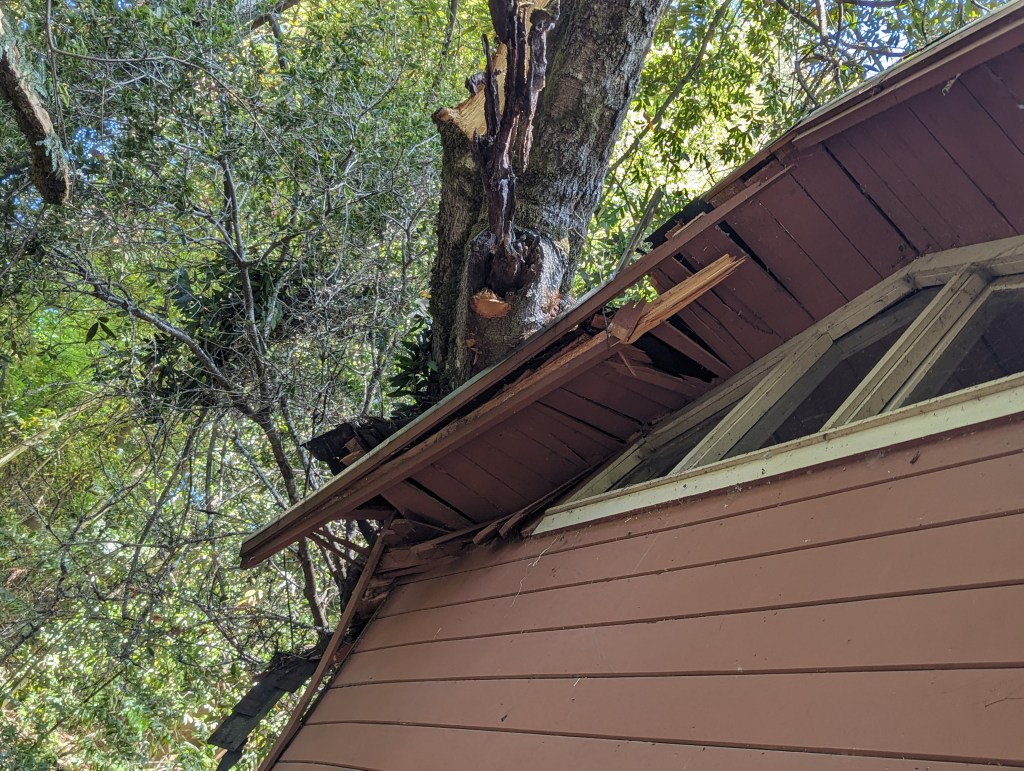
What goes up must come down. This elderly and deteriorated Shreve oak may have taken more than a century to go up, and then suddenly came down within only a few seconds. Unfortunately, it was not at all graceful about doing so, as it landed on this unoccupied cabin and a nearby bay tree. The cabin can be repaired. The bay tree needed to be removed with the fallen Shreve oak. Nature is messy like that. Some might say that it is also inconsiderate. Regardless, it can be difficult to live and work with. Most of our landscapes are adjacent to natural ecosystems. All are dominated by big natural trees, including coastal redwood, which is the tallest species of tree in the World. Even if none of the big trees are directly within some of the landscapes, some of such trees are big enough to drop debris or limbs within landscapes that are significant distances away; or worse, they can fall into the landscapes. As much as we try to limit such risks, nature, besides being messy and potentially inconsiderate, is also generally unpredictable. However, one of only a few aspects of nature that is always reliably predictable is gravity.

Oakland

Oregon white oak, Quercus garryana

Oakland, fifty miles north of here, was named for the oaks that formerly inhabited it. Imagine that! Although valley oak, Quercus lobata, is native, and assumed to be the origin of the regional name, coast live oak, Quercus agrifolia, was likely more abundant there at the time.

Of the many other towns in California with horticultural names, a few are also named for unspecified oaks, including del Rey Oaks, Oakdale, Oakley and Thousand Oaks. Encinitas, Live Oak and the Encino neighborhood of Los Angeles are named more specifically for coast live oak. Paso Robles is named more specifically for valley oak.

Oakland and Oakridge are the only two towns that I could find in Oregon that are named for Oaks. I suspect that Oakland is named for Oregon white oak, Quercus garryana, only because that is the most prominent species of oak there. It is also native here, although I am not aware if I have ever encountered it locally. It resembles small specimens of valley oak, which, incidentally, is also known as California white oak.

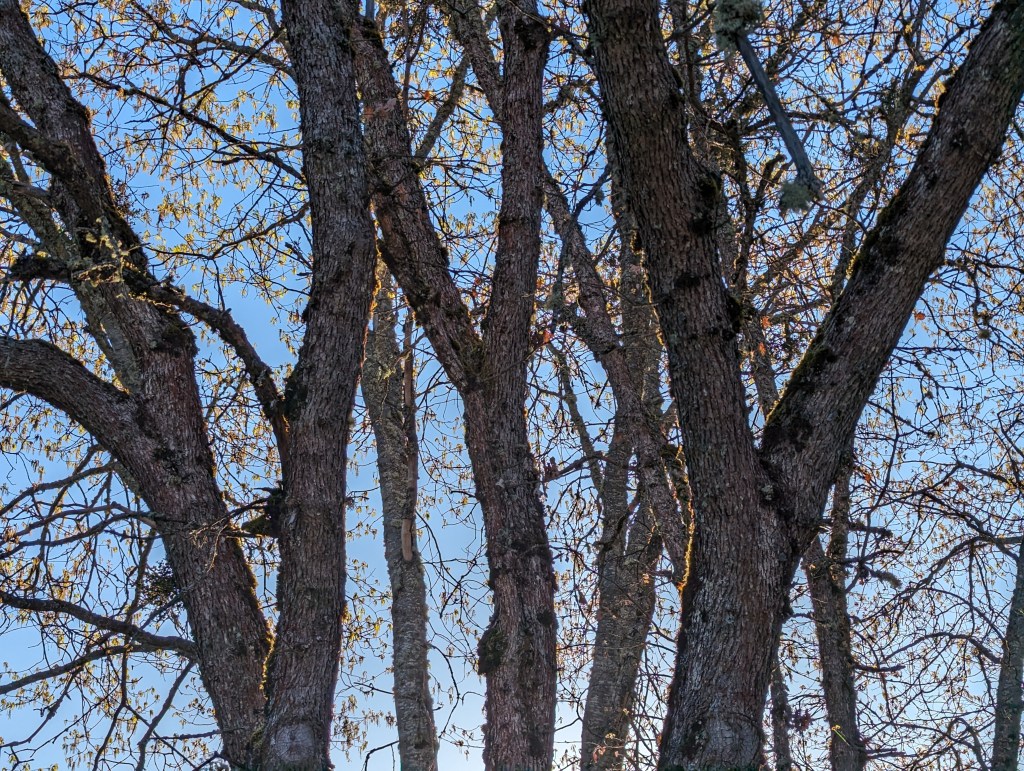
This picture of a few main limbs of an exemplary specimen of Oregon white oak is from Cabin Creek Rest Stop on Southbound Highway 5, just north of Oakland in Oregon. To me, it looks sort of Californian, like something that, a long time ago, was more prominent in Oakland here in California, on ‘the Bright Side of the Bay’.

Valley Oak

Foggy Oak Morning by Karen Asherah

‘Foggy Oak Morning’ by Karen Asherah, is another example of the local scenery that I miss while not taking a bus or walking. I drove past this scene for years on my way to work outside of San Martin without ever bothering to take a look at it. This happy tree is a native valley oak, Quercus lobata, like those that had been common throughout the Santa Clara Valley until only about two centuries ago. It is not exactly the sort of shade tree that everyone wants in a compact suburban garden, but is grand enough for large spaces like parks.

Mature specimens may not seem to get as tall as oaks in the Appalachian Mountains, but are actually the largest oaks in North America, and live more than five centuries. The tallest trees are mostly less than seventy feet tall, but can get taller. Trunks of the oldest trees are commonly six feet wide or wider. The distinctively and uniformly furrowed bark is as classically ‘oakish’ as the rounded prominent lobes of the deciduous leaves, and the sculpturally irregular branch structure. Odd stem galls, commonly known as ‘oak apples’, are home to the larvae of tiny wasps that rely on valley oaks for everything they need. Incidentally, Paso Robles, or ‘El Paso de los Robles’ is named for the valley oaks in the area, which Spanish immigrants thought resembled the ‘robles’, the European oaks that inhabit Spain.

More information about ‘Foggy Oak Morning’ can be found at the website of Karen Asherah at karenasherah.com.
California Black Oak

California black oak defoliates through autumn.

Only a few counties within California lack native California black oak, Quercus kelloggii. Yet, it is not prominent where it is native locally. It generally inhabits mixed forests within the Coastal Ranges. It is rare among home gardens, and rarely available from nurseries. Within the Sierra Nevada, it is common enough to be harvestable as a hardwood timber.

With good exposure, mature California black oaks may get no taller than thirty feet. They can get twice as tall where they must compete with tall trees. The largest trees are higher than a hundred feet. Their elegantly upright trunks are generally less bulky than those of other oaks. Few are more than four feet wide. Gray bark darkens and roughens with age.

The deciduous foliage of California black oak is almost brownish drab green. It becomes brownish yellow prior to defoliation. Cooler weather enhances brighter yellow or orange color, but also accelerates defoliation. Foliage can linger into winter with milder weather. The handsomely lobed leaves are about four inches long, and bigger on vigorous stems. The docile roots are vulnerable to rot with frequent watering.

Rest Stop

Quercus douglasii, blue oak

Rhody, Carson and I took Highway 101 for most of our recent trip from here to the Los Angeles region. We typically drive on more of a variety of highways between here and there, but for this trip, I wanted to drive on Highway 101, as was more typical when I was in college in the late 1980s.

Rhody enjoys rest stops, perhaps as much as our destinations. Because the rest stops near Gaviota remain defunct, only the Camp Roberts Southbound Rest Area was in service on our route. We stopped there, of course.

The old facilities that I remember were replaced years ago. I would prefer the old original buildings. I can not imagine why replacement was necessary. Nor can I understand why the more elaborate associated landscape was necessary. This new landscape, with its cliche crape myrtles, carpet roses and a bit of lawn, is irrigated so generously that the old coast live oaks are deteriorating and succumbing to rot. Most are now surrounded by irrigated lawn, after surviving with only annual rainfall for half a century or so. Like so much about California, not much of the familiar remains.

However, besides the deteriorating mature coast live oaks and a few seemingly younger California sycamores that are also within the landscaped areas, a few familiar native oaks remain beyond the landscaped area. Some seem to be older than those within the landscaped area, and if so, were there prior to the development of the rest stop. Most are coast live oaks, and a few are blue oaks.

I met the blue oak in the picture above in 1985. Although it has not grown much since then, the disproportionately large cavity within its trunk has. I am impressed that the trunk can still suspend the healthy foliar canopy above.