Torch Lily

Torch lily might still be blooming.

Once it gets established in a garden, it will likely always thrive there. Torch lily, Kniphofia uvaria, is as reliable and resilient as lily of the Nile and African iris. It is as easy to divide for propagation too. Mature specimens can survive without any more water than they get from annual rainfall. They might appreciate some through the middle of summer, though.

Old fashioned torch lily blooms for summer or early autumn, so some are blooming now. Modern cultivars are more likely to bloom earlier. Densely conical floral trusses suspend many narrow and tubular flowers. They stand as high as five feet on otherwise bare floral stalks. Dense mounds of grassy basal foliage should grow no more than three feet high.

Flower buds are orange as they begin to bloom, and then fade with age to pastel yellow. Because floral spikes bloom upwards from the bottom, they turn yellow at the base while orange on top. They resemble candy corn. Some cultivars are paler white at the base, or more reddish orange at the tip. Others are uniformly orange, yellow or soft creamy white.
Kaffir Lily

Kaffir lily may look like a bright orange lily of the Nile.

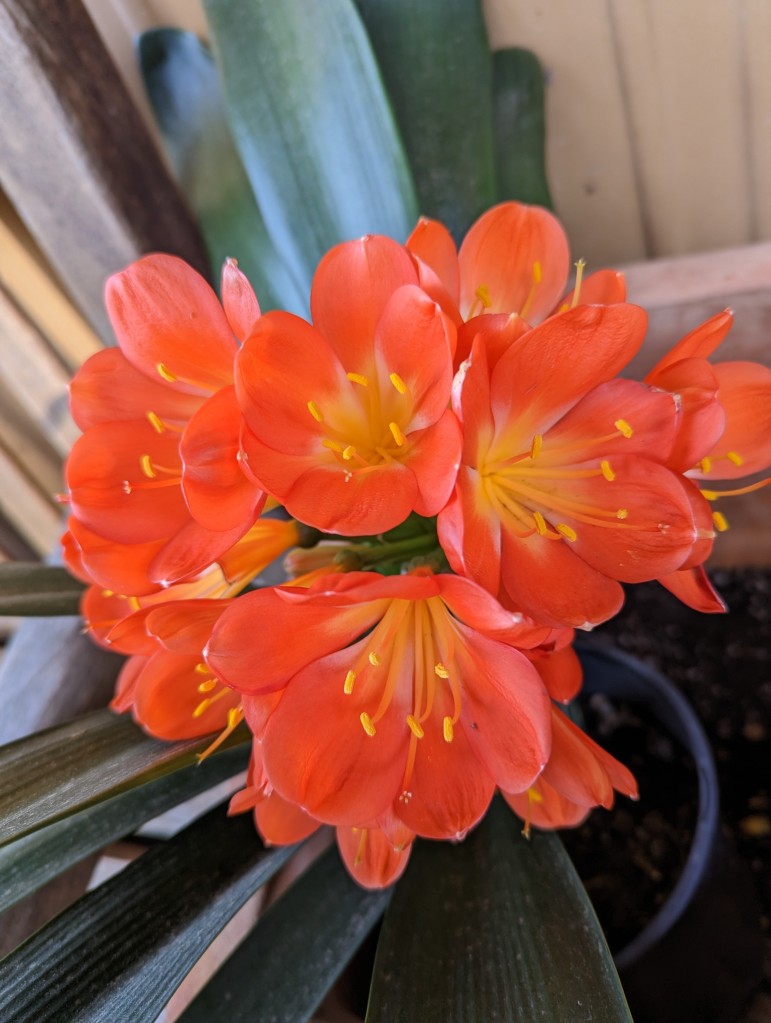
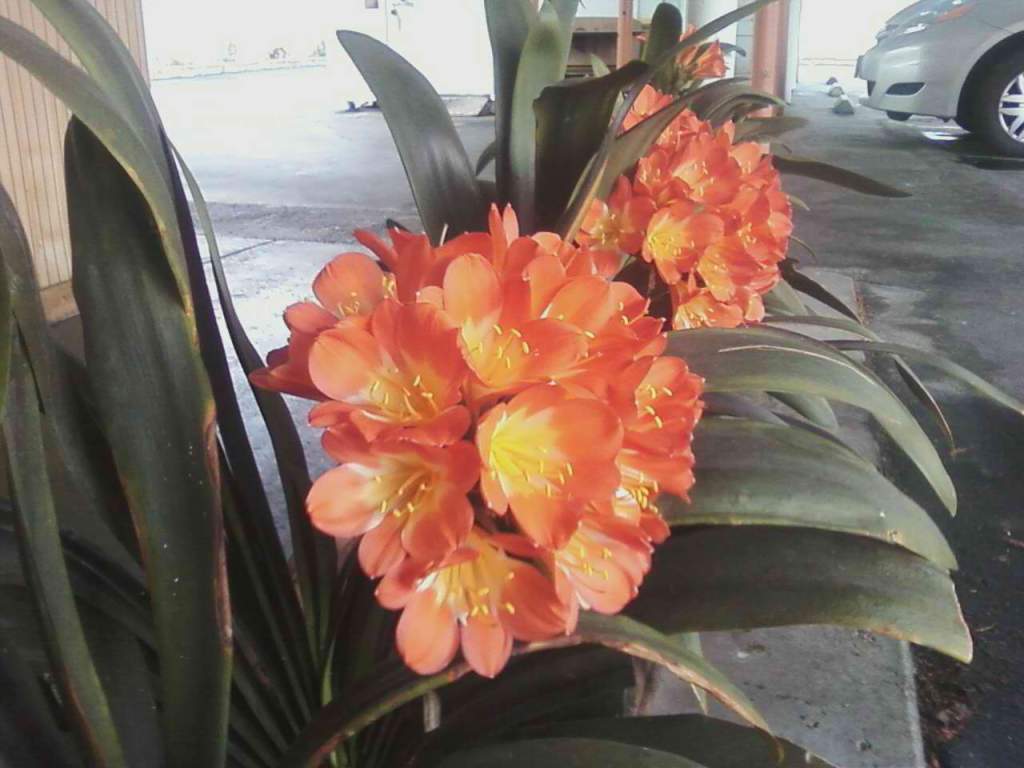
Not much more than a decade ago, Kaffir lily, Clivia miniata, was known almost exclusively for big rounded trusses of boldly bright orange flowers at the end of winter or beginning of spring. Relatively recent breeding has extended the color range to include some softer shades of orange as well as many shades of yellow and reddish orange. Solomone Hybrids are various shades of yellow. ‘Flame’ is brilliant reddish orange. Some varieties bloom earlier in winter. Others bloom later in spring.

Individual tubular flowers are actually rather small, but are clustered like hydrangea flowers on strong stalks that stand as tall as a foot and a half. Bright red berries sometimes appear after flowers fade. The rather rubbery foliage is deep green. The individual strap shaped leaves are rather wide and can be nearly a foot and a half long. Belgian and French hybrids have heftier flower stalks and wider leaves. Established plants do not like to be disturbed, but may get too crowded to bloom well if not dug and divided every few years or so.

Harlequin Flower

‘Tricolor’ (obviously) means ‘three colors’.

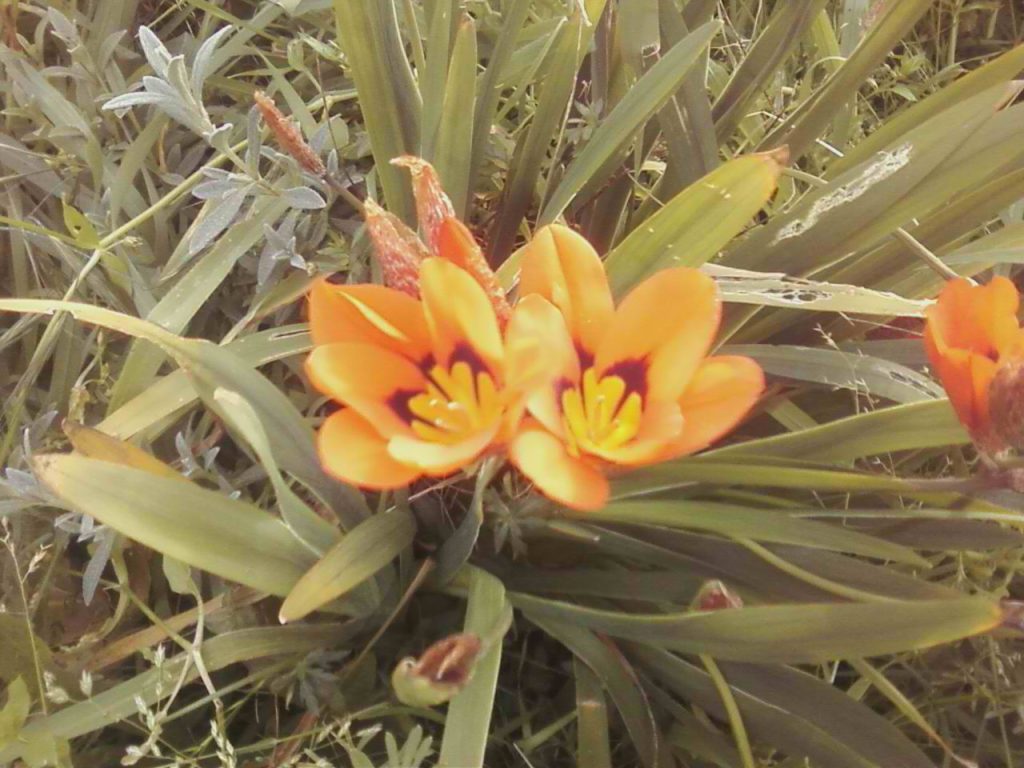
Even though bulbs for harlequin flower, Sparaxis tricolor, are no longer commonly found in nurseries when it is time to plant them in autumn, naturalized bulbs are somewhat common in some older gardens. Where winters are mild and soil does not get too dry and compacted, they are happy to slowly multiply and bloom every spring. They seem to be blooming a bit early this year, since they typically wait until later in spring. The upright narrow leaves resemble those of gladiolus, but get no taller than a foot. Each flower stems rises a bit higher to display a few flowers that are about an inch and a half wide. Each flower has a yellow center surrounded by a narrow rusty brown pattern, which is also surrounded by a third color; which is orange, red, pink or purple.

Lantana camara

The foliage is oddly aromatic.

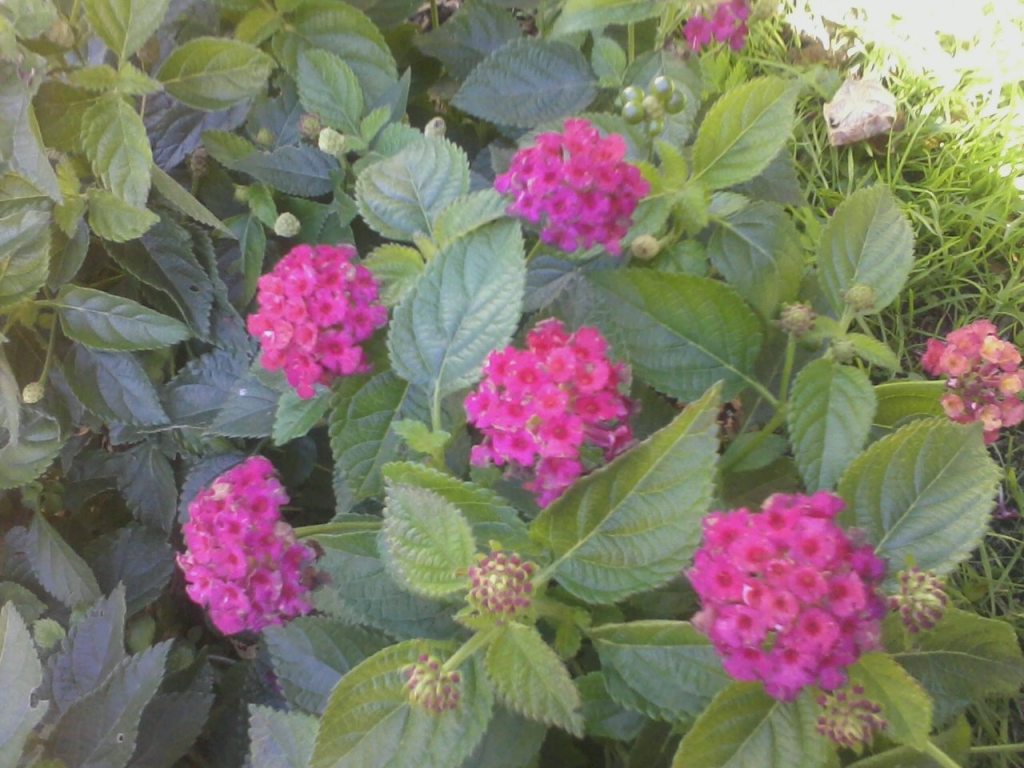
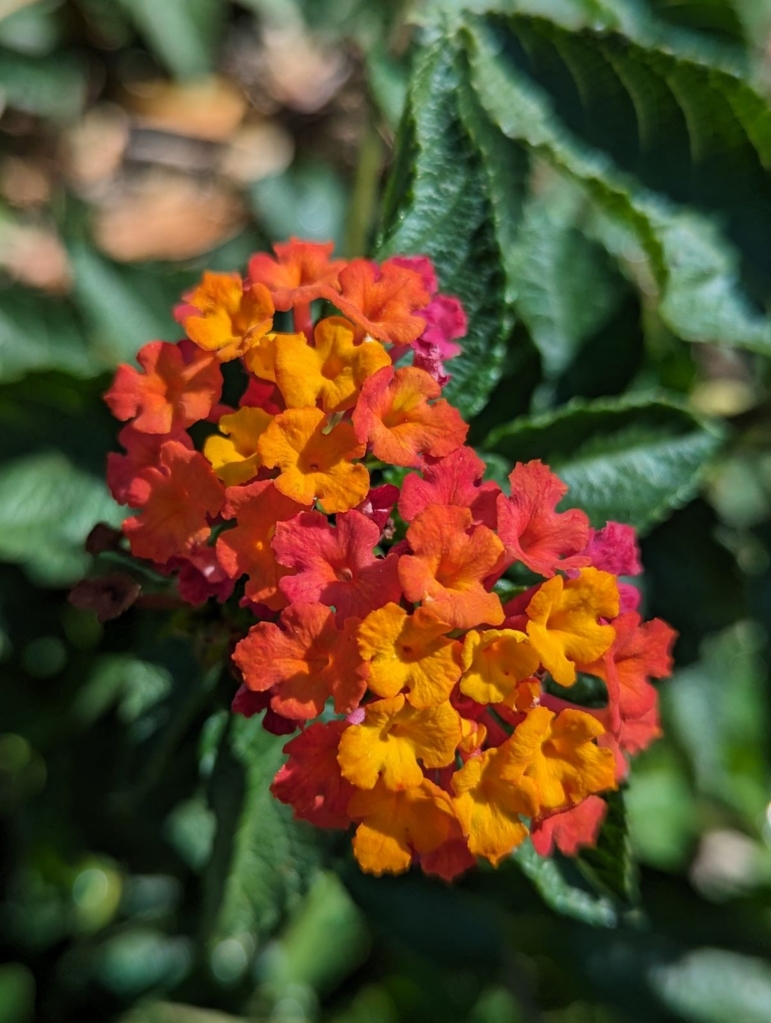
Even as most flowers of summer are finishing, the bright yellow, orange, red, pink and white blooms of Lantana camara continue to brighten gardens until the weather eventually gets too cool and damp for them to perform. This is quite impressive for a species that is endemic to the tropics of Central America, and has a taste for warmth. Blooms are actually one to two inch wide umbels of many small flowers. Individual flowers within each umbel may be different colors at different phases, so that each umbel may have blooms in as many as three different colors.

In the wild, Lantana camara can get almost six feet high and more than six feet broad. Garden varieties are of course much smaller and compact. Since Lantana camara does well in containers, a few cultivars that stay very compact and proportionate to container gardening have been developed, but unfortunately remain somewhat uncommon in nurseries. The potentially objectionably aromatic leaves are about two or three inches long and one or two inches wide, with minor serration and slightly sandy texture. Some dislike the foliar aroma, but many enjoy it.

Lantana camara is not too demanding, wanting only good warm exposure with no more than a bit of shade. Once established, it does not need much water, and can actually rot if watered too frequently, or if soil does not drain adequately. Excessive fertilizer will inhibit bloom. There are not many insects that bother Lantana camara, perhaps because it has an unpleasant flavor. It is actually toxic to animals that may try to eat it. However, butterflies really dig it.

Lantana

Lantana exudes a pungent foliar aroma.

Bloom continues as long as warm weather continues. Within warm exposures within the mildest of climates, it does not stop for long. Within cooler climates, Lantana camara may already be decelerating its bloom. Although remarkably resilient to arid warmth, it can be vulnerable to frost farther inland. Once established, lantana does not require much water.

Umbels of several tiny tubular flowers are about an inch and half wide. Individual flowers bloom progressively inward from the edges of their umbels. They are typically yellow, but then fade to orange, red or pink. Blooms therefore develop yellow centers within orange, red or pink edges. One cultivar is uniformly bright yellow. Another fades to creamy white.

Old fashioned lantana can eventually grow six feet tall. Congested old specimens might respond favorably to coppicing after winter. After coppicing, new growth can grow six feet high within its first season. Modern cultivars are generally shorter and relatively compact, and a few sprawl. Their very slightly raspy foliage is pungently aromatic when disturbed.

Pincushion Protea

Pincushion protea is most certainly distinctive.

Proteas seem to be as happy locally as they are within their native range in South Africa. The Mediterranean climates there and here must be similar. Like most species from such climates, they are quite undemanding. They enjoy sunny and warm exposure with good drainage. They dislike fertilizer and frequent irrigation. Occasional irrigation is tolerable.

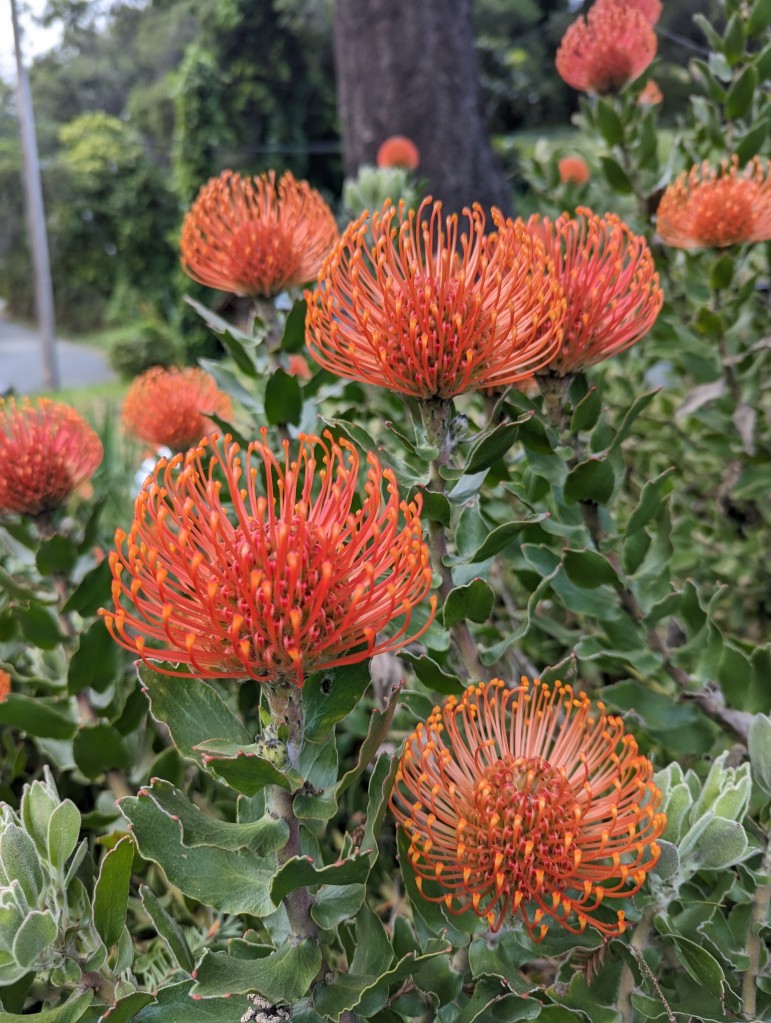
Pincushion protea, Leucospermum cordifolium, is the most popular protea here. Bloom can begin between late winter and early spring, and lasts for weeks. Many are presently blooming. Most are orange. Some are yellow or red. They are excellent cut flowers, both fresh and dried. Each rounded and four inch wide bloom contains many narrow flowers.

Pincushion protea develops stiff branches, but potentially wobbly roots. Sprawling stems that lean onto the ground improve stability. Pruning should remove undesirable stems at their origins, without leaving stubs. Shearing ruins form and texture, and inhibits bloom. Mature specimens can be about five feet tall and somewhat wider. Stiff evergreen leaves are about three inches long and half as wide.

Kaffir Lily

Kaffir lily brightens a shady situation.

Kaffir lily, Clivia miniata, and lily of the Nile seem to be similar but are very different. Both develop densely evergreen mounds of arched strap shaped leaves. Both bloom with many funnel shaped flowers in spherical umbels on upright stems. Even their thick and rubbery rhizomes and roots are similar. However, they are related neither to each other nor to lilies.

Kaffir lily bloom is rich orange, fiery orangish red or yellow. This is opposite of the pastel blue or white floral color range of lily of the Nile. While lily of the Nile requires abundant sunlight, Kaffir lily tolerates significant shade. Kaffir lily leaves and bloom are more stout and less pliable than those of lily of the Nile. Kaffir lily foliage is generally darker green.

Individual leaves of Kaffir lily can be three inches wide and about a foot and a half long. Mounding growth of old colonies can get more than two feet high. Bloom hovers barely above the foliage. A few round and bright red berries can develop after bloom. Individual seeds within each berry may be genetically variable. All parts of Kaffir lily, particularly the rhizomes, are toxic.

Geum

Geum has rustic appeal.

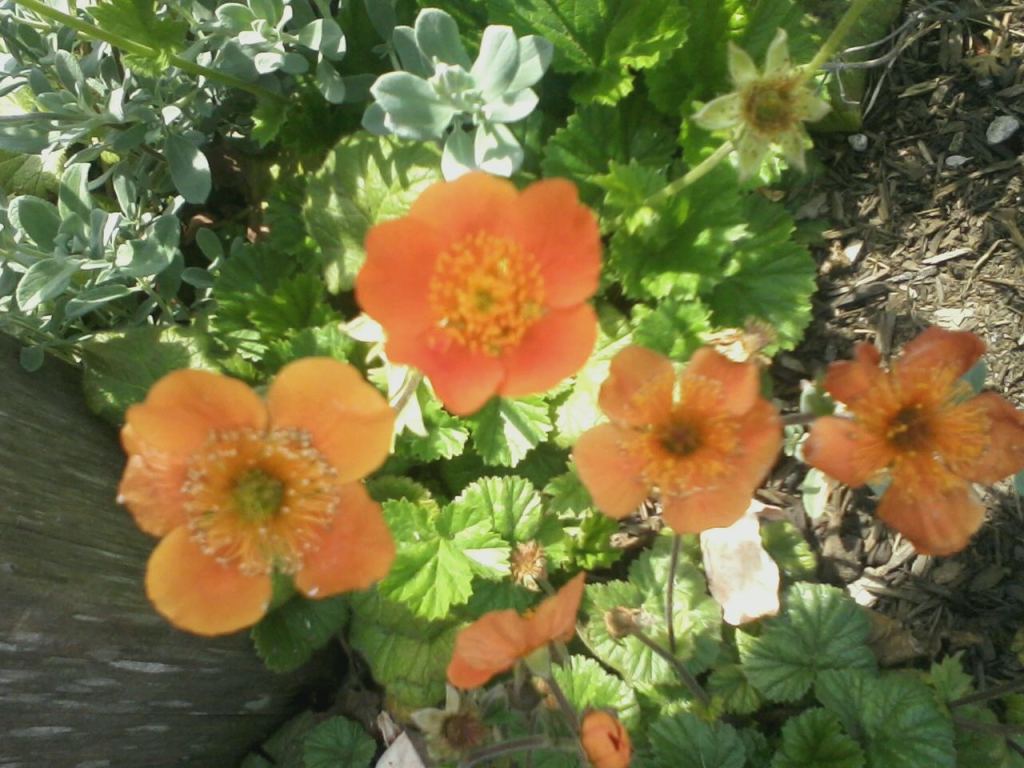
Old fashioned geum (or ‘avens’), Geum coccineum, was popular in rock gardens of the 1970’s because it clings to stone, and cascades somewhat. In modern gardens, it works just as well in large pots or planters, mixed with other perennials. The fuzzy foliage forms compact mounds about half a foot high and wide. The bright orange flowers with fuzzy yellow centers stand about twice as high, and bloom from spring through summer. Removal of fading flowers promotes continued bloom.

Flame Vine

Flame vine bloom before spring here.

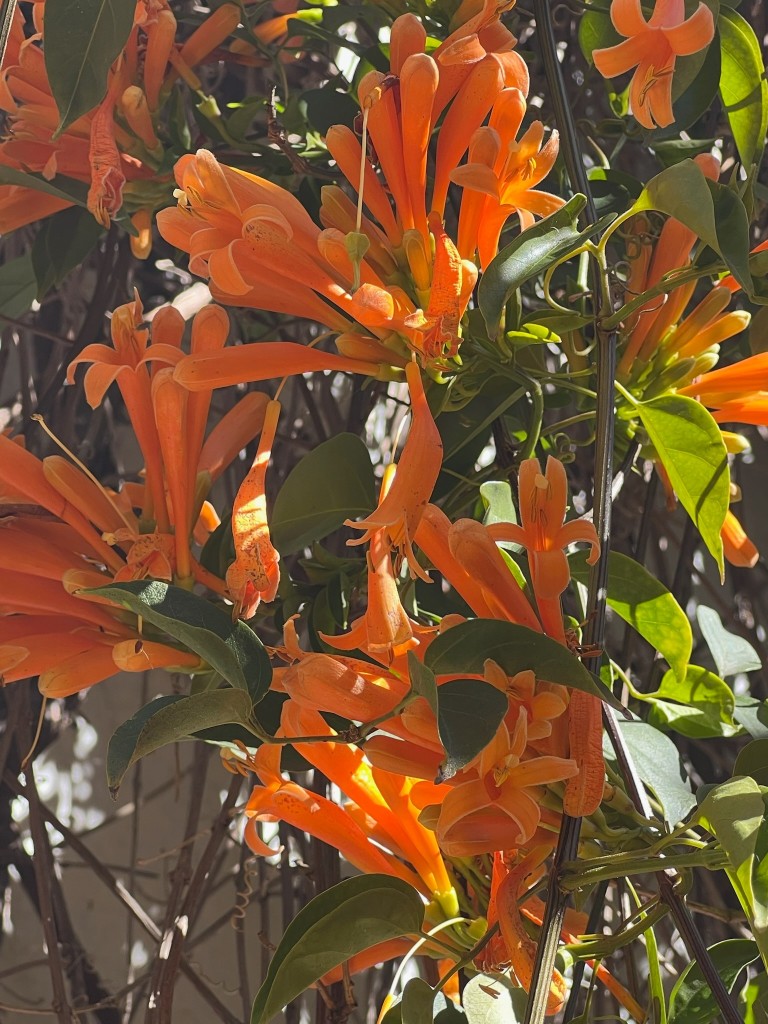
Like so many popular spring bulbs, flame vine, Pyrostegia venusta, may not delay bloom until spring as it should. Within the warmly sunny situations that it prefers, it is more likely to bloom during winter. It may wait until the end of winter or even the beginning of spring only where winter weather is cooler. Bloom is already finishing where winters are milder.

Bloom is spectacular, particularly while not much else blooms so copiously. It is about as profuse as bougainvillea bloom, but earlier. It is about as vibrant orange as poppy bloom, but earlier. With warmth, sunlight and regular watering, flame vine performs very reliably. Perhaps it should not be as uncommon as it is. Yellow blooming flame vine is quite rare.

Although a bit tamer than related red trumpet vine and royal trumpet vine, flame vine may be uncommon partly because it is so vigorous. If pruned to the ground after bloom, it can reach second story eaves to bloom there for the next season. It can grow absurdly high if it grows into trees. Its evergreen foliar tendrils can cling to and damage painted surfaces.

Lantana

Lantana just might bloom until frost.

Where winters are very mild, common lantana, Lantana camara, might bloom through all but the coolest of weather. It generally takes more of a break though. It could finish bloom at any time now, and resume at the end of winter. Where winter weather is cooler, foliage and perhaps stems may succumb to light frost. Growth should regenerate through spring. 

The tiny tubular flowers bloom inwardly from the margins of round umbels that are about and inch and a half wide. Flowers typically bloom yellow, and then fade to orange, red or pink. Therefore, the umbels have yellow centers with orange, red or pink margins during the middle of bloom. One cultivar blooms with one hue of yellow. Another fades to white.

Modern cultivars mostly stay rather low and compact. Some sprawl. Older cultivars might get as tall as six feet after a few years. However, after frost damage or coppicing, mature plants may regenerate from their roots, with vigorous stems that get six feet long through summer. The faintly raspy foliage appears to be smooth, and is aromatic when disturbed.