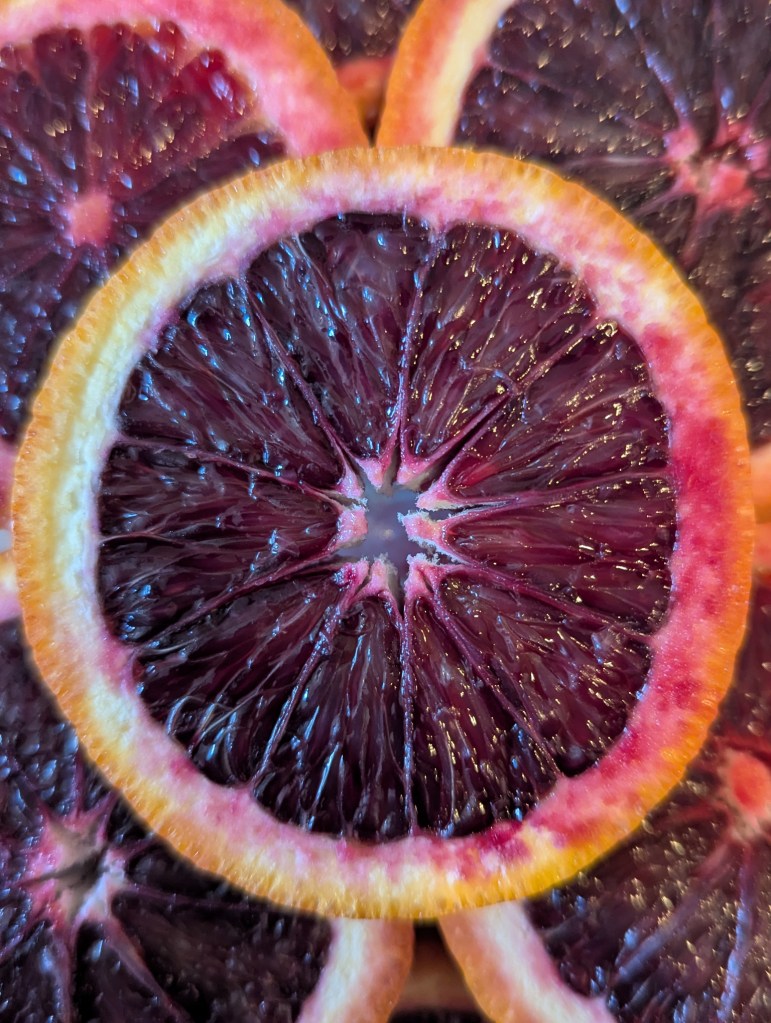
As weird as they seem, blood oranges are a class of common orange, Citrus X sinensis. Their fruit may resemble common sweet oranges externally, or may be blushed with red. Internally, the flesh exhibits red streaks or blotches, or is more uniformly garnet red. Cool autumn weather enhances red fruit color. ‘Tarocco’ may not develop any red color locally.
‘Sanguinelli’ is likely the most popular cultivar here. It produces relatively small fruits with peachy external blush. Their trees are relatively large and upright. ‘Moro’ produces larger unblushed fruits with darker and more uniformly red flesh. Their trees are relatively broad and low. While ‘Sanguinelli’ is more of a juicing orange, ‘Morro’ is more a dessert orange.
Blood oranges are quite popular in Europe, particularly within the Mediterranean region. Their flavor is more tart and berry-like than that of sweet oranges which are popular here. Blood orange trees are quite happy with the climates and soils here. They prefer regular irrigation while young, but become less demanding as they mature. Dwarf trees are most proportionate to gardens.
Winter is bare root season, which is the best time for installation of deciduous fruit trees. It is also the best time for dormant pruning of deciduous fruit trees. Evergreen fruit trees do not get much attention. Installation and any pruning of evergreen fruit trees happens after winter. However, regardless of perceived neglect, winter is actually citrus season.
Technically, citrus are always in season here. That is because most citrus fruits last so long on their trees after ripening. Also, some types produce a few fruits sporadically after their primary season. The latest ‘Lisbon’ lemons can still be good as the earliest of the following season ripen. ‘Eureka’ lemons ripen in minor phases after their primary phase.
Therefore, winter is citrus season merely because it is when most citrus fruit ripens. The schedule is ideal. It begins as pear and apple season finishes. It finishes as cherry and apricot season begins. Pears and apples, and especially cherries and apricots, are less predictable than citrus. Fortunately, citrus can begin a bit early or finish late if necessary.
All citrus are species or hybrids of the same genus of Citrus. Kumquats also classify as Fortunella though. The primary components of the flavors of their fruits are sweet, sour and bitter. The most familiar oranges are sweet oranges, but sour and bitter oranges also exist. Most lemons and limes are sour, but there are also sweet lemons and sweet limes.
Oranges, which are generally sweet oranges, are the most popular citrus. Navel oranges are traditional eating oranges. ‘Valencia’ is a traditional juicing orange. Blood oranges are a bit more tart, with blushed or red flesh and juice. ‘Seville’ sour orange is useful for marmalade. Rare bitter oranges provide flavoring for teas, and fragrance for perfumery.
Lemons are the second most popular citrus. Mandarin oranges, or mandarines, should probably be more popular. They are the more perishable of citrus though, because their rinds are relatively loose. Tangerines are merely mandarines of the Americas. ‘Rangpur’ lime is a sour mandarine. Real limes are very diverse, but mostly ripen greenish yellow. Grapefruits combine sweet, sour and bitter.
Most of us know what oranges are. The color is, of course, orange. They are very juicy and sweet. Cultivars that are most popular for eating fresh, particularly ‘navel’ oranges, are easy to peel and separate into segments. Those that are best for juicing, such as ‘Valencia’, are a bit smaller with thinner rind, so are a bit sloppier to peel and separate. Such ‘sweet’ oranges are Citrus sinensis.
Richly tangy blood oranges are of the same species, but have blushed or deep red pulp and juice. ‘Sanguinelli’, although rare here, is nonetheless the most popular of the blood oranges, and is a traditional citrus component of sangria. The juicy fruit is compact, with tightly fitting thin skin, comparable to that of ‘Valencia’. Rarer ‘Moro’ produces plumper fruit that is easy to peel and eat fresh.
Sour and bitter oranges, which are very rare here, are mostly Citrus auranticum. Sour oranges, such as ‘Seville’, are used for marmalades and confections. Bitter oranges are used for flavorings and fragrances, such as ‘Bergamot’ for Earl Grey tea. Both bitter and sour oranges were less rare a century ago, when some were appreciated for alluringly fragrant bloom and handsome foliage.
When life gives you lemons, it is likely this time of year. Although, the most popular garden varieties of lemon, like ‘Meyer’ and ‘Eureka’, continue to produce at least a few more fruits sporadically through the year. ‘Lisbon’ lemon that is still used in orchard production, and is the ancestor of the household ‘Eureka’ lemon, produces almost all of its fruit in winter, and blooms shortly afterward.
Ripe citrus in the middle of winter impresses those in climates where winter is too cold for much to happen in the garden. They could not grow a citrus tree if they wanted to. Even here, frost can damage some of the more sensitive citrus varieties, like ‘Mexican’ lime. Unlike the fruits of summer, citrus fruits ripen slowly and are not so perishable, so do not need to be harvested right away.
This means that if it is raining, cold or just to wintery to go outside, citrus fruits can be left on the tree until the weather improves. Most of us prefer to pick them in small batches anyway. Ideally, fruit should get picked as it is consumed. Lemons and limes typically get picked individually as needed, until there are so many that some need to be bagged and shared with friends and neighbors.
Mandarin oranges are the most perishable of the citrus. Because their skins are so loosely attached to the pulp, the pulp can oxidize, lose flavor and eventually get dry and pithy. Incidentally, a ‘tangerine’ is merely a Mandarin orange that was developed in North or South America. A surprisingly sour (unknown) Mandarin orange might really be a ‘Rangpur lime’, which is not a lime at all.
Unlike most fruit that continues to ripen after harvest, or pears that actually delay ripening until after harvest, citrus fruits stop developing flavor once picked. It is best to taste them for confirmation of ripe flavor prior to harvest. Some Mandarin oranges may have slightly greenish blotches on them even when completely ripe. The best ‘Valencia’ oranges can look rather yellowish. Grapefruits might mellow if left in their trees past ripeness, but can also inhibit bloom.


 When life gives you lemons, it is likely this time of year. Although, the most popular garden varieties of lemon, like ‘Meyer’ and ‘Eureka’, continue to produce at least a few more fruits sporadically through the year. ‘Lisbon’ lemon that is still used in orchard production, and is the ancestor of the household ‘Eureka’ lemon, produces almost all of its fruit in winter, and blooms shortly afterward.
 Tony Tomeo