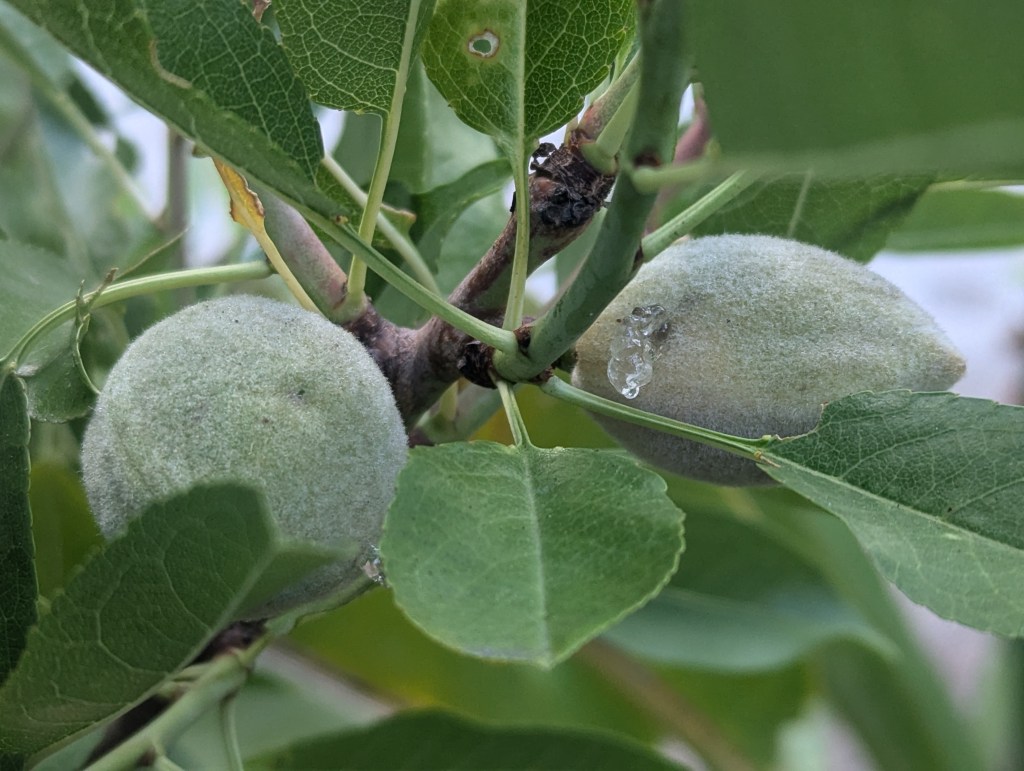
Almond / Almond

Pote-8-o or pote-aht-o? Tome-8-o or tome-aht-o? Ape-ricot or app-ricot? Pee-can or pi-kahn? What about “almond”? This is different from the distinction of plums and prunes. It is a matter of pronunciation. Is “almond” pronounced like “salmon” or “common”? Those who grow them, and likely know better than the rest of us, commonly pronounce it like “salmon”. Most of the rest of us pronounce it like “common”. The nuts are harvested by machines that shake them from their trees, which supposedly shakes the ‘ell out of them, which sort of makes sense. Although the “l” is silent within both pronunciations, it might be slightly more so within the “common” pronunciation. Everything associated with almonds prior to harvest, such as their orchards, trees, bloom, unharvested nuts and their collective industry, commonly employs the “salmon” pronunciation, in which the “l” may be slightly less silent. Everything associated with harvested and processed nuts and their products, which are what most of us are familiar with, more commonly employs the “common” pronunciation. For the pair of trees in my garden, I use the “salmon” pronunciation. For their nuts, I use the “common” pronunciation.

Firewood Still Warms Some Homes

Firewood is a byproduct of arboriculture.

Firewood was much more popular only a few decades ago. It was readily available from displaced orchards and nearby forests. Fireplaces and even a few woodstoves were not yet so uncommon. People were more motivated to cut and split firewood. More than now purchased it already cut and split. For heating, gas and electricity were more expensive.

Firewood is not so readily available nowadays. Forests are not so nearby. Orchards that were subject to displacement in the past are now completely gone. Most firewood that is available for purchase is a byproduct of arboriculture. Yet, it may not be much less costly than gas or electricity for warmth. Gas or electricity are more convenient and less messy.

Fireplaces and woodstoves are not so common nowadays either. Modern building codes prohibit them from new construction. Repair is rarely justifiable for any that incur damage from earthquakes. Because most are very rarely if ever in use, their removal is generally more practical. The many more households that are here now utilize much less firewood.

However, firewood is not obsolete. It is a renewable resource that very literally grows on trees. Some households consume only very minor volumes from their home landscapes. Some households purchase more significant volumes of it from tree service businesses. In some communities, it is available from woodcutters who harvest it from private forests.

Regardless of its source, firewood for this autumn and winter must be seasoned by now. In other words, after cutting and splitting, it needed time to dry thoroughly. Otherwise, it is difficult to ignite, produces excessive smoke, and burns inefficiently. Palm, cordyline and yucca trunks are not suitable for firewood. They burn fast, but do not produce much heat.

Average home gardens do not produce much firewood. However, removal of a single big tree can instantly provide an abundance. Tree services prefer to leave such wood where it falls. They usually cut it to fit fireplaces but do not split it. Those with an abundance are often happy to share, especially if they use none. It occupies space, and eventually rots.

Village Harvest Distributes Surplus Fruit (outdated)

Fruit trees are famously productive here.

(This is an old article with outdated information.)

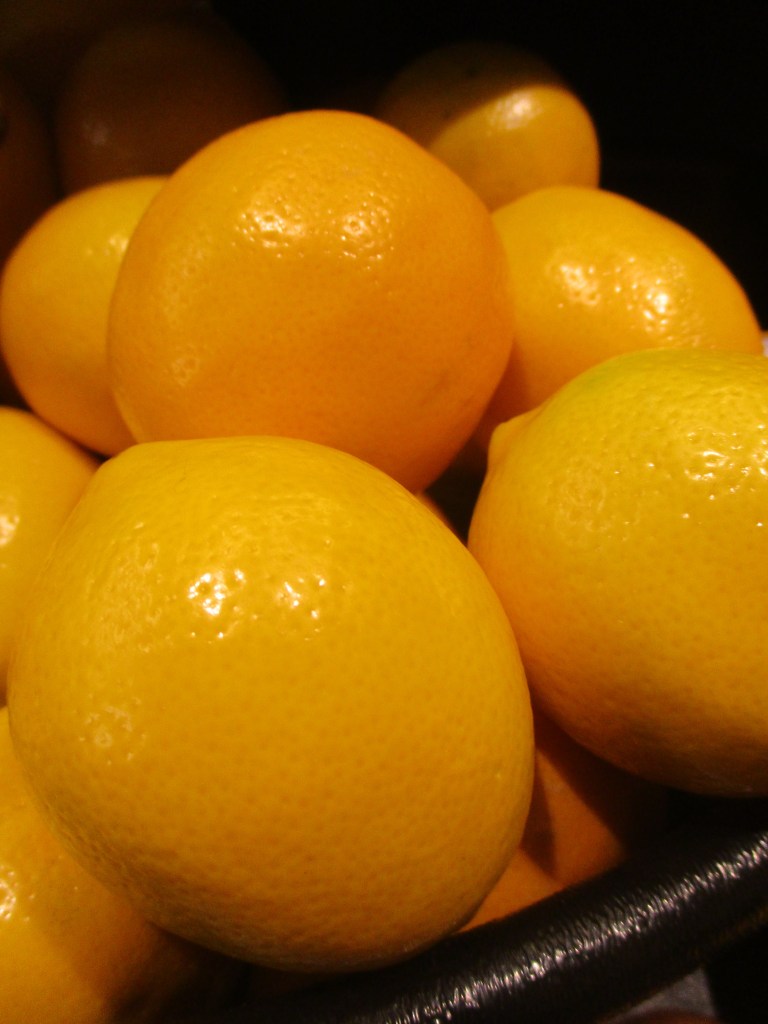
The vast orchards that formerly inhabited the Santa Clara Valley were here because this is among the best places on Earth to grow apricots, cherries, prunes, almonds and walnuts. Actually, there are not many fruit trees that would prefer to be somewhere else. Home gardens continue to produce the many traditional fruits, as well as many other types of fruit that were not so common in the orchards; such as citrus, figs, apples, pears, persimmons, avocados, peaches, nectarines and too many more to fit into a brief list.

Those of us who enjoy growing fruit trees do not need to be reminded of how well they do here. Some trees produce too much and  can become overwhelming. It is not always possible to can, dry, freeze or share with friends and neighbors all the fruit from the more productive trees. Leaving the fruit out in the garden is not only wasteful, but also bad for the garden, attractive to vermin, very messy and smelly.

Besides, there are other people in the community who could use it. During this past year, Village Harvest has harvested from local gardens, and distributed to those who can use the produce, approximately 156,000 pounds of fruit. The record for distribution of produce may be exceeded this year after apples, persimmons and citrus are harvested.

Volunteers make Village Harvest possible, by collecting excessive fruit from home gardens. Some of the people with productive trees like to retain some of the fruit. Volunteers are also welcome to take some of the fruit. The vast majority of fruit gets dispersed to others in the community who can use it.

The next apple harvest event in the Cupertino orchard on October 22 may no longer be able to accommodate additional volunteers; but the next major apple harvest in the Woodside Orchard on October 29 may still be in need of volunteers. Harvests take about three and a half to four hours, between 9:00 a.m. and 12:30 p.m.. Volunteers must be at least sixteen years old.

Volunteers can register for harvest events, or get more information at villageharvest.org. Early registration is recommended since space is limited. Volunteer instructions, including meeting location addresses will be e-mailed to volunteers a few days prior to each event. Those of us with excessively productive fruit trees who happen to be within range of harvest events can possibly make arrangements to get fruit harvested.

The next few neighborhood harvests will be on October 25 in Central San Jose, October 31 in Sunnyvale, November 1 in Central San Jose, November 6 in Mountain View, November 8 in Central San Jose, and November 14 in Sunnyvale. Sunnyvale harvests begin at 8:00 a.m.. Some harvests are repeated. For example, the Central San Jose harvests are weekly on Tuesday.

PruneYard

No more prunes.

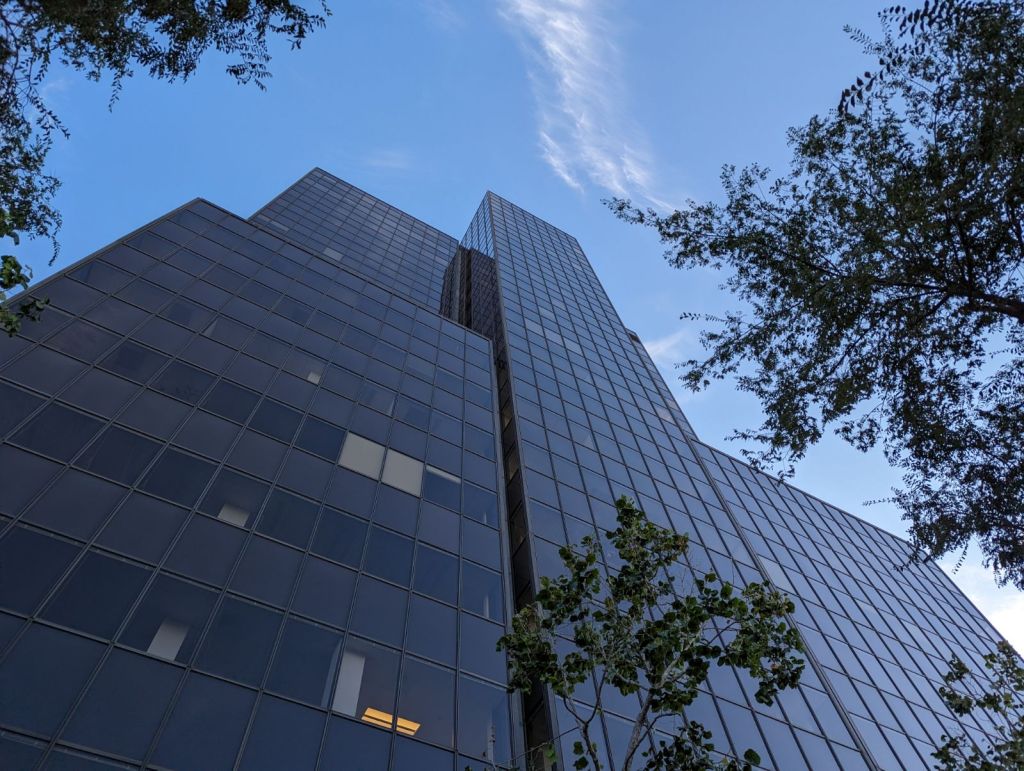
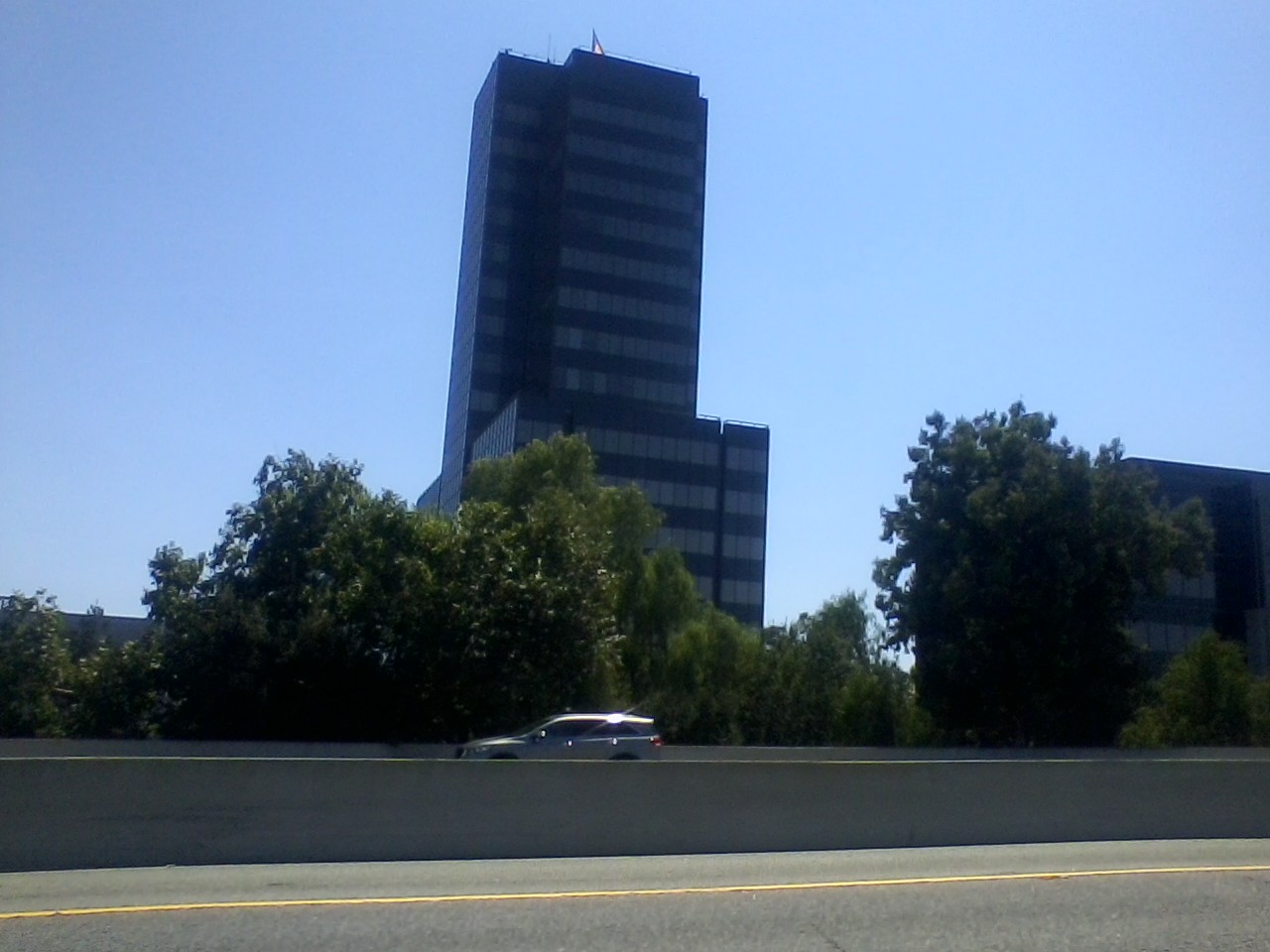
Ulmus parvifolia, Chinese elm extends most prominently into the picture from the right, with another bit from the left of the upper margin. Platanus X acerifolia, London plane extends into the picture from the right of the lower margin, with another minimal bit from the upper left. Otherwise, no other vegetation is visible. This is not exactly a horticultural topic.

The PruneYard Tower 1 is the big and dark skyscraper above the elms and planes. For a few years, it was the tallest skyscraper between San Francisco and Los Angeles. Like many major urban developments, it and its associated complex of buildings is named for what it displaced.

The PruneYard really was what its name describes, a large yard for drying prunes, as well as apricots, from the formerly vast orchards that surrounded it. Because the primary PruneYard complex of buildings is almost as old as I am, I can not remember it not being there. However, I can remember the ruins of some of the associated facilities nearby, as well as abandoned remnants of orchards. The stouter PruneYard Tower II was added in about 1976. The PruneYard Place was added in the early 1990s.

Nowadays, the name of the PruneYard must seem silly to those who are unaware of its history. Few are aware of the difference between prune and plum. Even those of us who can remember the last scraps of orchards find it difficult to believe that, not only were orchards here, but that they were formerly much more vast, and occupied most of the Santa Clara Valley. Just as tourists go to see the fall color of New England, tourists formerly came here to see the spring bloom. It is no wonder that the Santa Clara Valley was also known as the Valley of Heart’s Delight.

Firewood Season Begins Before Fireplace Season

Despite the pleasant warm weather, it will be autumn soon. This is the time to get ready for cooler weather through autumn and winter. The plants in the garden do that on their own without our help. They somehow seem to know what time it is. We only need to clean up the mess and empty the gutters when deciduous trees start to drop their leaves later. Most of our work involves features that are not plants.

Winters are so mild here that some of our work often gets delayed until it becomes necessary. If needed, we can paint, stain and seal decks, fences, patios and anything else outside anytime the weather allows right through winter. Many of us leave patio furniture outside all year both because the weather is not too harsh on it, and because patios are usable spaces even through winter.

Firewood is also commonly neglected or not even needed, but for different reasons. Many fireplaces were damaged or destroyed by the Loma Prieta Earthquake decades ago, and never repaired or replaced. Modern building codes outlawed the construction of new fireplaces even prior to that; so newer fireplaces are instead pellet stoves. Those of us who still use old fireplaces and stoves have more difficulty obtaining wood now that the orchards are gone and the outskirts of town are so much farther from home.

The advantage of pellet stoves is that fuel (which looks like stove food) is always available so does not need to be accumulated, stored and seasoned. The fuel also burns cleaner. Synthetic logs (made from compressed wood byproducts and fuel) are an expensive alternative for conventional fireplaces and stoves, but also burn cleaner than wood, and are always available. They are lightweight and clean, so can be picked up at the store and brought home in the trunk of a small car whenever a fire is wanted in the fireplace.

Good old fashioned firewood is both more work and stigmatized because of pollution. Those of us who do not have firewood available within our own gardens can purchase it from some tree service companies. It is most commonly obtained already split and seasoned directly from the wood yard where the tree service company stores it. It can be delivered for a price. Some people even like to pay a bit extra to get it  stacked.

Firewood obtained in this manner is typically a mix of random woods from trees found in local landscapes. There is often a preponderance of a particular type of wood. No one ever knows what to expect. The specific type of wood is designated only when a large tree or group of trees needs to be removed, and can be isolated from mixed wood.
Palms and yuccas, known as ‘herbaceous trees’, do not produce effective firewood! A few pieces in a load of firewood should not hurt anything, but palm or yucca ‘wood’ should not be purchased. Mixed wood often contains some resinous wood and eucalyptus, which burns just fine, but produces a bit more soot that needs to be cleaned from chimneys.

Firewood should be obtained annually in quantities that are likely to be used each winter. It is perishable, and can rot if stored several years outside. Even if it does not rot, it can become infested with rodents if it stays idle too long. Besides, excessive firewood simply takes up space that could be used for something else.

Feral Plum

P00301-1
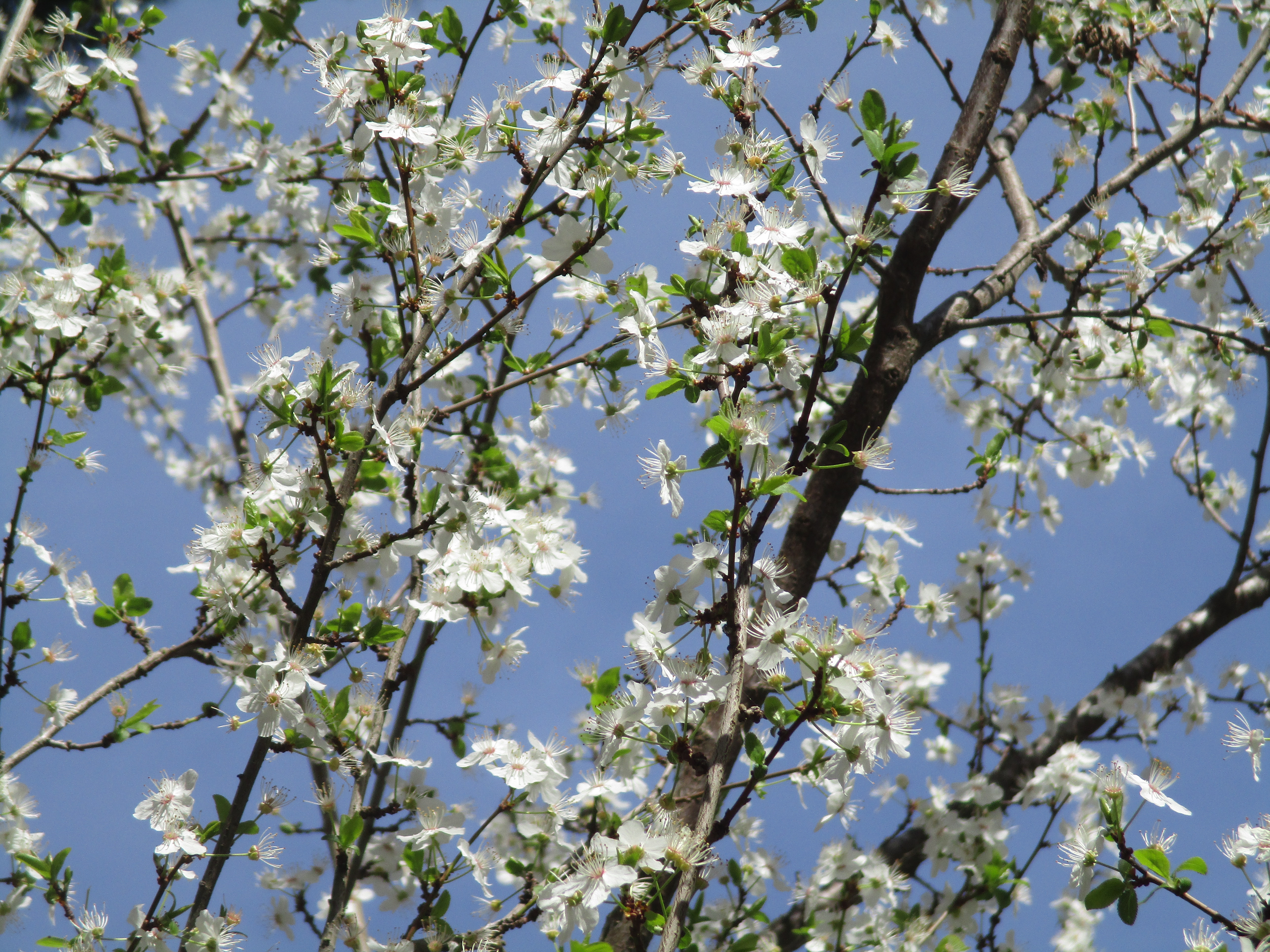
Feral plum naturalized from understock cultivars.

Springtime in the Santa Clara Valley was famously spectacular decades ago, when vast orchards occupied what is now only urban sprawl. Tourists came to see it like some still go to see foliar color of autumn in New England. Most of the orchards were for stone fruits. Only a few in cooler spots were for apples and pears. Only orchards of English walnuts did not bloom colorfully.

Cherry and almond trees typically bloomed first. Prune trees bloomed immediately afterward. Apricot trees were only a few days later. Of course, the schedule of bloom was variable. Prune trees often bloomed just after apricot trees. Various cultivars of cherry started to bloom at slightly different times, even though those that needed to pollinate each other managed to do so.

After the main bloom of all the stone fruits, and after the tourists were gone, the few apple and pear orchards in cooler spots and surrounding hillsides continued the process. Mulberry trees that grew sporadically on roadsides around the orchards bloomed no more colorfully than English walnuts, but somehow produced enough fruit to distract birds from developing stone fruits.

Feral plum trees are a group that was not easy to categorize even before the demise of the orchards. They were not intentionally grown in orchards, or even in home gardens. They just sort of grew wild along creeks or from the roots of grafted stone fruit trees that had been cut down. They were originally grown as understock cultivars, but had naturalized to become truly feral.

Because their fruit was not used for much, they did not get much consideration. We tend to forget that some types bloomed before any of the other stone fruits. To those who do not expect fruit, feral plum trees are as spectacular as productive stone fruit trees.

P00301-2
Feral plum bloom is now finishing. Foliage will replace blossoms.

What’s In A Name? Sometimes, Not Much.

P71209Newer developments are often named after what was destroyed to procure space for them. Writers and historians have been making that observation for decades.

There are obviously no remnants of a ranch in the McCarthy Ranch Marketplace in Milpitas. Heck, there are no little cornfields left in Milpitas, which is what ‘Milpitas’ means. Cherry Orchard Shopping Center in Sunnyvale? Give me a break! The Pruneyard Shopping Center in Campbell is no better.

I just happen to find the Pruneyard to be less objectionable than the others because it was built about the time I was born. It has been there as long as I can remember. My parents can remember when it was a drying yard for the prunes harvested in the surrounding orchards. I remember the last remnants of prune orchards, but by my time, there were not enough of them to justify the less lucrative use of real estate for drying, which could be done elsewhere.

The Pruneyard Towers are an office complex just to the west of the shopping center. The original Pruneyard Tower might still be the tallest building between San Francisco and Los Angeles. I know it was only a few decades ago. (Downtown San Jose has a ceiling on the heights of their skyscrapers because of the flightpath of the Mineta San Jose Airport.) I can remember as a kid, seeing the big black tower standing proudly off in the distance, beyond the blooming apricot orchards. When our parents were shopping there, and we got close to the Pruneyard Tower, we felt a bit more cosmopolitan, as if we lived in a big world class city. Back then, we had no idea that nearby San Jose was well on the way to becoming exactly that!

The shorter tower was added about 1976. The third and lowest of the three bigger towers was added in the 1990s. The late 1960s architecture of the shopping center is still prominent, but several original buildings have been rebuilt with modern architecture, and a few new buildings were added.

As much as I miss the orchards and the horticultural past of the Santa Clara Valley, I can not totally dislike the Pruneyard Shopping Center and the associated big towers. To my generation, they are also part of our history. They have been here as long as we have.

The one thing that I dislike about the Pruneyard Shopping Center is the name. It is a constant reminder that something that was such an important part of our local culture and history was destroyed so that it could be built. Nothing about the site is associated with the orchards, or drying yards or prunes, or anything of the sort.

War Of The Worlds

P71003To a little kid, it really had the potential to be a scary movie. I did not understand all of it, but I got the important parts. Mars was red, so was probably near Oklahoma. Apparently, the people from Mars had big scary machines that destroyed anything and anyone that was in their way. I did not perceive much of a threat because my parents let me watch the movie. (We children could not watch really scary movies.)

Shortly after watching War of the Worlds, I went for a long walk with my older sister and some of her friends into the last remnant or orchard that was such a prominent part of our world. We went out onto a new section of roadway beyond where our street used to end, and turned east on a completely new street that was not there before. The fresh new pavement and neat curbs seemed so flat and desolate . . . and expansive compared to the orchard that it now divided. I wondered how the trees got out of the way of this thing. Obviously, some moved to the left, and others moved to the right.

We eventually arrived at a larger clearing off to the left of this new street. Within this clearing, there were huge concrete rectangles with short pieces of rebar sticking up from their perimeters. One of the concrete rectangles lacked rebar, but was outfitted with four tall poles that curved on top. They looked something like those scary weapons on top of those machines that came from Mars. My sister confirmed my suspicions by explaining that the big concrete rectangles where where the flying machines landed when they arrived. Now I was getting a bit scared.

A few days later, we started to hear strange noises coming from the orchard. I was not allowed to go that far into the orchard without my sister, and was too afraid to go investigate anyway. The noises were mechanical and metallic, mixed with the sound of what seemed to be a big diesel engine and wood breaking. I dismissed them as not ‘too’ terribly threatening at first; but by the next day, they were closer! Each day, they got closer, until I could actually see motion through the trees. Something yellow was moving around in there, and small puffs of black smoke sometimes squirted out above the trees. I was terrified! I told my mother that the mean people from Mars were out there destroying everything like in the War of the Worlds!

She explained that there were no mean people from Mars in the orchard, but that a new park was being built on the site. Well that did not help much. What is this ‘park’? My mother explained that it would be a place where kids could play and run around and climb things and play games . . . and you know. Well duh, that is what the orchard is for. She said that it would be better. I wondered what could possibly be better than the orchard. This is something that I need to see!

Well, for the next two days or so, as they tore out the last two rows or so of trees, it became apparent that they yellow machines from Mars that spurted out black smoke were bulldozers gouging the trees right out of the ground. No one even bothered to cut up the firewood to leave on the side of the road like was typically done. The trees were unceremoniously piled up and burned. I was no longer terrified. I was saddened and confused. I could not understand why anyone would want to do this to the most important part of our world.

The big concrete rectangles with rebar protrusions were not landing pads for the flaying machines from Mars. They were the foundations and floors of the Recreation Center for the new park. The concrete rectangles with the four curved poles that seemed to be an assembly site for the weaponry from Mars simply became two basketball courts. The curved poles were outfitted with backboards and hoops. The orchard, devoid of trees, was leveled in most areas and mounded in others, and mostly covered with a vast lawn. New trees were planted around the perimeter and within landscaped areas around the Recreation Center. I suppose as far as parks go, it was a nice one.

The only problem with it was that we did not know what to do with it. The new trees were too small to climb or hide behind or really to do anything with. The lawn was nice, but there was way too much of it. The Recreation Center was nice inside, but we wanted to be outside. Eventually, we learned how to enjoy our park, and it really was nice; although it will never be an adequate substitute for an orchard. Our suburban (or some might say ‘rural’) world was invaded and, unlike in the movie, conquered by a more urban culture.

I would not say that one culture is any better than the other. However, I will say that I believe that there was a certain advantage to knowing the orchard and some of the nearby undeveloped wildlands the way that we did. I really believe that it was more educational than the refined and synthetic landscape of the new park. The maintenance of the park certainly required some degree of horticulture. There are trees, lawn and all sorts of shrubbery and perennials. The orchard had only trees and mustard. We interacted with it differently somehow. This is something that I can not explain adequately. It can only be experienced.