King Palm

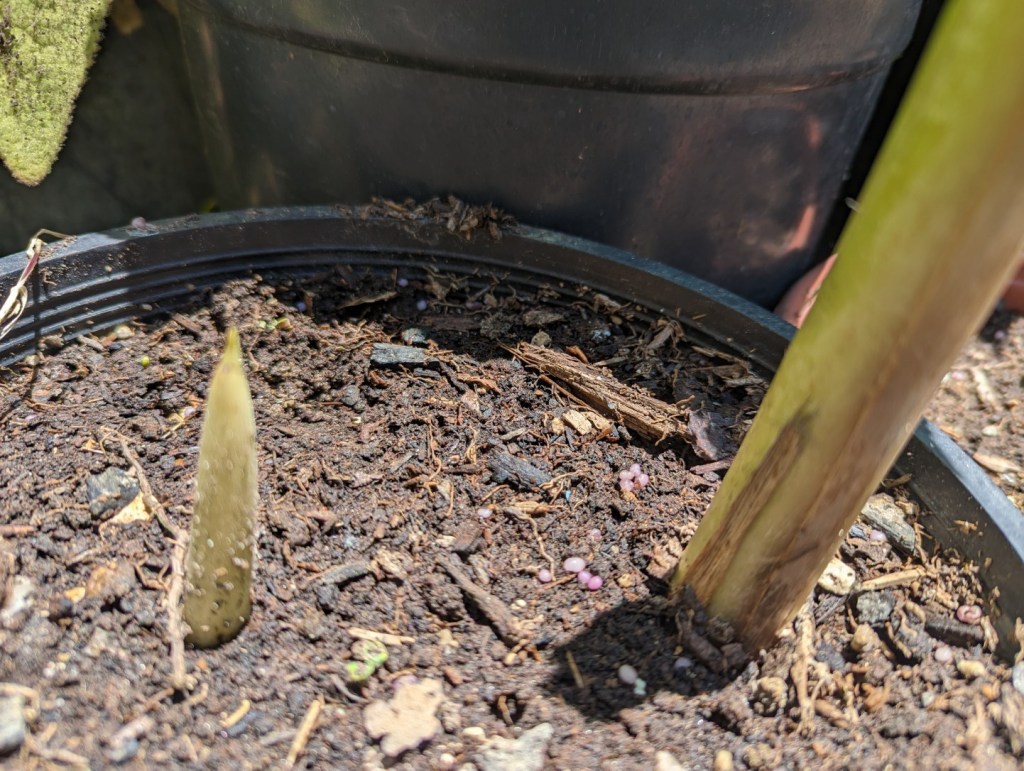
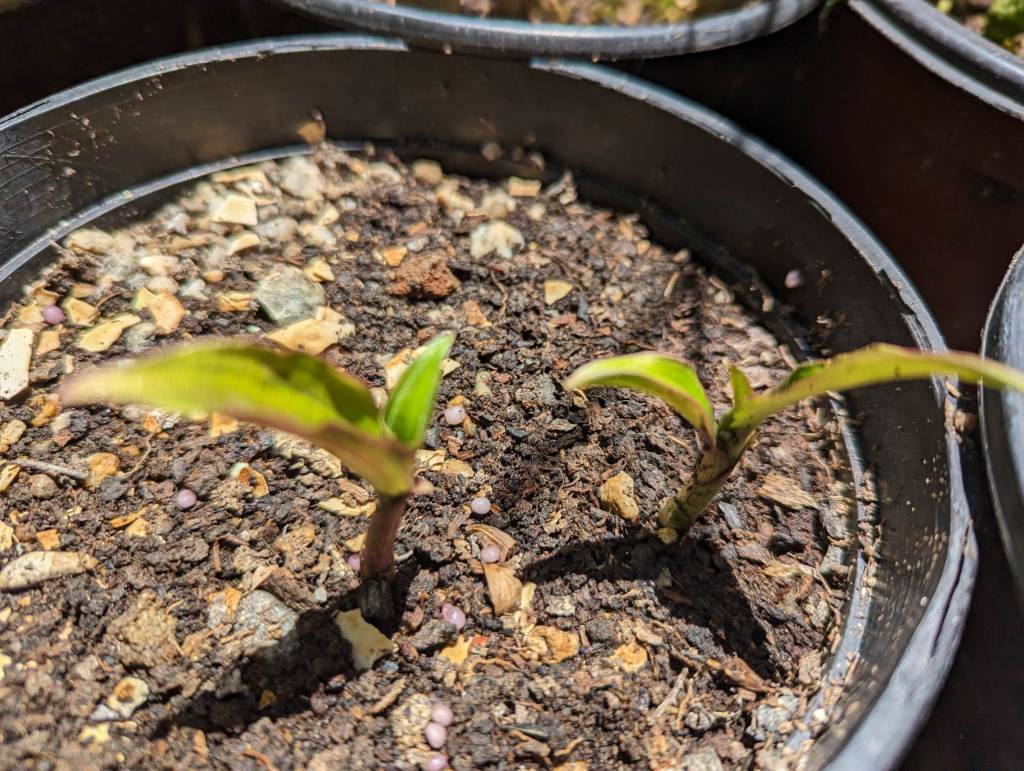
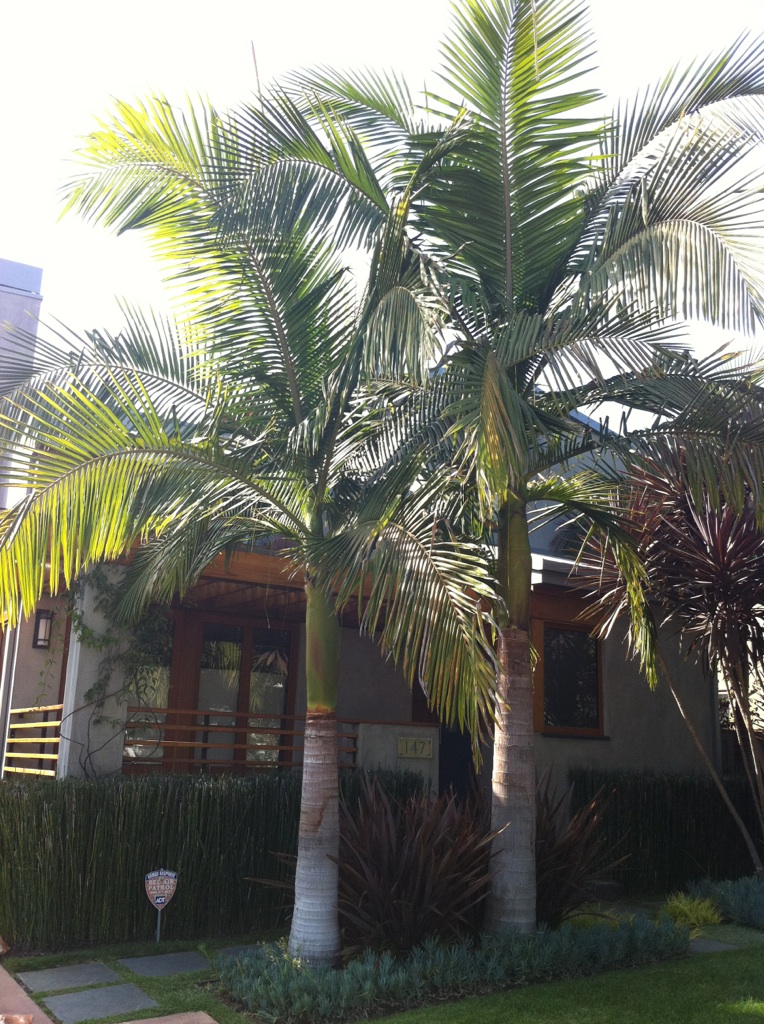
Piccabeen palm or bangalow palms is known more commonly here as king palm.

Where it grows wild in rain forests of eastern Australia, the piccabeen or bangalow palm, Archontophoenix cunninghamiana, is a strikingly elegant tree that gets to about fifty feet tall on a clean, slender trunk. The six to ten foot long feather fronds (pinnate leaves) form a light but distinctive canopy about ten to fifteen feet broad. Smooth green petioles (leaf stalks) encase the upper few feet of crownshaft, eventually peeling away cleanly to reveal the smooth trunk as it grows below. A juvenile king palm does not bloom, but eventually flaunts adulthood with softly pendulous ‘graduation’ tassels of profuse but tiny purple tinged white flowers.
Locally, this palm is known more commonly as the king palm, and does best as a large houseplant or where it is protected from frost. Outdoors, it seem to be happiest close to the San Francisco Bay where it is somewhat insulated by all the water, but can unfortunately get smacked about by the wind there. A mature tree is somewhat more tolerant to frost than a young tree is, but can be damaged or even killed if it gets cold enough.
King palm fortunately does well in the partial shade of larger adjacent trees or buildings that might shelter it from frost. However, it can not be pruned down for clearance from higher trees, ceilings or any other overhead obstruction (including utility cables), so should be planted where it has plenty of room to grow vertically, or where no one will mind it getting removed when it gets too tall after many years.
Unlike most other palms, king palm does not transplant easily when mature. It has no problem getting planted from a pot to a larger tub or planter, or into the ground. Once in the ground though, it is there to stay.

Palms

Mexican fan palm is the most prominent palm.

Only a few of the  many different palms that can be grown locally are actually common. The Canary island date palm and the Mexican fan palm, which had historically been the most common palms, have unfortunately given palms a bad reputation. Both get too large for small gardens, and need costly maintenance when they grow out of reach.

Since the late 1980s, the formerly uncommon queen palm has become the most common palm. Although it too eventually grows beyond reach, it is still more proportionate to home gardens while young. It has a relatively narrow trunk that is partially ‘self-cleaning’ (which means that old fronds, or leaves, often fall off or can be easily peeled off).

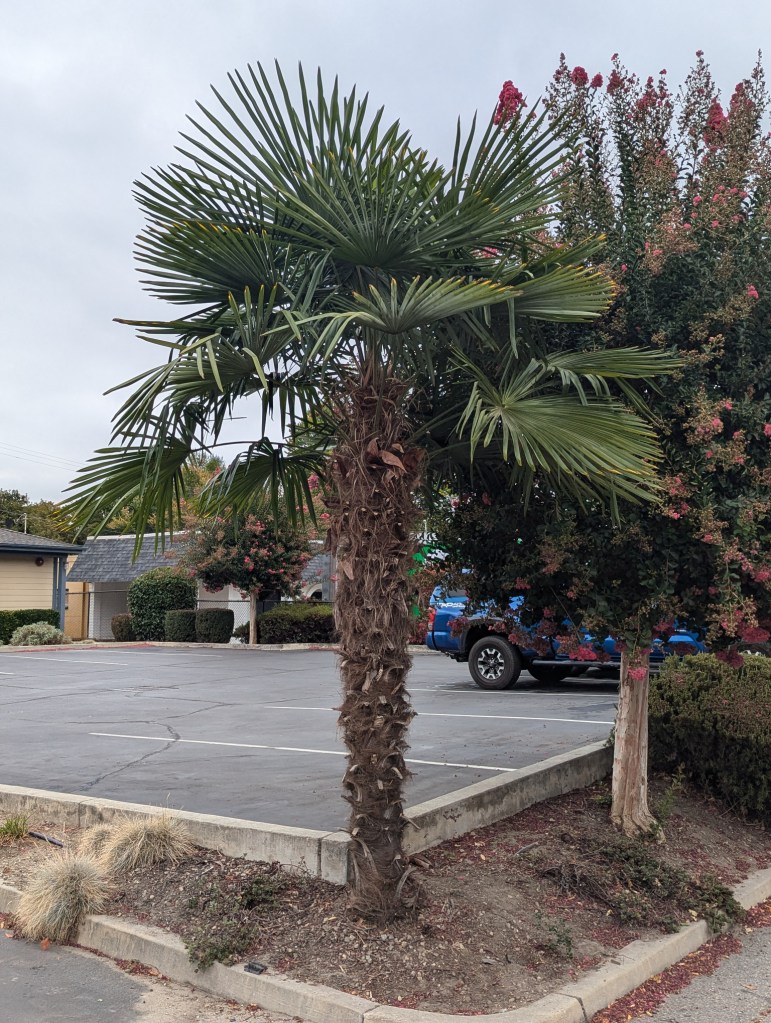
The windmill palm and the Mediterranean fan palm, although no more common now than a century ago, are two of the better palms for home gardens, since they do not get too large, and are somewhat easy to maintain. The Mediterranean fan palm has several sculptural trunks that curve out randomly from the base. Sharp teeth on their petioles make pruning a challenge, but not impossible.

The windmill palm has a straight solitary trunk that is distinctively hairy where old fronds get pruned away. It eventually grows out of reach, but takes many years to do so. By that time, many people allow beards of old fronds to accumulate on the trunks overhead instead of bothering to keep them pruned.

The desert fan palm, which is the only palm that is native to California, is very similar to the Mexican fan palm, but is about twice as stout and half as tall, with a fluffier canopy. Because it grows slower and stays smaller, it would be a better palm for urban gardens, except that it does not like to be watered regularly when mature. It really prefers warmer and drier climates.

Pindo palm and Mexican blue palm would also be great palms for urban gardens, but grow rather slowly before getting big enough to get noticed. In some climates, pindo palm produces strange and messy, but sweet and tasty fruit. Mexican blue palm is one of the most resilient palms, and blooms with really cool long floral tassels that a can drag on the ground from short trees.

‘Feather’ palms, like Canary Island date palm, queen palm and pindo palm, have pinnate (and generally compound) leaves, with small leaflets arranged on solitary midribs. Their fronds must be removed as they deteriorate.

‘Fan’ palms, like Mexican fan palm, Desert fan palm and windmill palm, have palmate leaves, centered around the distal termini of solitary petioles. These are most often pruned away, leaving distinctive patterns of petiole bases, but can alternatively be left to accumulate into thick beards of thatch.

Mexican fan palms are sometimes ‘shaven’ of their petiole bases to expose elegant lean trunks, although the procedure is intensive and expensive. Desert fan palms and some Mexican fan palms drop their own beards naturally.

Perennials Perform Longer Than Annuals

Kaffir lily is a reliable perennial.

Annuals live for only one year. Biennials live for only two. Technically, all other plants are perennials. Horticulturally, this classification is much more specific. Generally, It does not include vegetation that qualifies as something else. Also generally, plants that qualify as perennial are herbaceous rather than woody. Of course, this is not as simple as it seems.

Palm trees that develop substantial trunks, for example, classify as herbaceous trees. So do arboriform yuccas, such as Joshua tree. Palms and yuccas that do not develop trunks can classify merely as perennials though. Different species of one genus could therefore classify very differently. Tree ferns may also qualify as herbaceous trees as they mature.

Many palms and yuccas, as well as agaves, bamboos and banana trees, are perennials. They might not seem as if they should be, since they can grow so large. Spring bulbs are more recognizable as perennials likely because of their small size. Lavenders and some salvia develop more woody stems than banana trees. They are perennials nonetheless.

Perennials are generally self perpetuating. Lavenders and similarly twiggy sorts may not not seem like they are, but they can be. Their lower stems that sprawl over the surface of the soil can grow adventitious roots. These adventitiously rooted stems can grow as new plants to replace the old. Herbaceous perennials are more overt about self perpetuation.

Lily of the Nile, for example, constantly produces new rhizomes to replace the old. It can do so indefinitely. Some may have done so longer than the oldest bristlecone pines have been alive. They do not retain old growth as evidence of their age. This self perpetuation is an advantage in home gardens. It facilitates both sustainability as well as propagation.

Lily of the Nile, Daylily, Kaffir lily and African iris are very simple to propagate by division. Once separated, either after bloom or while dormant, their rhizomes grow as new plants. Many perennials actually perform better after occasional division. It alleviates congestion by providing more space to grow and bloom. Canna and ginger rhizomes grow very fast. Canna may benefit from annual division.

Palm Trees Deserve Special Accommodation

Palm trees are bold landscape features.

Palm trees qualify as trees only because of their size and form. The most familiar sorts here develop trunks, and many grow quite tall. The smallest houseplant palms can grow as tall as dwarf citrus trees. Mexican fan palm can grow nearly a hundred feet tall. Palms are monocots, though, so are not actually woody. Technically, they are herbaceous trees.

Palm trees share this distinction with several other herbaceous trees. Banana tree trunks are just tightly rolled leaves. Tree ferns elevate their growth on roots that grow downward through rotting stem growth. Neither banana trees nor tree ferns can generate branches. Sago palms, cabbage trees and arboriform yuccas develop branches, but without wood.

Some palm trees develop a few trunks, but almost none develop branches above grade. Date palms can, but rarely branch. Doum palms typically branch, but are extremely rare. Any other branching palm trees are either aberrative or not really palm trees. Palm trunks do not grow wider as they grow taller. Adventitious roots can become buttressed, though.

All palm trees are evergreen, with either pinnate or palmate foliage. Feather palms have pinnate foliage. Each leaf consists of a central rachis that supports many narrow leaflets. Fan palms have palmate foliage. Each leaf radiates from the terminus of its stout petiole. Both basal leaflets of feather palms and petioles of fan palms are typically horridly spiny.

Since palm trees can not branch, they are not conducive to pruning to direct their growth. Their big but solitary terminal buds grow only upward and maybe away from shade. Any that reach high voltage cables can not go around, so necessitate removal. Clearance for overhanging obstacles is a major consideration for situating new palms. Some grow fast.

While unconducive to directional pruning, most palm trees benefit from grooming. Only a few shed their old foliage naturally. Most get shabby by retaining it. Many, particularly fan palms, eventually become combustible or infested with rodents. However, some may be visually appealing with neat beards of old foliage. Only arborists can groom large palms.

Windmill Palm

Windmill palm can disperse copious seed.

Palms take commitment. Some of the most popular grow too big for their situations. Most grow so tall that only arborists can maintain them. None are conducive to pruning to limit their natural height. Individual palm trunks rely on their single terminal buds, which grow only upward. Diversion is not an option for any palm that encroach into electrical cables.

Windmill palm, Trachycarpus fortunei, is one of the more complaisant of palms. It can not grow around utility cables, but otherwise does not grow obtrusively big. Young trees can grow fast to fifteen feet tall, but then grow slowly to double their height. Only a few elderly trees grow as tall as forty feet. Their foliar canopies are generally less than ten feet wide.

Trunks of windmill palms are distinctively shaggy. Pruning dead fronds as closely to their trunk as possible promotes a neater appearance. Because growth decelerates with age, trunk shag is typically wider higher up. Trunks are about half a foot wide, but seem twice as wide since they are so shaggy. Gathering seed from pollinated female trees is simple.

Arrest

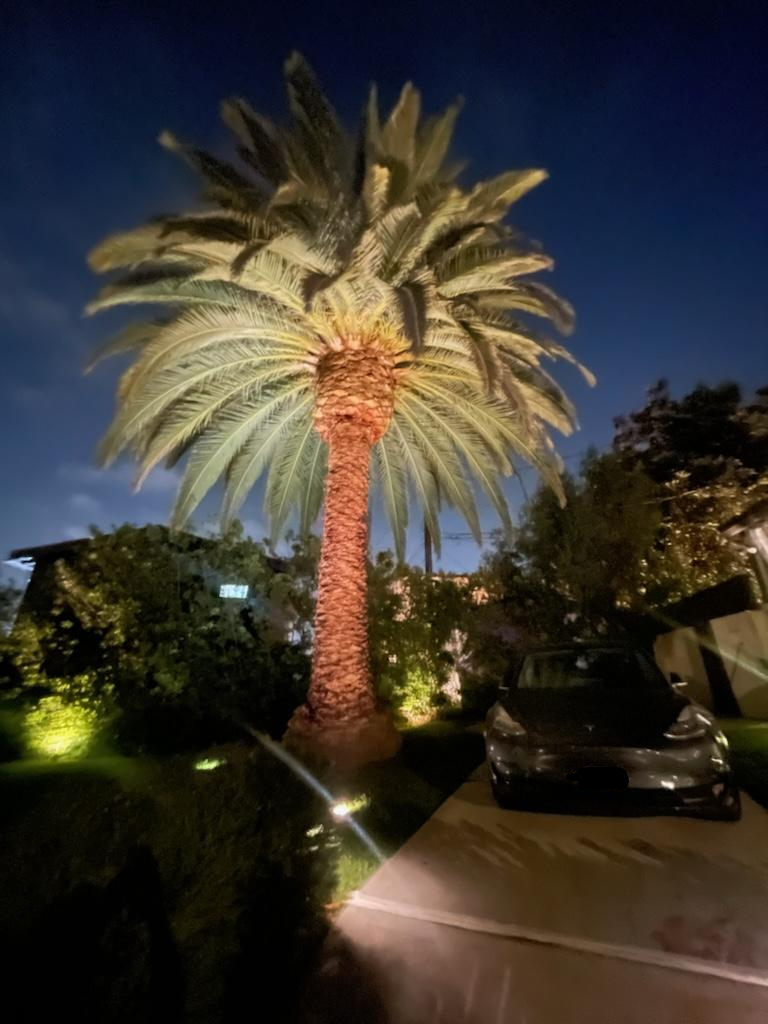
Phoenix canariensis, Canary Island date palm

“Put your hands in the air!

That is what this uplit Canary Island date palm seems to be responding to. It seems to be surrounded by police, with their spotlights aimed at it as they proceed with an arrest. It actually seems to be guilty, although it might merely be humiliated.

Brent is a renowned landscape designer in the Los Angeles region. I know that I should not question his work. After all, aside from all the other unusual horticultural work that I do, my primary work is supposed to be on the farm. I merely grow the material that Brent’s crews assemble into their landscapes. I know that Brent knows what he is doing, and his clients appreciate it very much. I just do not quite get it.

Although I happen to be fond of Canary Island date palms in other peoples’ landscapes, I do not think that I would want one in my own garden. I would prefer a fruiting pair of date palms. Even that is a stretch. They occupy significant space, and probably would not produce good fruit here anyway. Even if such palms inhabited my garden, I know that I would not want them uplit like this. Such trees seem to be embarrassed or annoyed about being kept up late. They really deserve to get some sleep at night like everyone else.

Uplighting became popular in the 1970s. By the time that Brent and I were in school, and he was studying landscape design, lighting of various colors had become popular. I can remember a landscape in his Parents’ neighborhood that was done up like a horror movie with red lights. Another was done up like a circus with various tacky colors. Eventually, white lights became most popular, although colorful lights are not completely unpopular.

Six on Saturday: Los Angeles to Los Gatos

Six on Saturday is hasty for me this Saturday. The last few days have been rather hectic. It is now about midnight on Friday. I am presently in Los Angeles, and will be returning to Los Gatos in a few hours. It is a long story. I did not get many pictures.

1. Washingtonia robusta, Mexican fan palm is the most familiar palm of the Los Angeles skyline. This one is very unique though. It grew under the onramp from the northbound Harbor Freeway to the westbound Santa Monica Freeway, on top of an embankment on northbound Toberman Street. It grew vertically until it encountered the underside of the onramp. It then crept along the underside of a merge lane toward the south. It resumed vertical growth after reaching the edge, and escaping from below. Countless commuters who drive past it, and perhaps also over it, are unaware of its extraordinary contortions.

2. Coleus scutellarioides, coleus is still performing nicely within Brent’s garden. Autumn is a bit later and significantly milder within Los Angeles than within Los Gatos or Felton.

3. Coleus scutellarioides, coleus is familiar among my generation because it was popular as a houseplant through the 1970s. It is likely more popular in home gardens nowadays.

4. Nephrolepis exaltata ‘Variegata’, variegated Boston fern or tiger fern is one of several species that I will bring back from Los Angeles because I can not procure it in Los Gatos.

5. Three little kittens are new residents of Brent’s garden. I doubt that they are related to those that Los Gatos is named after. They will eventually help with rodent management.

6. Rhody is normally terrified of kittens. He does not seem to be aware that they are just small cats. Now that we are about to leave, he is much more tolerant of their playfulness.

This is the link for Six on Saturday, for anyone else who would like to participate: https://thepropagatorblog.wordpress.com/2017/09/18/six-on-saturday-a-participant-guide/

Palm Springs

Palms and redwoods do not mix.

No, not ‘the’ Palm Springs. It is merely a concept for a new garden. It may not begin to develop for quite a while, and certainly will not begin prior to when the rainy season begins this autumn.

Palms and redwoods do not mix. Technically, they can, but they look silly together. However, there are a few young palms here, and there will be more in the future. Some are very important to me. The pair of Mexican fan palm seedlings came from the mature specimen that Brent scattered some of his brother’s ashes under in front of his home at the Jungalow. The windmill palm came from the childhood home of two of my best friends from the fourth grade. The rare hesper palm was a gift from a now deceased friend. It was stolen and then recovered.

Palm Springs may be developed to accommodate the various palms within their own space, away from the redwoods. The preferred location is a small and relatively mildly sloped plateau on an otherwise steep hillside, where oaks and chaparral species grow wild. A natural spring, if tapped, may be able to provide adequate irrigation. Otherwise, water is available reasonably nearby. Other lush or jungly species can also inhabit this garden. This includes heliconia, giant bird of Paradise, canna, calla, blue ginger, cup of gold vine, Philodendron selloum, four cultivars of angel’s trumpet and three distinct species of bamboo palm that are already here. The garden would not be visible from either of the nearby roads until some of the palms get very tall a few decades later. I doubt that anyone would mind if they could see such odd vegetation anyway.

Ultimately, Palm Springs could be like a bit of Southern California within its own confined oasis almost hidden above the redwoods.

Palm Trees Are Specialized Trees

Many palms have palmate leaf form.

A tree is a woody perennial plant with a single tall trunk and branches. Banana trees and tree ferns lack both branches and wood. Arboriform yuccas develop branches but are not woody. Palm trees are no better. Some develop a few trunks but without branches. Doum palms that develop branches are extremely rare in California. No palm is actually woody.

Palms are trees only because of their size and form. In other words, most are big and tall. The most compact of palms are no smaller than Japanese maples, which are also trees. Realistically though, palms are merely large to very large perennials. They are monocots like grass, bamboo or cordyline. Some horticulturists classify them as herbaceous trees.

Only California fan palm is native to California, and only to remote desert oases. All other palms are exotic. Spanish Missionaries imported date palms to produce dates within arid regions. Only a few other palms were similarly utilitarian. The majority are desirable only for their distinctive form, texture and evergreen foliage. They are genuinely ornamentals.

All palms are evergreen. Fan palms produce rounded palmate leaves on sturdy petioles. Feather palms produce elongated pinnately compound leaves on sturdy rachises. Many fan palms also produce wicked teeth on their petioles. Many feather palms also produce dangerously sharp spines on the bases of their rachises. Even lush palms can be mean.

Not many palms get big enough to provide much shade. Many types are shady in groups though. Without branches, palms are not conducive to containment or redirection. Some eventually grow tall enough to shade neighboring gardens instead. Unfortunately, palms that encroach too closely to high voltage cables require removal. They do not go around.

Palm trunks do not widen as their canopies grow higher above. Palms with plump trunks grow at ground level for several years before they can launch. Their single terminal buds must first grow as wide as their mature trunks will ever get. Their foliar canopies likewise grow no broader than they were when they launched. They only grow higher. Most large palms develop distended basal adventitious roots that can get quite wide, though.

Six on Saturday: Return From Arizona

The first three of these six are the last of my trip to the Los Angeles and Phoenix regions. That was weeks ago. If there were a time limit for such pictures, these first three pictures would have exceeded it. With a limit of six pictures weekly though, it takes quite a while to post all of an abundance of pictures. Cool weather has inhibited activity in the garden anyway. Although there is plenty of bloom, much of it is no longer new. I am still waiting for vegetative growth from a few tropical types of vegetation that prefer warmth to grow. This includes the last three here.

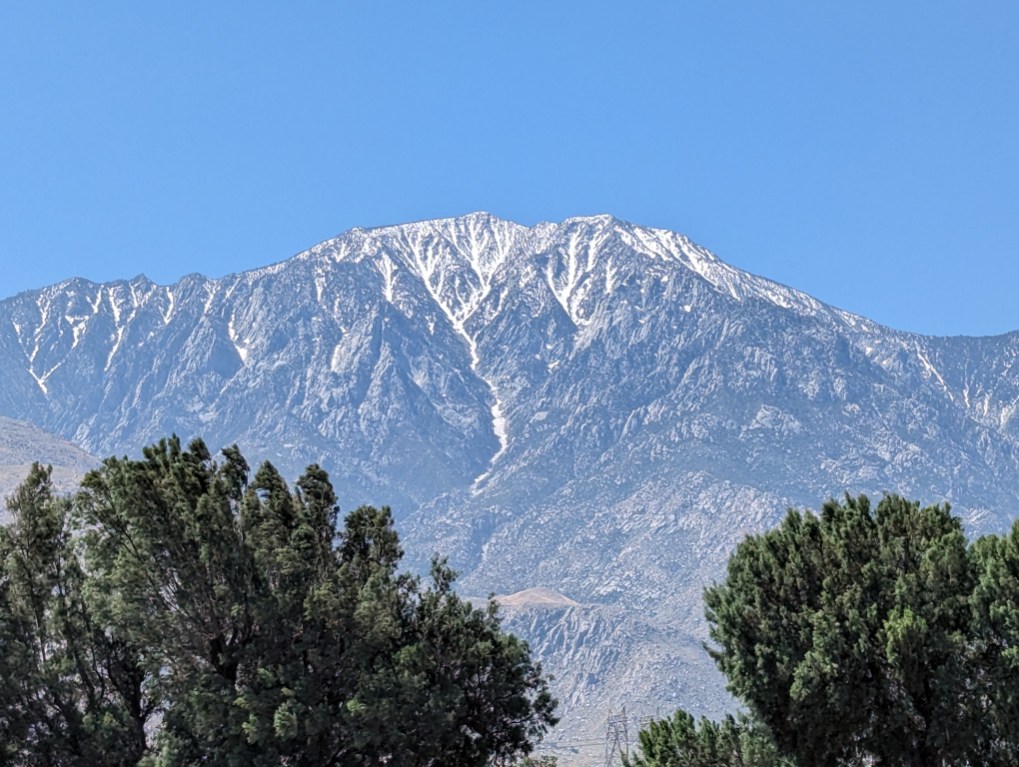
1. Mount San Jacinto is not exactly horticulturally relevant, and I do not even know what that vegetation in the foreground is, but it is a grandly scenic backdrop to Palm Springs.

2. Phoenix dactylifera, date palm grows in date orchards throughout the Mojave Desert and the Sonoran Desert, and is most likely the origin of the name of Phoenix in Arizona.

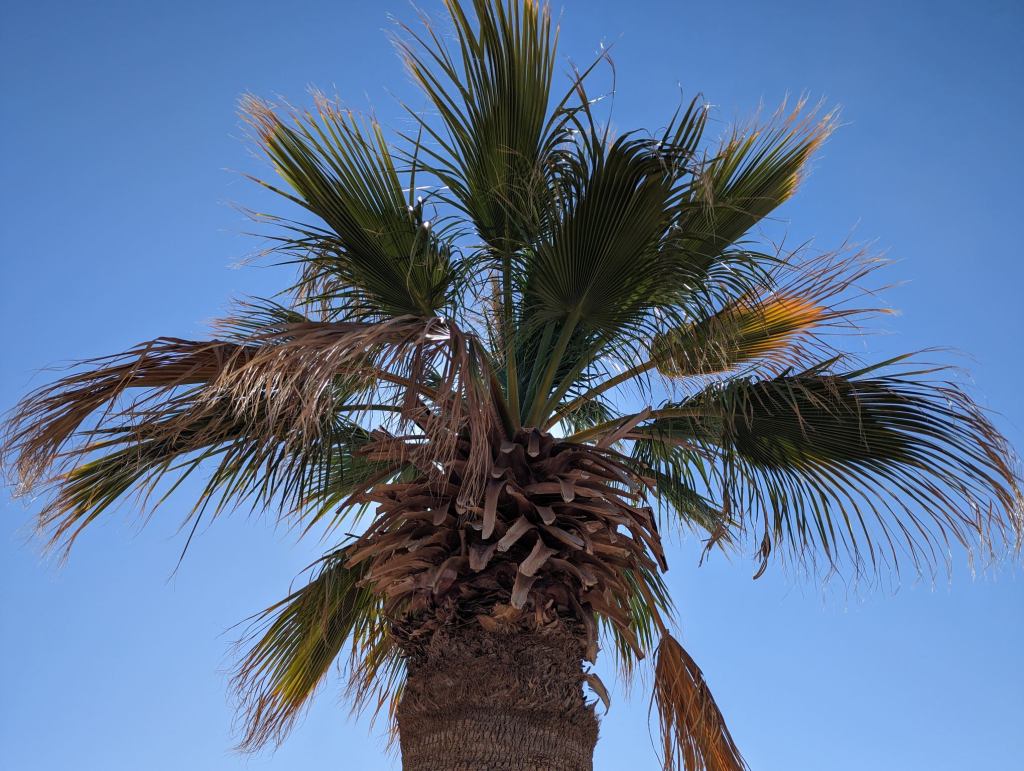
3. Washingtonia filifera, California fan palm is the only palm that is native to California. It is the origin of the name of Palm Springs because it grows wild around nearby springs. This happens to be an atypically shabby specimen at a roadside rest stop on Highway 10.

4. Heliconia psittacorum, parrot heliconia had done no more than survive last winter. It needed to be removed from Brent’s garden, so came here. It is finally beginning to grow.

5. Hedychium greenii, red butterfly ginger arrived with the parrot heliconia, but canned separately here. I did not know what it is until Brent mentioned that his is now missing.

6. Dichorisandra thyrsiflora, blue ginger was not expected to survive the unusually cold frost of last winter, but finally is slowly generating these little shoots from eight cuttings.

This is the link for Six on Saturday, for anyone else who would like to participate: https://thepropagatorblog.wordpress.com/2017/09/18/six-on-saturday-a-participant-guide/