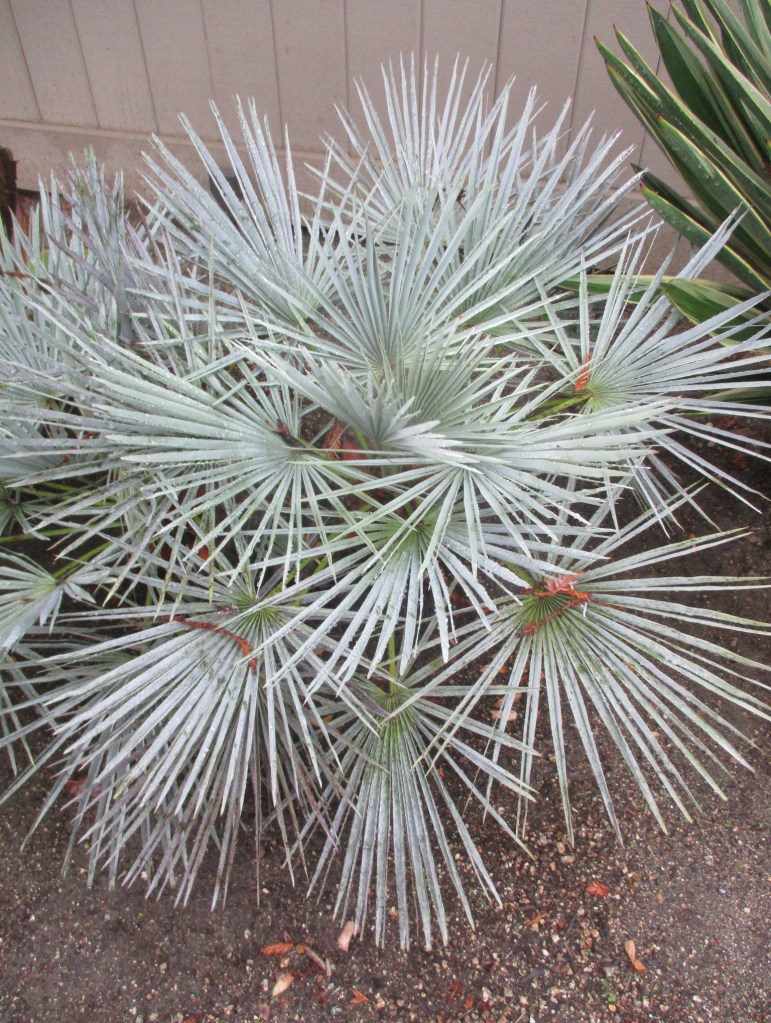
Mediterranean fan palm is a shrubby palm, with a few small trunks. Atlas Mountain palm, Chamaerops humilis var. argentea, is an even shrubbier variety. Mediterranean fan palm can grow slowly to about twenty feet tall. Atlas Mountain palm grows even slower to only about eight feet tall. Its several trunks become strikingly sculptural only after many years.
The primary allure of Atlas Mountain palm, though, is its distinctly silvery gray foliar color. Individual fan shaped leaves may be nearly two feet broad, with deep and narrow clefts. Petioles are so nastily thorny that grooming and pruning can be painfully difficult. Mature trunks can be six inches wide with dense coats of petiole bases. Bloom is not prominent.
Atlas Mountain palm is notably undemanding. Once established, it does not crave much water or fertilizer. Nor is it finicky in regard to soil quality. It is resilient to both extremes of heat and cold. After several years, it might benefit from thinning of superfluous trunks and pups. Like many palms, Atlas Mountain palm should perform well within big pots or tubs.
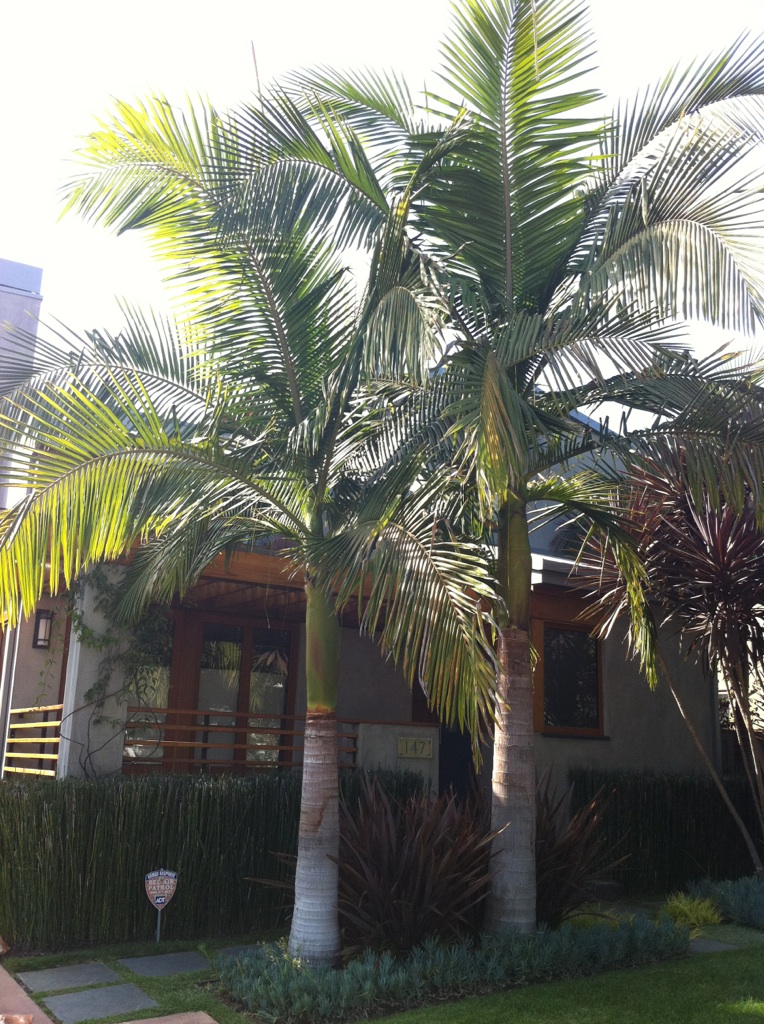
Piccabeen palm or bangalow palms is known more commonly here as king palm.
Where it grows wild in rain forests of eastern Australia, the piccabeen or bangalow palm, Archontophoenix cunninghamiana, is a strikingly elegant tree that gets to about fifty feet tall on a clean, slender trunk. The six to ten foot long feather fronds (pinnate leaves) form a light but distinctive canopy about ten to fifteen feet broad. Smooth green petioles (leaf stalks) encase the upper few feet of crownshaft, eventually peeling away cleanly to reveal the smooth trunk as it grows below. A juvenile king palm does not bloom, but eventually flaunts adulthood with softly pendulous ‘graduation’ tassels of profuse but tiny purple tinged white flowers. Locally, this palm is known more commonly as the king palm, and does best as a large houseplant or where it is protected from frost. Outdoors, it seem to be happiest close to the San Francisco Bay where it is somewhat insulated by all the water, but can unfortunately get smacked about by the wind there. A mature tree is somewhat more tolerant to frost than a young tree is, but can be damaged or even killed if it gets cold enough. King palm fortunately does well in the partial shade of larger adjacent trees or buildings that might shelter it from frost. However, it can not be pruned down for clearance from higher trees, ceilings or any other overhead obstruction (including utility cables), so should be planted where it has plenty of room to grow vertically, or where no one will mind it getting removed when it gets too tall after many years. Unlike most other palms, king palm does not transplant easily when mature. It has no problem getting planted from a pot to a larger tub or planter, or into the ground. Once in the ground though, it is there to stay.
Canary Island date palm is the biggest and boldest.
The biggest and boldest of the common palms is the Canary Island date palm, Phoenix canariensis, which can get more than sixty feet tall and nearly forty feet wide, with a full canopy of gracefully arching deep green fronds. A young tree actually spends the first many years as a shrubby plant while the base of the trunk develops. Fronds get longer and spread broader every year until the trunk gets big enough to elongate. Vertical growth then accelerates somewhat, but the canopy gets no broader.
Most trees are female, eventually producing ornately orange but messy clusters of inedible dates. Male trees eventually get a bit taller, but are not quite as graceful and bloom with unimpressive dusty tan flowers.
Old deteriorating fronds need to be pruned away close to the trunk. Petiole bases of the most recently removed fronds are often carved into ‘pineapples’ to leave a bit of support directly below the canopy. Removed fronds leave a distinctive pattern on the trunk.
Only a few of the many different palms that can be grown locally are actually common. The Canary island date palm and the Mexican fan palm, which had historically been the most common palms, have unfortunately given palms a bad reputation. Both get too large for small gardens, and need costly maintenance when they grow out of reach.
Since the late 1980s, the formerly uncommon queen palm has become the most common palm. Although it too eventually grows beyond reach, it is still more proportionate to home gardens while young. It has a relatively narrow trunk that is partially ‘self-cleaning’ (which means that old fronds, or leaves, often fall off or can be easily peeled off).
The windmill palm and the Mediterranean fan palm, although no more common now than a century ago, are two of the better palms for home gardens, since they do not get too large, and are somewhat easy to maintain. The Mediterranean fan palm has several sculptural trunks that curve out randomly from the base. Sharp teeth on their petioles make pruning a challenge, but not impossible.
The windmill palm has a straight solitary trunk that is distinctively hairy where old fronds get pruned away. It eventually grows out of reach, but takes many years to do so. By that time, many people allow beards of old fronds to accumulate on the trunks overhead instead of bothering to keep them pruned.
The desert fan palm, which is the only palm that is native to California, is very similar to the Mexican fan palm, but is about twice as stout and half as tall, with a fluffier canopy. Because it grows slower and stays smaller, it would be a better palm for urban gardens, except that it does not like to be watered regularly when mature. It really prefers warmer and drier climates.
Pindo palm and Mexican blue palm would also be great palms for urban gardens, but grow rather slowly before getting big enough to get noticed. In some climates, pindo palm produces strange and messy, but sweet and tasty fruit. Mexican blue palm is one of the most resilient palms, and blooms with really cool long floral tassels that a can drag on the ground from short trees.
‘Feather’ palms, like Canary Island date palm, queen palm and pindo palm, have pinnate (and generally compound) leaves, with small leaflets arranged on solitary midribs. Their fronds must be removed as they deteriorate.
‘Fan’ palms, like Mexican fan palm, Desert fan palm and windmill palm, have palmate leaves, centered around the distal termini of solitary petioles. These are most often pruned away, leaving distinctive patterns of petiole bases, but can alternatively be left to accumulate into thick beards of thatch.
Mexican fan palms are sometimes ‘shaven’ of their petiole bases to expose elegant lean trunks, although the procedure is intensive and expensive. Desert fan palms and some Mexican fan palms drop their own beards naturally.
Mexican fan palm is also known as the skyduster palm.
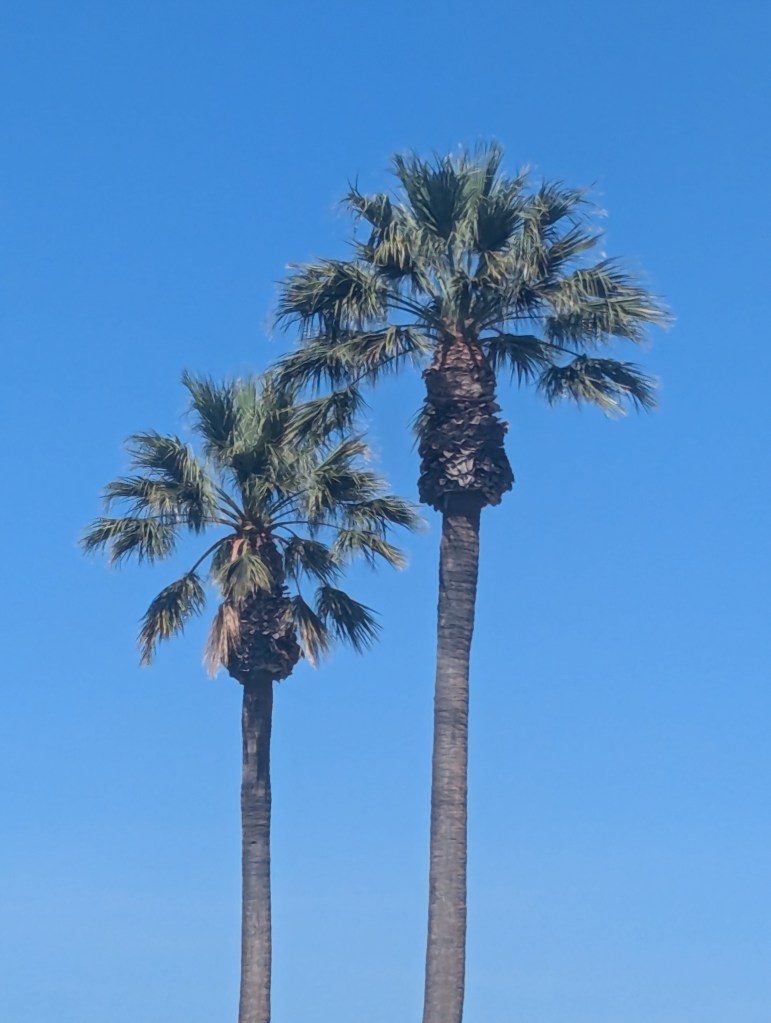
It does not take long for Mexican fan palm, Washingtonia robusta, to get too big for most of the spaces it so often self sows its abundant seed into. The attractive lush foliage looks innocent enough, although the long petioles (leaf stalks) have nasty teeth. As trees get tall enough to get out of the way, they also get too big to manage, eventually reaching a hundred feet tall on elegantly curving trunks. No matter how tall they get though, their canopies always stay about eight feet wide. The problem is that the maintenance of such tall and aggressive trees can be costly.
Beards of old leaves can be allowed to accumulate on the trunks, but are combustible and can get infested with rats. Old leaves are more often pruned off, leaving a distinctive pattern of petiole bases. Old leaves can alternatively be ‘shaven’ to expose elegant bare trunks.
California fan palm, Washingtonia filifera, is the only palm that is native to California. It is naturally exclusive to very distinct ecosystems, though. It inhabits isolated riparian oases of the Colorado Desert. Some also inhabit the Mojave Desert and the Sonoran Desert. It prefers arid warmth. Unfortunately, it may not perform as well within milder climates here.
Otherwise, it is a stately palm that is more adaptable than most are to formal landscapes. It resembles Mexican fan palm, but is shorter and stouter, with a fluffier canopy. It tends to stand straighter, with neatly bare gray trunks. Groomed trees rarely retain petiole stubble. Alternatively, they are handsome, although combustible, with full beards of dried leaves.
California fan palm grows about fifty feet tall, and taller in the wild. Its canopy may be ten to fifteen feet wide. If flattened, its fronds, or complete leaves, might be more than ten feet long. Stiff petioles, with rigid and sharp teeth, are a bit more than half of their total length. The species name filifera describes filaments that hang from the clefts of fronds, and new bud growth.
Palm trees qualify as trees only because of their size and form. The most familiar sorts here develop trunks, and many grow quite tall. The smallest houseplant palms can grow as tall as dwarf citrus trees. Mexican fan palm can grow nearly a hundred feet tall. Palms are monocots, though, so are not actually woody. Technically, they are herbaceous trees.
Palm trees share this distinction with several other herbaceous trees. Banana tree trunks are just tightly rolled leaves. Tree ferns elevate their growth on roots that grow downward through rotting stem growth. Neither banana trees nor tree ferns can generate branches. Sago palms, cabbage trees and arboriform yuccas develop branches, but without wood.
Some palm trees develop a few trunks, but almost none develop branches above grade. Date palms can, but rarely branch. Doum palms typically branch, but are extremely rare. Any other branching palm trees are either aberrative or not really palm trees. Palm trunks do not grow wider as they grow taller. Adventitious roots can become buttressed, though.
All palm trees are evergreen, with either pinnate or palmate foliage. Feather palms have pinnate foliage. Each leaf consists of a central rachis that supports many narrow leaflets. Fan palms have palmate foliage. Each leaf radiates from the terminus of its stout petiole. Both basal leaflets of feather palms and petioles of fan palms are typically horridly spiny.
Since palm trees can not branch, they are not conducive to pruning to direct their growth. Their big but solitary terminal buds grow only upward and maybe away from shade. Any that reach high voltage cables can not go around, so necessitate removal. Clearance for overhanging obstacles is a major consideration for situating new palms. Some grow fast.
While unconducive to directional pruning, most palm trees benefit from grooming. Only a few shed their old foliage naturally. Most get shabby by retaining it. Many, particularly fan palms, eventually become combustible or infested with rodents. However, some may be visually appealing with neat beards of old foliage. Only arborists can groom large palms.
Palms take commitment. Some of the most popular grow too big for their situations. Most grow so tall that only arborists can maintain them. None are conducive to pruning to limit their natural height. Individual palm trunks rely on their single terminal buds, which grow only upward. Diversion is not an option for any palm that encroach into electrical cables.
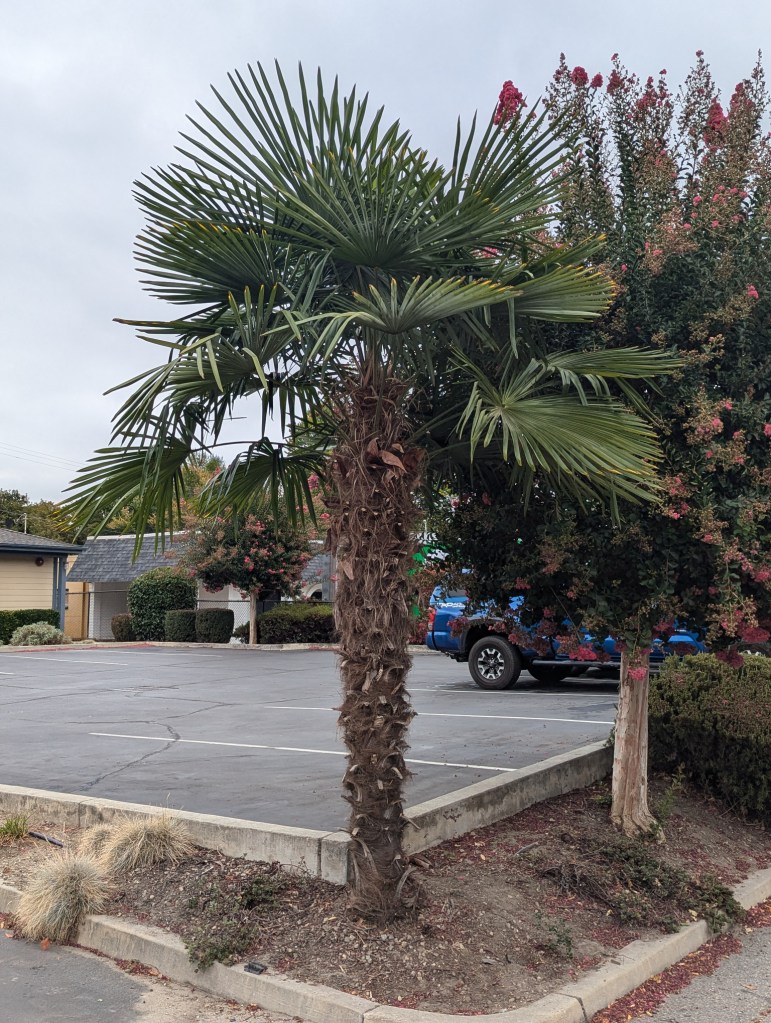
Windmill palm, Trachycarpus fortunei, is one of the more complaisant of palms. It can not grow around utility cables, but otherwise does not grow obtrusively big. Young trees can grow fast to fifteen feet tall, but then grow slowly to double their height. Only a few elderly trees grow as tall as forty feet. Their foliar canopies are generally less than ten feet wide.
Trunks of windmill palms are distinctively shaggy. Pruning dead fronds as closely to their trunk as possible promotes a neater appearance. Because growth decelerates with age, trunk shag is typically wider higher up. Trunks are about half a foot wide, but seem twice as wide since they are so shaggy. Gathering seed from pollinated female trees is simple.
Mexican fan palm, Washingtonia robusta, is the most familiar palm throughout most of California. It is most typically groomed to remove deteriorated leaves without removing the associated toughly fibrous petiole bases that form a neat lattice-like sweater of stubble around its trunks. Some are groomed to also remove the stubble, leaving a clean shaven and leaner looking trunk. Some are shaven only part way up, with a sweater higher up. Without grooming, or if grooming discontinues, some accumulate beards of deteriorated leaves. Although generally harmless, such beards are combustible and can be infested with rats. On rare occasion, they become dislodged from their trunks and fall. They are dangerously heavy and very messy. This silly looking Mexican fan palm was groomed part way up, and then neglected long enough to accumulate a significant beard. The beard then fell, leaving the bare trunk exposed. Only the few lowest of the old leaves remain below where the beard was. A new beard is now forming above.
Queen palm, Arecastrum romanzoffianum, was an uncommon palm until it suddenly became very popular and almost too common through the 1990s. By that time, selective breeding produced the standardized modern variety, which is a bit greener, fluffier and more vigorous than most old specimens. Although it is a bit more genetically conformative than old specimens, it still exhibits genetic variability. Unless some are cloned by tissue culture, all are grown from seed. Some grow slower, so stay shorter. Some develop unusually plump trunks. Some are unusually floppy. This one is just weird. Its foliar canopy is so strictly narrow that it resembles the locally rare Andean wax palm, Ceroxylon quindiuense. Perhaps it actually is an Andean wax palm! A pindo palm, Butia capitata, lives in the associated front garden, and it is not exactly common.
queen palm, Arecastrum romanzoffianum or Andean wax palm, Ceroxylon quindiuense or something else?
Many years ago and before I started writing my gardening column in response to all the horticultural misinformation that I had been observing in the San Jose Mercury News, I heard some of the most idiotic commentary I have ever heard about palms on the radio. I do not remember what radio station it was broadcast from, but it was likely in San Jose. The commentator was expressing his disapproval of the many mature palms that were being incorporated into public landscapes there at the time. He started by stating that, “There are two kinds of palms . . . ” Well, that certainly got my attention. He continued to say, ” . . . the tall skinny kind and the short fat kind.” Wow, I can not forget a comment like that. I knew that he was referring to Mexican fan palm and Canary Island date palm, which were and probably still are the most common palms in San Jose. Also, they were the two species that were so commonly installed into public landscapes at the time. There was no mention of queen palm, windmill palm, Mediterranean fan palm or California fan palm, all of which also inhabit San Jose. Since then, queen palm and the formerly rare pygmy date palm have become more common than they had been. Hesper palm remains rare. I brought three distinct species of bamboo palm from Los Angeles, and would like to bring a few more of the palms that perform well there, even if they do not perform so well here. I happen to be fond of the few types of king palm. I very much want to procure Bismarck palm like this one. Although still uncommon in Los Angeles, it is not completely rare. No one knows how well it performs here because no one has tried it yet.





 Tony Tomeo