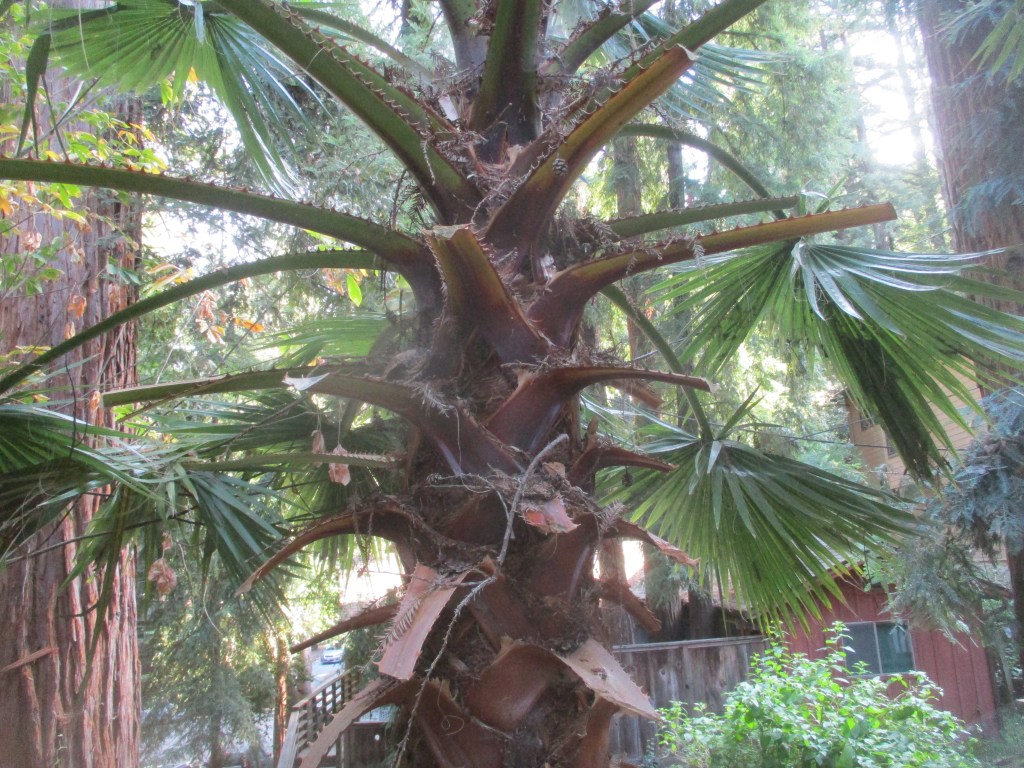
Six on Saturday: Palm Springs

Palms spring up anywhere they want to. Only the fourth and sixth of my Six on Saturday are not feral. Incidentally, the last three are not my pictures; and Brent sent the last two. His curbside Mexican fan palm is at least one of the parents of my pair of seedlings here.

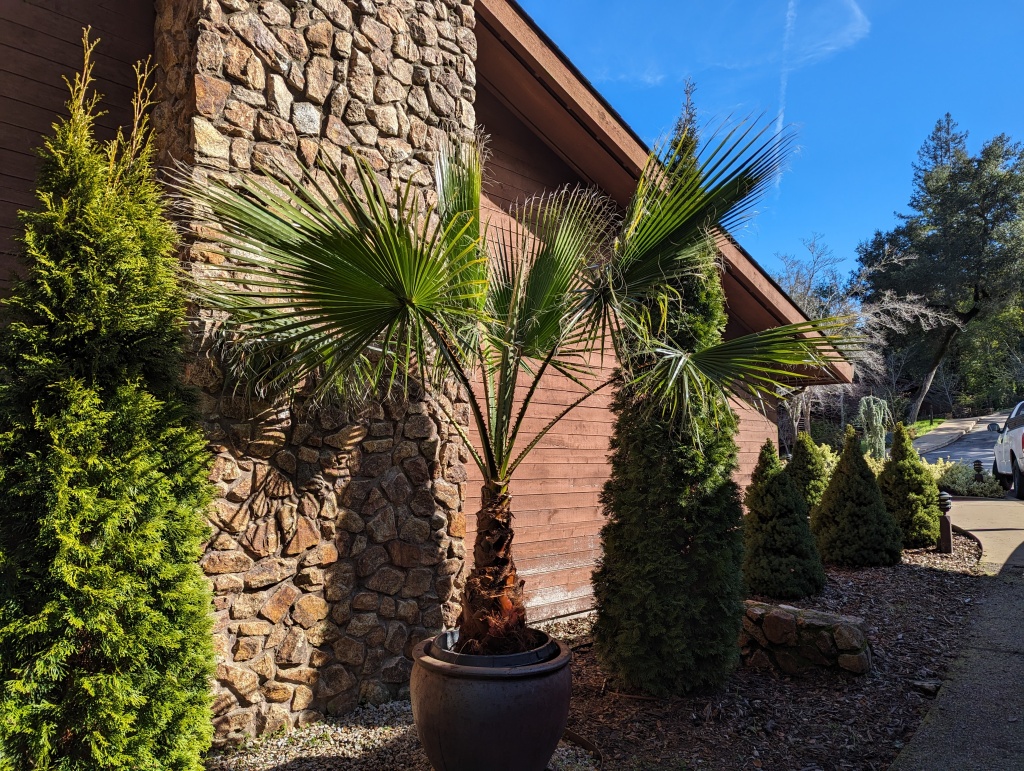
1. Washingtonia robusta, Mexican fan palm, which I wrote about earlier, was too pretty to stay in the recovery nursery where no one can see it. We put it here temporarily, until a pup from the Agave ovatifolia, whale’s tongue agave that bloomed and died here, gets large enough to replace it. It is canned within the big pot for ‘efficient’ removal, but is so heavy that I have no idea of how to get the can out of its pot. It will be a bit heavier later.
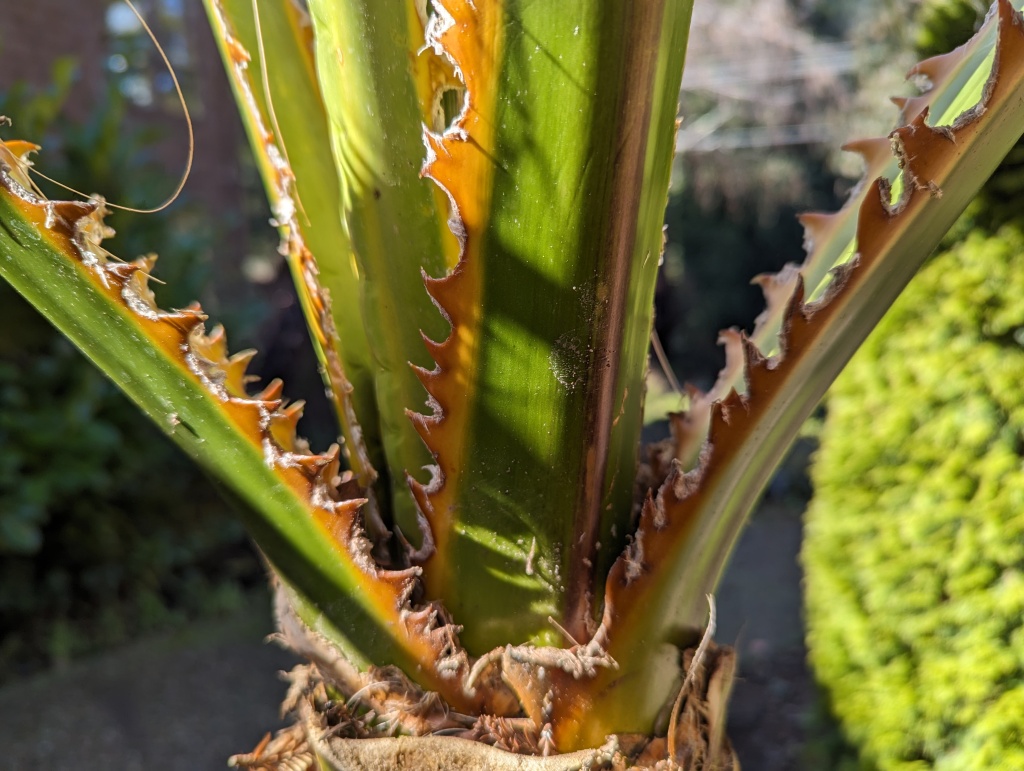
2. Wicked spines on its petioles contribute to the difficulty of relocating this heavy palm.
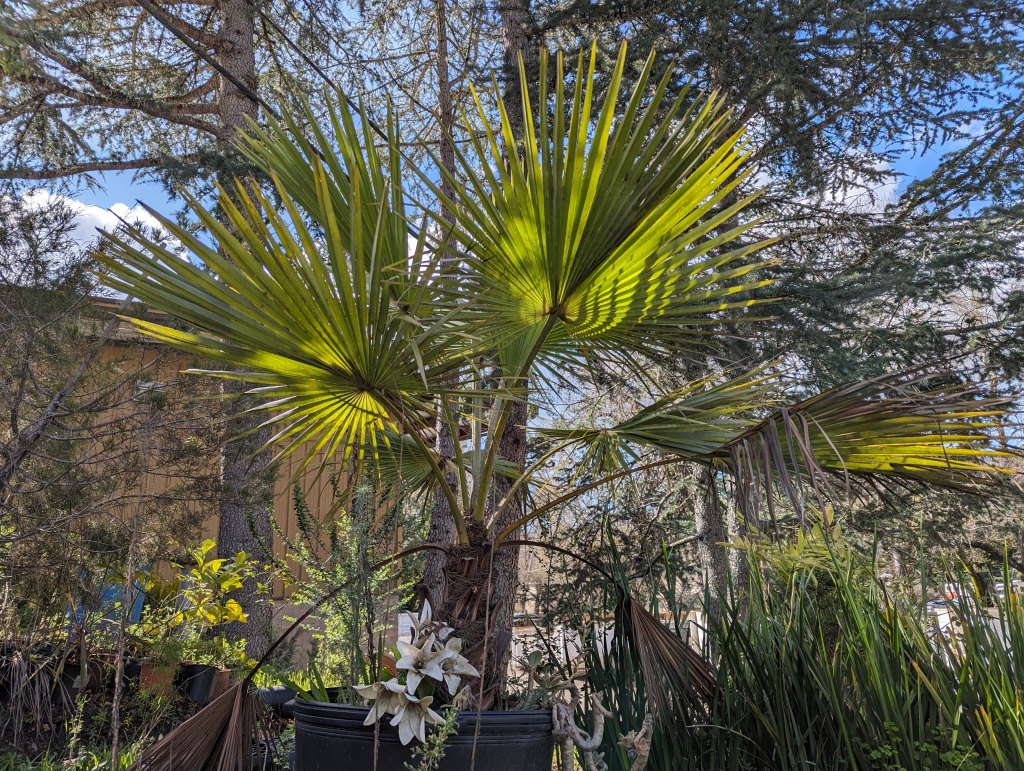
3. Trachycarpus fortunei, windmill palm is also too pretty to stay unseen in the nursery. It will also get groomed and relocated temporarily to a landscape next week. This young palm grew in the garden of the mother of childhood friends, so I am very protective of it.
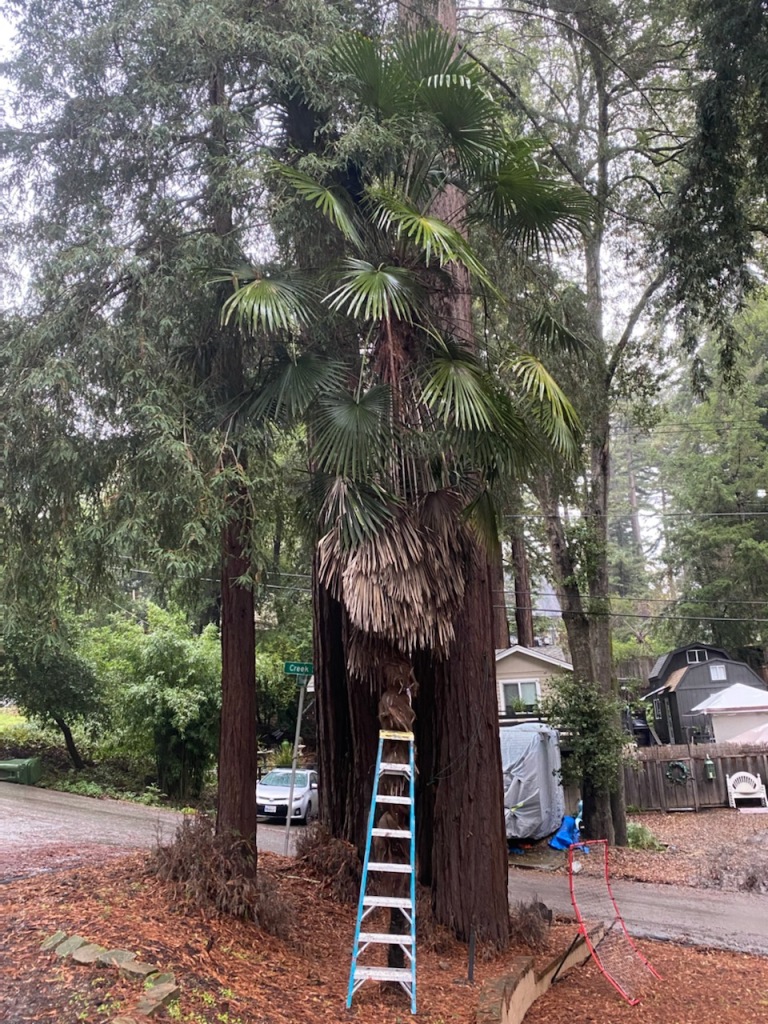
4. Palms and redwoods do not mix well. A colleague wants this windmill palm gone. It is about twenty four feet tall. That ladder is eight feet tall. It will be difficult to relocate, but I do not want it cut down and killed. Like the others, I have no idea of what to do with it.
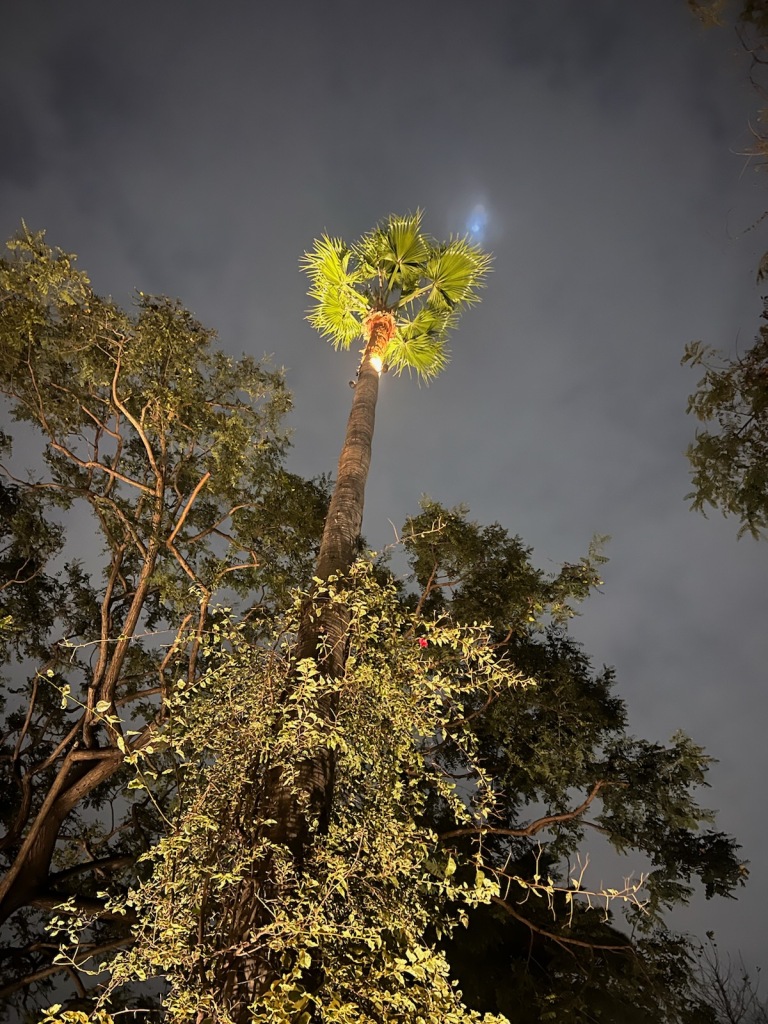
5. Brent’s curbside Mexican fan palm looks embarrassed with its silly uplighting. That is the moon above. This palm, which is a Memorial Tree for Brent’s brother, was about ten feet tall when relocated here because it grew under electrical cables several blocks away.
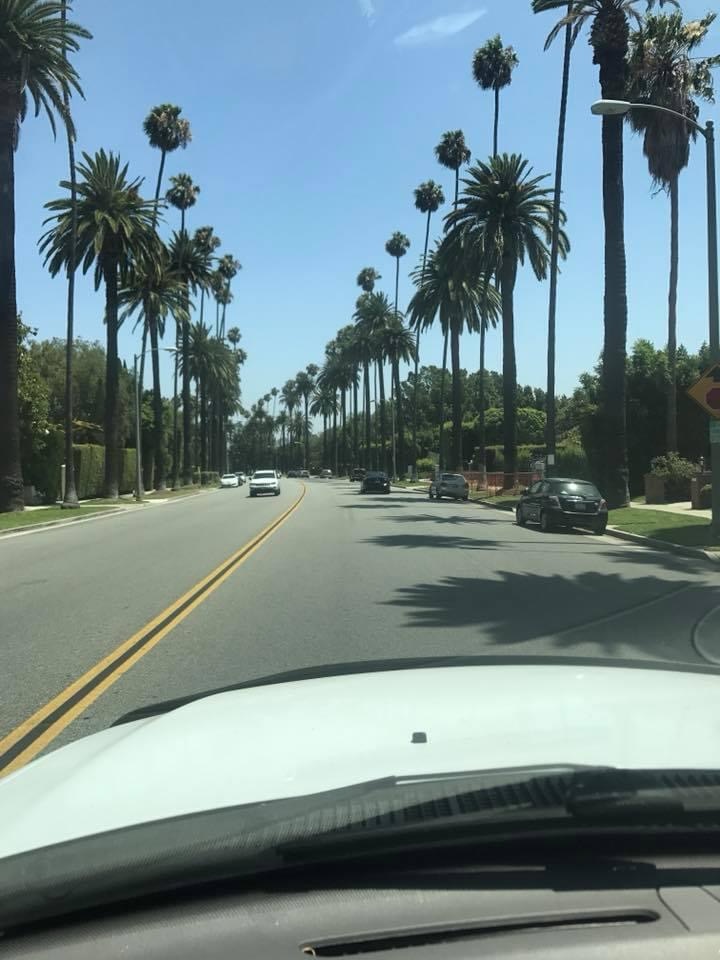
6. Bedford Drive, nearer to the original location of Brent’s curbside Mexican fan palm, is flanked by very old and alternating Mexican fan palms and Phoenix canariensis, Canary Island date palms. They were grandly uniform until the Canary Island date palms began to succumb to pink rot during the 1980s. The Beverly Hillbillies started their shows with a scene of their arrival in town on a similarly flanked street three blocks to the northeast.
This is the link for Six on Saturday, for anyone else who would like to participate: https://thepropagatorblog.wordpress.com/2017/09/18/six-on-saturday-a-participant-guide/

No Bad Habit

Washingtonia robusta, Mexican fan palm

Technically, this one is different. I did not get it from a situation that it needed to be removed from at work, and then can it because I did not want it to be discarded. I did not grow it from seed or cutting that I ‘borrowed’ from a landscape somewhere else. I did not ‘borrow’ it from Brent’s gardens at the Jungalow. I did not find it for free on Craigslist.

I found it for free on the Marketplace of Facebook, which is NOT Craigslist or any other familiar source. Therefore, technically, it is not a bad habit.

It is a Mexican fan palm, Washingtonia robusta. It was too appealing to ignore. I noticed its post several days ago, but did not respond immediately. I thought that someone else would claim it if I ignored it long enough. No one claimed it; so it is here now. Actually though, I am very pleased with it.

It came from the Willow Glen neighborhood of San Jose, so is accustomed to excellent soil and climate. Its species is remarkably adaptable though. It will be as satisfied with the slightly cooler climate and sandier soil here. I will need to provide it with plenty of water while it disperses its new roots. It is only canned now because the situation that it will be installed into is not yet ready for it. A few deteriorating black locusts and box elders will need to be pruned or removed first.

As it recovers from transplant, the presently healthy leaves will likely desiccate and need to be pruned away. I will leave them until they do so because they may not, and they help to sustain new root growth and dispersion. The process is actually less stressful through the cool and rainy season of winter.

King Palm

King palm prefers frostless climates of Southern California.

Where it grows wild in rain forests of eastern Australia, the piccabeen or bangalow palm, Archontophoenix cunninghamiana, is a strikingly elegant tree that gets to about fifty feet tall on a clean, slender trunk. The six to ten foot long feather fronds (pinnate leaves) form a light but distinctive canopy about ten to fifteen feet broad. Smooth green petioles (leaf stalks) encase the upper few feet of crownshaft, eventually peeling away cleanly to reveal the smooth trunk as it grows below. A juvenile king palm does not bloom, but eventually flaunts adulthood with softly pendulous ‘graduation’ tassels of profuse but tiny purple tinged white flowers.

Locally, this palm is known more commonly as the king palm, and does best as a large houseplant or where it is protected from frost. Outdoors, it seem to be happiest close to the San Francisco Bay where it is somewhat insulated by all the water, but can unfortunately get smacked about by the wind there. A mature tree is somewhat more tolerant to frost than a young tree is, but can be damaged or even killed if it gets cold enough.

King palm fortunately does well in the partial shade of larger adjacent trees or buildings that might shelter it from frost. However, it can not be pruned down for clearance from higher trees, ceilings or any other overhead obstruction (including utility cables), so should be planted where it has plenty of room to grow vertically, or where no one will mind it getting removed when it gets too tall after many years.

Unlike most other palms, king palm does not transplant easily when mature. It has no problem getting planted from a pot to a larger tub or planter, or into the ground. Once in the ground though, it is there to stay.

Canary Island Date Palm

Canary Island date palm is the boldest of the common palms here.

The biggest and boldest of the common palms is the Canary Island date palm, Phoenix canariensis, which can get more than sixty feet tall and nearly forty feet wide, with a full canopy of gracefully arching deep green fronds. A young tree actually spends the first many years as a shrubby plant while the base of the trunk develops. Fronds get longer and spread broader every year until the trunk gets big enough to elongate. Vertical growth then accelerates somewhat, but the canopy gets no broader.

Most trees are female, eventually producing ornately orange but messy clusters of inedible dates. Male trees eventually get a bit taller, but are not quite as graceful and bloom with unimpressive dusty tan flowers.

Old deteriorating fronds need to be pruned away close to the trunk. Petiole bases of the most recently removed fronds are often carved into ‘pineapples’ to leave a bit of support directly below the canopy. Removed fronds leave a distinctive pattern on the trunk.

Palms Are A Californian Tradition

Mexican fan palm might still be the most common palm here, but is not native.

Only a few of the  many different palms that can be grown locally are actually common. The Canary island date palm and the Mexican fan palm, which had historically been the most common palms, have unfortunately given palms a bad reputation. Both get too large for small gardens, and need costly maintenance when they grow out of reach.

Since the late 1980s, the formerly uncommon queen palm has become the most common palm. Although it too eventually grows beyond reach, it is still more proportionate to home gardens while young. It has a relatively narrow trunk that is partially ‘self-cleaning’ (which means that old fronds, or leaves, often fall off or can be easily peeled off).

The windmill palm and the Mediterranean fan palm, although no more common now than a century ago, are two of the better palms for home gardens, since they do not get too large, and are somewhat easy to maintain. The Mediterranean fan palm has several sculptural trunks that curve out randomly from the base. Sharp teeth on their petioles make pruning a challenge, but not impossible.

The windmill palm has a straight solitary trunk that is distinctively hairy where old fronds get pruned away. It eventually grows out of reach, but takes many years to do so. By that time, many people allow beards of old fronds to accumulate on the trunks overhead instead of bothering to keep them pruned.

The desert fan palm, which is the only palm that is native to California, is very similar to the Mexican fan palm, but is about twice as stout and half as tall, with a fluffier canopy. Because it grows slower and stays smaller, it would be a better palm for urban gardens, except that it does not like to be watered regularly when mature. It really prefers warmer and drier climates.

Pindo palm and Mexican blue palm would also be great palms for urban gardens, but grow rather slowly before getting big enough to get noticed. In some climates, pindo palm produces strange and messy, but sweet and tasty fruit. Mexican blue palm is one of the most resilient palms, and blooms with really cool long floral tassels that a can drag on the ground from short trees.

‘Feather’ palms, like Canary Island date palm, queen palm and pindo palm, have pinnate (and generally compound) leaves, with small leaflets arranged on solitary midribs. Their fronds must be removed as they deteriorate.

‘Fan’ palms, like Mexican fan palm, Desert fan palm and windmill palm, have palmate leaves, centered around the distal termini of solitary petioles. These are most often pruned away, leaving distinctive patterns of petiole bases, but can alternatively be left to accumulate into thick beards of thatch.

Mexican fan palms are sometimes ‘shaven’ of their petiole bases to expose elegant lean trunks, although the procedure is intensive and expensive. Desert fan palms and some Mexican fan palms drop their own beards naturally.

Mexican Fan Palm

Mexican fan palm is the most familiar palm of California.

It does not take long for Mexican fan palm, Washingtonia robusta, to get too big for most of the spaces it so often self sows its abundant seed into. The attractive lush foliage looks innocent enough, although the long petioles (leaf stalks) have nasty teeth. As trees get tall enough to get out of the way, they also get too big to manage, eventually reaching a hundred feet tall on elegantly curving trunks. No matter how tall they get though, their canopies always stay about eight feet wide. The problem is that the maintenance of such tall and aggressive trees can be costly.

Beards of old leaves can be allowed to accumulate on the trunks, but are combustible and can get infested with rats. Old leaves are more often pruned off, leaving a distinctive pattern of petiole bases. Old leaves can alternatively be ‘shaven’ to expose elegant bare trunks.

Palm Reading

This is painful to look at.

Not everyone is interested in horticulture. Most enjoy other interests, such as sports, arts or cooking. They may know no more about horticulture than a garden enthusiast knows about the Seattle SeaMonkeys. Unfortunately though, some are not as aware of their lack of horticultural expertise as garden enthusiasts are aware of their lack of proficiency with other interests.

For example, I can grow just about any fruit or vegetable or perhaps grain that can grow here, but if I can not eat some of them fresh, I am aware that I do not know how to cook them. I must rely on someone who does know how. Yet, someone who is proficient with cooking is likely to believe that it is practical to grow fresh vegetables on a kitchen windowsill because it seems so easy on television gardening shows.

Someone I work with found this young Mexican fan palm to be bothersomely obtrusive to a confined situation within which he was working. He is, incidentally, a sports enthusiast. Naturally, as a sports enthusiast, he believed that he was qualified to groom the obtrusive fronds from the trunk of the Mexican fan palm. This was the result.

The necrotic but nonetheless harmless and relatively pliable foliage was removed to expose the wickedly sharp teeth of its rigid petioles, which extended outwardly in all directions from the trunk. This could have been quite dangerous for anyone who might have been so unfortunate as to bump into it. The thorns curve inward, to maximize damage to victims who pull back, which is, of course, the natural response to an encounter with such thorns. It was painful to merely look at! It seriously reminded me that I am no expert on sports or cooking. I pruned the petioles cleanly back to the main trunk.

Palm Springs

Palms and redwoods do not mix.

No, not ‘the’ Palm Springs. It is merely a concept for a new garden. It may not begin to develop for quite a while, and certainly will not begin prior to when the rainy season begins this autumn.

Palms and redwoods do not mix. Technically, they can, but they look silly together. However, there are a few young palms here, and there will be more in the future. Some are very important to me. The pair of Mexican fan palm seedlings came from the mature specimen that Brent scattered some of his brother’s ashes under in front of his home at the Jungalow. The windmill palm came from the childhood home of two of my best friends from the fourth grade. The rare hesper palm was a gift from a now deceased friend. It was stolen and then recovered.

Palm Springs may be developed to accommodate the various palms within their own space, away from the redwoods. The preferred location is a small and relatively mildly sloped plateau on an otherwise steep hillside, where oaks and chaparral species grow wild. A natural spring, if tapped, may be able to provide adequate irrigation. Otherwise, water is available reasonably nearby. Other lush or jungly species can also inhabit this garden. This includes heliconia, giant bird of Paradise, canna, calla, blue ginger, cup of gold vine, Philodendron selloum, four cultivars of angel’s trumpet and three distinct species of bamboo palm that are already here. The garden would not be visible from either of the nearby roads until some of the palms get very tall a few decades later. I doubt that anyone would mind if they could see such odd vegetation anyway.

Ultimately, Palm Springs could be like a bit of Southern California within its own confined oasis almost hidden above the redwoods.

Mexican Fan Palm

Palms are familiar within Californian landscapes.

California fan palm is the only palm that is actually native to remote regions of California. However, Mexican fan palm, Washingtonia robusta, is much more common. Technically, its native range is not far away. It had been the most popular of palms prior to the 1990s. It is more adaptable to more populous climates. Also, it naturalizes within some regions.

Mexican fan palms grow vigorously while young. Growth decelerates with maturity. Very old trees can grow very slowly without completely stagnating. Wild specimens may have potential to survive for a few centuries with such slow growth. Cultivation and irrigation of home gardens may limit this potential. Few local specimens are more than a century old.

Mexican fan palms are taller and slimmer than California fan palms. Their trunks lean as prevailing wind blows them. They easily grow fifty feet tall, and eventually get a hundred feet tall. Such tall and leaning trunks can suspend their canopies over adjacent gardens. Their pleated and palmate leaves are about three feet wide, on petioles with nasty teeth.

Palm Trees Are Specialized Trees

Many palms have palmate leaf form.

A tree is a woody perennial plant with a single tall trunk and branches. Banana trees and tree ferns lack both branches and wood. Arboriform yuccas develop branches but are not woody. Palm trees are no better. Some develop a few trunks but without branches. Doum palms that develop branches are extremely rare in California. No palm is actually woody.

Palms are trees only because of their size and form. In other words, most are big and tall. The most compact of palms are no smaller than Japanese maples, which are also trees. Realistically though, palms are merely large to very large perennials. They are monocots like grass, bamboo or cordyline. Some horticulturists classify them as herbaceous trees.

Only California fan palm is native to California, and only to remote desert oases. All other palms are exotic. Spanish Missionaries imported date palms to produce dates within arid regions. Only a few other palms were similarly utilitarian. The majority are desirable only for their distinctive form, texture and evergreen foliage. They are genuinely ornamentals.

All palms are evergreen. Fan palms produce rounded palmate leaves on sturdy petioles. Feather palms produce elongated pinnately compound leaves on sturdy rachises. Many fan palms also produce wicked teeth on their petioles. Many feather palms also produce dangerously sharp spines on the bases of their rachises. Even lush palms can be mean.

Not many palms get big enough to provide much shade. Many types are shady in groups though. Without branches, palms are not conducive to containment or redirection. Some eventually grow tall enough to shade neighboring gardens instead. Unfortunately, palms that encroach too closely to high voltage cables require removal. They do not go around.

Palm trunks do not widen as their canopies grow higher above. Palms with plump trunks grow at ground level for several years before they can launch. Their single terminal buds must first grow as wide as their mature trunks will ever get. Their foliar canopies likewise grow no broader than they were when they launched. They only grow higher. Most large palms develop distended basal adventitious roots that can get quite wide, though.