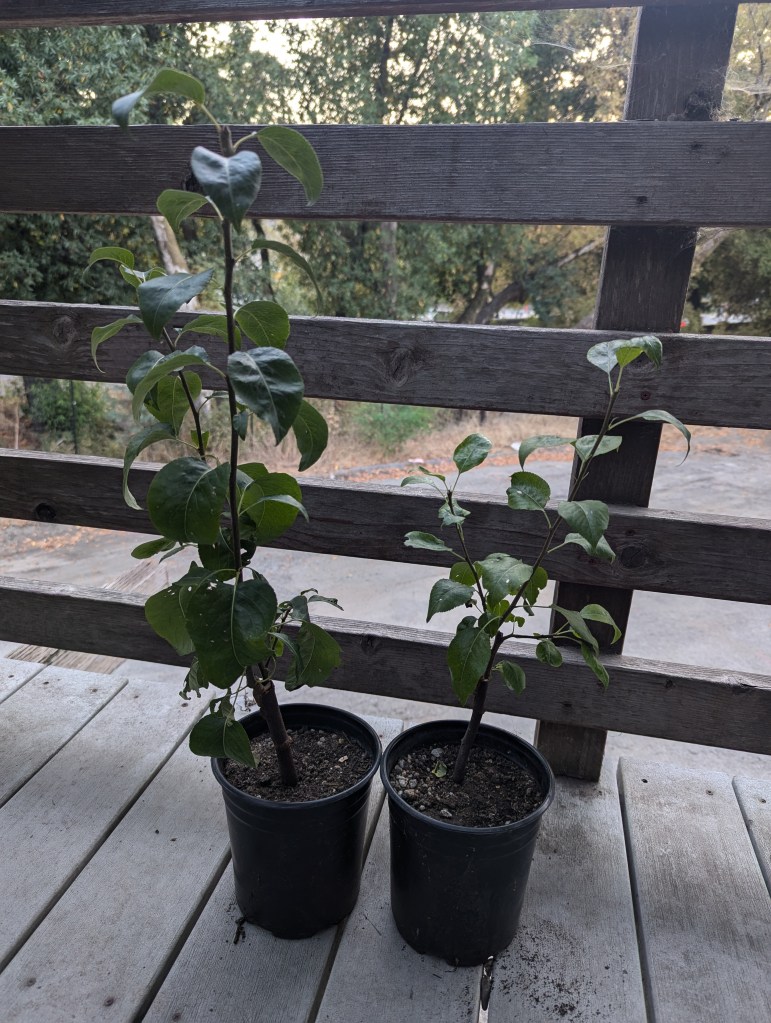
‘Beurre d’Anjou’ is to the left. ‘Seckel’ is to the right.
Two new pear trees have grown well this year after being grafted last winter.
‘Seckel’ is to the right in the picture above. I acquired its scion from the Scion Exchange of the Monterey Bay Chapter of the California Rare Fruit Growers on the first of February. It was one of only two cultivars that I wanted to graft onto one of only three quince understock trees that were available at the time.
‘Beurre d’Anjou’ is to the left in the picture above. Because it was unavailable from the Scion Exchange, and also because it was the other of only two cultivars that I wanted to graft, I purchased its scion online.
I wanted to retain one of the three quince understock trees for its fruit, and possibly for cuttings for understock for more pear trees in the future. However, more copies of it grew from cutting from the two trees that were grafted last winter. Now, I have a third quince tree to graft a pear scion onto this winter. I will most likely procure a scion of ‘Bartlett’, because, a very long time ago, that was the most common cultivar within the orchards of the Santa Clara Valley.
(This is an old article with outdated information.)
The vast orchards that formerly inhabited the Santa Clara Valley were here because this is among the best places on Earth to grow apricots, cherries, prunes, almonds and walnuts. Actually, there are not many fruit trees that would prefer to be somewhere else. Home gardens continue to produce the many traditional fruits, as well as many other types of fruit that were not so common in the orchards; such as citrus, figs, apples, pears, persimmons, avocados, peaches, nectarines and too many more to fit into a brief list.
Those of us who enjoy growing fruit trees do not need to be reminded of how well they do here. Some trees produce too much and can become overwhelming. It is not always possible to can, dry, freeze or share with friends and neighbors all the fruit from the more productive trees. Leaving the fruit out in the garden is not only wasteful, but also bad for the garden, attractive to vermin, very messy and smelly.
Besides, there are other people in the community who could use it. During this past year, Village Harvest has harvested from local gardens, and distributed to those who can use the produce, approximately 156,000 pounds of fruit. The record for distribution of produce may be exceeded this year after apples, persimmons and citrus are harvested.
Volunteers make Village Harvest possible, by collecting excessive fruit from home gardens. Some of the people with productive trees like to retain some of the fruit. Volunteers are also welcome to take some of the fruit. The vast majority of fruit gets dispersed to others in the community who can use it.
The next apple harvest event in the Cupertino orchard on October 22 may no longer be able to accommodate additional volunteers; but the next major apple harvest in the Woodside Orchard on October 29 may still be in need of volunteers. Harvests take about three and a half to four hours, between 9:00 a.m. and 12:30 p.m.. Volunteers must be at least sixteen years old.
Volunteers can register for harvest events, or get more information at villageharvest.org. Early registration is recommended since space is limited. Volunteer instructions, including meeting location addresses will be e-mailed to volunteers a few days prior to each event. Those of us with excessively productive fruit trees who happen to be within range of harvest events can possibly make arrangements to get fruit harvested.
The next few neighborhood harvests will be on October 25 in Central San Jose, October 31 in Sunnyvale, November 1 in Central San Jose, November 6 in Mountain View, November 8 in Central San Jose, and November 14 in Sunnyvale. Sunnyvale harvests begin at 8:00 a.m.. Some harvests are repeated. For example, the Central San Jose harvests are weekly on Tuesday.
(This article posted in 2012, so much of its information is now outdated.)
How could so many public gardens throughout the area get all the work that needs to be done in winter? There are roses to prune in both of the Rose Gardens of San Jose. Fruit trees in the Historic Orchard of Guadalupe Gardens need to be pruned. Even Village Harvest of Palo Alto needs to collect citrus fruits that ripen through winter. All this works gets done only because there are so many generous volunteers to help.
The gardens of Filoli are fortunate to get so many volunteers through the year. Nonetheless, the extra pruning that the deciduous fruit trees need in winter reminds us that more volunteers are often welcome. Not only are there big collections of modern and classic apple and pear trees at Filoli, but many are espaliered onto trellis-like supports. (‘Espalier’ trees are pruned onto trellises, fences, walls or other lateral supports, so that they can attain considerable width without much depth from front to rear, conserving space.)
The New Volunteer Recruitment Open House at Filoli is not until January 21. However, those interested in attending must register in only the next few days, before 4:00 p.m. on January 13! Registration can be arranged at volunteer@filoli.org or by telephoning 650 – 364 8300 extension 300, and leaving one’s name and daytime telephone number. The New Volunteer Recruitment Open House will be from 9:30 to 11:30 a.m. on January 21, at the Visitor and Education Center of Filoli, located at 86 Canada Road in Woodside.
Guests will learn about the many different opportunities to volunteer. More than 1,200 volunteers presently help sustain Filoli in areas such as house and garden self guided docents, member services, visitor services, the Ambassador Program, the Cafe and the Garden Shop.
Besides the sixteen acres of English Renaissance gardens that display an expansive horticultural collection, the 654 acre Filoli property includes a 36,000 square foot residence furnished with an extensive collection of 17th and 18th century English antiques, and is recognized as one of the finest remaining country estates of the early 20th century. More information can be found at http://www.filoli.org.
Properly pruned peartrees produce pears prolifically.
Ancestral species of modern pears grow wild from western Europe and northern Africa to eastern Asia. Long before they were domesticated and developed in China about three thousand years ago, their fruit was eaten by indigenous people. Farther west, dozens of cultivars were developed and popularized in ancient Roman societies. There are now more than three thousand cultivars.
Most pears that are popular in America are descendants of European pear, Pyrus communis. Asian pears, which are mostly descendants of Pyrus X bretschneideri and Pyrus pyrifolia, became a fad in the 1980s, and are still somewhat popular, particularly in California. Asian pears are generally rounder and firmer than the familiar ‘pear shaped’ European pears that soften as they ripen.
There are too many cultivars of pear for all to conform to similar characteristics. All that are grown for fruit are deciduous, and almost all have potential to exhibit remarkable foliar color in autumn. Abundant clusters of small white flowers bloom in spring. Floral fragrance of some cultivars might be unappealing. Semi-dwarf trees can get more than fifteen feet tall, so should be pruned lower.
Pears can be shades of yellow, green, red or brown, and might be blushed or russeted. They can be canned, dried, juiced, or eaten fresh.
Bunches of blackened leaves hanging from blackened stems in otherwise healthy pear trees really are as serious as they look. They probably appeared as new growth was developing in spring, and are still as dead now as they were then. As surrounding foliage colors and falls, the blackened foliage will remain until it gets knocked out by rain and wind in winter, or until it gets pruned out.
Because these dead bits seem to have been scorched by fire, the bacterial infection that causes them is known as ‘fireblight’. Pear, flowering pear and evergreen pear are most susceptible to it. Apple, flowering crabapple, quince, flowering quince, hawthorn, loquat, cotoneaster, pyracantha and photinia are also very susceptible. Some cultivars are more resistant to fireblight than others. Few other members of the ‘rose family’ are rarely infected.
At the base of each dead bit (or toward the supporting limb from dead bits that do not stand upright) is a lesion where the bacteria that cause fireblight infected the stem. These infections not only obstruct vascular activity and kill the distal (outward) portion of the infected stems, but they also spread proximally (inward) to more important limbs, branch unions and even main trunks and roots.
Fireblight is transmitted mostly by bees, and also by other insects, birds, rain and wind, while trees are blooming in spring. It most often infects through flowers, and can also infect where infected debris, particularly falling flower parts, get caught in branch unions. If it infects root suckers, it can infect the roots right away, and kill an entire tree. Root suckers should be pruned away anyway.
There is no remedy for fireblight. Because it is very contagious, all infection should be pruned out. Because infection extends inward from obvious lesions, infected stems should be pruned back at least a foot and a half below (inward from) obvious infection. Sadly, this often disfigures infected trees, sometimes severely. Pruning scraps should be removed from around susceptible trees.
Some say that fireblight should be pruned out in summer. Others say that winter is best. Really though, the only bad time is spring, while weather is warm but still damp, and the trees that are so susceptible to fireblight are active and blooming. The reason for pruning it out in winter is that the disease is inactive while cold. However, it does not get cold enough here to slow it down much.

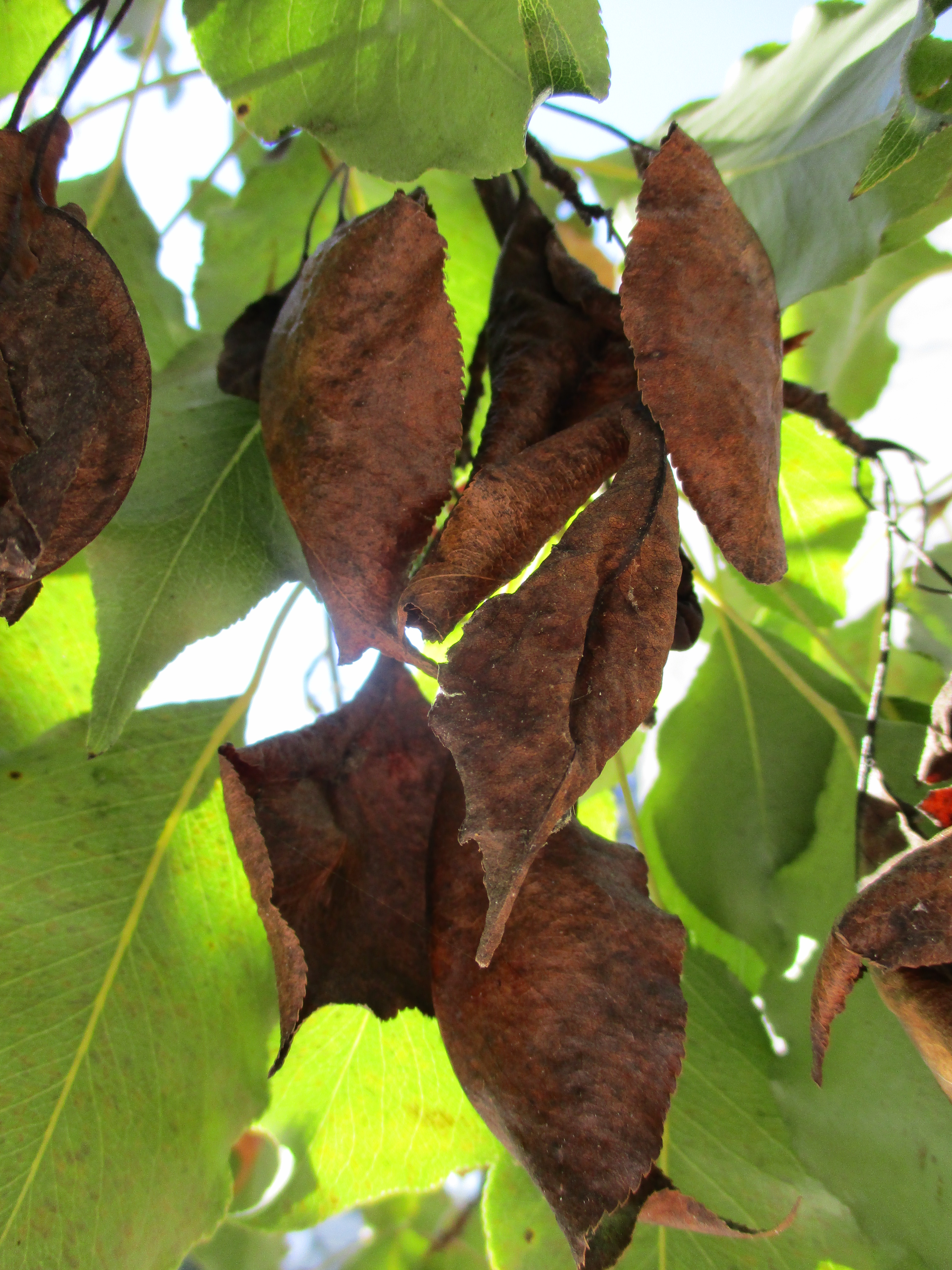 Bunches of blackened leaves hanging from blackened stems in otherwise healthy pear trees really are as serious as they look. They probably appeared as new growth was developing in spring, and are still as dead now as they were then. As surrounding foliage colors and falls, the blackened foliage will remain until it gets knocked out by rain and wind in winter, or until it gets pruned out.
 Tony Tomeo