On the West Coast between British Columbia and Mexico, the largest native fern might be the giant chain fern, Woodwardia fimbriata. In sheltered and damp coastal forests, it can get taller than six feet, although it is typically about three feet tall and wide in home gardens. The lightly colored and almost yellowish green fronds generally stand upright and flare outward from the center. The foliage is doubly lobed and lacy, but quite substantial. The thick rhizomes spread rather slowly. Established plants are remarkably resilient. They can tolerate almost full sun exposure if watered enough. Those in partial shade can tolerate lapses of watering. However, they do not recover too readily from relocation or division.
Ferns are an odd group. They lack the color or fragrance of flowers, or the branch structure of shrubbery, trees or vines. Very few turn color in autumn. They provide only green foliage. Yet, as simple as this seems, the generally evergreen foliage that ferns provide is some of the most distinctive foliage that can be found in the garden.
With few exceptions, ferns are richly deep green. Only a few are lighter green or almost yellowish. The leaves, which are known as ‘fronds’, can be soft and papery, or coarse and tough. The fronds of most ferns are pinnately divided into neatly arranged leaflets; and many ferns have leaflets that are intricately lobed. Some ferns have leaves with more palmate symmetry. A few ferns actually have undivided leaves.
(Pinnate symmetry involves a central midrib or midvein to each leaf, or a central rachis that supports lateral leaflets. Radial symmetry involves multiple midveins or rachi that radiate outward from the centers of individual leaves.)
The Australian tree fern is the largest of the common ferns. It develops a broad canopy of long fronds on top of a trunk that can launch it as high as a two story home. Both the fronds and trunk of the Tasmanian tree fern are shorter and stouter. Other tree ferns are rare. The trunks are not really stems, but are thick accumulations of roots dispersed through decomposed stem tissue.
The staghorn fern is an epiphyte that naturally clings (nonparasitically) to trunks and limbs of trees. The flared upper fronds collect foliar litter that falls from the trees above to sustain the roots within. In home gardens, it is popularly grown on wooden plaques or hung like hanging potted plants, but without a pot.
Some ferns can be grown as houseplants like the classic Boston fern, which cascades softly from a hanging pot. Maidenhair fern is popular for intricate foliage on wiry rachi (leaf stems). Squirrel foot fern has lacy foliage and interestingly fuzzy rhizomes that creep over the edge of a pot.
Since almost all ferns are understory plants that naturally live on or near a forest floor below a higher canopy of trees, they are generally quite tolerant of shade. In fact, most prefer at least some sort of partial shade. This is quite an advantage for spots in the garden that are too shady for other plants. Also, many ferns can disperse their roots into soil that is already occupied by more substantial plants, even if the more substantial plants happen to also be making the particular spot too shady for other plants. In other words, they play well with others.
However, many ferns are more demanding than other plants are in regard to soil quality and watering. They perform best with rich and well drained soil, and regular watering. Sickly ferns generally respond well to fertilizer; but too much fertilizer can burn foliage. Old leaves may need to be groomed out if they do not naturally get overwhelmed by new foliage.
While so many flowers are finishing their bloom and leaving their drying foliage behind, naked lady, Amaryllis belladonna, is just beginning to bloom, naked of any foliage. Clusters of a few to several bright pink flowers stand on bare stems about two feet tall. Individual flowers are about two and a half to three and a half inches long, and resemble lily flowers. Foliage only appears after flowers deteriorate, and lasts only until weather gets warm late in spring. The strap shaped leaves are about a foot to a foot and a half long. Through summer, the two or three inch wide bulbs are dormant and bare, and seem to be dead with their tops visible at the soil surface, but retain fleshy roots below. They should therefore only be dug and divided if they get too crowded or need to be moved.
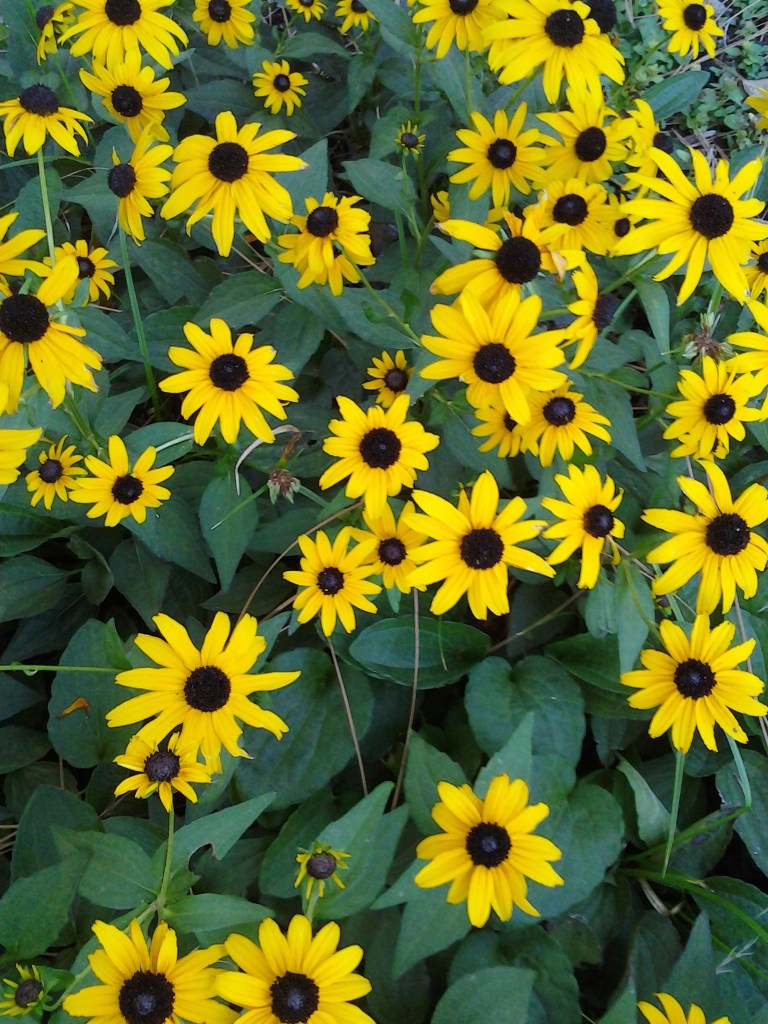
A flower that is so prominent in American culture should have a more appealing name than black-eyed Susan. Even the Latin name, Rudbeckia hirta, sounds bad. Is Becky really so rude? Did she hirt Susan? Well, black-eyed Susan is good enough to be the state flower of Maryland, and is one of the most popular of flowers for prairie style gardens of the Midwest. After all, it naturally grows wild in every state east of Colorado. Here in the West, it is a light-duty perennial that is more often grown as an annual. As a cut flower, it can last more than a week.
In the wild, the three inch wide flowers of black-eyed Susan are rich yellow with dark brown centers, and can stand as high as three feet. The typically smaller but more abundant flowers of modern varieties can be orange, red or brownish orange, on more compact stems. Gloriosa daisies are fancier cultivars, with larger flowers that are often fluffier (double) or patterned with a second color. Individual plants do not get much wider than a foot, with most of their rather raspy foliage close to the ground. All black-eyed Susans bloom late in summer or early in autumn.
Black-eyed Susan, sunflowers and a few of the late warm season annuals and perennials are still blooming, and a few will continue into autumn. By that time, cool season annuals can move in; and some of the deciduous trees, shrubs and vines that turn color for autumn will be doing so. Realistically though, this can be the leanest time of year for color in the garden. Even some of the foliage that is colorful through spring and summer has faded.
There are certainly plenty of flowers in season now. However, not many are colorful. Honeysuckle vine is pleasantly fragrant as it bloom in random phases until the weather gets cooler, but the flowers are only pale yellowish white. Some melaleuca trees bloom profusely enough to make a mess, but are just as pale, and do not even provide fragrance; although some have pretty light pink flowers. Abelia flowers are pink and abundant, but are really not all that flashy against their bronzy foliage.
Some of the more colorful flowers are not quite as reliable. Princess flower, hibiscus, blue hibiscus and mandevilla certainly can bloom in late summer or autumn, but sometimes bloom earlier than expected, so have nothing left for later. The bright red flowers of blood red trumpet vine are quite impressive, but only if they are not obscured by the accompanying foliage. Some roses bloom in phases as late as the weather will allow, but actually, most are done by now.
Fuchsia and angel’s trumpet likewise bloom in a few phases once they get started, but unlike the many cultivars of roses, they are much more reliable for a late bloom phase. Escallonia blooms late with small but colorful flowers, but only if they have not been shorn in the past few months. Shearing deprives them of the blooming stem tips that they had worked most of the year for.
Butterfly bush, tree mallow, cape plumbago, bee balm and several varieties of sage and salvia are among the most reliable plants for late summer or autumn bloom. Even without multiple bloom phases, they just naturally bloom at the end of their growing season, before winter dormancy.
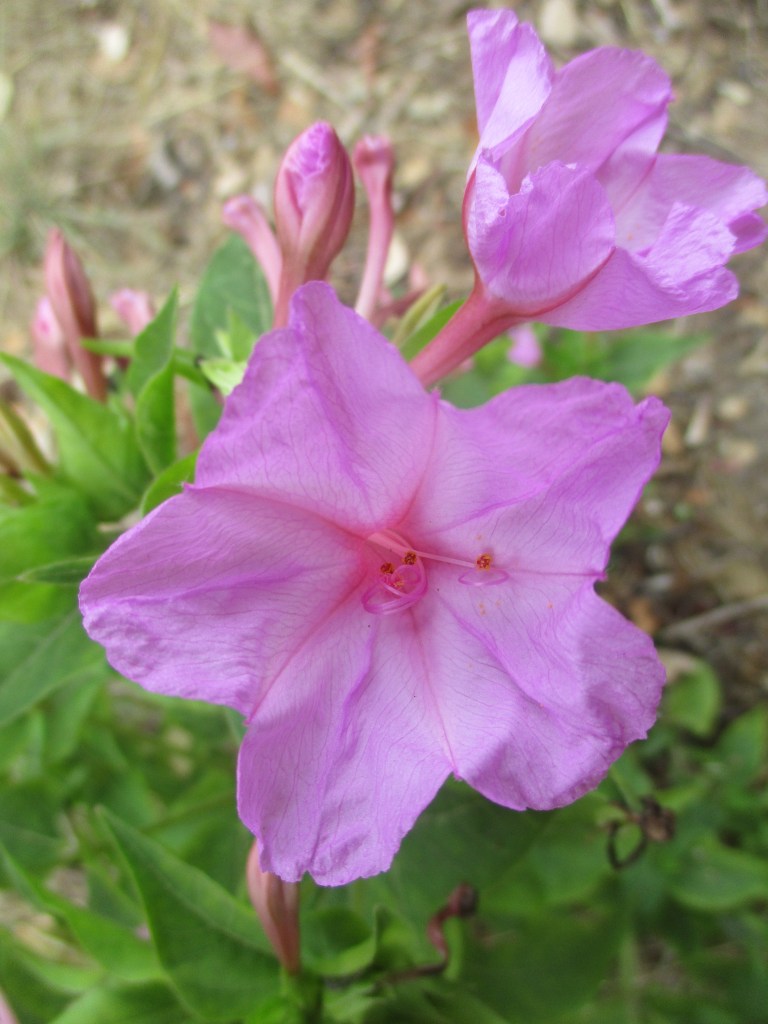
Most who enjoy four o’clock, Miribilis jalapa, do not grow it intentionally. It tends to sneak into gardens from outside, and then bloom too delightfully to be unwanted. It naturalizes, but not aggressively enough to be a weed. New seedlings develop tuberous roots during their first year. They regenerate to produce abundant seed as early as their second year.
Flowers are supposed to open at 4 o’clock. They may open earlier during warm or humid weather. They remain open through the night, and perhaps for part of the morning. Floral color ranges through white, yellow, orange, red, and many tints of pink. Flowers might be striped or spotted with the other colors. Individual plants might bloom with various colors.
Mature four o’clock plants do not get much taller than three feet. They might sprawl twice as broad. Rich light green foliage is quite full, and obscures unexpectedly soft and lanky stems with knobby nodes. Bloom continues through most of summer, but decreases with increased seed development late in summer. All growth above ground succumbs to frost.
Until the patent expires, unauthorized vegetative propagation (cloning) of ‘Angelina’ stonecrop, Sedum rupestre ‘Angelina’, is still illegal. However, it regularly flaunts its own unlawful proliferation wherever dislodged bits of stem can find anything to take root into. It can be just as happy to root into cracked concrete as in bare soil. Yet, it is a surprisingly complaisant small scale ground cover that cascades only several inches over stones, low retaining walls or the edges of planters.
Without getting more than four inches deep, stems root as they creep indefinitely but slowly along the ground. The bright yellowish evergreen foliage and bright yellow flowers that bloom about now contrast nicely with darker green or bronze foliage. Exposed foliage can get blushed with orange in winter. Shabby plants regenerate vigorously after getting pruned back. Pruning scraps sprinkled over bare soil and lightly mulched with finely textured compost will happily but illegally grow into more of the same. ‘Angelina’ stonecrop likes somewhat regular watering, but can survive with less.
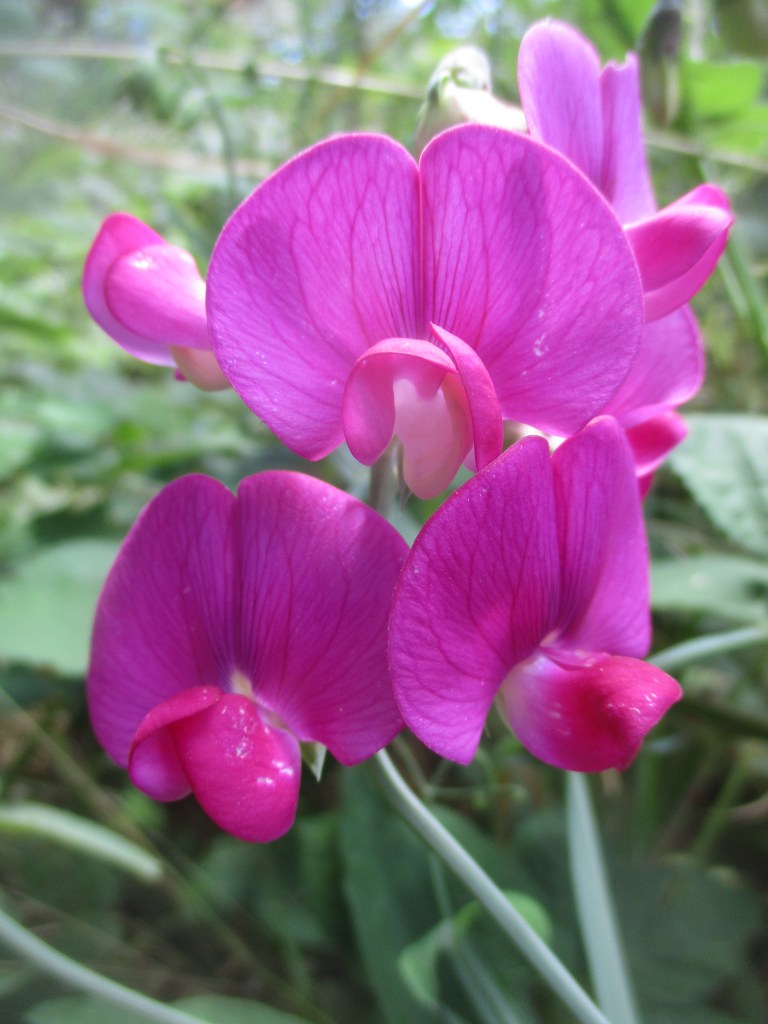
Although rarely planted intentionally in home gardens, perennial pea, Lathyrus latifolius, is somewhat common near rural roadside ditches and in riparian situations. It naturalizes to a minor degree, generally where the soil retains a bit of moisture after the rain finishes. It can eventually become somewhat overwhelming in unrefined but irrigated landscapes.
Bloom is typically rich purplish pink during late spring or early summer. A few specimens might bloom white or pale pink. Seed for varieties that bloom in any of these three colors, as well as red, is available online. Flowers resemble those of annual sweet pea, but are more abundant, and lack fragrance. Their delicate foliage might be slightly bluish green.
Vines might be lean through their first season from seed, but can get six feet long. By the middle of summer, they begin to die back to their plump perennial roots. They last longer with watering. Without watering, they may finish before July. Vines that grow from mature roots as winter ends after the first season should be bigger, fuller and perhaps voracious.
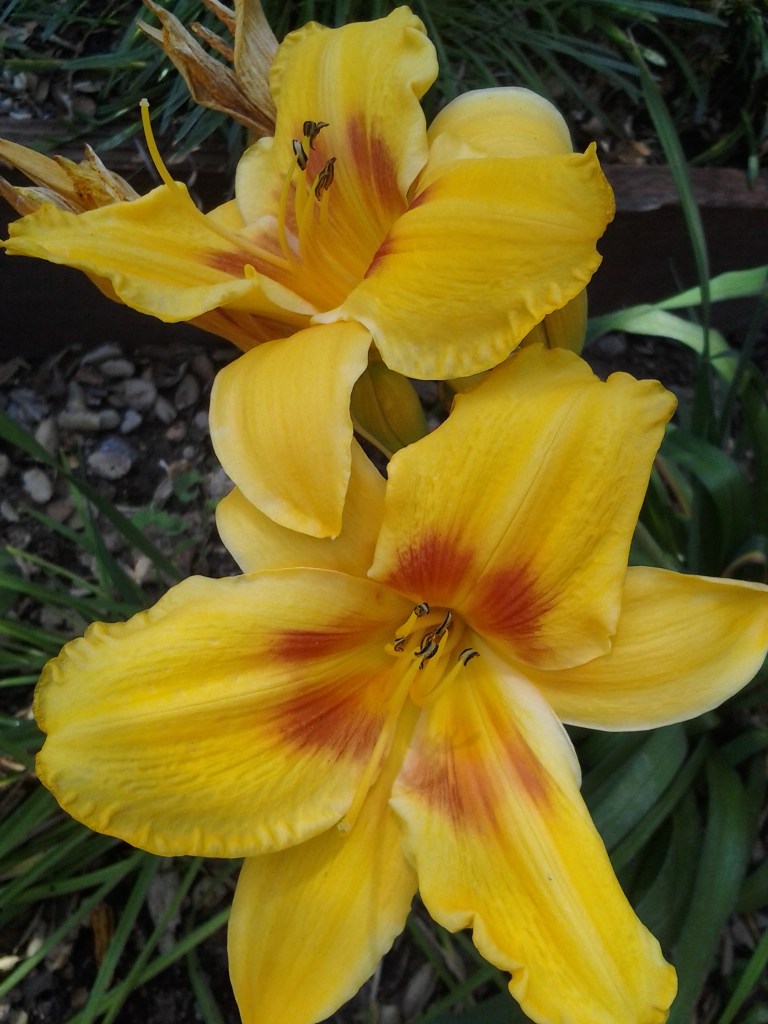
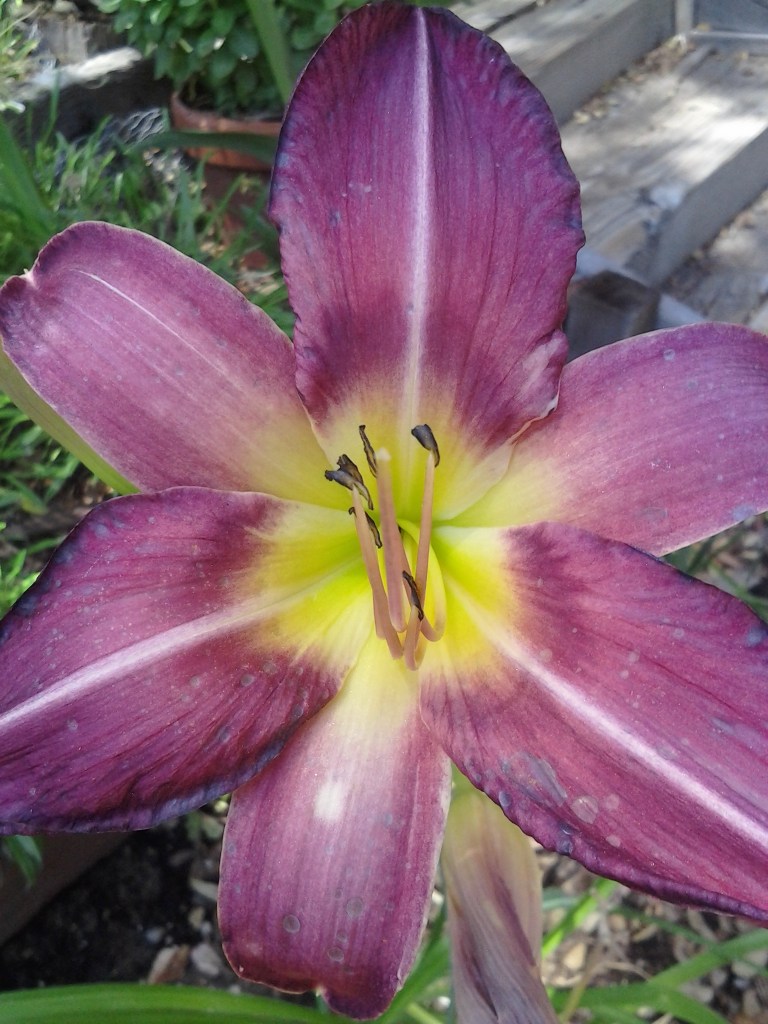
As the name implies, each individual flower of daylily, Hemerocallis, lasts only about a day. They open just after dawn, and wither by dusk. However, bloom last from a week to a month because there are several flowers on several stalks. These flowers take turns blooming, so that a flower that blooms today will likely be replaced by a new flower tomorrow, until bloom finishes. Some daylilies bloom early in spring. Others wait until summer. A few bloom again, as late as early autumn.
Flowers can be almost any color except for blue or white, and typically have a a different color in the throat. The most popular varieties are bright yellow, pastel yellow, orange, pink or rusty red. Purple flowers are not quite as flashy as the color implies. Each flower has six petals, (which are actually three petals and three sepals). Bare stems hold the flowers about two feet high, well above the clumping grassy foliage. Some stay only a foot tall. A few get considerably taller. Plants should be groomed of finished flower stems, and may sometimes want to be groomed of deteriorating foliage. Daylilies known as ‘deciduous’ daylilies shed all foliage by autumn.
Does anyone really know what a ‘perennial’ plant is? It is obvious that it is not an ‘annual’ plant that lives only a single year. A ‘biennial’ plant produces vegetative (non-blooming) growth in the first year, and then blooms, develops seed, and dies in the second year. A plant only needs to live more than two years to be a perennial plant, or simply a ‘perennial’. Well, that does not narrow the definition down much. Bristlecone pine can live for thousands of years, but is not often thought of as a perennial.
In simple home gardening terminology, a perennial not only lives for more than two years, but does so without producing significant woody stems. Yes, this also happens to include palms and trunk forming yuccas (which are known as ‘perennial trees’), but that is another topic. Some perennials live only a few years. Some can live indefinitely by replacing their stolons, rhizomes, bulbs, tubers or whatever they regenerate from as their old growth gets left behind.
For example, bearded iris spread by fleshy stems known as ‘rhizomes’. As they grow from the forward tips, the older ends that get left behind will rot away. They are constantly replacing themselves, without leaving evidence of how long they have been doing so. (In other words, it is impossible to cut one down to count the rings.)
Many plants that are known as annuals are actually perennials, but get removed and replaced during their respective dormant season. Busy Lizzy can regenerate each spring if their roots do not succumb to frost in winter. Begonia, chrysanthemum, cyclamen and primrose are just some of the many other annuals that could technically survive as perennials.
Lily-of-the-Nile, African daisy, daylily, canna, penstemon, New Zealand flax and various grasses and ferns are some of the more familiar perennials. They are too diverse to generalize about, but happen to be among the most reliable of plants for bloom and foliage. Because form and mature size is somewhat predictable, properly selected perennials are unlikely to outgrow their particular situations.



 Tony Tomeo