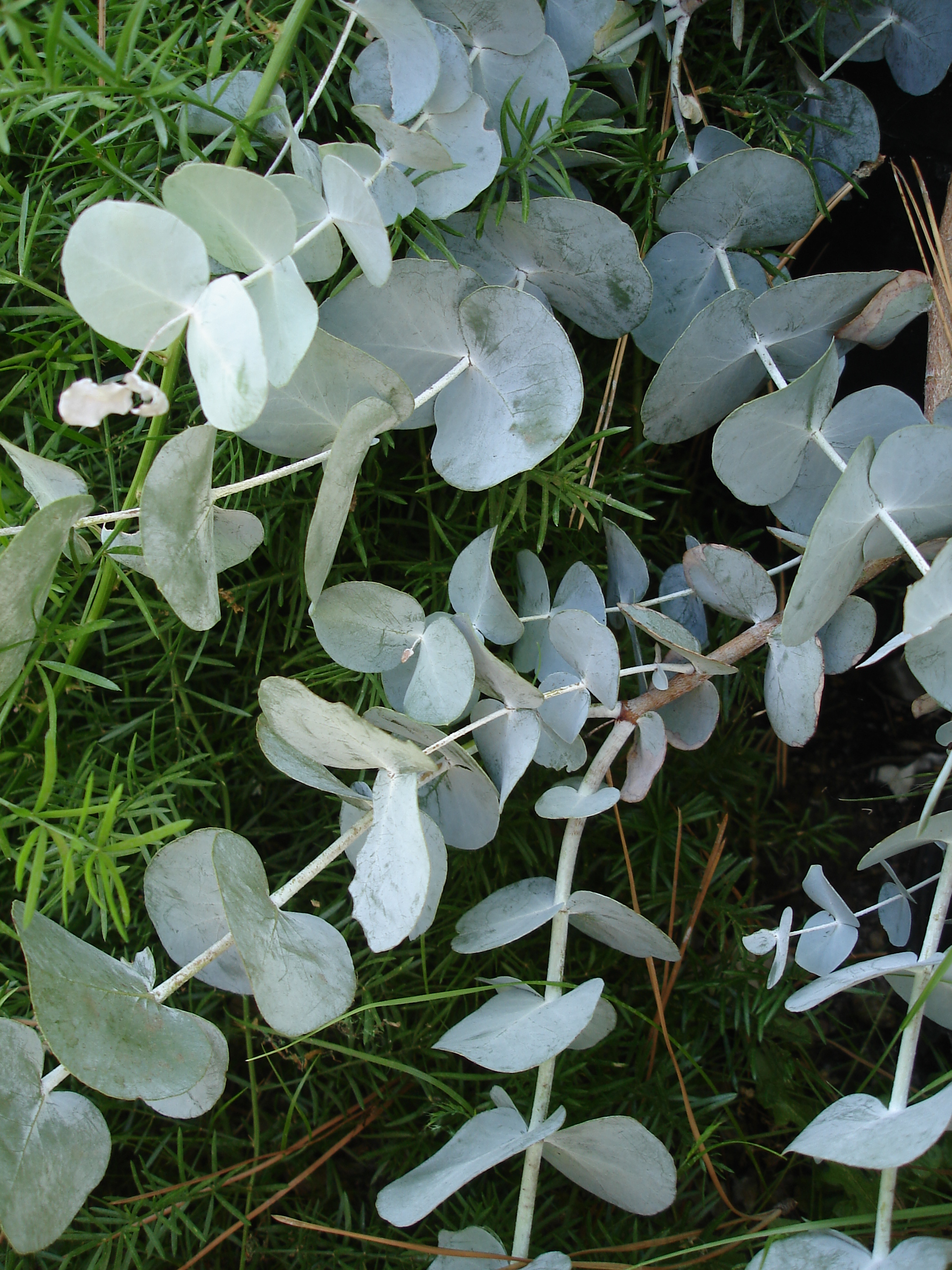
Proper Plant Selection

Redwoods grow much too tall for this particular application.

The worst part of getting stuck in traffic on the West Valley Freeway was actually not that I was without a Buick. It was the objectionable view of ridiculously dysfunctional landscaping that flanks newer section of the freeway south of Steven’s Creek Boulevard. After more than a decade and a half, it should be performing much better than it does.

Instead, it has developed far more problems than the older section to the north. Many of the purple leaf plums have been overwhelmed by their own green suckers. Some of the flowering pears also have serious suckers, or have been damaged by the harsh exposure they get on the side of a freeway. All sorts of plants have succumbed to irrigation problems.

The overly abundant micro-trees like purple leaf plums and crape myrtles are not proportionate to a freeway landscape. London planes will eventually be more proportionate, but are almost as useless for muffling the sound of traffic while they are bare through winter. The few functional features of the landscape are can only be seen in the background.

Meanwhile on the relatively old fashioned Junipero Serra Freeway, the landscape does what it was intended to do when it was planned in the late 1960’s. Where there is enough space, mature eucalyptus trees absorb ambient noise all year. Arizona cypress trees do the same where there is less space. Western redbuds and oleanders add a bit of color whether they get watered or not.

Home gardening may not always get the sort of planning that freeway landscapes need, but deserves the same sort of common sense. Much of what goes into the garden will be around for a very long time, so should be selected accordingly in order to function as intended with as few problems as possible. Yet, it is sometimes worth taking minor risks to get trees and plants that get the job done.

For example, crape myrtles have become much too common because they do not get big enough to cause many problems. They are used as street trees because they will not damage pavement; but they do not get big enough to make much shade or to get out of the way of trucks. Honey locusts may not seem like such a good choice because they may eventually displace pavement when they get older, particularly if watered too much while young; but they are more proportionate and out of the way.

Proper selection of plants simply makes the garden work better. Trendy plants like crape myrtles, London planes, carpet roses and dwarf Heavenly bamboos (nandinas) certainly work well in the right situations, but are not necessarily the best choices for every situation. Desired function, proportion (when mature), exposure, potential problems, maintenance requirements and landscape style are just some of the variables that should be considered when selecting new plants for the garden.
Shade Trees

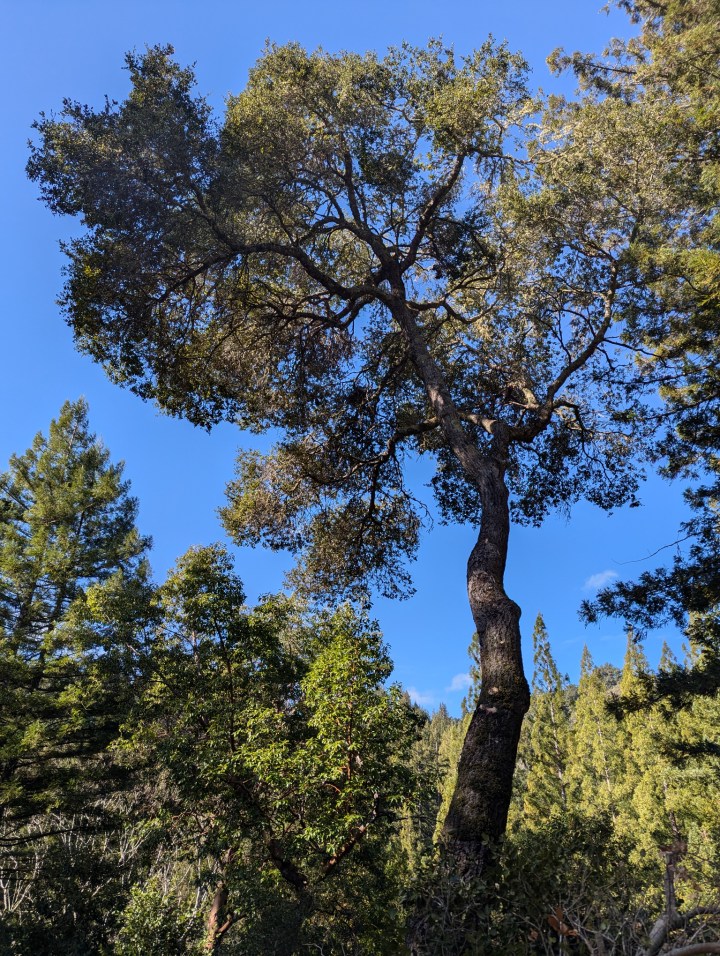
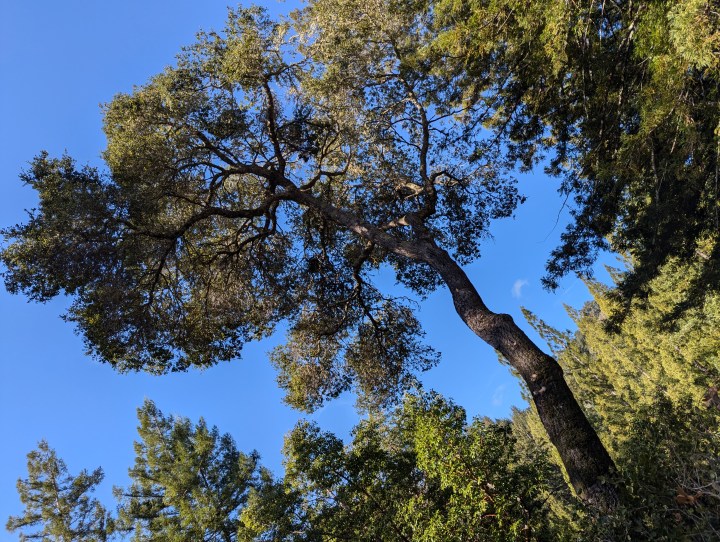
Trees are the most substantial components of a landscape.

Shady characters inhabit some of the best gardens. Actually, most of the best gardens have some sort of shade tree. There are so many to choose from for every sort of garden. Some stay small and compact enough to provide only a minimal shadow for a small atrium. Others are large enough to shade large areas of lawn.

Like every other plant in the garden, shade trees should be selected according to their appropriateness to particular applications. Favorite trees are of course welcome, but should be placed in appropriate locations where they will be less likely to cause problems later. For example, those of us who like silver maples should only plant them where they will not crowd other trees, and if there is sufficient area to accommodate them when mature. Southern magnolias are bold shade trees, but create too much mess for infrequently raked lawns, and create too much shade for many other plants around them.

Shade trees near to the home should be deciduous if possible. This means that they will drop their leaves to be not so shady when it would be good to get more sunlight through winter. Honey locust, red oak, Raywood ash, tulip tree and many varieties of maple (except Japanese maple) are some of the best. Silver maple gets a bit too large for small gardens, but is an elegant shade tree for large lawns. Japanese maple and smoke tree are small trees that fit nicely into an atrium or a small enclosed garden.

Evergreen trees also make good shade trees, but should be kept farther from the home if possible, in order to avoid shading too much through winter. Besides, most evergreen trees are messier than deciduous trees so are not so desirable over lawns, patios or roofs. Camphor tree and several of the well behaved eucalypti are delightful shade trees where their litter will not bother anyone. Mayten tree is a smaller tree for more confined areas. Strategically placed evergreen shade trees can also function to obscure unwanted views.

Every shade tree creates a specific flavor of shade. Honey locust makes just enough shade for summer weather without making the garden too dark for other plants and lawn grass. Silver maple is a bit shadier. The shade of redwood and Southern magnolia (when mature) though, is so dark that not many other plants want to get close to them.

Remember that appropriate shade trees may be in the garden for decades or even centuries. It is best to select them accordingly so there will be fewer problems in the future.

Tree Selection

Some trees grow too large for urban situations.

Trees are the most significant components of the landscapes that they inhabit. They get larger than all other plants, and live for decades or centuries. Because inappropriate trees have such potential to cause such serious problems, and can be so difficult and expensive to remove, it is important to select trees that are appropriate to each particular application.

Size and form of trees when they mature are important considerations. Crape myrtles are small to midsized trees that fit nicely into tight spots, but are too dinky to be good street trees. London plane trees are more proportionate as street trees, but eventually displace sidewalks and curbs with their aggressive buttressed roots. Chinese elms can be good street trees, but need to be pruned regularly to maintain clearance. Red maples are a better choice because they get large enough without getting too big, have complaisant roots, and are easily pruned for adequate clearance.

Other features in the area can limit tree selection. Poplars and willows have aggressive roots that invade septic systems or old unsealed iron or terra cotta sewer pipes. Queen palms eventually reach utility cables, but can not be pruned to go around them. Any good shade tree can provide too much shade over solar panels. Partial shade from large trees or structures is a problem for most other trees, but is actually preferred by a few ‘understory’ trees like vine maples, Japanese maples and dogwoods.

Trees that are expected to provide shade through summer should probably be deciduous, like red oaks or silk trees, to allow warming sunlight through during winter, particularly close to the home. However, trees that should obscure unwanted views should be evergreen, like Southern magnolias or arborvitaes.

Some trees that need more attention than others are only appropriate where they will get the attention they need. Mexican fan palms are easy to care for while young, but eventually grow out of reach and need to be groomed by professional arborists. Of course, every tree is limited to particular climates. Various ficus trees that are common in nurseries in San Diego will not survive even a mild frost, which is why they are not available in San Jose.

Selection of Appropriate Trees

Many trees get too big for many situations. Trees should be proportionate to their spaces.

Japanese maples are among my least favorite of trees. There; I said it! Even though I can not think of any single species of tree that has so many distinct and fascinating cultivars, I am bothered by how Japanese maples have been denigrated by their own overuse. That which is naturally an understory tree (lives in the partial shade of larger trees), which should be thoughtfully selected for its individual form, texture and color, to function as a focal point specimen tree, has become too common and misused.

Every tree should be thoughtfully selected for its particular application. The ultimate size, shape, shade, potential mess, cultural requirements, root characteristics and foliar characteristics (evergreen or deciduous) all need to be considered. Japanese maples are certainly appropriate for certain applications, but not every application. The same goes for London plane, crape myrtle, Chinese pistache and any overused tree.

Crape myrtles and Japanese maples are popular partly because they do not get too big, and are proportionate to small spaces. However, they do not get big enough for other situations. Although a silver maple will not fit into an atrium as well as a Japanese maple would, it is a much better shade tree for a big lawn. Italian cypress can actually get taller, but its very narrow shape makes a minimal shadow. Monterey cypress gets broader, but the shade is too dark for lawn.  

Unfortunately, there is no such thing as a perfect tree. Jacaranda is of moderate size, has a good shape, and makes medium shade, but is quite messy, particularly over pavement. Silk tree is both messy and has aggressive roots that can break pavement, but just like jacaranda, it looks great and is not a problem surrounded by ground cover. Both are deciduous, so allow warming sunshine through in winter. An evergreen tree that would be better to obscure an unwanted view should not get so large that it also blocks a desirable view for a neighbor.

Palm trees are very different from all other trees in that they have no branches, only leaves. As they grow out of reach, they will need to be groomed by professional arborists. Palms only grow upward, and can not be pruned around utility cables. They will need to be removed if their trunks get too close to high voltage cables.

I certainly do not intend to convince anyone to not plant any trees. I merely want people to consider the variables involved with the selection of trees that are appropriate to each particular application. Trees are long term commitments. Problems caused by improper selection can be difficult or impossible to correct later.

Horridculture – Inappropriateness

Vines and annuals are not shrubbery and ground cover.

Vegetation within a planned landscape should serve a purpose. The form of such vegetation should be appropriate to such purpose. Trees provide shade. Shrubbery defines space and obscures undesirable scenery. Vines climb fences and other infrastructure. Annual bedding plants provide more seasonal color than most other vegetation. Turf grows into useful lawns. It is helpful to plan accordingly for a landscape.

Turf can not do much more than become useful lawn. It can not provide shade, obscure undesirable scenery, climb fences or provide more seasonal color than green. Nor can trees, shrubbery or vines become useful lawn. Again, each form of vegetation should be appropriate to its particular application.

Trellised rocktrumpet is not shrubbery. Rose periwinkle is not permanent ground cover.

There is so much other vegetation that would have been appropriate to this particular situation. Star jasmine, trailing lantana, trailing rosemary or even the dreaded English ivy would have been better and more permanent ground cover. Dwarf oleander, barberry, arborvitae or even dwarf New Zealand tea tree would have been better shrubbery.

Rose periwinkle is an annual bedding plant. Although it is somewhat pretty now, it will not likely survive through winter. Even if it does, it will not migrate far enough to reliably function as a ground cover.

Trellised rocktrumpet is a small but vigorous vine that will always be reliant on trellises for support. As its cheap trellises decay and deteriorate, it will eventually develop into shabby mounds of tangled vine stems, but will never be able to support itself as high as the new trellises are now. It can reach out to cover some of the ground that will be vacated by the rose periwinkle, but can not reliably function as a ground cover for this much area. It will bloom less if shorn for neatness.

Conformity Is No Simple Task

Patching bald spots within Iris moss with Scottish moss might look . . . odd.

A combination of modern horticultural apathy and too many choices was probably the demise of conformity in home gardens. Formal hedges or even informal screens of several of the same plants are nearly obsolete. Ironically, long and low barrier hedges and so called ‘orchards’ of identical trees planted in regimented rows or grid patterns have become common in large landscapes in public spaces.

Those of us who still crave formal hedges, paired trees or any such symmetry in our home gardens must be more careful with the selection of the plants that need to conform than would have been necessary decades ago when there was less variety to complicate things. It is just too easy to get different varieties of the same plant. Only plants with matching cultivar (cultivated variety) names will necessarily match. (Yet, on rare occasion, even these are inaccurate.) For example, ‘Emerald’ arborvitaes will match other ‘Emerald’ arborvitaes, but will not match ‘Green splendor’ arborvitae, no matter how they resemble each other in the nursery.

Plants that are identified by their characteristics instead of by cultivar name are riskier. Blue lily-of-the-Nile could be any one of many different cultivars with blue flowers. It is therefore best to obtain all lily-of-the-Nile for any matching group from the same group in the same nursery at the same time. What will be available next week may actually be a different variety with a different shade of blue and different foliar characteristics. Nurseries bring stock in from so many different growers.

Adding new plants to replace those that have died within established hedges or streets flanked with the same trees can be particularly difficult, especially if the old varieties are no longer available. The old fashioned yellowish Japanese boxwood that was so common for small hedges in the 1950’s has not been common in nurseries for several decades. Replacement plants are darker green. Some are even compact cultivars or different specie like English boxwood. When lined up and shorn together, they make ‘calico’ hedges.

Give Plants What They Want

Flowering crabapples are generally reliable for profuse bloom, but some varieties might perform and grow better where winters are cooler.

Dogwoods are certainly pretty as they bloom this time of year. They are rare, but seen often enough in nurseries to make one wonder why they are even more scarce in local gardens. Those that got sold in previous years should now be prominent features around town. The problem is that because they are not happy in local climates, dogwoods become dogwon’ts. They won’t bloom. They won’t provide good fall color. Many won’t even grow. Dogwoods prefer more humidity, so in local gardens, want to be sheltered from full sun exposure and drying wind by larger trees or buildings.

Nurseries generally stock plants that are appropriate for local climates. A few nurseries also have a few plants that would rather be somewhere else, but can be grown with certain accommodations. Reputable retail nurseries are generally careful to divulge which plants need more attention, and what their requirements are. However, many of the big garden centers in home improvement stores are more interested in selling what they can rather than selling what is actually appropriate, particularly since they thrive on turnover and replacing plants that do not survive.

Not all plants are as easy to grow as junipers and oleanders are. Japanese maples and rhododendrons like at least some degree of shelter from direct sun exposure and dry heat; but the California fan palm thrives in wicked heat. Plumerias and coleus can be damaged by even slight frost; but many apples and pears want more frost. Spruces like even moisture; but many yuccas rot without enough dry time.

This is why it is important to know how to accommodate plants that may be less than ideal for local climates. Those of us who choose to grow plants that have special needs should at least give them what they want if we expect them to perform as we want them to.

Horridculture – Bad Name

51104Junipers have a bad name. So do eucalypti. Too many of the wrong types were planted back at a time when they were too trendy. Those that were planted into inappropriate situations grew up to cause problems. The names of all junipers and eucalypti are now synonymous with those problems, even though there are many types of both genera that are quite practical for landscape purposes.
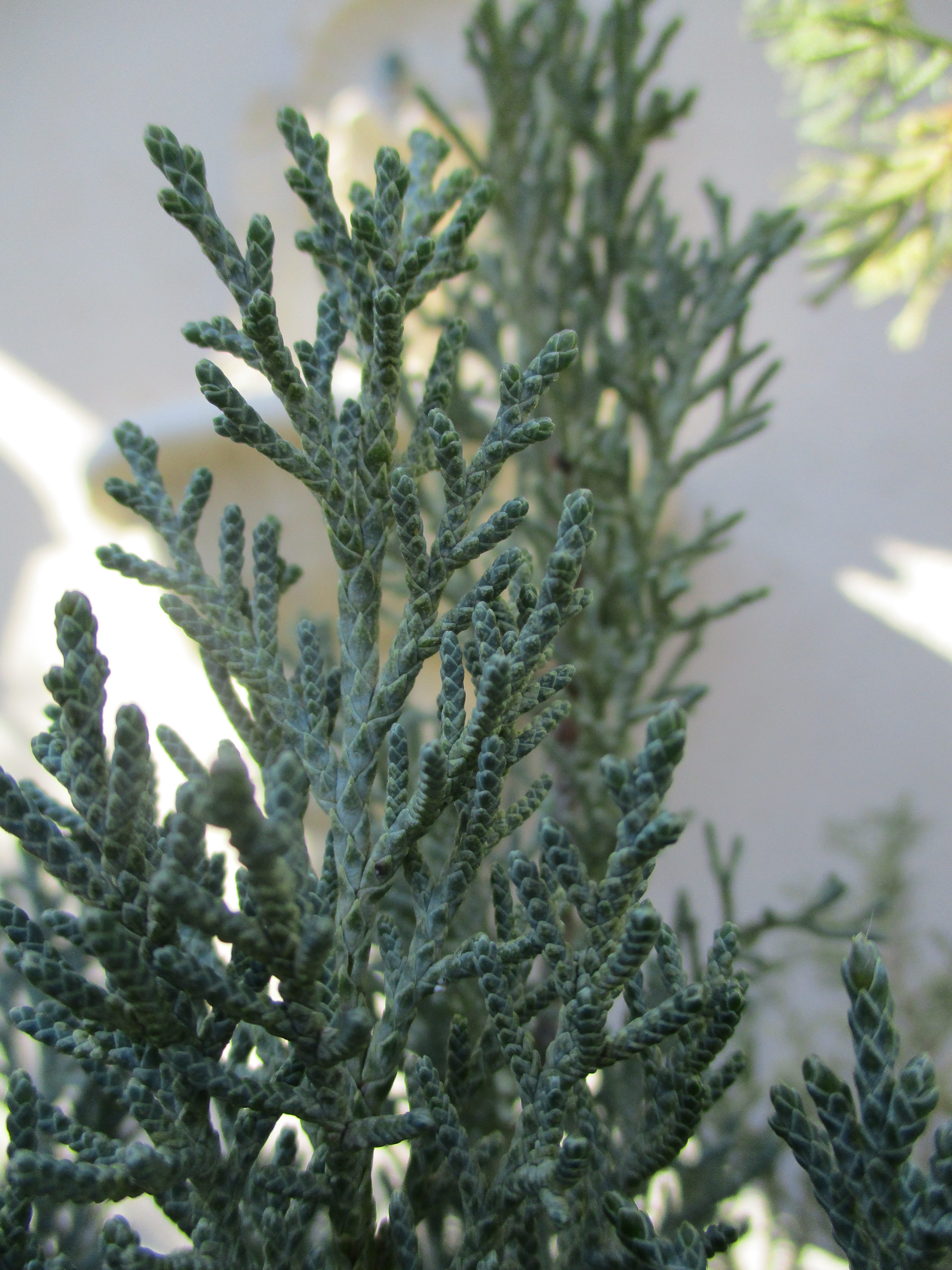
Get over it.
There are many junipers and eucalypti that are very good options for some landscape purposes. They need only minimal watering once established, and many will survive with none at all when mature. Some types of juniper grow as very low and very dense ground cover. With proper pruning, others can develop as exquisitely sculptural shrubbery or even small trees. (Just do NOT shear them!) Because of their very complaisant roots, some of the smaller eucalypti work very well as street trees.
I am certainly not promoting either junipers or eucalypti. They will not work for every application. I am merely saying that they should not be automatically dismissed because of their names. They were once overly popular for a variety of reasons, and those reasons are still valid.
However, I will say that there are a few species and varieties of each that are worth avoiding. They are likely what originally justified the bad reputations that are now shared by all of their relatives. For example, blue gum eucalyptus that was planted as a timber crop so long ago really is MUCH too big and messy for home gardens. Even where space is sufficient, there are probably better options.
Some of the current fads are also worth avoiding, or at least questioning. Some are very likely to earn a ‘bad name’ in the future, either because there will be too many of them, or because their faults will become evident as they mature. Because so many get planted within such a short time, many that mature at the about the same rate will develop their faults at about the same time.
For example, crape myrtle is such a useful and complaisant tree that it has been planted too commonly for just about every situation in which a tree is desired. It is resilient. It is complaisant with concrete. It blooms spectacularly. It colors splendidly in autumn. It really is an excellent small scale or medium tree for small garden spaces or near utility easements. It works very well in narrow park strips where larger trees would displace concrete. Yet, despite all the attributes, it is not good for everything, and does not get big enough to become a substantial shade tree, as it so commonly gets planted for. In the future, there will be so many crape myrtles in so many of the wrong situations that they will be considered to be too common.
Queen palm is another example. It used to be somewhat uncommon and respected. Through the 1990s, big box stores were selling them like junipers and eucalypti decades earlier. They happen to be very appealing palms that are more practical than the formerly more common Mexican fan pale, but have become so common that they were very often planted into situations that they are not appropriate for. Those that are under utility easements will need to be removed when their canopies start to encroach into utility cables. Because they are palms, they can not be pruned around the cables. Those that are able to mature will outgrow the reach of those who maintain their own gardens, or typical gardeners, necessitating attention from more expensive tree services. Like crape myrtles, they will also lose their appeal in the future.70222

Very Bad Houseplants

P71230Just because it ‘can’ be grown as a houseplant does not meant that it ‘should’ be. That is a lesson that Brent and I never learned in college. He and I were roommates in the dorms at Cal Poly in San Luis Obispo, which, as you can imagine, was a problem. Our room on the top floor of Fremont Hall was known as the Jungle Room. It was so stuffed full of weird houseplants, as well as a few plants that had no business inside. We had a blue gum eucalyptus bent up against the ceiling, an espaliered Southern magnolia, a Monterey cypress, and a herd of camellias that we rescued from a compost pile on campus.

After college, our own homes were no better. Because my dining room was rather small, Brent gave me tall weeping figs that had unobtrusively bare trunks down low, and plenty of fluffy foliage pressed up against the ceiling; a technique we did not quite perfect with our Jungle Room blue gum. I had a giant yucca in the guest suite, a redwood in my bedroom, king palms in the parlor, and a lemon gum eucalyptus over my desk in the office. The bathroom was the worst, with pothos and Algerian ivy hanging over the shower curtain, and billbergias up over the shower. A pair of small birds nested in the billbergias, and before I realized that they were there and evicted them, they started a family!

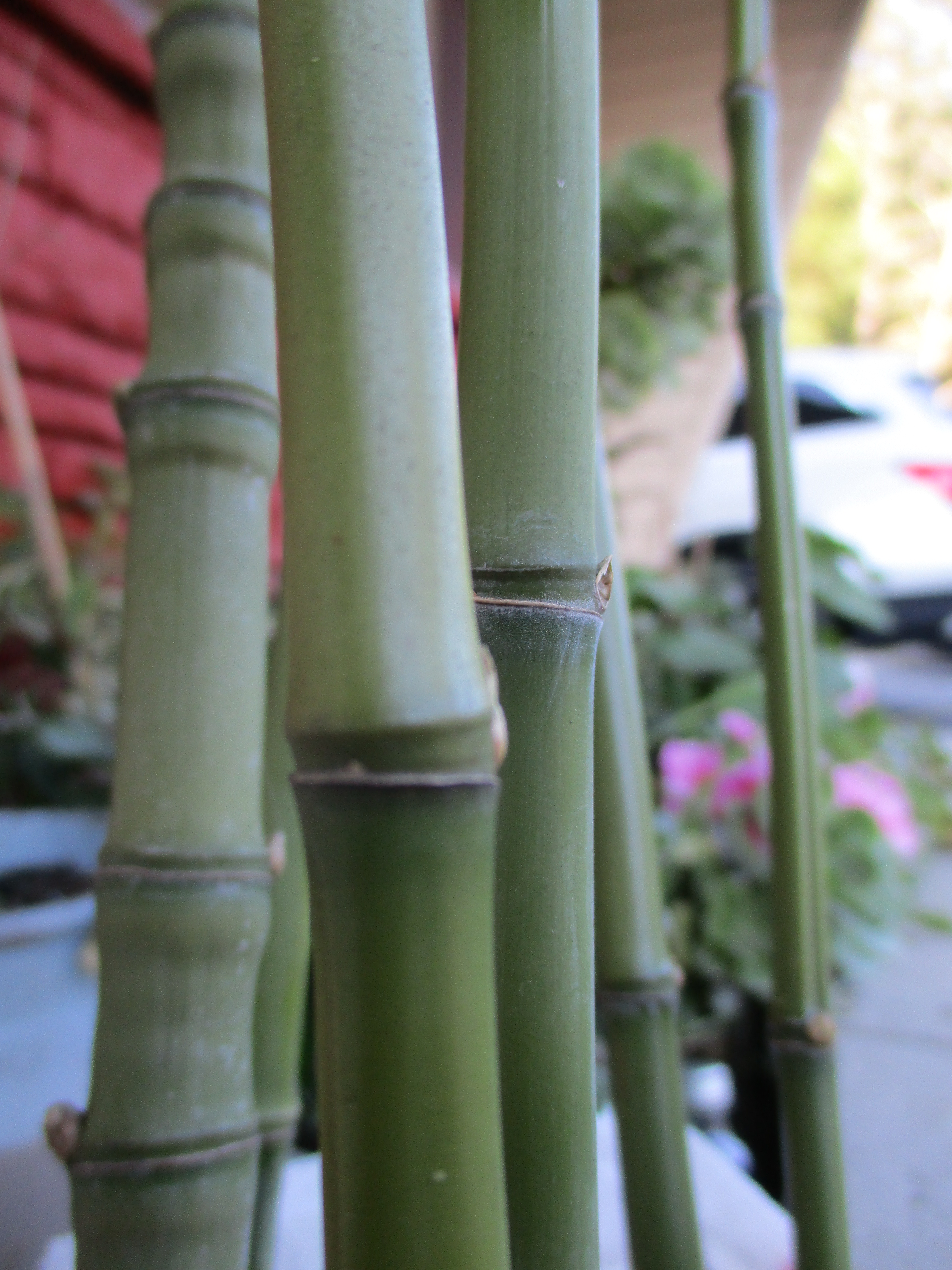
At least Brent kept most of his plants outside where they belong. The staghorn ferns grab onto the walls when they get the chance. Wisteria vines grab onto anything else. The flame vine climbed up the chimney (appropriately), and before Brent knew it, had sneakily spread to the opposite side of the parapet roof! Then there was the giant timber bamboo. Yes, that is what I said; giant timber bamboo. I know what you are thinking right now, so there is no need to say it.

There is a narrow space between north side of Brent’s home and the concrete driveway next door. It is almost three feet wide. Brent though that if he planted the bamboo there, it would not get to the other side of the driveway. He was actually correct.

Did I ever mention how vain Brent is? Well, that is another topic for another time. I will say for now that he has more clothes than his teenaged daughter Grace. A lot more. They do not all fit in his big closet. He hangs some of his longer coats that he does not need very often in Grace’s much smaller closet. One day, he was reaching around the clutter that is common in a teenaged girl’s room, and groping for one of his coats in Grace’s closet, when he grabbed a hold of something that should not have been there. He was not certain what it was at first, but when he found his coat and pulled it out, a few dried bamboo leaves came with it and fell onto the floor!

The bamboo did not even try to go under the neighbor’s driveway. Instead, it went under the foundation of the house. Where it came up, it had nowhere to go, so somehow weaseled in next to a water pipe, and followed it up behind the bathroom washbasin. Once inside, it somehow weaseled past a valve access panel behind Grace’s closet, and straight up to the ceiling. What is even funnier is that Grace knew it was there, but figured that it was just another one of Brent’s crazy landscaping ideas!

Just in case you are wondering, giant timber bamboo is a very bad houseplant!

The bamboo is gone now. It got so tall that the wind would blow it against the terracotta tiles on top of the parapet wall. Also, the foliar litter was too messy on the parapet roof and the neighbor’s driveway. It did not contribute much to the landscape anyway, and shaded only a driveway that is seldom used.