Autumn Really Was For Planting

70531thumbIt is easy to see why there are optimum times to prune, and just as easy to see when pruning should not be done. Generally, deciduous plants prefer to get pruned while dormant and bare. They should not be pruned when actively blooming or making new foliage. Roots are of course not so easy to see. Do we really know what they are doing, or what sort of mischief they are getting into?

Autumn is the best time for planting most plants. They are less active than they had been earlier in the year, and many are going dormant. Either way, they do not need much. Once in the ground, their roots are kept cool and moist by the weather. They get to sit there all winter, as they slowly begin to disperse their roots to get ready for the following spring. It all fits into their natural life cycle.

Shopping habits, however, do not. By autumn, many plants are neither as pretty nor as tempting as they were earlier in the year. By winter, the weather keeps many of us inside, and out of nurseries. Now that it is spring, it is difficult to resist all the pretty plants that are blooming so delightfully. We are tempted to buy them compulsively, even if we have no immediate plans for them.

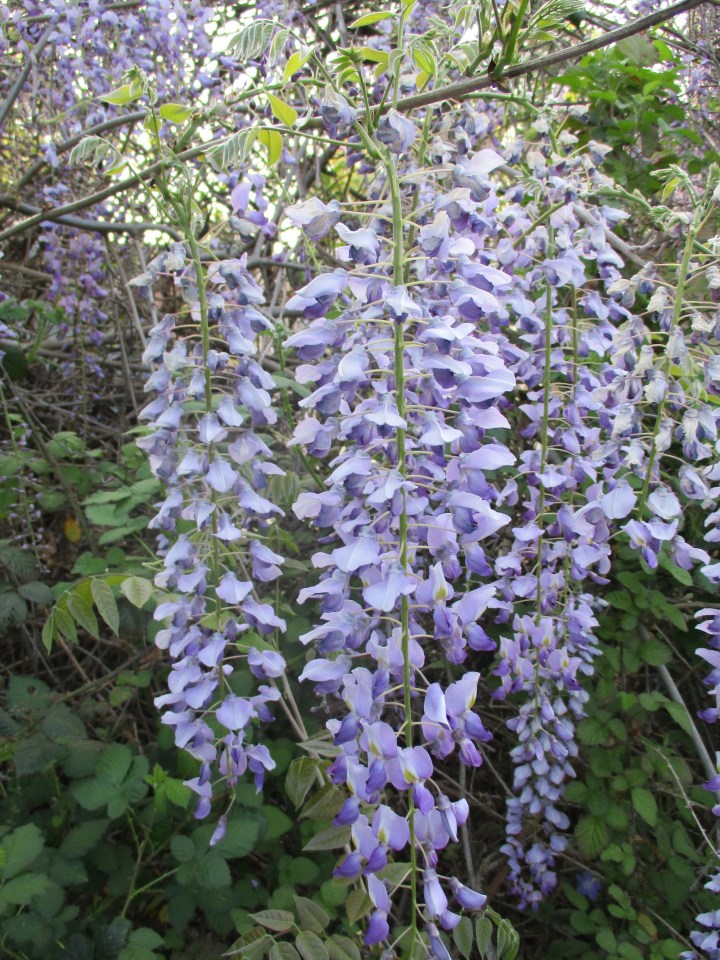
That is okay. We can make this work. Buying certain plants in bloom actually has certain advantages. It shows how and when particular plants bloom. This might be helpful when trying to decide between different cultivars of deciduous magnolias, flowering cherries, flowering crabapples or wisterias, for example. Besides, they will finish blooming quickly, and start to produce new foliage.

If planted before new foliage matures, new plants should be planted in cool weather, and maybe sprayed lightly with water after the roots get soaked in. This is best for drought tolerant plants like ceanothus, that want out of their cans (nursery pots) as soon as possible. If new plants stay in their cans long enough for foliage to mature, they must be watered carefully, but not kept saturated. The black vinyl cans should be shaded, since they get warm in sunlight.

Pots And Pans Need Cleaning

30918thumbThis is getting to be cliché. “While they are dormant through winter”, plants tolerate all sorts of abuse that would offend them at any other time of year. It applies to planting bulbs and bare root plants. It also works for pruning deciduous fruit trees and roses. It is a predictable seasonal pattern. Most winter gardening is contingent on dormancy. Processing potted plants is no exception.

Plants that have gotten too big for their pots should be replanted into larger pots. Any circling roots should be severed, just as if the plants were going into the ground. Unlike planting into the ground, potted plants require artificial media, known simply as ‘potting soil’. If larger pots are not an option, overgrown plants must at least be pruned to stay proportionate to their confined roots.

A plant that has been in a pot long enough for the media to decompose and settle might benefit from being ‘stuffed’. This involves removing the root mass from the pot, adding just enough media to the pot to support the root mass at the desired level, replacing the root mass on top, and then adding more media around the root mass to fill the pot. Exposed surface roots can be buried too.

Many overgrown succulents (not including cacti) can be replanted lower instead of higher. If settled, more media can be added on top. If all the foliage is clustered on top of bare stems, the stems can be cut and ‘plugged’ as new plants into pots of media, while the old roots and basal stems can be left to generate new stems and foliage. Newly plugged stems will generate roots by spring.

In the processes of potting, stuffing and plugging, while pots are empty, it would be a good time to scrub away mineral deposits from the bases and inner rims of pots. These deposits tend to accumulate just above the surface of the potting media, and where pots sit in water that drains from them. The pans or saucers that contain drainage water also accumulate mineral deposits. While plants are being processed, they can be groomed of deteriorating foliage and other debris.

Perennials Can Divide And Conquer

10810Along with all the bare root fruit trees, roses and cane berries, nurseries also stock bare root perennials like strawberries, asparagus, horseradish and rhubarb. They are so easy to plant while dormant. They recover from transplant through spring, and by summer, should be growing as if they had always been there. Although, if they had always been there, they might be crowded by now.

Yes, many but not all perennials eventually get crowded. Strawberries spread by runners, so are easily plucked and transplanted to avoid overcrowding, as well as to propagate more productive plants. Asparagus are variable, so may not get crowded for decades. Horseradish and rhubarb may not mind getting crowded, but could be more productive if individual plants have their space.

For example, crowded horseradish plants produce many small roots. If dug, split apart, and replanted with more space between individual plants, the individual roots get much larger. Separating the roots, which is known as ‘division’, also produces many more new plants. Mature rhubarb plants may not mind being crowded, but are often divided simply to propagate new productive plants.

Division of these sorts of perennials is typically done while they are dormant through winter. If that sounds familiar, it because it is the same reason why these sorts of perennials are available as bare root stock. They get processed while they are unaware of what is happening, and wake up in their new and better situations. Many defoliate while dormant. However, most are evergreen.

Ornamental perennials like lily-of-the-Nile, African iris, New Zealand flax, society garlic, torch lily, lily turf and acorus grass are all good candidates for division if and when they become overgrown. So are most aloes, some terrestrial yuccas, several ferns and some of the more resilient clumping grasses. Agave pups can be dangerous, but really should not be allowed to get too crowded.

Division might be as simple as taking a few pups or sideshoots from a large clumping plant, or as involved as digging an entire large plant to divide each individual shoot. More often, large plants get dug and split into a few smaller clumps of many shoots. New plants should be groomed of deteriorating foliage. The long leaves of New Zealand flax should be cut in half to avoid desiccation.

GREEN

P71112

GREEN – Greening Residential Environments Empowering Neighborhoods – allocates resources, procured from both municipal funding and private donations, to the installation, maintenance and protection of trees in public spaces within the collective urban forest of Los Angeles, and to the enforcement of environmental justice.

How is that for a mission statement?

It is no coincidence that GREEN is also Brent’s last name. He is quite vain. Really though, it works.

Brent has been planting street trees since we were in school in the 1980s, and did his first big project of thirty trees in the median of San Vicente Boulevard on his thirtieth birthday in 1998. This January, twenty years later, he will be planting fifty more trees.

Here and there, I will be writing more articles about these projects. They are too involved to write just one article about. For now, I would like to mention the Facebook page for GREEN, at https://www.facebook.com/GREEN-1518459741733375/. I am sorry that I can not devote more attention to it. I really should be writing more articles about what GREEN does.

There is more to it than just planting. Trees also require staking. Street trees need pruning for clearance above the roadways that they shade. Some trees needed to be injected with systemic insecticide for homopteran insect infestation. When mature Canary Island date palms were being stolen from the embankment of the Santa Monica Freeway and sold into other neighborhoods, GREEN was there to stop it, and to get at least one of the trees returned (although the neighborhood is still waiting for other reparations). GREEN has organized neighborhood clean-ups and graffiti abatement.

GREEN is in Los Angeles, but could be duplicated in other municipalities that could use more trees, or that already have trees that need maintenance. So many trees in America have tree preservation ordinances, but some of the biggest cities need to enforce their ordinances more diligently.

If you continue to read my blog, you will be reading more about GREEN. Again, the Facebook page is at https://www.facebook.com/GREEN-1518459741733375/