Blue Elderberry

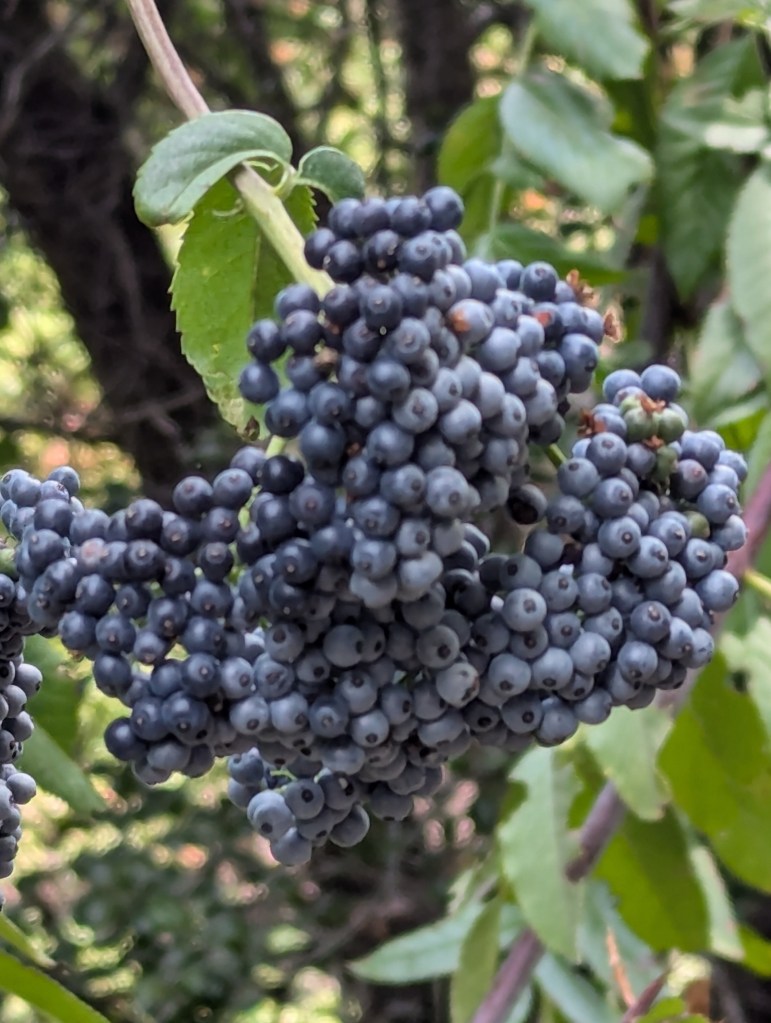
Blue elderberries ripen through summer warmth.

Native blue elderberry, Sambucus cerulea, can grow twenty feet tall and wide in the wild. It is rare among compact home gardens. Domestic specimens are fortunately conducive to various pruning techniques, though. They regenerate very efficiently from coppicing or pollarding. Alternating canes pruning involves more effort but promotes berry production.

Blue elderberries are toxic while fresh, but make good jelly or syrup when cooked. They are also edible dried. Although quite tiny, they grow in large clusters that are three or four inches wide or wider. They ripen through late summer. Flowers, which bloom during late spring, are useful for teas or cordials. Some find their floral fragrance to be unappealing.

Because it grows so large, blue elderberry can be a large shrub or a small tree. It usually develops several trunks. Aggressive dormant pruning enhances foliar lushness. Without much pruning, old trees can develop dense thicket growth with sparse foliage. Individual leaves are pinnately compound, with five to nine leaflets. They are as long as six inches.

Dwarf Alberta Spruce

Dwarf Alberta spruce stays very compact.

It is a diminutive tree with a big name. Picea glauca var. albertiana ‘Conica’ is commonly known as dwarf Alberta spruce. It is a type of white spruce that grows more as shrubbery than as a tree. After many years, it may be only eight feet tall and four feet wide with strict conical form. Because of its form and tame growth, it is practical as a live Christmas tree.

Potted specimens may remain potted for several years. They maintain their conical form quite naturally without shearing or pruning. Their finely textured needles are only slightly bristly. Their primary disadvantage as a Christmas tree is their foliar density. They do not extend lateral stems for Christmas ornaments to dangle from. Their foliar aroma is slight.

Dwarf Alberta spruce is splendid for formal landscapes. Alternatively, it can instill a bit of formality or symmetry into otherwise relaxed landscapes. Although it does not grow very wide, it should have room to grow. Pruning or shearing for containment compromises its strictly conical form. Potted specimens rely on frequent irrigation, but are not demanding.

Pomegranate

Pomegranates ripen through autumn to winter.

Not many fruit trees have been in cultivation for as long. After several thousands of years of breeding, there are quite too many cultivars to count. Pomegranate, Punica granatum, is now common in many regions throughout the World. It is particularly productive within Mediterranean climates, including locally. Bare root trees are now available in nurseries.

Without pruning, old trees can grow fifteen feet tall, with dense and thorny thicket growth. Fruit is easier to collect from tamer trees that are subject to regular thinning and pruning. Individual trees typically develop a few trunks, but can have only one. They may survive for centuries. Ruddy orange flowers bloom for spring. Foliage yellows prior to defoliation.

Pomegranate fruit ripens so late during autumn that it can linger after autumn defoliation. It is generally brownish red. Individual fruits are about three or four inches wide, but may be wider. They contain hundreds of seeds, which are surrounded by juicy and succulent flesh. Such flesh is generally garnet red, but might be purplish, pinkish or even colorless. Flowers are edible too.

Forsythia

Forsythia blooms very early in spring.

This may seem to be unseasonable for now. Forsythia, Forsythia X intermedia, does not bloom until early spring. However, this is the time to plant it as bare root stock. It is one of only a few fruitless ornamental species that is available as such. New specimens will not bloom much for spring. They grow through summer, though, to bloom for the next spring.

The famously bright yellow flowers of forsythia are small but very abundant. They bloom on bare stems before their deciduous foliage regenerates. The simple paired leaves are about two or three inches long. Mature specimens mostly do not grow more than ten feet tall unless partly shaded. Most branches arch upward and outward from their root bases.

Pruning should involve the removal of deteriorating older canes, to favor younger canes. Complete removal at their base promotes more vigorous new basal growth. Pruning can happen after bloom rather than before. Pruning of the exterior compromises the naturally outwardly flaring form. Complete coppicing eliminates all bloom for the following season.

Laurustinus

Laurustinus can become a small tree.

Winter bloom may or may not be an benefit of laurustinus, Viburnum tinus. Most grow as regularly shorn hedges that are unable to bloom much between shearing. Those that do bloom often generate a floral fragrance that some find to be objectionable. Nonetheless, with only timely pruning, laurustinus does bloom for winter. Many consider this an asset.

Flowers are small and white or blushed with pink. They huddle together in dense cymes, which are about two or three inches wide. Their dense evergreen foliage is forest green. Individual leaves are paired, about two or three inches long, and half as wide. They have a very slightly raspy surface texture. Mature laurustinus can sucker from their basal roots.

If bloom is not a concern, laurustinus can be a dense shorn hedge, only several feet tall. Otherwise, it can become a dense small tree more than twenty feet tall and ten feet wide. Once established, it does not need much water and can actually survive with just rainfall. It is not very discriminating about soil quality. Mites or mildew can become problematic in damp coastal climates, particularly among shaded or very congested specimens.

Mugo Pine

Mugo pine exhibits very compact growth.

Although it classifies as a tree, mugo pine, Pinus mugo, is more like shrubbery. Old trees may be only a few feet tall, and maybe twice as wide. Not many are more than eight feet tall. Their form is densely rounded. Foliage is deep forest green. Stiff paired needles are only about one to two inches long. Plump cones are not much longer, and are quite rare.

Mugo pine, although native to the Alps, is a traditional feature of Japanese gardens. Yet, it is rare within other types of gardens. It does not grow fast or big enough to be practical for much more than aesthetic appeal. It does excel at that, though, by developing such a distinctly rounded form. It can work well as foundation planting or a short informal hedge.

Mugo pine is not particularly discriminating about local soils or climates. It merely craves sunny and warm exposure. Mature specimens do not need much water, but are healthier with occasional irrigation. Mugo pine appreciates room for unrestricted growth. Shearing deprives it of its natural form and texture. If necessary, selective pruning may be tedious.

Norfolk Island Pine

Norfolk Island pine seems to have been built rather than grown.

            In coastal areas of Southern California, the Norfolk Island pines, Araucaria heterophylla, are among the most distinctive large trees. Perhaps they are better described as ‘unusual’ . . . , or even ‘strange’. They are so symmetrical that they seem to have been assembled from prefabricated kits than to have grown as natural trees. Their strictly organized conical branch structures and remarkably straight central trunks are always visible through their uniformly open canopies. In such mild climates, they can get nearly a hundred feet tall and half as wide, so are not easy to hide. In Hawaii, their symmetry has actually made them popular as Christmas trees. Their finely textured juvenile foliage is comprised of narrow, half inch long pine-needle like leaves, which are wider among adult growth.

            Locally though, Norfolk Island pines are primarily enjoyed as houseplants, particularly since they can grow slowly and live in pots for many years. The climate is just a bit too cool in winter for them to be very happy in the garden. However, as they eventually get too large for their homes, many end up in the garden anyway. They stay much smaller and are not nearly as symmetrical as they are in milder climates, and may be damaged by the more severe frosts every few years, but they have a certain appeal and distinction regardless. Those that get planted in the garden while young seem to be more symmetrical than those that get disfigured by living as houseplants longer. For some reason, trees that develop weak or curved trunks as houseplants tend to continue to grow with interestingly irregular trunks and branch structure.

Atlas Mountain Palm

Atlas Mountain palm resists frost damage.

Mediterranean fan palm is a shrubby palm, with a few small trunks. Atlas Mountain palm, Chamaerops humilis var. argentea, is an even shrubbier variety. Mediterranean fan palm can grow slowly to about twenty feet tall. Atlas Mountain palm grows even slower to only about eight feet tall. Its several trunks become strikingly sculptural only after many years.

The primary allure of Atlas Mountain palm, though, is its distinctly silvery gray foliar color. Individual fan shaped leaves may be nearly two feet broad, with deep and narrow clefts. Petioles are so nastily thorny that grooming and pruning can be painfully difficult. Mature trunks can be six inches wide with dense coats of petiole bases. Bloom is not prominent.

Atlas Mountain palm is notably undemanding. Once established, it does not crave much water or fertilizer. Nor is it finicky in regard to soil quality. It is resilient to both extremes of heat and cold. After several years, it might benefit from thinning of superfluous trunks and pups. Like many palms, Atlas Mountain palm should perform well within big pots or tubs.

White Alder

White alder has a distinctive silhouette.

During the summer, the native white alder, Alnus rhombifolia, is a nice shade tree that looks bigger than it really is. By late winter, the bare deciduous canopy has an appealingly picturesque silhouette. This time of year is actually when white alder is typically less appealing, with dead foliage that provides no interesting fall color, but lingers until knocked down by rain or late frost. Yet, even now, it sometimes surprises with these funny looking floral structures that are interesting both in the early winter landscape, and with cut flowers.

In past decades, white alder was an ´expendable’ tree that was put into landscapes for quick gratification while slower but more desirable trees matured. By the time the desirable trees matured, the alders were removed to make more space for the desirables. This technique was practical because, like many fast growing trees, alders do not live very long, so start to deteriorate after about twenty five years anyway. However, alders often live longer than expected.

Mature alders are usually less than fifty feet tall where they are well exposed. They can get at least twice as tall where shaded by other trees or big buildings. Their plump trunks with mostly smooth silvery gray bark make them seem larger than they really are though. Too much water promotes buttressed roots which can displace pavement.

Firethorn

Firethorn berries are delightfully bright red.

Nothing is lost in translation. The botanical name of Pyracantha coccinea literally means “Firethorn red”. Firethorn is its common name. It produces bright red berries on wickedly thorny stems. Some old-fashioned cultivars produce bright orange berries. Cultivars that produce bright yellow berries are now rare. Fruit ripens for migrating birds about autumn.

The thorns of firethorn are difficult to work with. However, they make a hedge of firethorn impenetrable. Frequent shearing deprives hedges of their natural form and some of their fruit. Selective pruning is tedious and likely painful, but retains more berries. Pyracantha needs sunny exposure, but is otherwise quite undemanding. It is susceptible to fireblight.

The most popular cultivars of firethorn can grow taller than eight feet. Taller cultivars that can grow twice as tall are uncommon. Sprawling types initially stay quite low, but without adequate pruning, form thickets. These same sprawling types are conducive to espaliers on fences and walls. Because pyracantha is difficult to work with, it should not be left to get unruly.